
CONTENT
STRATEGY
OUR WORK
ABOUT
RESOURCES
SUBSCRIBE
LOGIN
CONTACT US


Eighty-seven percent of commercial-intent searches now show an AI Overview at the top of the page. When that panel appears, click-through to position 1 drops 40-60%. The traffic doesn't disappear — it routes to the three or four businesses named inside the AI Overview. If your business isn't one of them, you've lost the query before the user even scrolls. Your traditional SEO investment is now optimizing for the half of search results that's dying.
The AI Overview Citation Protocol™ is built on the same 5-component AI Trust Score methodology that drives the Maps Domination Program™. It's the four-stage framework that gets local service businesses named as cited sources by Google's AI Overview, ChatGPT, Perplexity, and Claude. Top 3 in the Map Pack and AI Overview citation in 12 weeks, or you don't pay.
↑ Run the Free GeoGrid + AI Trust Scan →
Free heatmap. AI Overview citation audit included. No credit card.
If you've ever wondered why your competitor — the one with worse reviews and a thinner website — keeps getting cited in the AI panel for your money keyword, this page was built for you. The answer isn't backlinks. It isn't content volume. It isn't keyword density. It's something Google calls entity authority, and most SEO agencies in 2026 still don't know how to engineer it.
The lazy version of "AI Overview SEO" is publishing more blog posts and waiting. That doesn't work. The lazy version of "Generative Engine Optimization" is buying ChatGPT credits and producing content at scale. That doesn't work either. Real AI Overview citation requires a deliberate four-stage protocol that engineers your business as an entity that AI models recognize, trust, and select.
This page is the deep-dive into that protocol. For the broader AI SEO methodology that this protocol sits inside, see our AI SEO for local business pillar. For the review-side trust signals, see Online Reputation Management for Local Business.
Your Semrush dashboard shows you ranked #4 for "best HVAC company Las Vegas." Your competitor — ranked #11 — gets cited in the AI Overview every time. You see fewer leads. You don't know why.
Operating in Henderson, NV? See the dedicated Henderson SEO methodology for submarket-specific deployment across Green Valley, Anthem, Lake Las Vegas, Inspirada, Whitney Ranch, MacDonald Ranch, Seven Hills, and Tuscany. Henderson is its own market with distinct competitive dynamics — affluent demographics, MPC + HOA preferred-vendor channels, and submarket-specific GeoGrid coverage requirements.
Want to verify your current Map Pack rank before reading further? Run a free Google Maps ranking checker — it generates a GeoGrid heatmap of your actual rank at every point across your service area, shows where you have dead zones, and reveals which competitors are beating you in those zones. Most rank checker tools lie because they report a single average; the GeoGrid shows you the truth.
Three measurement gaps that traditional SEO tools cannot close:
The position-based fallacy. Traditional SEO measures whether you rank at position N for a query. The AI Overview doesn't care about position N. It picks 3-5 sources from anywhere in the top 50, sometimes from outside the top 50 entirely, based on entity authority signals that have nothing to do with classic ranking factors. A business at position 12 with strong cross-platform reviews and clean schema can be cited while a business at position 3 with thin entity signals is invisible above the fold.
The backlink fallacy. Backlink count and Domain Authority were proxies for trust. They worked when the algorithm was a link graph. The AI Overview's source selection is based on a different signal stack: entity coherence across third-party sources, schema completeness, review depth and recency, content alignment with the answer pattern. A page with 50 backlinks and weak entity signals loses to a page with 5 backlinks and strong entity signals — every time.
The on-page-content fallacy. Traditional SEO optimized your H1, H2s, keyword density, internal linking. The AI Overview model doesn't read pages the way Google's classic algorithm did. It reads the coherence of your entity across the open web — your business name across Clutch, BBB, Yelp, Avvo, news mentions, your own schema markup, your Google Business Profile primary category, your structured data. On-page is one of seven inputs, not the dominant signal.
That's the gap. AI Overview citation is engineered through entity work, not on-page work. Your tool can't see entity work because it was built for a different game.
↑ See If You're Cited Right Now →
The Google AI Overview is the panel that appears at the top of most commercial-intent search results in 2026. It synthesizes a direct answer to the user's query and cites 3-5 source businesses or websites inside the answer. The user gets the answer without clicking. If they click through, they click on the cited source — almost never on a business that isn't cited.
You'll see this product called several different names depending on where you read about it:
For this page, when we say AI Overview we mean Google's product specifically. When we say GEO or generative engine optimization, we mean the broader category that includes ChatGPT, Perplexity, and similar surfaces. The methodology to win on both is largely the same; the surfaces differ.
In 2026, the AI Overview appears on:
If your local service business has any digital footprint at all, the majority of searches that mention your category are now showing an AI Overview at the top. The question is no longer whether the AI Overview appears for your queries. The question is whether you're in it.
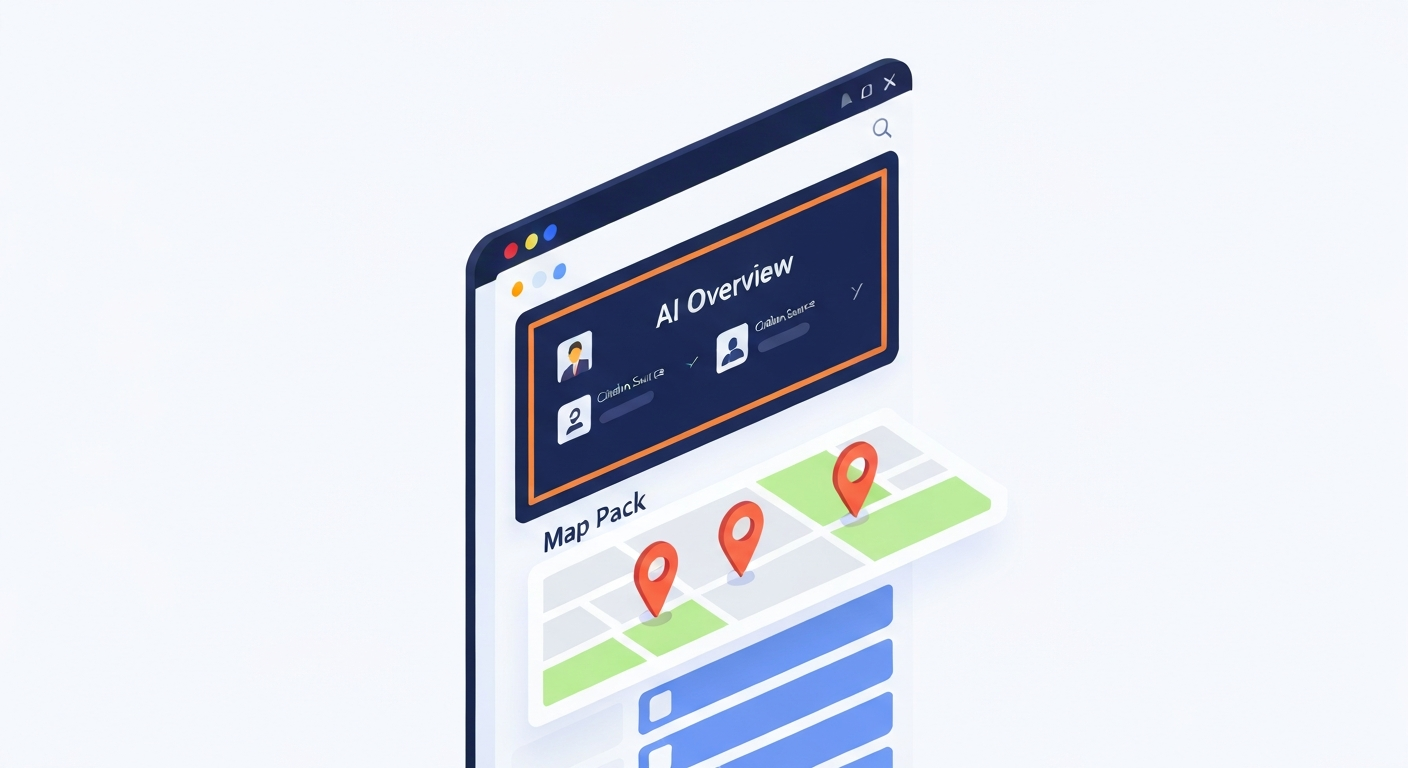
When the AI Overview appears, here's what happens to the rest of the page:
Click-through to position 1 drops 40-60%. Multiple studies (Sistrix, Authoritas, Semrush) confirm this. The CTR collapse is concentrated on informational and commercial queries — exactly the queries local businesses depend on for top-of-funnel discovery.
The Map Pack moves down. In 2024, the Map Pack typically appeared above or alongside the first organic results. In 2026, the AI Overview displaces it. The Map Pack is now below the AI Overview in most queries — sometimes pushed below the fold entirely.
Position 1 traffic routes to AI Overview citations. The 40-60% of position-1 traffic that disappears doesn't go to position 2 or 3. It goes to the 3-5 businesses cited inside the AI Overview panel. Those citations include a clickable link to each cited source. Users who want to verify the answer click the citation, not the organic blue links below.
Bottom line: AI Overview citation is now worth more than position 1. A business cited in the AI Overview at position 12 gets more clicks than a non-cited business at position 1. This is the inversion most agencies haven't internalized.
↑ Free GeoGrid Scan + AI Overview Audit →
Google has not published the exact algorithm. We've reverse-engineered the signals through patent filings, public statements, log analysis on hundreds of client engagements, and pattern matching across thousands of AI Overview results in dozens of verticals.
Four signals dominate AI Overview source selection:
The AI Overview model reads your business as an entity that exists across the open web. Coherence is the signal: does your business name, address, phone, and category match across Google Business Profile, Yelp, BBB, Clutch, vertical-specific directories (Avvo for legal, RealSelf for med spas, Healthgrades for medical, Houzz for trades), local news mentions, and Reddit threads? Drift kills entity authority. Compression wins. This is Entity Trust Compression in the Near Me Domination methodology.
Schema is the structured-data layer that tells the AI model what your business is. The AI Overview model weights:
Organization schema with consistent identifiers (sameAs links to your other profiles)LocalBusiness schema with primary category, address, hours, service areaService schema for each service you offerAuthor schema with credentials (especially for YMYL verticals)FAQPage schema with structured Q&ABreadcrumbList schema for site navigation hierarchyReview and aggregate rating schemaA page with five schema types correctly implemented is treated as a stronger entity than a page with one or zero. Most local business websites have one or zero.
This is where reputation management and AI SEO converge. The AI Overview model weights:
The full framework here is the 5-layer Review Velocity Protocol™ — the reputation management methodology that drives both Map Pack ranking and AI Overview citation.
The AI Overview synthesizes a specific answer to the user's query. To be cited, your content must match the answer pattern. If the user asks "what's the best [vertical] in [city]," the AI is looking for content that names the comparison and meets the answer head-on. If your content is "We are a [vertical] in [city]" but doesn't structurally match the comparison answer, you're invisible to the model — even if your entity signals are strong.
This is why generic local SEO blog content doesn't get cited. It optimizes for keywords, not for answer patterns. AI Overview citation requires content that the model can directly synthesize into its panel answer.
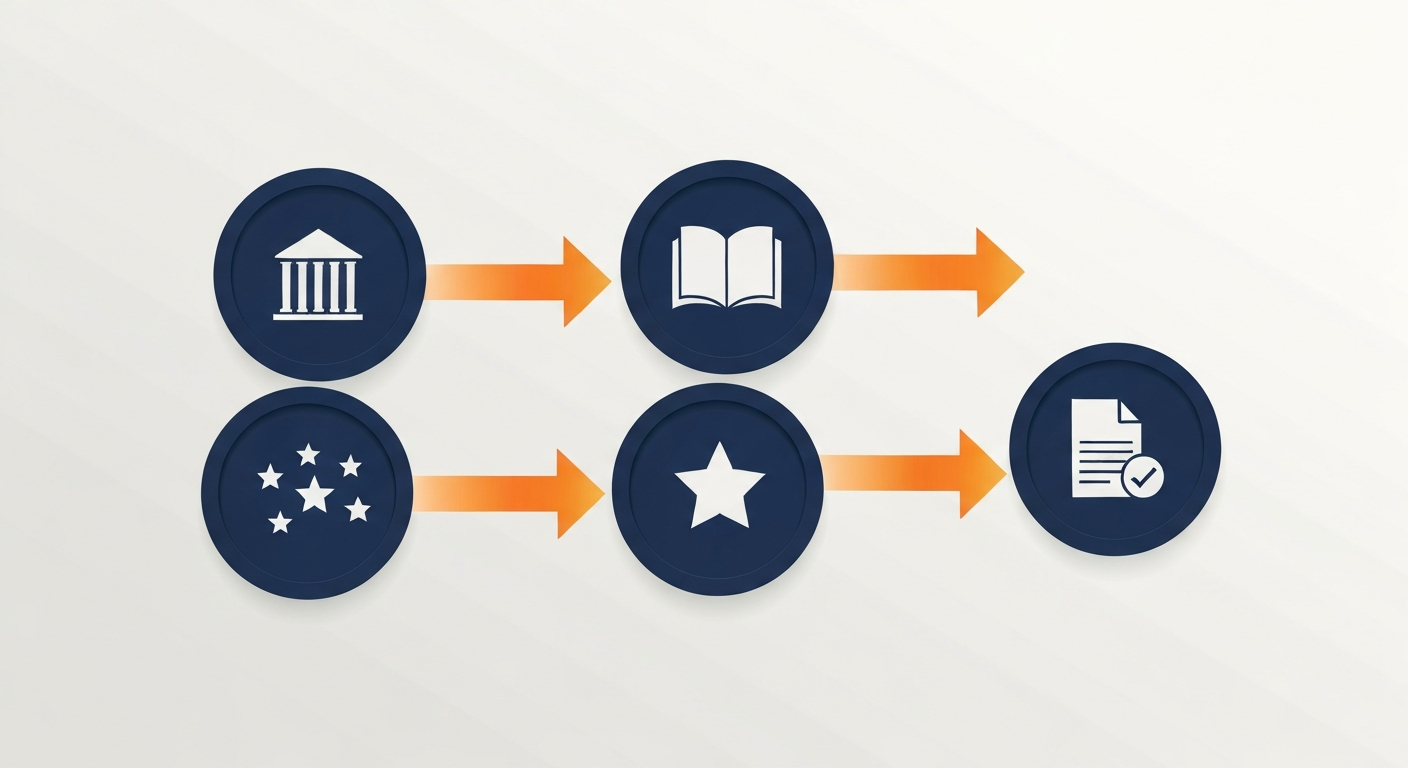
Every Maps Domination Program™ engagement that targets AI Overview citation runs the AI Overview Citation Protocol™ — a 4-stage framework that operationalizes the four signals into a deployable protocol. It sits inside the broader AI Trust Score methodology and complements the 5-layer Review Velocity Protocol™ for the review-side signals.
| Stage | What It Does | Tied To |
|---|---|---|
| Stage 1: Entity Trust Compression | Audits and unifies your business identity across Google Business Profile, schema markup, and primary third-party citations (Clutch, BBB, Yelp, vertical directories). Resolves drift in name, address, phone, category, services. | AI Trust Score: Entity Consistency component (15 pts) |
| Stage 2: Authority Citation Building | Earns or claims placements in the third-party sources the AI model reads — vertical directories, industry associations, local news, manufacturer certifications, peer recognitions (Avvo, Super Lawyers, RealSelf, Houzz Pro, etc.). | AI Trust Score: Competitive Position + Entity Consistency |
| Stage 3: Review Depth Engineering | Drives review velocity to AI citation thresholds across Google, Yelp, BBB, and vertical platforms. Engineers review content (not just count) to include vertical and location terms substantively. Builds 100% response coverage. | Review Velocity Protocol™ — full 5-layer framework |
| Stage 4: Question-Alignment Content | Builds dedicated content pages that match the AI Overview answer patterns for your money queries. Schema-marked FAQ blocks. Direct answers to "best [vertical] in [city]," "what is [service] in [city]," "how much does [service] cost in [city]" patterns. | AI Trust Score: Grid Coverage + Radius Reach (via on-page signals) |
| Generic "AI Overview SEO" Services | AI Overview Citation Protocol™ |
|---|---|
| Add schema markup, write more content, hope. | 4-stage deployable protocol with measurable signal output per stage. |
| Treats AI Overview as a separate optimization problem. | Integrated with the 5-component AI Trust Score and the Map Pack ranking methodology — same engagement covers both surfaces. |
| Monthly retainer; vague reporting on whether you're cited. | 12-week protocol. AI Overview citation status audited weekly. Top 3 + citation in 12 weeks or you don't pay. |
| Generic across verticals. | Vertical-specific deployment — schema and citation work differs by trade vs. legal vs. medical/aesthetic vs. personal service. |
↑ Get Your Stage 1-3 Audit Free →
The terminology proliferation makes this category hard to navigate. Here's the cleanup:
Google's current production name for the AI-synthesized answer panel at the top of search results. Rolled out 2024, fully expanded across commercial queries by 2025. The panel cites 3-5 sources, summarizes an answer, and provides clickable follow-up questions.
Before AI Overview, Google ran SGE in Search Labs (2023-2024). Same product, different name. If you read older content (pre-2025), it likely calls the product SGE. The methodology to win citation is the same regardless of which name the article uses.
GEO covers optimization for all generative AI surfaces, not just Google's AI Overview. The category includes:
The 4-stage AI Overview Citation Protocol™ extends to all of these surfaces, with platform-specific tweaks. Entity authority, schema completeness, review depth, and content alignment are universal signals; the implementations differ. For the broader GEO methodology, see our AI SEO for local business pillar.
The same entity-trust work that gets you cited in Google AI Overview gets you named in ChatGPT and Perplexity. Different surfaces, same underlying signal stack. This is why the Maps Domination Program™ is built around AI Trust Score components rather than around any individual platform — the methodology is platform-agnostic by design.
National e-commerce brands struggle to win AI Overview citation. The category is too crowded; entity authority is too diffuse across thousands of competitors. Local service business is the exact opposite. Here's the math:
Entity authority is bounded by service area. A plumber in Las Vegas competes against ~50 other plumbers in the AI Overview's eligible source pool for "plumber Las Vegas" queries. That's a winnable category. A national e-commerce site competes against thousands.
Vertical platforms are concentrated. The AI model reads vertical directories the way it reads Google. For local service business, the dominant verticals are well-known and limited (Avvo, Healthgrades, RealSelf, Houzz, BBB, Yelp). For a national e-com brand, the relevant authority sources are infinite and unmanageable.
Review velocity is achievable. A local plumber generating 3-5 substantive reviews per week sustained for six months hits AI citation thresholds. A national brand needs review velocity in the hundreds per week per category to register.
Schema work is finite. A local business has 5-10 schema types to implement correctly. A national brand has thousands of schema relationships to maintain.
Content alignment is targeted. Local query patterns are predictable: "best [vertical] in [neighborhood]," "[vertical] near me," "[service] in [city] cost." Building question-alignment content for 10-20 query patterns is achievable. National e-com query patterns are infinite.
Bottom line: AI Overview citation is the highest-leverage SEO investment a local service business can make in 2026. The methodology is more achievable for you than for a Fortune 500 company. The category is more uncontested than national SEO. The CPCs and competition scores in the cluster prove it: "ai overviews seo" is 5,400 monthly searches at competition 0.05.
You can't optimize what you can't measure. Three ways to track AI Overview citation:
Open an incognito browser window. Set your location to your service area (or use a VPN to confirm). Search your money keyword. Note which businesses appear in the AI Overview panel at the top. This is the most accurate method, since AI Overview output varies by location, device, and personalization.
Limitations: incognito browsing reduces but doesn't eliminate personalization. Mobile vs desktop produces different AI Overviews. Geo varies the result. You'll need to run multiple checks across the dimensions that matter for your market.
Most ranking tools have not yet implemented reliable AI Overview citation tracking. The few that have (Semrush AI Overview tracker, Sistrix AI module, Authoritas) are agency-priced and only track whether an AI Overview appears for a keyword, not who's cited.
The GeoGrid scan (part of the free AI Trust Scan) includes AI Overview citation status across your service area for your money keyword. You see whether the AI Overview appears at each grid point, which 3-5 businesses are cited, and where you sit. This is the most thorough free tracking available for local businesses in 2026.
Once you're tracking, focus on three metrics:
The Maps Domination Program™ tracks all three weekly and reports the trend.
Two different games, two different deliverables, two different methodologies.
| Traditional SEO | AI Overview Citation | |
|---|---|---|
| Surface measured | 10 organic blue links + Map Pack | 3-5 cited sources inside the AI panel |
| Ranking signal | Position-based (where in the SERP) | Entity-based (cited or not) |
| Primary inputs | Backlinks, on-page keywords, content depth | Entity authority, schema, reviews, content alignment |
| What "winning" looks like | Rank in top 5-10 organic positions | Be one of the 3-5 cited sources in the AI panel |
| CTR collapse risk | High — AI Overview eats organic clicks | Low — citation is the new prime placement |
| Tools that measure it | Semrush, Ahrefs, Moz (well-established) | Few — most rank-tracking tools don't see it yet |
| Time to result | 6-12 months for new domains | 8-14 weeks for entity work; 2-4 weeks for content alignment |
| Where the methodology lives | Long-established (15+ years) | Emerging — most agencies still figuring it out |
| Best fit for local business | Required but increasingly insufficient | Highest-leverage SEO investment in 2026 |
You need both. Traditional SEO ensures your business is indexable and ranks for the queries the AI Overview doesn't trigger on. AI Overview citation ensures you're not invisible above the fold for the 87% of commercial queries where it does appear. The Maps Domination Program™ runs both simultaneously.
Twelve-week protocol. Territorial. One business per vertical per area.
What's included:
Week 1 — AI Trust Score baseline + AI Overview audit. Full GeoGrid scan of your service area. AI Overview citation status checked at every grid point for your money keyword. Entity audit: NAP coherence across 8-12 third-party sources, schema completeness check, review velocity baseline, content alignment audit.
Weeks 2-4 — Stage 1 + 2 (Entity Trust Compression + Authority Citation Building). NAP unification. Schema markup completion. Vertical directory placements. Manufacturer certification claims. Local news outreach where applicable. Peer recognition platform claims (Avvo, Super Lawyers, RealSelf, Houzz Pro).
Weeks 5-8 — Stage 3 (Review Depth Engineering) + Stage 4 (Question-Alignment Content). Review Velocity Protocol™ activation across 4-6 platforms. Question-alignment content pages built for 10-20 money query patterns. Schema-marked FAQ blocks. Content engineered to match AI Overview answer patterns.
Weeks 9-12 — Citation lock + Geolock Defense Matrix™. Continuous AI Overview citation monitoring. Reactive content for any competitor moves. Review velocity maintenance at the threshold that triggered citation. Map Pack ranking lock at top 3.
Week 12 result. Top 3 Map Pack across your grid for your money keyword. AI Overview citation present for the same keyword. Named in ChatGPT and Perplexity for "best [vertical] in [city]" queries. Hit those three, or you don't pay.
The free GeoGrid + AI Trust Scan is the prerequisite. If your AI Trust Score is in the Invisible or Partial band and your vertical/territory is open, you'll see an invitation to apply.
Real Digital Domination clients who ran the Maps Domination Program™ — including the AI Overview Citation Protocol™ component.
| Vertical + Location | Pre-Engagement | After (8–14 weeks) | Outcome |
|---|---|---|---|
| Family-Owned Electrician (multi-location) | No AI Overview citation; thin entity signals; Google-only review presence | Cited in AI Overview for "electrician [city]" queries across all locations; cross-platform review presence on Google + Yelp + BBB + Angi | Revenue $1,244,815 → $1,954,320 (+57%). Cost per lead $110 → $29 (−74%). |
| John Roberts, Mobile Mechanic (Nashville) | Not on the AI Overview map; named "near me" queries had zero citation | Named by ChatGPT for "mobile mechanic Nashville"; AI Overview citation for "auto repair near me" within service area | 0% → 37% Map Pack share in 8 weeks. Calendar fully booked. |
| Mark, Eyeglass Store (Pensacola) | Absent from AI Overview for "eye exam" queries | AI Overview citation for "eye exam Pensacola" + cross-platform citations on Healthgrades, ZocDoc | 100% Map Pack lock + AI Overview citation in under 90 days. Closing 4th location off the lift. |
| Phoenix Auto Repair | Stagnant; not appearing in AI Overview | AI Overview citation in week 4 — entity work hit the threshold faster than expected | +400% Map Pack share in week 1; AI citation followed by week 4. |
Each case ran the full AI Overview Citation Protocol™ as part of the Maps Domination Program™ engagement.
The four most frequent mistakes we see when auditing prospects who tried to do this themselves or hired generic AI Overview SEO services:
1. Treating AI Overview SEO like traditional SEO. Building backlinks, optimizing keyword density, writing more blog posts. None of these address the entity-trust signal stack that drives citation. They might move organic ranking. They don't move AI Overview citation.
2. Schema half-done. Adding Organization schema and stopping there. The AI Overview model reads schema completeness as a signal — partial schema is treated as a less-trustworthy entity than complete schema. Five schema types implemented correctly beats one schema type implemented thoroughly.
3. Single-platform reviews. Treating Google reviews as the only review platform that matters. The AI Overview model reads cross-platform coherence. A 4.9-star Google profile with no presence on Yelp, BBB, or vertical directories is a fragmented entity to the AI. Distribution is the signal, not just average rating.
4. Generic content that doesn't match answer patterns. Publishing "We are a [vertical] in [city] offering [services]" content. The AI Overview model is looking for content that matches the answer it's trying to synthesize. "Best [vertical] in [city]" content that names the comparison and meets the answer head-on gets cited. Generic "about us" content does not.
The 4-stage AI Overview Citation Protocol™ addresses each of these systematically. Generic AI Overview SEO services do not.
Three categories of provider claim "AI Overview SEO" expertise in 2026.
| Generic SEO Agencies (Rebranded) | AI Content Mills | AI Overview Citation (Digital Domination) | |
|---|---|---|---|
| Methodology | "Add schema, build backlinks" — 2018 SEO with new buzzwords | High-volume AI-generated content; light editing | Named 4-stage protocol — Entity Trust Compression, Authority Citation Building, Review Depth Engineering, Question-Alignment Content |
| Surfaces measured | Organic SERP rankings; partial Map Pack | Organic SERP only | AI Overview citation + Map Pack + ChatGPT/Perplexity entity recognition |
| Diagnostic | Backlink audit, keyword gap analysis | Content gap analysis | 5-component AI Trust Score (free) — entity, citations, reviews, content alignment, geographic coverage |
| Deliverable cadence | Monthly retainer, vague AI Overview reporting | High content volume; vanity metrics | 12-week protocol with weekly AI Overview citation tracking, dollar-math projections, named milestones |
| Guarantee | None | None | Top 3 Map Pack + AI Overview citation in 12 weeks or you don't pay |
| Exclusivity | Will sign three competing roofers in same city | Same | One business per vertical per area, period |
| Pricing | $1,500–$5,000/mo retainer, indefinite | $0.10–$2 per generated article | Performance-tied; territorial application; no engagement without qualification |
The first two categories will tell you they "do AI Overview SEO." The deliverables and the guarantees will tell you whether that's true.
The Google AI Overview is the AI-synthesized answer panel that appears at the top of most commercial-intent search results in 2026. It cites 3-5 source businesses or websites inside the answer and provides clickable follow-up questions. When the panel appears, click-through to position 1 organic results drops 40-60%, with the displaced traffic routing to the cited sources.
Four signals dominate AI Overview source selection: (1) entity authority across third-party sources, (2) schema markup completeness, (3) review depth and recency across multiple platforms, (4) content alignment with the AI's answer pattern. The 4-stage AI Overview Citation Protocol™ is built to address all four. Generic SEO won't do it.
Same product, different name. SGE (Search Generative Experience) was Google's experimental name for the product during 2023-2024 in Search Labs. AI Overview is the production name after rollout. Methodology to win citation is identical regardless of which name the article uses.
Yes — and no. AI Overview reduces click-through to position 1 organic by 40-60%, which hurts traditional SEO traffic. But the displaced traffic routes to AI Overview citations. So if you're cited, AI Overview helps your traffic; if you're not cited, it hurts. The strategic question shifts from "rank higher" to "get cited."
Entity work (Stages 1-2 of the AI Overview Citation Protocol™) typically takes 4-6 weeks to register with the model. Review depth work (Stage 3) takes 6-10 weeks. Content alignment work (Stage 4) takes 2-4 weeks for the content to be indexed and weighted. The Maps Domination Program™ is structured as a 12-week protocol because all four stages are sequenced to produce citation by week 12.
Stage 4 (question-alignment content) is achievable as a DIY effort if you have copywriting capacity. Stages 1-3 (entity work, citations, review depth) require infrastructure, vertical platform expertise, and competitive monitoring that DIY effort can't match at scale. The honest answer: yes, you can do partial AI Overview optimization yourself, but the citation outcome typically requires done-for-you execution.
For local businesses: the GeoGrid scan (free) from the AI Trust Scan reports AI Overview citation status across your entire service area for your money keyword. For broader tracking, agency-tier tools (Semrush AI Overview tracker, Sistrix, Authoritas) report whether AI Overview appears for a keyword but generally don't show you which specific businesses are cited.
Better than for national e-commerce, in fact. Entity authority is bounded by service area for local business — you compete against ~50 entities for citation, not thousands. Vertical platforms are limited and well-known. Review velocity is achievable. Schema work is finite. Local query patterns are predictable. AI Overview citation is the highest-leverage SEO investment a local service business can make in 2026.
GEO is the broader category — optimization for ranking inside generative AI answers across all surfaces (AI Overview, ChatGPT, Perplexity, Claude, Gemini, Copilot). The AI Overview Citation Protocol™ is the Google-specific methodology, but the same 4-stage approach extends to the other surfaces with platform-specific tweaks. For the full GEO methodology, see our AI SEO for local business pillar.
YMYL adds layers but doesn't change the core methodology. Legal verticals require Bar admission credentials in schema, peer recognitions (Avvo, Super Lawyers, Martindale-Hubbell) as authority citations, bar-compliant review content, and attorney-author schema. Medical verticals require RN/MD credentials in schema, manufacturer certifications (Allergan, Galderma for med spas), HIPAA-compliant review handling. The AI Overview Citation Protocol™ deploys differently for YMYL but the four stages apply.
The AI Overview Citation Protocol™ is run by Digital Domination Marketing. Nick Thompson (author of The Google Maps Domination Playbook, Amazon) and the Digital Domination operations team designed the 4-stage framework on top of the Near Me Domination methodology — the same framework that covers S2 cell occupancy, BERT vector optimization, hub-and-spoke neighborhood silos, entity trust compression, and the information gain patent (#11,366,956).
AI Overview citation isn't separate from local SEO in 2026. It's the surface above the Map Pack that decides whether a customer ever reaches your Map Pack listing in the first place. We built the AI Overview Citation Protocol™ as the Google-specific deployment of the broader AI SEO methodology, and as the upstream complement to the 5-layer Review Velocity Protocol™ that drives the underlying signal stack.
"The AI Overview is the new position 1. Everything below it gets a fraction of the traffic. The agencies that won't admit this are the ones still selling backlink campaigns. The signal stack the AI Overview reads is different. The methodology is different. The deliverable is different. We built the protocol so local businesses don't have to figure that out by accident."
Nick Thompson, The Google Maps Domination Playbook
Thirty seconds to run the GeoGrid + AI Trust Scan. Two minutes to your AI Overview citation audit in your inbox — citation status at every point in your service area for your money keyword, plus the four-stage gap report telling you exactly where your entity, citations, reviews, and content alignment stand against the AI Overview model. And if your vertical and territory are open, an invitation to apply for the Maps Domination Program™ — Top 3 in Maps + AI Overview citation in 12 weeks, or you don't pay.
↑ Run the Free GeoGrid + AI Trust Scan →
Free. No credit card. No sales call. No dashboard login. Heatmap and AI Overview audit by email in under 2 minutes. Weekly AI SEO newsletter is opt-in only.
Built by the authors of The Google Maps Domination Playbook on the Near Me Domination methodology. Territorial: one business per vertical per area.
Copyright © Super Boost SEO. All Rights Reserved
