
Your ranking tool reports one number. Your customers see something completely different.
The GeoGrid heatmap maps your business's actual Map Pack position across every S2 cell in your service area to reveal exactly where you appear and where competitors are taking your leads.
The Problem
Your standard SEO tools measure ranking from a single desktop location. That one reading misses the real geographic spread your customers actually experience as they search from different neighborhoods.
Millions of customers search 'near me' every day, and Google's Map Pack only has three seats, period. If you are not in those three across the places your customers search, you are losing the call.
What Your Ranking Tool Can't See
Traditional tools like Semrush and Ahrefs simply cannot measure how local ranking works today. They miss the things that decide whether a customer finds you.
- ▸Your actual Map Pack position across different neighborhoods
- ▸Distance decay effects as searchers move away from your storefront
- ▸Specific competitor positioning by location
- ▸The shift from old 2015 proximity models to new S2-cell spatial-vector ranking
What the GeoGrid Scan Checks
The diagnostic analyzes six dimensions of your local visibility, mapped across a grid of points throughout your service area.
- ▸Map Pack Position across grid points
- ▸Grid Coverage percentage
- ▸Competitor Benchmarking
- ▸Radius Reach from your storefront
- ▸S2 Cell Signal mapping
- ▸NAP and Trust Signals
AI Trust Score (0-100)
Your scan returns a single AI Trust Score on a 0-100 scale, built from five weighted components measuring geographic and trust visibility.
The bands are clear: Invisible (0-40), Partial (41-70), and Dominant (71-100). It tells you in one number how findable you really are.
Sample Heatmap Output
You receive a one-page email report that turns the data into something you can act on at a glance.
It shows your overall score, a visual grid snapshot of where you rank, your top competitors, your estimated lead loss, and recommended next steps.
Post-Scan Process
The flow is built to respect your time and your inbox. You run the scan in about 30 seconds and receive your heatmap by email within two minutes.
From there, an optional weekly newsletter is opt-in only, and qualified businesses may be invited into the Maps Domination Program(TM).
Frequently Asked Questions
Is the GeoGrid scan really free?
Yes, with no credit card required. The weekly newsletter is opt-in only.
How long does the GeoGrid scan take?
About 30 seconds to run, and under two minutes for the heatmap to arrive by email.
What does the scan actually analyze?
Your Map Pack position for a target keyword across geographic grid checkpoints, showing neighborhood dominance, competitor positioning, and ranking distance decay.
Will I get spammed or surprise sales calls?
Contact only happens with your consent: you choose whether we may call or text you, and you can revoke that consent at any time by replying STOP, saying "stop" on any call, or emailing privacy@digitaldomination.ai. See our Do Not Call Policy at digitaldomination.ai/do-not-call-policy/.
What is the AI Trust Score?
A composite 0-100 metric measuring Grid Coverage, Radius Reach, Competitive Position, Entity Consistency, and AI Overview presence.
How is this different from Local Falcon, BrightLocal, or Whitespark?
This is a one-click diagnostic for a single operator. Those are agency SaaS platforms that require subscriptions and credit management.
Do you work with my industry?
Coverage includes roofers, HVAC, plumbers, electricians, lawyers, med spas, gyms, barbershops, and chiropractors.
What happens if my AI Trust Score is low?
The report prioritizes three corrective actions and invites qualified applicants into the Maps Domination Program(TM). The work aims to improve Map Pack visibility. Results vary.
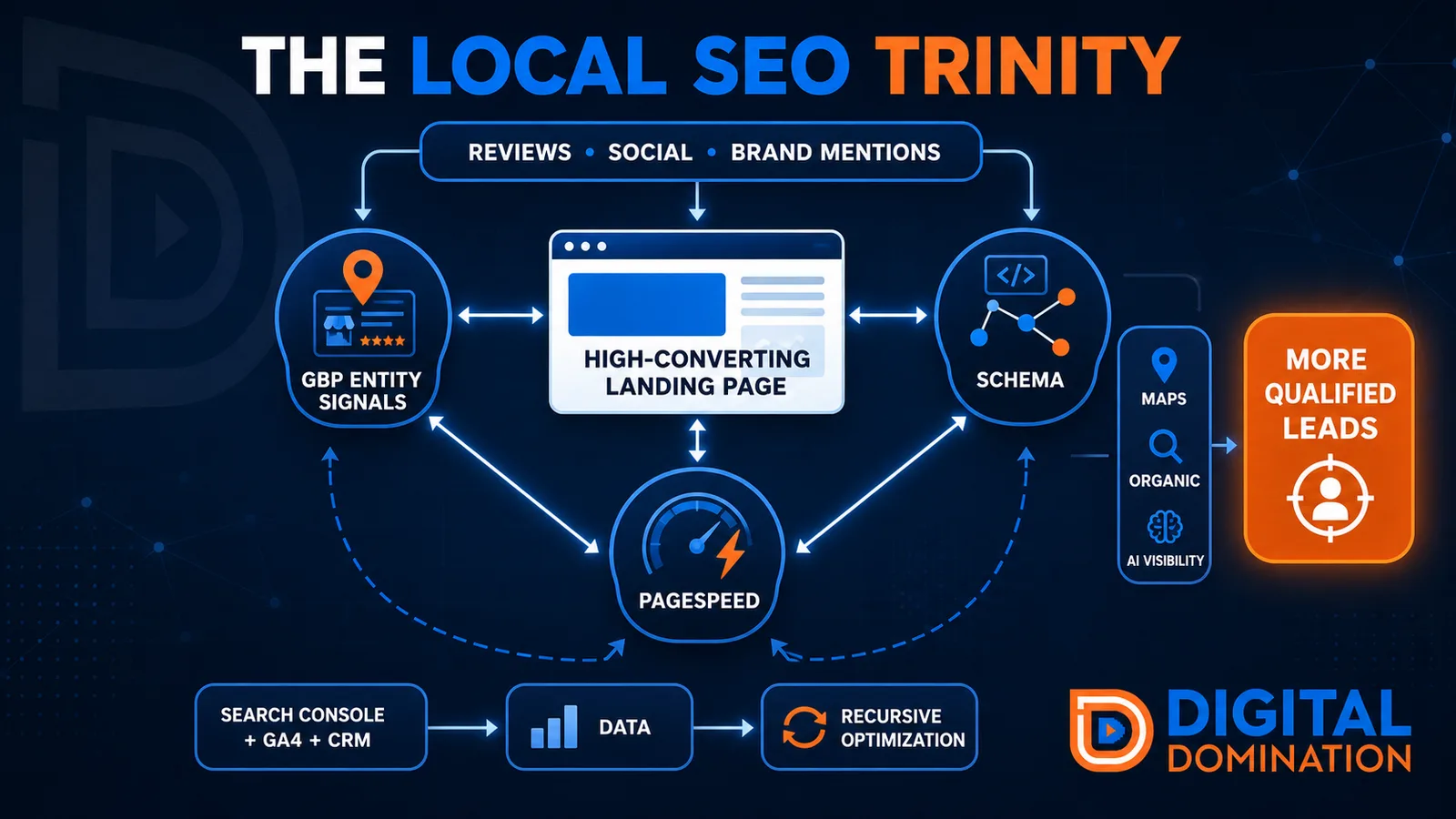
The Local SEO Trinity
Think of a three-legged stool. Your Google profile, your website, and your reviews all have to hold you up. If one leg is short, the whole thing wobbles.
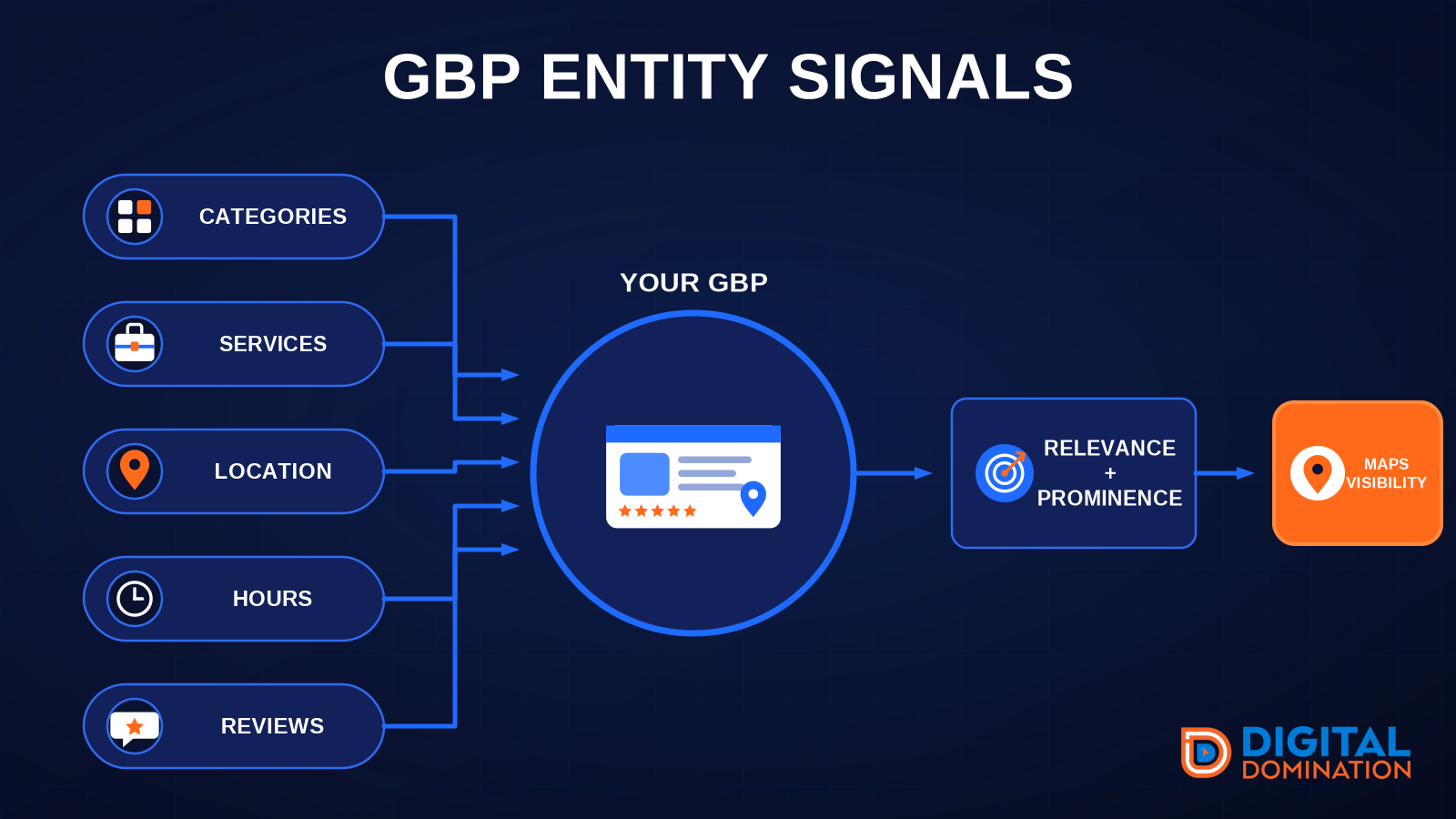
GBP entity signals
This leg is your Google Business Profile. GBP means Google Business Profile. It covers your categories, your services, your location, your hours, and your reviews. Google uses those facts to decide who to show.
Your Google profile is your storefront sign. If the sign is missing, or it names the wrong shop, people drive past.
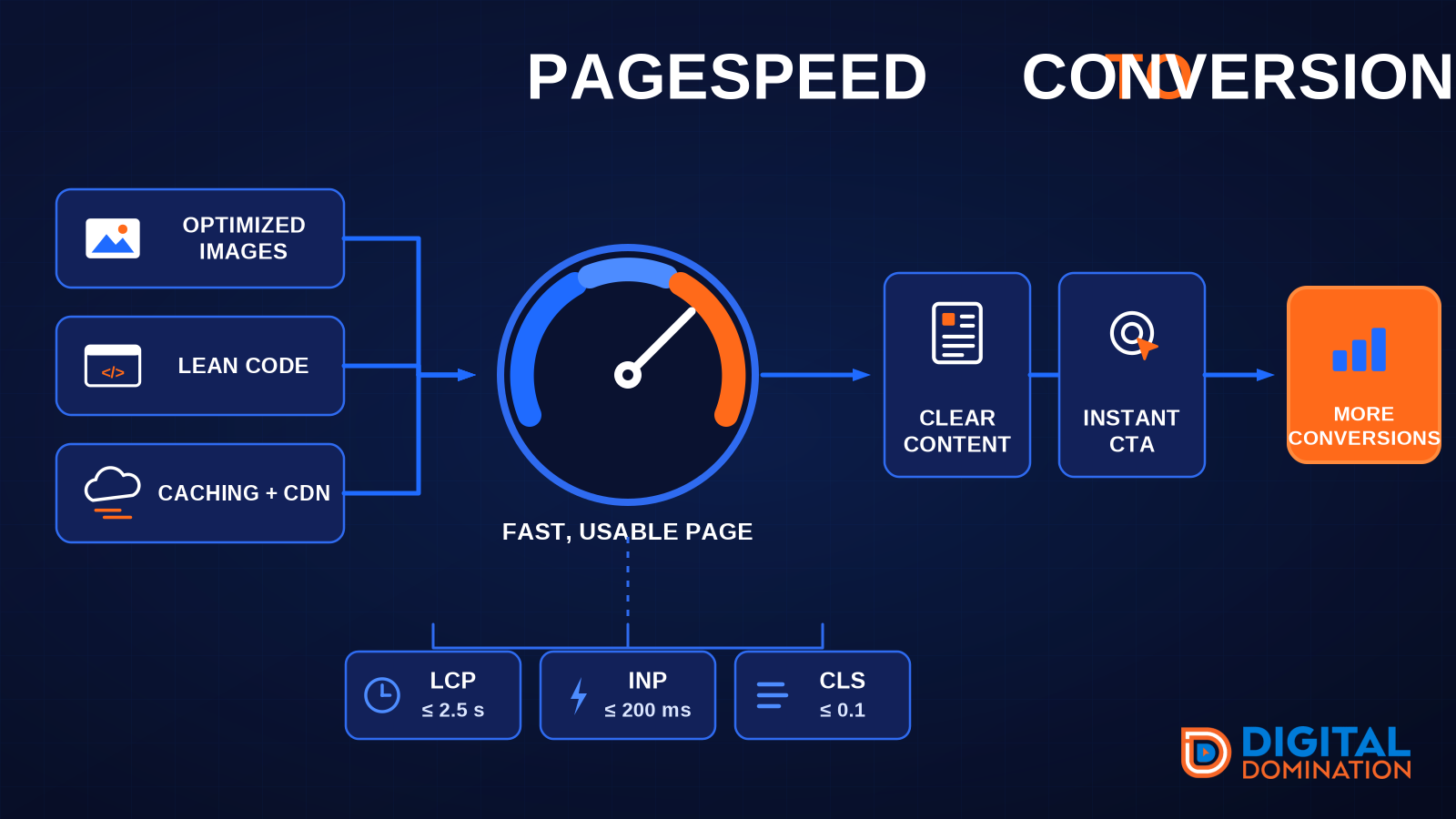
PageSpeed to conversion
This leg is your website, above all on a phone. Small images, lean code, and caching make a page fast. A fast, clear page is what turns a visit into a call. Phone speed is one of the 12 Trinity checks because a slow page loses the call before anyone sees your offer.
Your website is the showroom. If the door sticks, people leave before they look around.
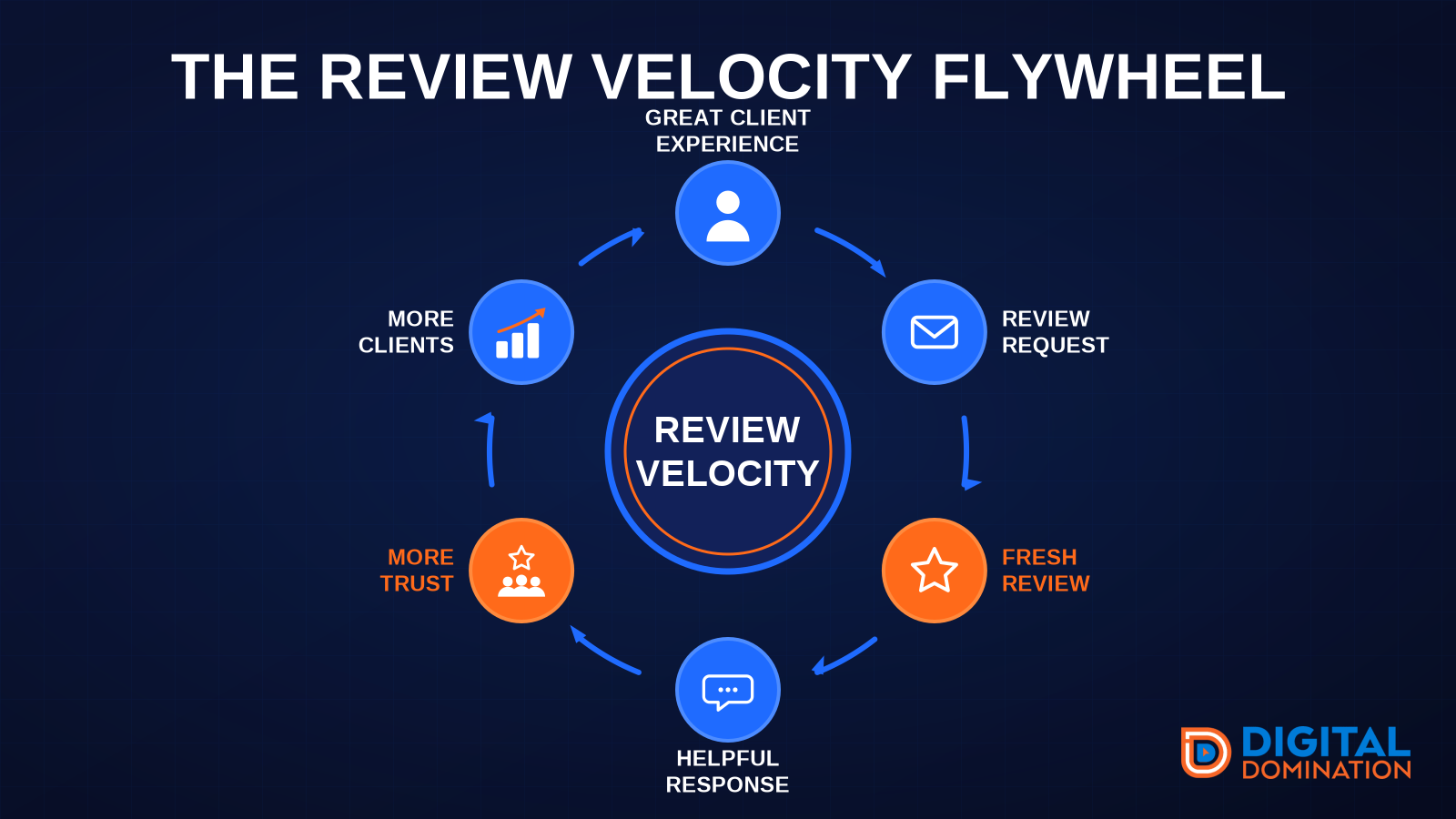
The review velocity flywheel
This leg is reviews and reputation. A good visit leads to a review request, then a fresh review, then a helpful reply, then more trust, then more customers. When the scan can find your Google listing, it shows your rating, your recent reviews, and how many you answered.
Reviews are word of mouth. One kind word helps. A steady stream of real reviews, and a reply from you, helps more.
How this turns into revenue
Being found in more searches leads to more calls. More calls lead to more booked jobs. More booked jobs lead to more revenue.
Example numbers, not a real business: 40 calls from search in a month, a 25 percent close rate, and a $400 average job. That is 10 booked jobs. That is $4,000. The math is the lesson. It is not a promise.
The full page has a box where you can type your own average job value and close rate.
One real story, from our car dealership case study: Medina Auto Group went from invisible on Google Maps to dominating every high-intent search across their market. The turnaround spanned all four of their rooftops at once. The same page says the team eliminated 89 unfair one-star reviews that had been dragging the dealership's reputation down and keeping it out of the Map Pack. It also says: “Results described here are exceptional and non-typical. Outcomes vary based on market conditions, competition, and implementation. No guarantees are made regarding earnings, rankings, or conversions.”
Free strategy call
More booked jobs start with a clear plan
Book a free strategy call. We look at your Google profile, your website, and your reviews, and we tell you what to fix first.
Free. You pick the time. A real person shows up.