
Fence contractor local SEO: how GBP entity signals, schema and PageSpeed turn a blown-down fence into a signed estimate
The crew that sets the straightest posts does not automatically get the job. The contractor Google can read, a homeowner can trust from the driveway and a phone can load before the dog gets to the corner does.
Why the better fence company loses the homeowner standing in the driveway
A spring wind advisory rolls through overnight. At 7:15 on Saturday morning a homeowner walks out to find forty feet of cedar privacy fence flat across the side yard, three posts snapped at the concrete, and the dog gone. She finds the dog two houses down, walks back with him under one arm, and searches "fence repair near me" with the other hand while standing over the wreckage. She reads two ratings, taps the profile that shows real photos of a fence that looks like hers and a service called Wind damage fence repair, and requests an estimate. The whole decision takes about ninety seconds.
The contractor with the twenty-year crew and the perfectly plumb posts may never have appeared in that three-pack. Maybe the profile lists a single category and no services, so Google has no idea the company does repairs. Maybe the website is a builder template carrying sixty uncompressed gallery photos that took nine seconds to render on a phone in the driveway. The homeowner did not choose the better fence builder. She chose the one she could evaluate.
The short version for a fence contractor
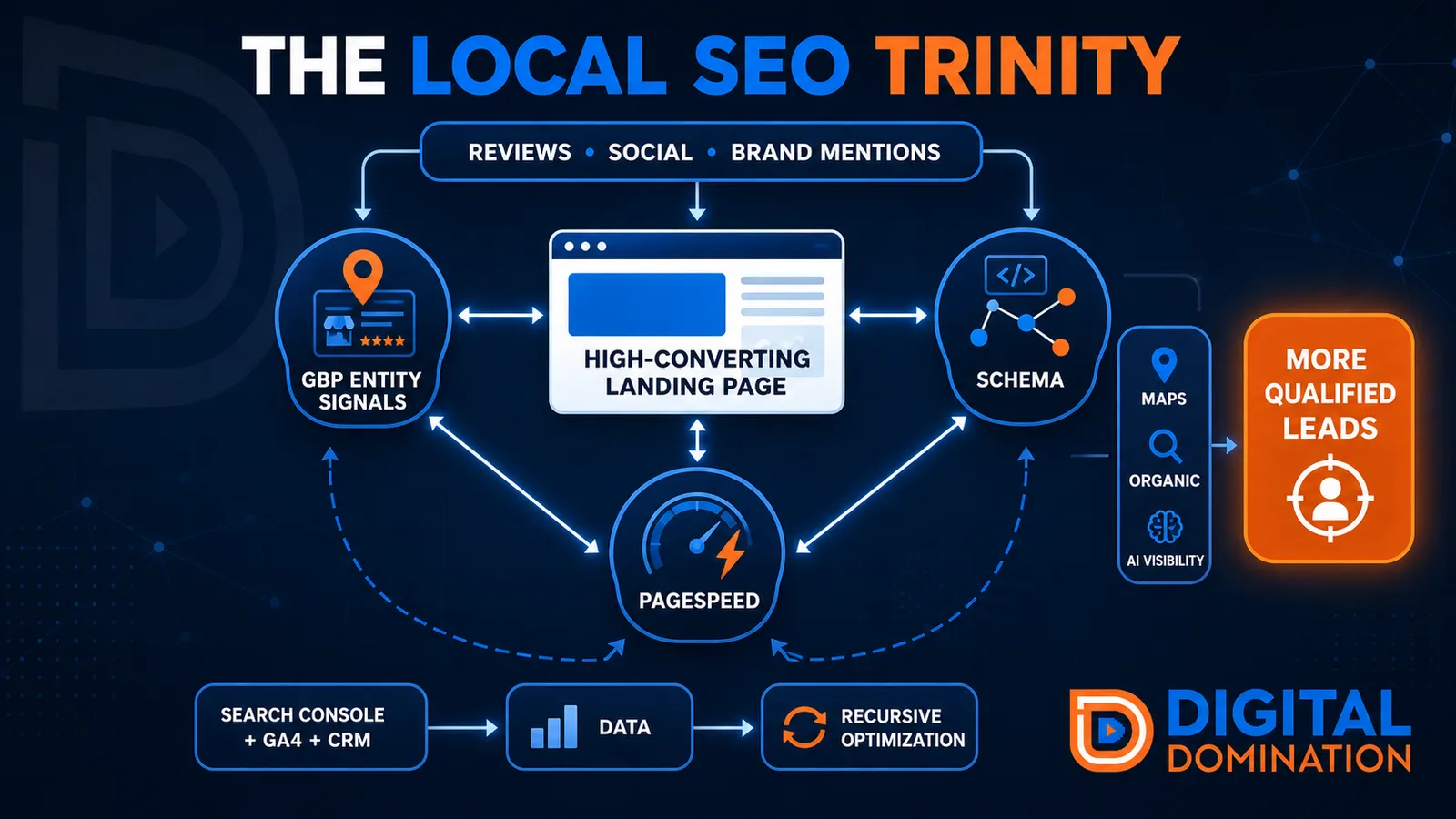
Google ranks local results on relevance, distance and prominence. Distance is fixed by where the homeowner is standing, so the winnable fight is relevance, prominence and conversion across every neighborhood you actually serve. At Digital Domination we build fence contractor local SEO as three pillars with a measurement loop wrapped around them:
- ▸Google Business Profile entity signals establish who the company is, which fence types it builds, whether it repairs or only installs, and where the crews will drive.
- ▸Schema turns the company, its license, its estimators, each fence material, its per-foot pricing and its service area into a machine-readable graph with permanent identifiers.
- ▸PageSpeed makes sure a homeowner on a phone, a Google crawler and an AI agent can all use the estimate page before they give up.
- ▸Search Console, GA4 and the estimating or CRM software close the loop by showing which searches produced estimates and which estimates became signed contracts.
GBP entity signals: categories, fence types and a real service area
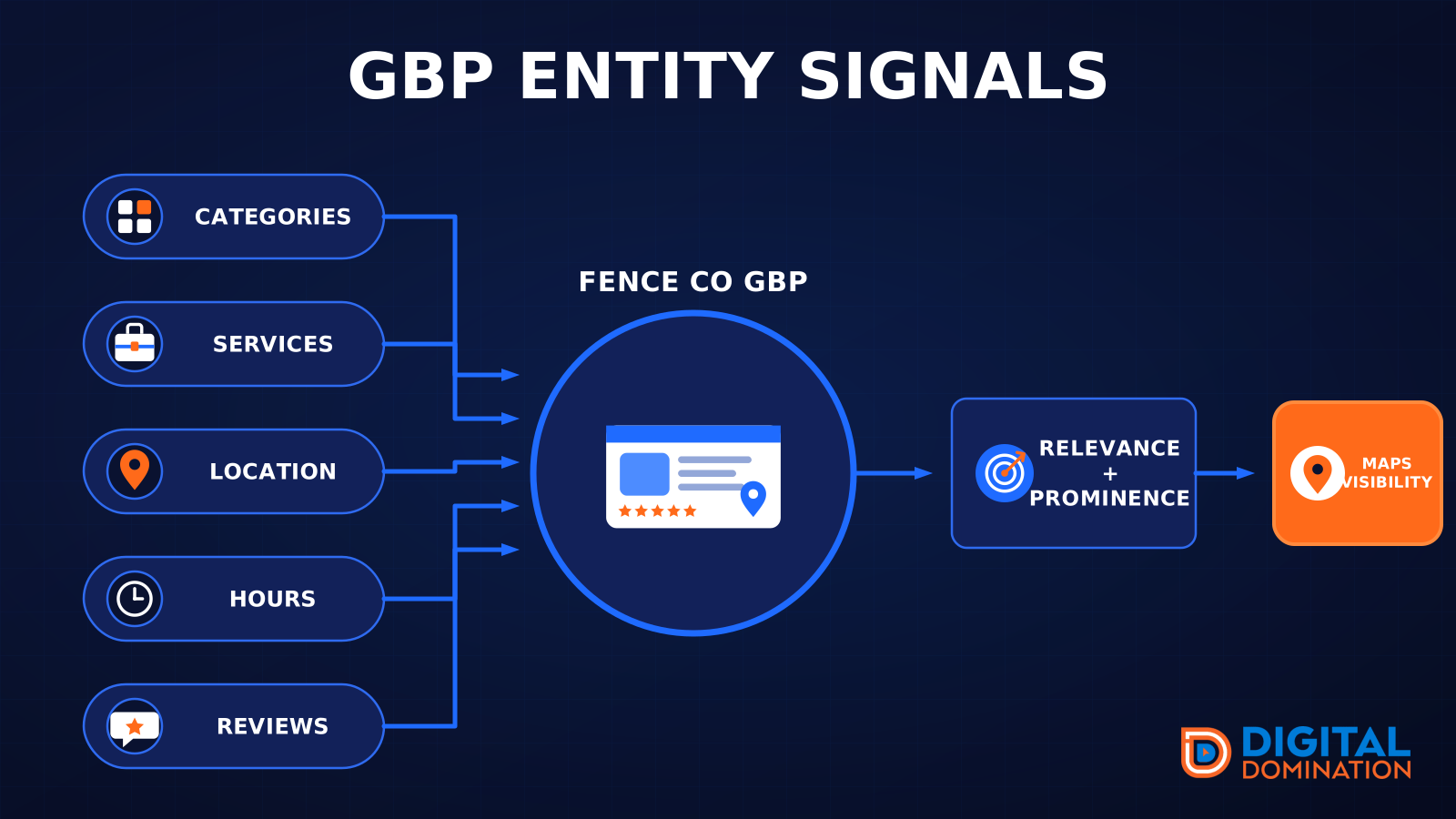
The primary category is Fence contractor. Secondary categories should only reflect work you really do and are licensed for: Gate installation service, Deck builder, Welder or Concrete contractor if you build block walls. Adding General contractor because it sounds bigger dilutes the entity and can create a licensing problem with the state board. Services are where most fence profiles fall apart. Google lets you list each service with a description and a price, and homeowners search by material and by problem, not by "fencing". Then the same vocabulary has to appear on the website, or the relationship between profile and page is weak. Build the service list from what the phone actually rings for:
- ▸Vinyl privacy fence installation, wood privacy fence installation and horizontal cedar fence, each as its own service with a per-linear-foot starting price.
- ▸Chain link fence installation, ornamental iron and steel fence, and block wall construction where you build it.
- ▸Pool fence installation with the barrier height and self-closing gate requirements your inspectors enforce.
- ▸Gate installation, driveway gates and automatic gate opener installation, listed separately because they are searched separately.
- ▸Fence repair, wind damage fence repair, post replacement and gate repair, because repair searches spike after every storm and most competitors never list them.
- ▸Commercial fencing, temporary construction fencing and ranch or agricultural fencing if you serve those buyers.
- ▸Attributes that matter to homeowners: free estimates, licensed and insured, veteran owned or family owned, and the payment methods you accept.
Photos, service area and the authority strip above the fold
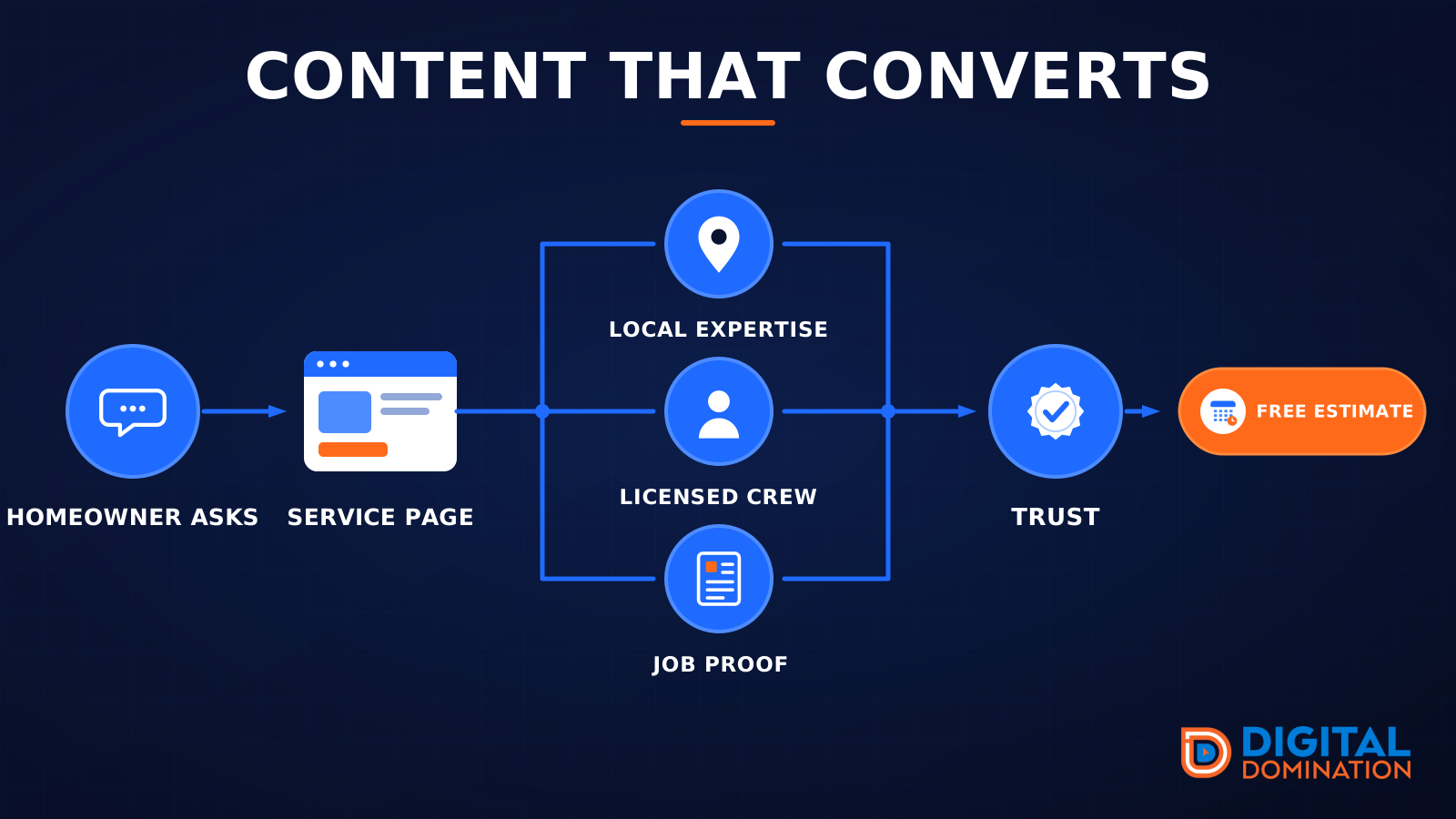
Fencing is a visual purchase. Before a homeowner reads a word she compares your photos with the competitor's. Upload finished project photos by material, shot straight on in daylight, captioned with the fence type and the neighborhood or city. Include a few progress shots showing post holes, concrete and string lines, because those prove you set posts properly, which is the number one thing a repair customer worries about. Add the crew and the trucks. Skip stock images entirely; Google and homeowners both recognize them.
Most fence contractors are service-area businesses with a yard, not a showroom. Set the service area honestly by the cities and neighborhoods your crews actually drive to, not a two-hundred-mile circle. Hours should reflect when someone answers the phone, and if you take estimate requests on Saturdays, say so, because Saturday morning is when fences get discovered. Each city you serve deserves a landing page with that city's HOA and permit realities, local project photos and reviews from that area, and that page, tagged with UTM parameters, should be the link Google sends people to.
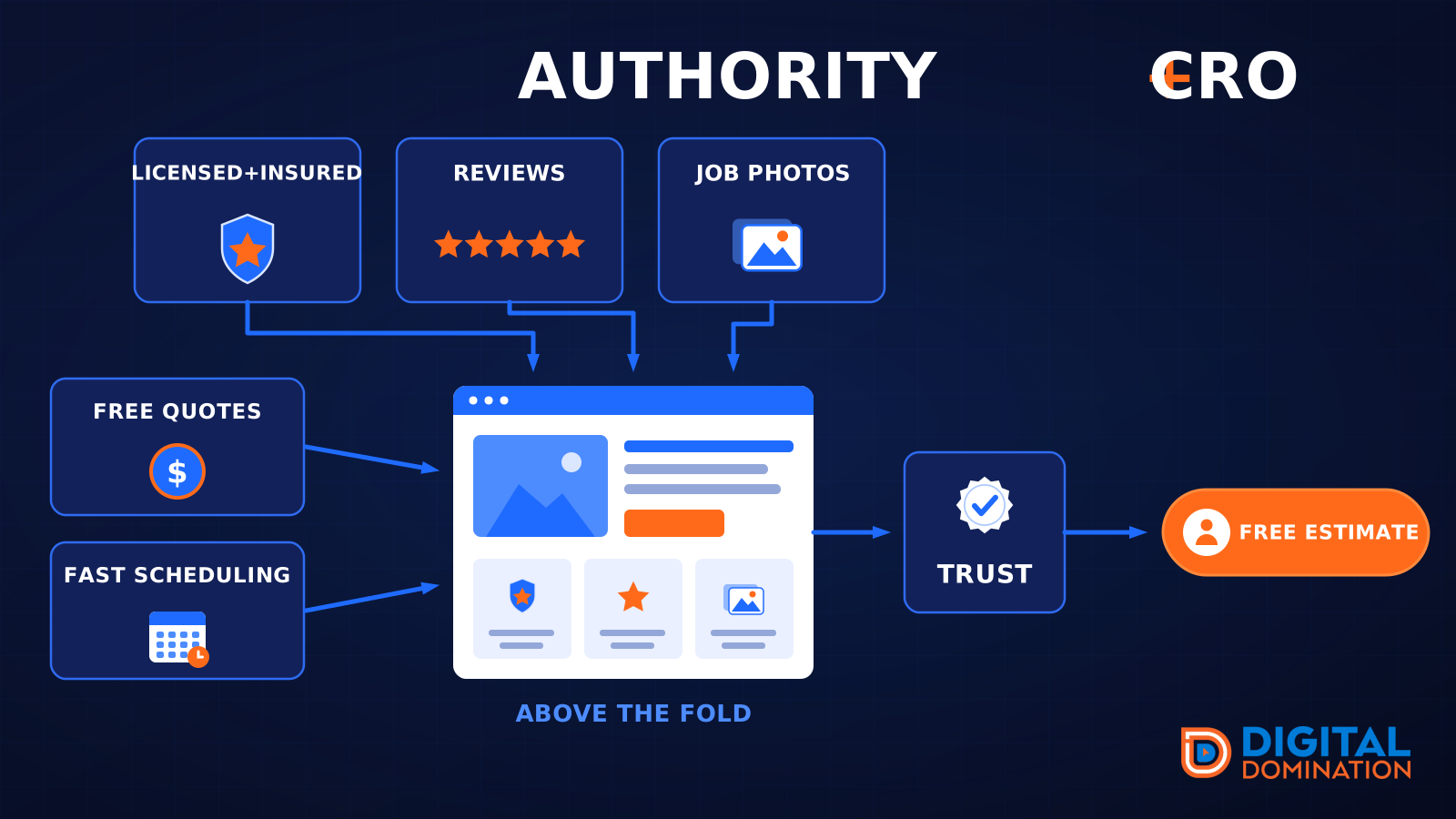
A fence is a five-figure purchase that sits on a property line, so the homeowner is quietly asking two questions: will this company still exist when the gate sags in three years, and are they allowed to build this. The first screen of the landing page has to answer both before it says anything clever. Pull the credentials into an authority strip under the headline, then let the rest of the page prove them. An illustrative strip for a generic company might read: Licensed and bonded, 15+ years in the valley, 4.8 stars from 300+ reviews, written workmanship warranty, free on-site estimates. Those are example figures only. Put the details a homeowner will check at the top of the page:
- ▸State contractors board license number, classification and monetary limit, written exactly as the board lists it, with a link to your board record. In Nevada that is the Nevada State Contractors Board and fencing falls under its own classification.
- ▸Bond and general liability insurance, with the carrier named if you are willing to publish it, and workers compensation coverage for the crew that will be on the property.
- ▸Years in business under the current license, not counting the years the owner spent working for somebody else.
- ▸Workmanship warranty length in plain words, separate from the manufacturer warranty on vinyl, composite or ornamental steel products.
- ▸Material brands you install and any certified installer status, whether that is a vinyl manufacturer, a composite fencing line or a gate opener brand.
- ▸Who does the estimate and who runs the crew, with a name and a real photo. Fence buyers hand a stranger a deposit; a face lowers the risk.
- ▸Whether you pull permits, handle HOA architectural submittals and call for utility locates, because those are the three things homeowners do not want to do themselves.
Review velocity and what a fence review needs to say
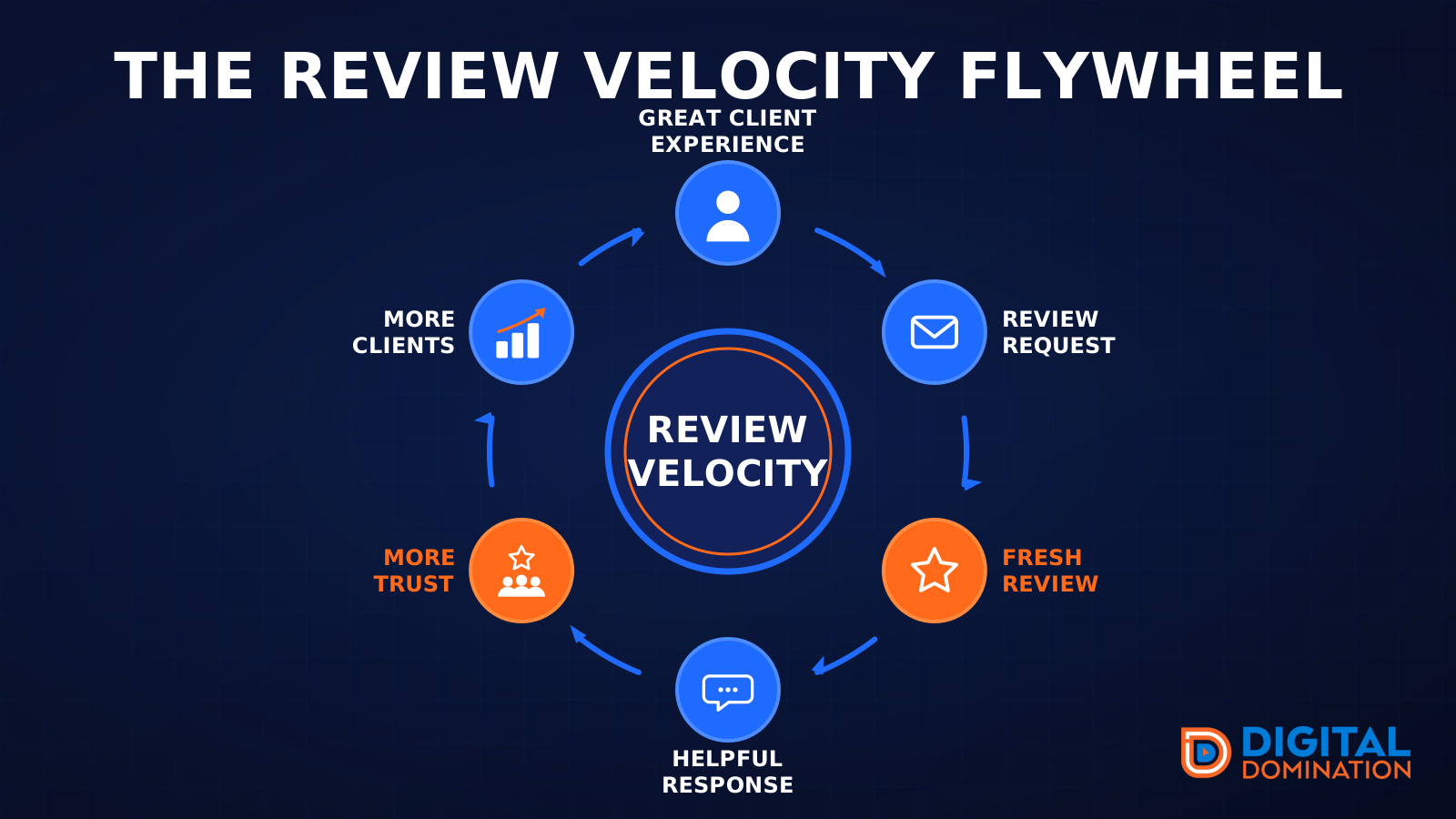
Fence contractors have a natural review advantage: the job finishes on a single day, the result is visible from the kitchen window, and the customer is standing there when the crew cleans up. Ask that afternoon, by text, with the direct review link. A company with 400 reviews and nothing since last fall looks dormant next to a competitor earning three a week during the spring season. Velocity and recency matter as much as the star average.
The content of the review matters too. "Great job" tells Google nothing. A review that says the crew showed up when scheduled, the horizontal cedar fence in Summerlin came out perfectly level, the gate latches correctly and they hauled off the old panels connects material, city, quality and service in one sentence. Coach that by asking a specific question: which fence did we build and what stood out. Respond to every review, mention the fence type and area in your response, and pull the strongest quotes about straight lines, cleanup and gate alignment onto the matching service page.
Schema architecture for a fence contractor
Schema is JSON-LD that labels what is already visible on the page so search engines and AI systems stop guessing. Without it, Google sees a company name, a license number, a list of materials and some prices. With it, Google understands that the company is a HomeAndConstructionBusiness, that a named estimator works for it, that the license identifier belongs to that company, that vinyl privacy fence is a Service it offers at a starting per-foot price, and that the service is available in specific cities. Most fence sites we audit have either no schema or the default LocalBusiness output from a page builder, which models none of those relationships. The structure that works:
- ▸The company: HomeAndConstructionBusiness with name, telephone, address or service-area designation, priceRange, openingHoursSpecification and a permanent @id such as yourdomain.com/#business.
- ▸The license: hasCredential pointing to an EducationalOccupationalCredential, with the license number as a PropertyValue under identifier and the issuing board as recognizedBy.
- ▸Owner and estimators: Person nodes with worksFor pointing back to the business @id, a jobTitle, a photo and knowsAbout for the materials they specialize in.
- ▸Each fence type: a Service node (vinyl, wood, chain link, ornamental iron, block wall, gates, repair) with serviceType, a description matching the page and its own @id.
- ▸Pricing: an Offer on each Service carrying a UnitPriceSpecification with the starting price per linear foot, the currency and any minimum job note.
- ▸Service area: areaServed on the business and on each Service, listing cities and neighborhoods as City or Place entries rather than a radius.
- ▸Corroboration: sameAs to the state board record, Google Business Profile, Yelp, Houzz, Angi, Nextdoor, BBB and social profiles.
- ▸Proof: ImageObject for project photos with captions naming material and city, Review and AggregateRating drawn only from reviews shown on the page, and BreadcrumbList on every city and service page.
PageSpeed: the gallery is usually the problem
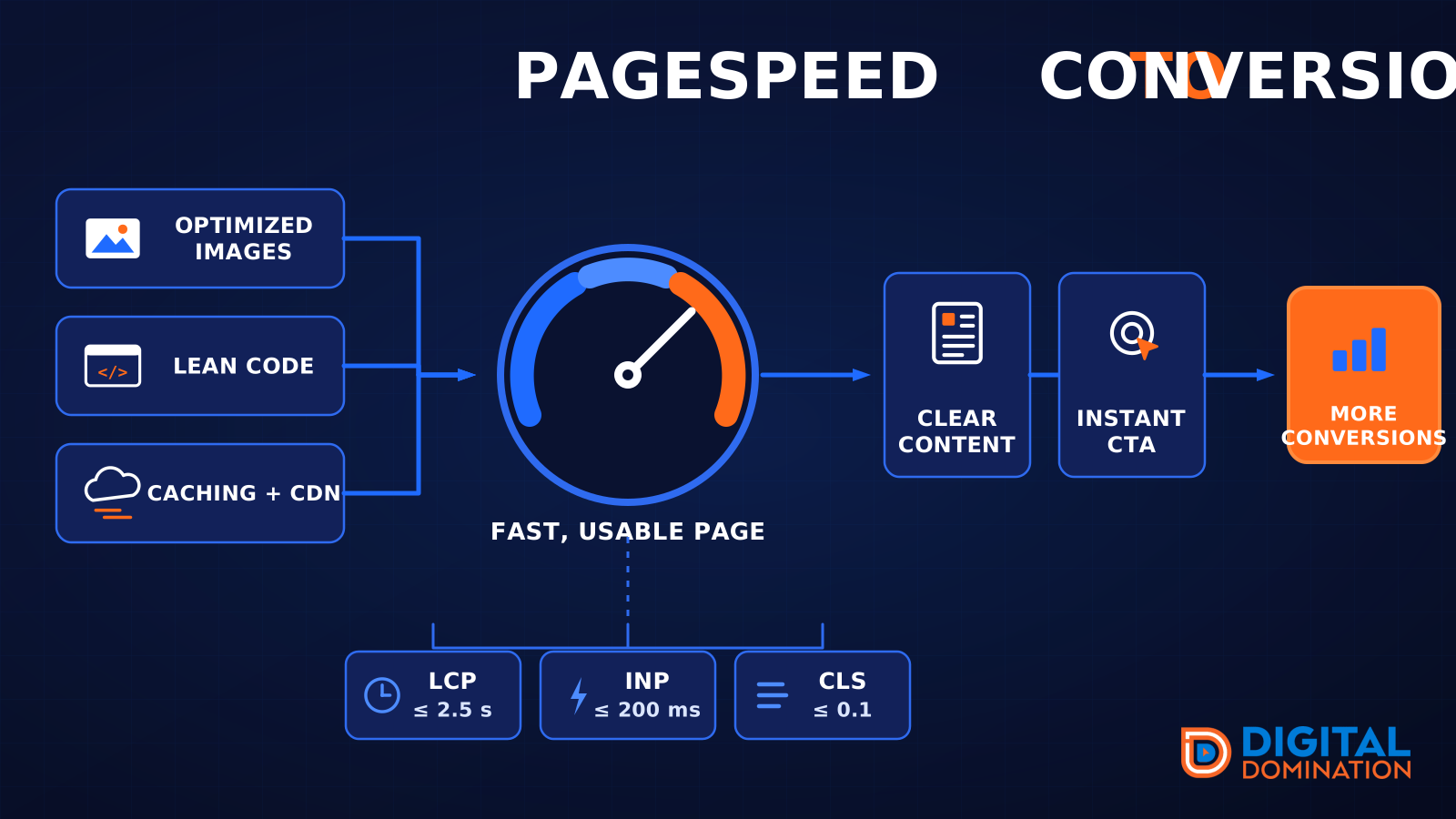
The homeowner in the driveway is on a phone, often on a cellular connection, comparing three sites in a row. Fence contractor websites are among the slowest we test in the home services space, and almost always for the same reason: a gallery of fifty or more full-resolution photos straight off a phone, an autoplay hero slider and three chat or scheduling widgets loading before the phone number. Google's good thresholds for Core Web Vitals are a Largest Contentful Paint of 2.5 seconds or less, Interaction to Next Paint of 200 milliseconds or less and Cumulative Layout Shift of 0.1 or less, measured at the 75th percentile of real field data. At Digital Domination we target a PageSpeed Insights performance score of 90 or higher and a 2/2 result on the agentic browsing check, because AI agents now open contractor pages on a homeowner's behalf. The fixes with the biggest payoff on a typical fence site:
- ▸Resize every gallery photo to the size it displays at, convert to WebP or AVIF, and lazy load everything below the first screen. A 4 MB phone photo displayed at 400 pixels wide is the single most common failure.
- ▸Replace the hero slider with one static hero image of your best fence, preloaded and never lazy loaded, with the headline and phone number rendered as text on top of it.
- ▸Reserve height and width on every image, review widget and estimate form so the click-to-call button does not jump while the homeowner is trying to tap it.
- ▸Delay chat, heatmap and pixel scripts until after first interaction, and drop any scheduling widget you do not actually use.
- ▸Self-host and subset fonts, remove unused theme CSS and JavaScript, and turn on caching and compression at the host or CDN.
- ▸Swap the auto-loading Google Map for a click-to-load map on city pages, and keep the sticky mobile call and estimate buttons lightweight.
Per-linear-foot pricing that AI Overviews can quote
Fence pricing is unusually easy to publish because the whole industry already thinks in linear feet, and homeowners already know that. Yet most fence sites say "call for a free quote" and nothing else, which means AI Overviews and LLM answers quote a national average or a competitor instead. Publishing honest starting ranges does not commit you to a number; it qualifies the lead before the phone rings. Put the language on each material page, on the estimate page, in the FAQ and in GBP services, and connect it to schema through the Offer and UnitPriceSpecification described above. Language that works for fence contractors:
- ▸Starting price per linear foot for each material, with the height and grade the price assumes, for example six-foot vinyl privacy versus four-foot picket.
- ▸What changes the price: gates, corners, slopes, tear-out and haul-away of the old fence, rock or caliche digging, permit fees and HOA color requirements.
- ▸Free on-site estimate, estimate valid for a stated number of days, and what deposit you take at contract signing.
- ▸Financing availability, cards accepted and whether you offer a discount for neighbors who share a fence line.
- ▸Typical schedule from signed contract to install day by season, because the spring backlog is a real buying consideration.
Content that follows the fence buyer from first search to install day
A fence buyer moves through a predictable set of questions, and each one is a search. Do I need a permit for a fence in my city. Does my HOA allow six-foot vinyl. Who owns the fence between two houses. How deep should fence posts go here. Vinyl or wood in this climate. How long will it take. A page per material and a page per city should answer those directly under descriptive headings, with the local answer, not the national one. A Las Vegas page should talk about caliche, HOA architectural committees, wind loads and block wall conventions, not about frost lines.
Support those pages with project write-ups that read like short case studies: the property, the problem, the material chosen and why, the obstacles such as a slope or a shared line, and finished photos. Add named authors, a published and updated date, links to the city permit page and the state contractors board, and internal links between the material page, the city page, the estimator's profile and the matching projects. That is the material search engines and AI systems retrieve when someone asks what a fence costs in your city.
Search Console, GA4 and the estimating software as one loop
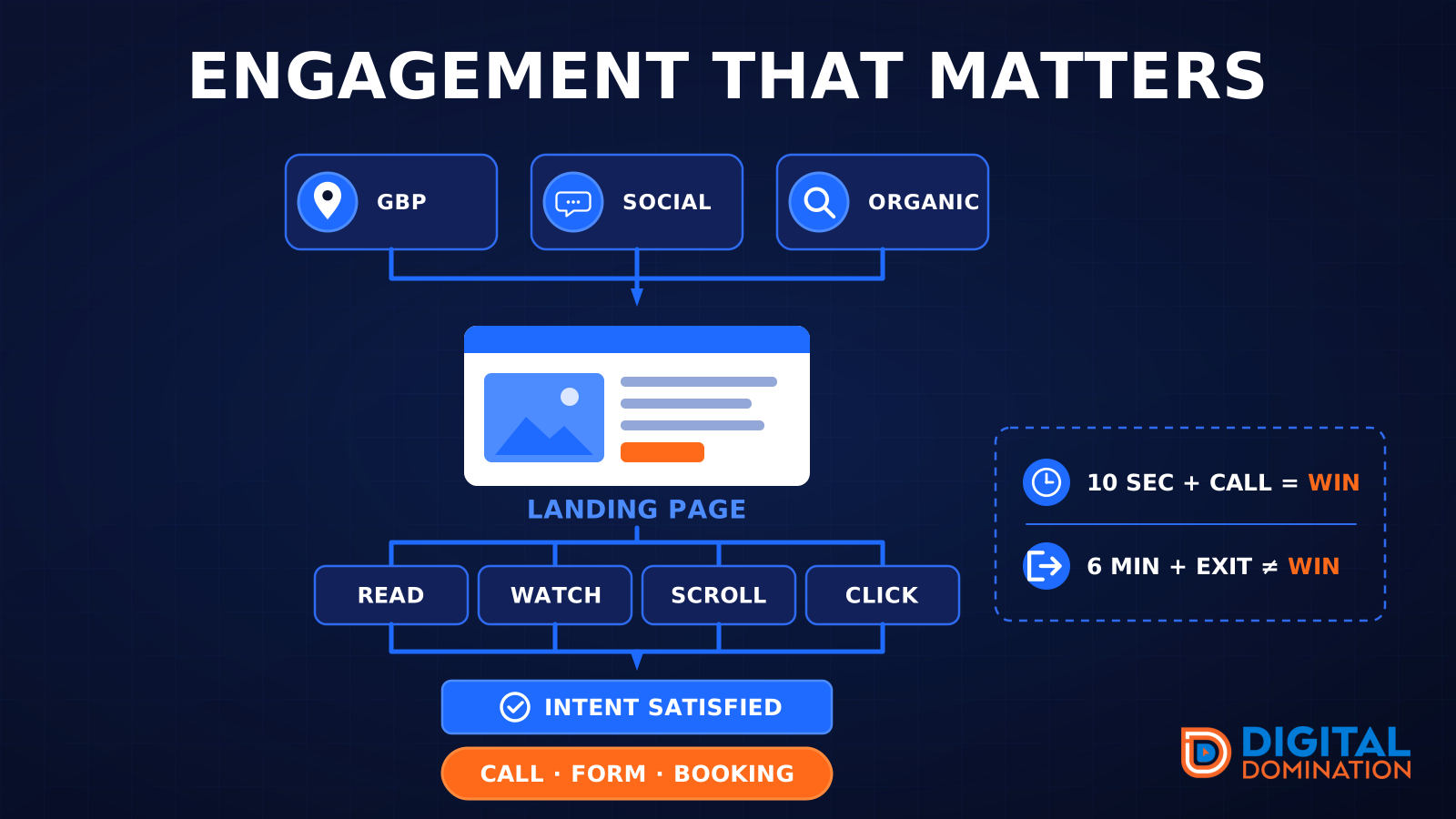
Search Console shows which queries and which city or material pages Google is surfacing, where impressions are high but clicks are low, and which pages have Core Web Vitals or structured data errors. GA4 shows what happened after the click: click-to-call taps, estimate form starts and completions, photo gallery engagement, and which pages produce estimate requests on mobile. The estimating or CRM software then tells you which estimates were quoted, which were signed and at what contract value. Each tool answers a different question, and together they decide what to change next:
- ▸Impressions without clicks on "vinyl fence cost Henderson": rewrite the title and opening, add local photos and reviews, and check that the Henderson GBP link points at that page.
- ▸Clicks without calls or form starts: check field speed on mobile, the authority strip, the pricing language and whether the phone number is visible before the gallery.
- ▸Calls without signed contracts: look at which materials and cities are calling, whether the estimate turnaround is too slow for the season and whether pricing language is attracting the wrong budget.
- ▸Annotate every change with a date, run it for a full estimate cycle, compare signed contracts and revenue rather than only rankings, then pick the next test.
Social posts, Nextdoor threads and brand mentions that corroborate the entity
Fence work photographs beautifully and finishes fast, which makes it ideal for social publishing that feeds the entity. Every completed job can become a GBP post naming the material and neighborhood, a before-and-after reel on Instagram and Facebook, a short YouTube video on how you set posts in rocky soil, and a project page on the site. Google's Search Console now reports supported social and video platform properties, which shows how closely social content and search discovery have converged. Watch which posts get saves and comments; a reel about fixing a wind-damaged fence that outperforms everything else is telling you which service page to expand next.
Mentions without links still count as context. When a neighbor writes on Nextdoor that a named company rebuilt her block wall in a specific neighborhood and the crew cleaned up every scrap, that sentence connects the brand, the service, the location and the experience. Nextdoor, local Facebook groups and HOA community pages are the fence industry's most relevant forums. On Reddit specifically, Axios reported in August 2026 that Reddit's share of visible ChatGPT Search citations fell roughly 86 percent, while OpenAI still has a Reddit data partnership. Visible citations and underlying retrieval are not the same thing, so keep the footprint diversified: the board record, Houzz, Angi, Yelp, BBB, supplier dealer locators, local news and community sponsorships all confirming the same name, phone and license.
A 90-day roadmap built around the spring and fall seasons
Fence demand has two peaks and a storm-driven repair spike, so the roadmap front-loads the work that has to be live before the next peak: photos, services and the material pages with pricing. The sequence we use:
- ▸Days 1-14, baseline: run a GeoGrid scan for fence installation and fence repair across the market, audit every GBP field and category, inventory license, bond, insurance and warranty proof, run PageSpeed on the home, estimate and top material pages, and confirm GA4 call and form events feed the CRM.
- ▸Days 15-30, foundation: complete GBP services with per-foot pricing, upload captioned project photos by material, fix the gallery weight and hero slider, publish the authority strip, and ship HomeAndConstructionBusiness, Service, Offer and Person schema with permanent identifiers.
- ▸Days 31-60, expansion: publish a page per material and a page per city with local permit and HOA answers, build the repair and gate pages competitors skip, start the post-install review text, and begin weekly GBP posts and reels from completed jobs.
- ▸Days 61-90, loop: compare Search Console queries and GA4 estimate requests against signed contracts by material and city, rescan the GeoGrid, fix the pages with impressions but no calls, and lock in the review and publishing cadence before the next season.
One fence company, one entity, seen the same way everywhere
The homeowner in the driveway, the Google crawler and the AI agent shopping on her behalf are all trying to answer the same question: is this a real, licensed, well-reviewed fence contractor that builds the fence I need in my neighborhood and will answer the phone. The profile, the license record, the website, the schema, the reviews, the Nextdoor threads and the project reels should all describe one company in the same words, with the same phone number, the same license number and the same service list. When they do, relevance and prominence follow, the page loads before she looks away, and the estimate request lands in your CRM instead of a competitor's.
Digital Domination builds that system for fence contractors under a simple promise: top 3 in the Google Map Pack in 12 weeks or you do not pay. The first step costs nothing. Run the free GeoGrid scan, which checks 169 points across your market, and see where your company shows up when a homeowner searches from her own driveway instead of from yours.
Keep reading
Related guides
- ▸Google review management near me
- ▸Google review management vs doing local SEO yourself
- ▸Google review spam alerts can pause your new reviews
Put it into action
Frequently Asked Questions
What is the right Google Business Profile primary category for a fence company?
Fence contractor. Add secondary categories only for work you are licensed and equipped to do, such as Gate installation service, Deck builder, Welder or Concrete contractor for block walls. Do not add General contractor unless you hold that license; it weakens the entity and can create a problem with the contractors board.
Should a fence contractor publish prices per linear foot?
Yes, as starting ranges tied to a specific height and material. Publishing per-foot starting prices qualifies leads before the phone rings and gives AI Overviews and LLM answers your number instead of a national average. State clearly what changes the price, such as gates, tear-out, slopes, rocky digging and permit fees, and connect the language to schema through an Offer with a UnitPriceSpecification.
Why does a fence website need to be fast when homeowners mostly just want a quote?
Because they are usually on a phone, often standing outside, comparing three companies in a row. A gallery of uncompressed photos and an autoplay slider can push the phone number below several seconds of loading, and the homeowner taps the next result. Core Web Vitals targets are LCP under 2.5 seconds, INP under 200 milliseconds and CLS under 0.1 at the 75th percentile of field data, and speed usually pays off more in estimate requests than in rankings.
Should I list fence repair as a service if I prefer full installs?
If you will do it at all, yes. Repair searches spike after every wind event and most competitors never list the service, so it is often the easiest visibility to win. A repair job also puts your crew in a neighborhood where the surrounding fences are the same age, and a well-handled repair frequently becomes a full replacement estimate later.
What schema type should a fence contractor use?
HomeAndConstructionBusiness for the company, with a permanent @id, hasCredential for the state license, Person nodes for the owner and estimators, a Service node per fence material with an Offer carrying per-foot pricing, areaServed for the cities you cover and sameAs pointing to the board record and your directory profiles. The default LocalBusiness output from a page builder models none of those relationships.
How do I get more reviews for a fence company?
Ask on install day, by text, while the customer is looking at the finished fence, and include the direct review link. Ask a specific question such as which fence we built and what stood out, so the review names the material, the city and the experience. Consistent new reviews every week during the season matter more than a large total earned years ago.
Do photos on the Google Business Profile actually affect fence leads?
Fencing is a visual purchase, so homeowners compare photos before they compare anything else. Upload finished projects by material, captioned with the fence type and area, plus a few progress shots of post holes and concrete that show proper installation. Photos also help Google connect your profile to the materials and neighborhoods you serve. Never use stock fence images.
How many city pages should a fence contractor build?
One for each city or major area your crews actually drive to, each with local permit and HOA guidance, project photos and reviews from that area. Thin pages that swap the city name in a template do not work. Link each page from the matching Google Business Profile service area and tag the link with UTM parameters so you can measure estimate requests by area.
Ready to dominate your map?
Top 3 in the Google Map Pack in 12 weeks, or you don't pay.