
How Do I Rank in Surrounding Cities and Towns on Google Maps?
You are asking Google to associate your business with a place your address does not put you in. Only a few signals actually do that, and the service area field is not one of them.
Does Adding Cities to My Service Area Increase My Ranking There?
No, and this is the most expensive misunderstanding in local SEO. The service area field on your Google Business Profile controls how your business is presented as a service-area business and which areas are shown on your listing. It does not tell Google to rank you in those places. Local search practitioners have tested this repeatedly by adding and removing areas, and rankings in those areas do not follow the field.
You rank in a surrounding city by giving Google reasons to associate your business with that city other than your address: a dedicated page about that city that says something only a business working there would know, customers in that city leaving reviews that describe the work, and consistent business data everywhere Google reads it. Those are the levers. The field is administrative.
Fill it out accurately anyway, because it sets expectations for customers and it should reflect where you genuinely work. Just do not expect ten new checkboxes to produce ten new markets, and be wary of anyone who sells that as a strategy.
- ▸The service area field controls presentation, not ranking strength
- ▸List the areas you actually serve, and keep the list honest
- ▸Ranking in a new city comes from content, reviews, and consistency
- ▸Adding more areas does not widen your radius on its own
Why Does My Ranking Fade a Few Miles From My Address?
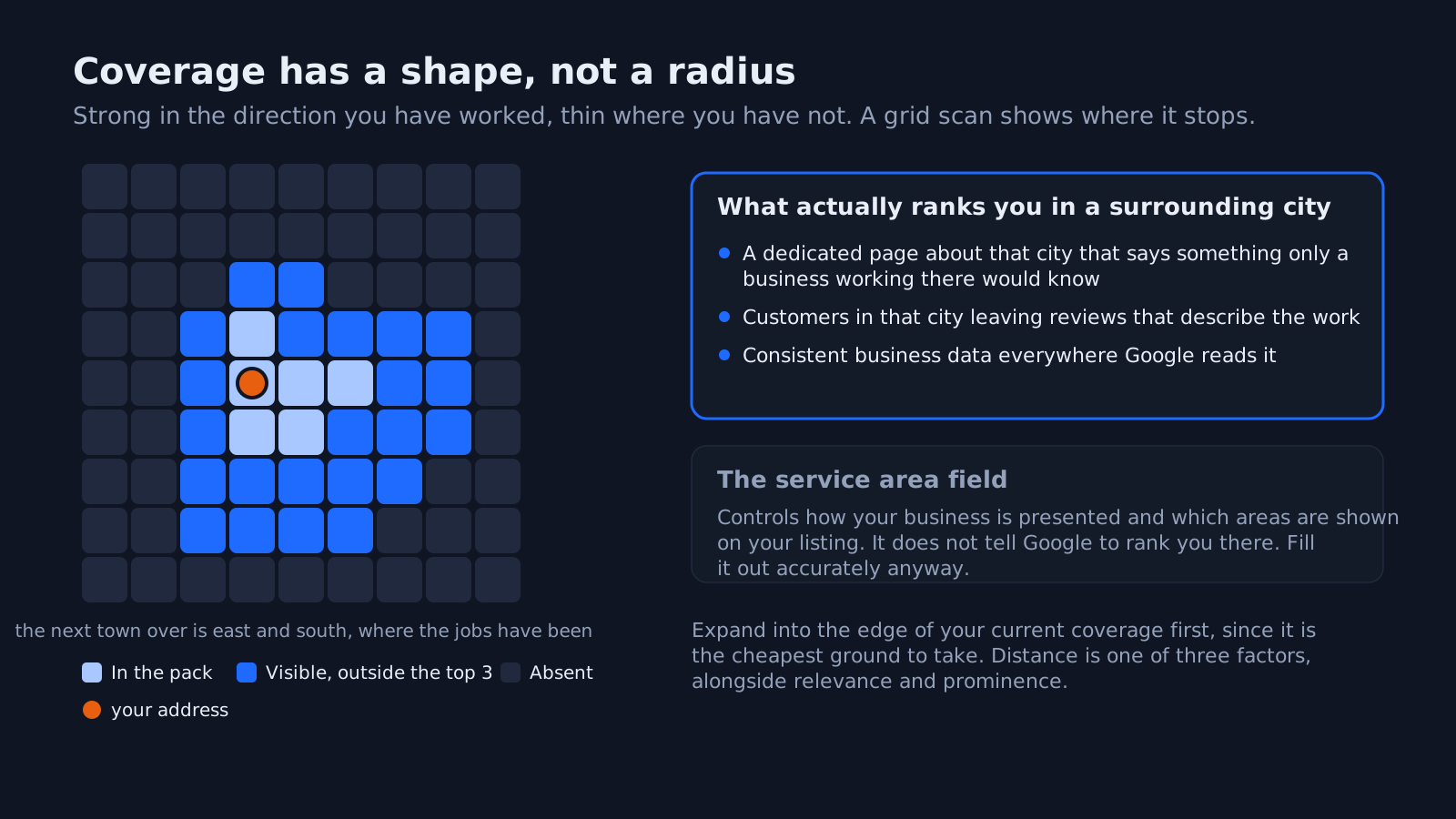
Because distance to the searcher is one of the three factors Google uses for local results, alongside relevance and prominence. As a customer moves away from your address, the businesses closer to them get a proximity advantage, and once your other signals stop compensating you drop out of the three visible seats. That is the fade, and it usually has a shape rather than a radius: strong in the direction where you have worked and thin where you have not.
Most owners never see the shape, because they check their ranking from one place. A grid scan runs the same search from dozens of points across the region and returns your position at each one, which turns a vague sense that you do not rank in the next town over into a map showing exactly where coverage stops.
That map is what tells you where to spend. Expanding into a town you already half-cover is a very different project from starting in one where you have never had a job, and the grid tells you which one you are looking at before you commit a quarter to it.
- ▸Distance is one of three factors, not the only one, but it strengthens as you move away
- ▸Coverage has a shape, usually following where you have actually worked
- ▸Scan the grid before choosing which city to expand into
- ▸Expand into the edge of your current coverage first, since it is the cheapest ground to take
What Makes a City Page Actually Rank Instead of Just Existing?
Specificity that could only come from working there. Google has gotten very good at recognizing a page that is the same paragraph with a different city name pasted in, and that pattern earns nothing. A page that names the neighborhoods, references the local permitting or HOA quirks, discusses the housing stock or the conditions that actually change how the job is done there, and shows work from that area is a different asset entirely.
Structure matters as much as content. Build one page per service and one page per area, and resist the temptation to combine them into a page that tries to cover four services across three towns. Link each area page up to its city hub and across to two or three genuine siblings, so the pages form a structure Google can read rather than a pile. Our hub and spoke guide at /hub-and-spoke-silo/ covers that architecture in full.
Then get reviews from those customers. A review left by someone in the next town, describing the work you did there, is one of the few signals that connects your business to that place in a way you cannot fake. Ask for it while you are still in their driveway, not three weeks later.
- ▸One page per service, one page per area, never a combined page
- ▸Include detail only a business that has worked there would know
- ▸Show real photos from jobs in that area rather than stock imagery
- ▸Ask customers in that town for reviews at the moment the job is finished
- ▸Link each area page up to the city hub and across to two or three siblings
Should I Open a Second Location or Rent a Virtual Office to Rank There?
A virtual office, a mailbox, or an unstaffed coworking desk is not an eligible address for a Google Business Profile, and using one is among the most common reasons profiles get suspended. It is worth being blunt about the risk: you are not gambling a few positions, you are gambling the listing and its entire review history, and reinstatement is not guaranteed. The cost of getting caught is far higher than the cost of doing it the slow way.
A real second location is a legitimate answer, and it is also a real business decision with a lease, staff, signage, and hours attached. If you genuinely open and staff a location in the next city, you can verify a profile there. If you would not open it for any reason other than ranking, it is not a location, it is an address, and Google is specifically looking for that difference.
Two separate businesses can share an address when they are genuinely distinct: different legal entities, different names, different categories, different phone numbers, and separate staffed operations. What does not survive scrutiny is one business creating a second profile at a related address to cover a second city, which reads as a duplicate and tends to take both listings down with it.
- ▸Virtual offices, mailboxes, and unstaffed desks are not eligible addresses
- ▸A second profile requires a real, staffed location with its own hours and signage
- ▸Distinct legal entities can share an address, duplicates of one business cannot
- ▸A suspension costs the listing and its reviews, not just a ranking position
How Do I Know If I Am Gaining Ground in a New City?
Measure the grid, not a single position, and measure it on a schedule. Take a baseline scan before you publish anything, then rescan monthly on the same query set from the same coordinates. Progress in a new city almost never appears as a jump into the top three: it appears as the outer points climbing from nowhere into the teens, then into the top ten, then into the pack.
Watch the calls separately from the positions. Positions in a new town are worth nothing until the phone reflects them, and the lag between the two is real. If the grid is improving and the calls are not, the problem has moved to your page and your reviews rather than your ranking.
Be realistic about the timeline. A surrounding city takes longer than your home city, because you are overcoming the proximity advantage of every business physically located in it, and the pages, photos, and reviews that get you there accumulate over months rather than weeks. Anyone promising a new market in two weeks is describing something other than the Map Pack.
- ▸Take a baseline grid scan before publishing the first area page
- ▸Rescan monthly with the same queries from the same points
- ▸Expect the outer grid points to climb gradually rather than jump
- ▸Track calls from the new area separately from ranking positions
Map Your Real Coverage on a Free 15-Minute Call
If you want to know which surrounding cities are actually winnable for you, book a free 15-minute call with Digital Domination. We will look at where your coverage stops today, which neighboring markets sit at the edge of it, and which ones would be an expensive fight against a well-established local competitor.
If you want us to run the expansion, our program puts clients in the top 3 of the Google Map Pack in 12 weeks or you do not pay, and we take one client per trade per service area so we are never building the same map for two competing businesses.
Bring the towns you want and the towns your best jobs have actually come from. Those two lists are rarely identical, and the overlap is usually where the fastest money is.
Keep reading
Related guides
- ▸AI Search Optimization Vs Doing Local SEO Yourself Diy With Free Googl
- ▸How Much Does AI Search Optimization (AEO and GEO) Cost?
- ▸AI SEO for Local Business
Put it into action
Frequently Asked Questions
Can I rank in a city where I do not have an address?
Yes, but not by default. You rank there by building genuinely specific content about that city, earning reviews from customers in it, and keeping your business data consistent, which together give Google reasons to associate you with the area despite the distance.
Does the service area in my Google Business Profile impact ranking?
It does not lift your rankings in the areas you list. The field governs how your service-area business is presented and which areas appear on your profile. Testing across the local search industry consistently shows rankings do not follow additions to that list.
Can I use a virtual office address to set up a Google Business Profile?
No. Virtual offices, mailbox services, and unstaffed coworking desks are not eligible addresses, and they are a leading cause of suspensions. The risk is losing the listing and its review history, which is a far worse outcome than ranking slowly in the new city.
Can two businesses use the same address on Google?
Yes, when they are genuinely separate businesses: different legal entities, names, categories, phone numbers, and staffed operations, such as distinct suites in one building. What Google removes is one business creating extra profiles at the same or related addresses to reach more areas.
Should I create a separate Google Business Profile for each city I serve?
Only where you have a real, staffed location. Creating profiles for cities you merely serve is a guideline violation, and duplicate profiles frequently take down the original listing along with the new one.
How many city or neighborhood pages should I build?
Build one for every area you can write about with real specifics and back with actual jobs, and stop there. Ten pages that reflect real work outperform forty templated pages, and the templated version can hold the whole site back.
How long does it take to rank in a surrounding city?
Longer than your home city, because you are competing against businesses that hold the proximity advantage there. Expect gradual movement across a grid scan over months rather than a jump into the pack, with the closest neighboring areas moving first.
Do reviews from customers in another city help me rank there?
They are among the strongest signals available for it, because a review from a customer in that area, describing work done there, connects your business to the place in a way content alone cannot. Ask for the review at the job site, while the work is fresh.
Ready to dominate your map?
Top 3 in the Google Map Pack in 12 weeks, or you don't pay.