
Pool builder local SEO: how GBP entity signals, schema and PageSpeed win the design consultation
Pool construction is a small number of large contracts, so every design consultation you were never asked to is expensive. Here is how the profile, the schema and the site decide which builder gets the Tuesday evening appointment.
Saturday morning, a tape measure and a dirt backyard
A couple closed on a new-construction house in January and got the standard Sunbelt backyard: a block wall, a gravel pad and dirt. On the first warm Saturday in March they are out there with a tape measure and a can of marking paint, pacing off where a pool and spa would go. She sits on the patio step and types "pool builders near me" into her phone.
The AI Overview at the top answers a question she has not asked yet, how much an inground pool costs. The Map Pack below shows three builders. She taps the one with a 4.9, a Swimming pool contractor category and a photo of a finished pool at night. The site opens in about a second: a state license number in the header, gunite pool and spa packages starting at a stated range, a review that names the project manager and the week the water went in, and a button to book a design consultation. She books Tuesday at 5:30.
The builder who would have done the better job, with twenty years of finished pools and a project manager who answers texts during the mud phase, was sitting sixth. His profile said Contractor and nothing else, the newest photo was a 3D rendering, and his homepage opened with an autoplaying drone reel that took nine seconds to get out of the way of the phone number. Pricing was "request a consultation." She never scrolled that far.
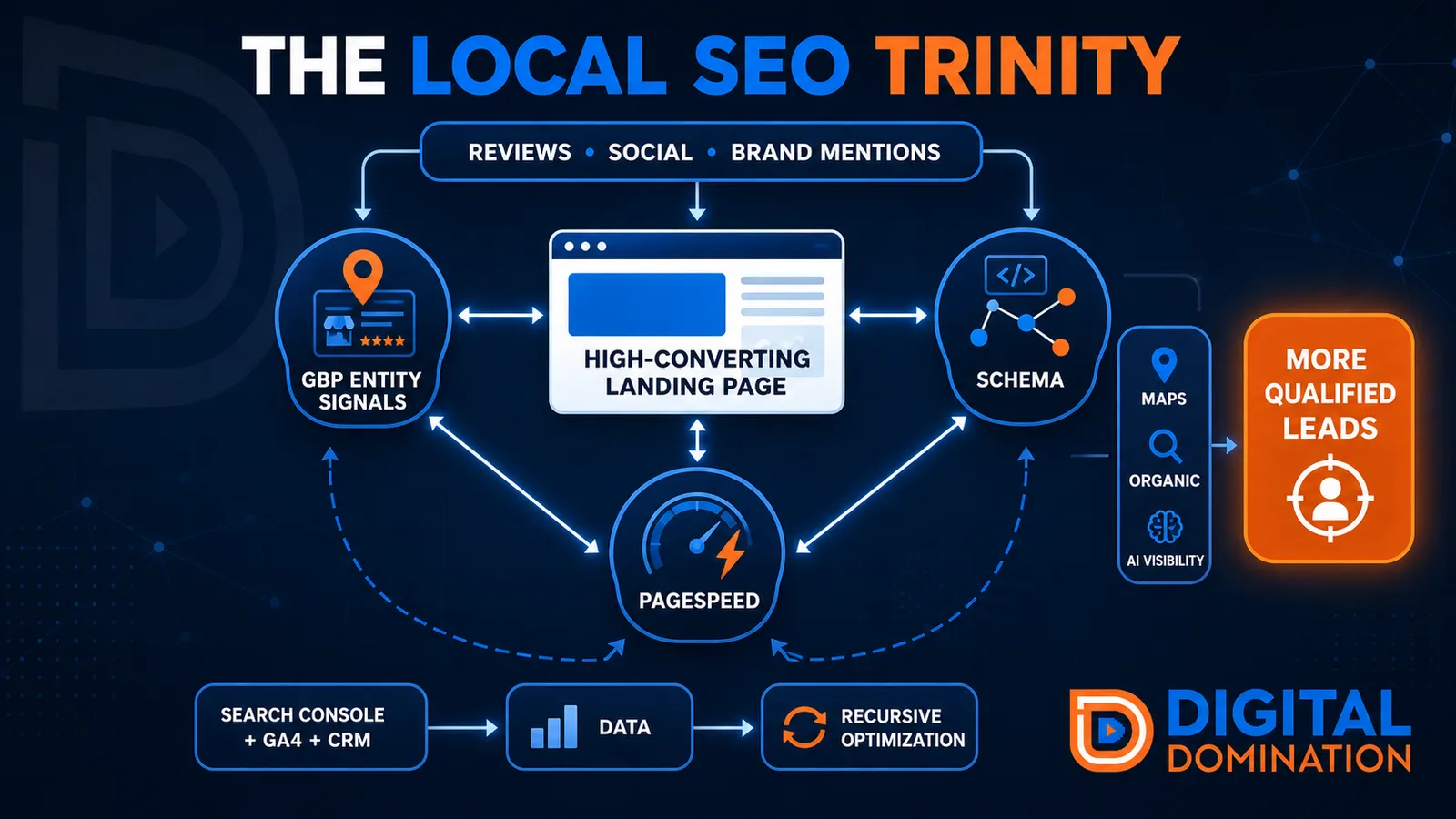
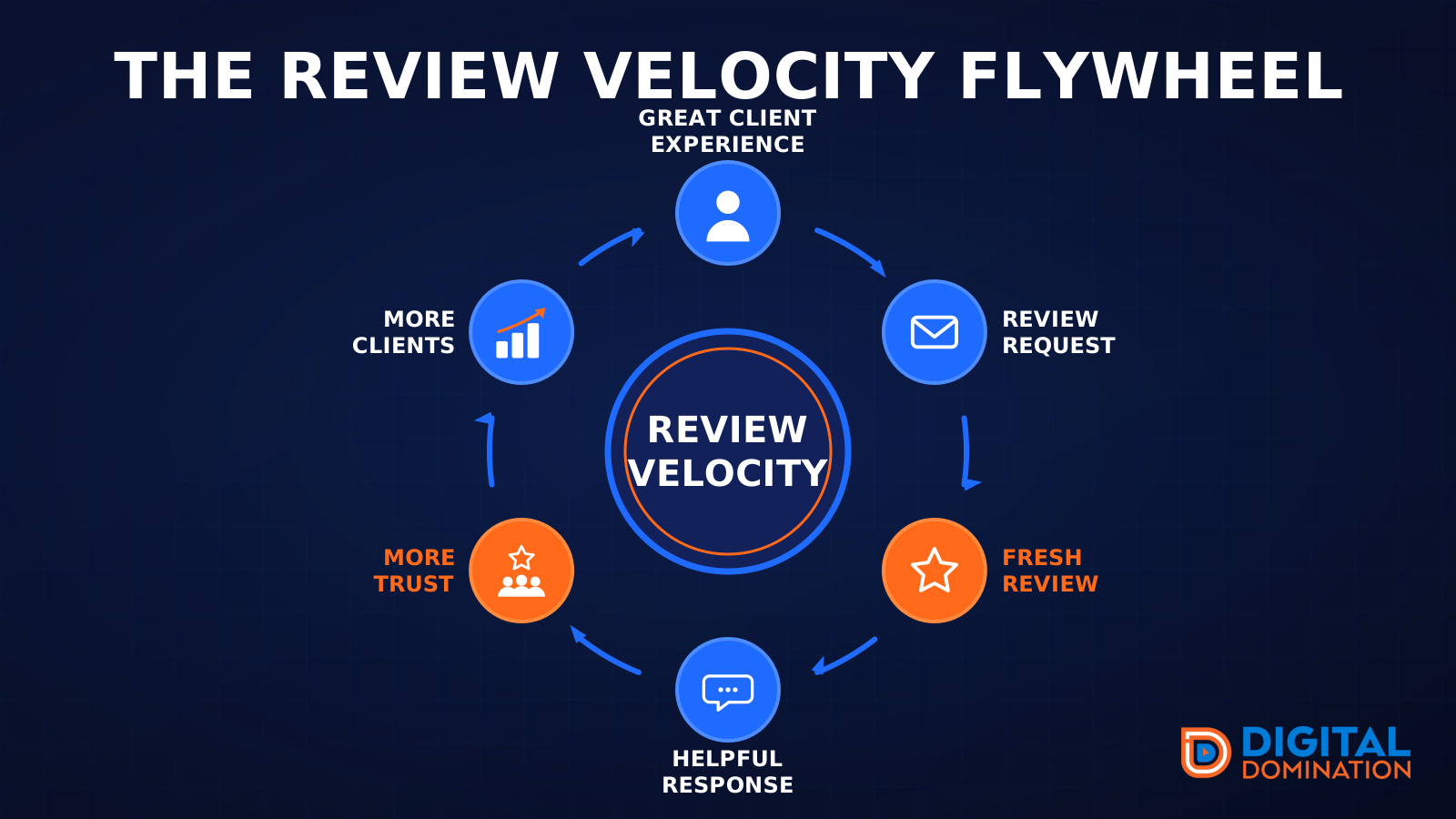
Most builders finish a few dozen pools a year, so one consultation you were never invited to is an expensive loss. Google and the AI systems that answer "is this pool quote fair" judge the same things she did, at scale: what kind of company you are, whether you are licensed, what your finished work looks like, what families say about the build, and whether the site works on a phone. At Digital Domination we treat the foundation as a trinity: Google Business Profile entity signals, schema and PageSpeed, held up by a landing page that converts, a review rhythm built for forty projects a year, and a loop that runs on Search Console, GA4 and your CRM.
The short version, drawn on the plot plan
Google ranks local results on relevance, distance and prominence. Distance is wherever the homeowner is standing, and you cannot move her yard closer to your showroom, so the work is relevance, prominence and conversion across every city you actually pull permits in. Each layer answers one question the homeowner, or the machine, is asking:
- ▸Google Business Profile: are you a pool builder, a service route or a hardscape crew that subs out the occasional pool, and where do you build.
- ▸Landing page: why a stranger should hand you a deposit and let you tear out her back fence for a bobcat.
- ▸Schema: how the company, its license, its people, its pool packages, its warranty and its service area connect.
- ▸PageSpeed: whether the portfolio and the consultation button are usable before she taps the next listing.
- ▸Reviews and authority: whether families who built with you say it finished on time and looks like the rendering.
- ▸Search Console, GA4 and the CRM: which searches became consultations, and which consultations became contracts.
Teaching Google you build pools, not just clean them
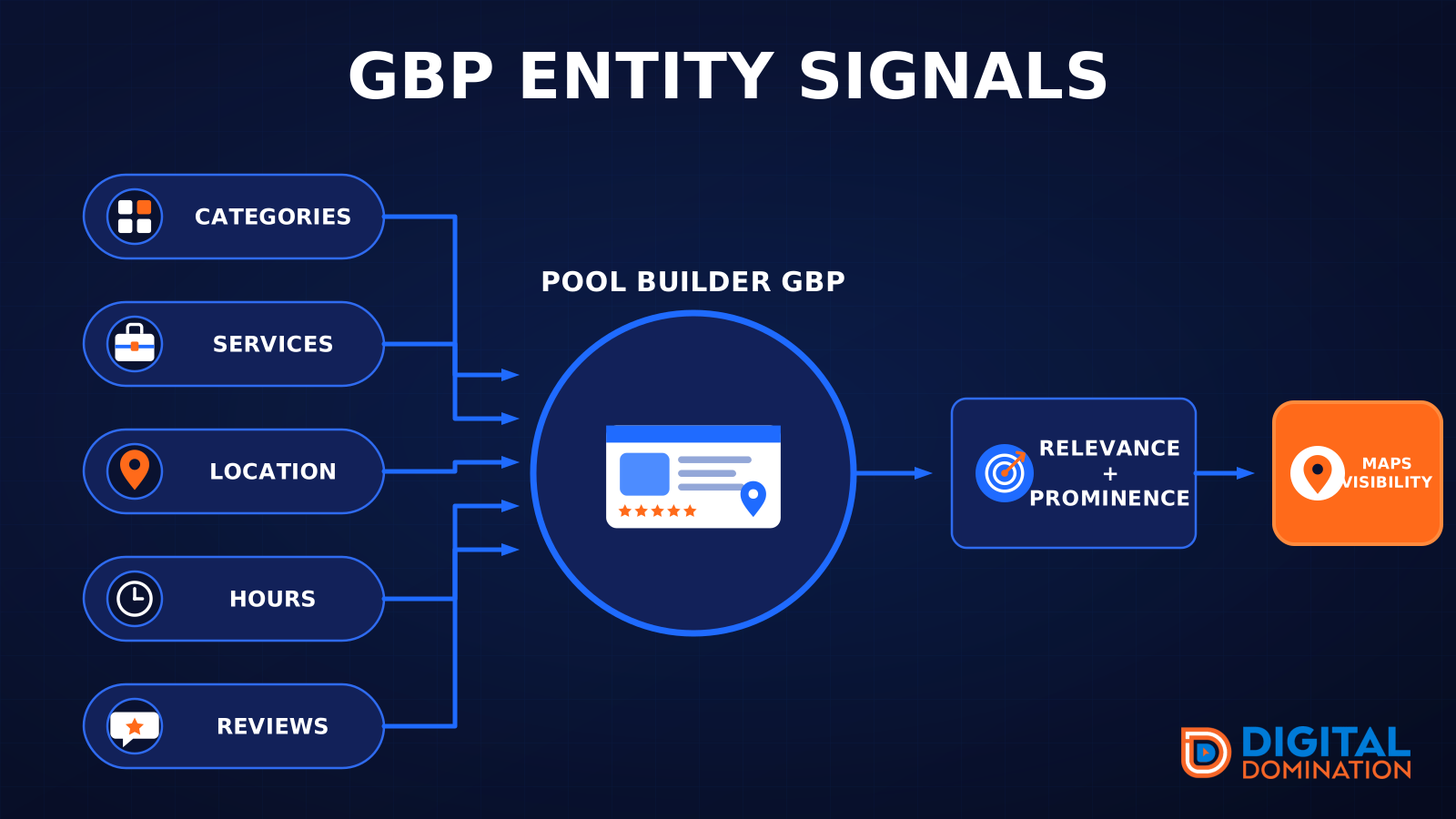
Service routes, supply stores, hardscape crews and lead-generation directories all compete for pool searches, and Google sorts them mostly by category, services, photos and reviews. Set Swimming pool contractor as the primary category. Add secondaries only for work you do with your own crews or permits: Swimming pool repair service if you run a repair division, Pool cleaning service if you keep routes, Masonry contractor or Concrete contractor if you build the block work, Swimming pool supply store only if you have a retail counter. Listing Pool cleaning service when you have never skimmed a pool tells Google you are a service company.
Fill the services list with the words homeowners type: custom gunite pool construction, fiberglass pool installation, pool and spa combo, tanning ledge, infinity edge, pool remodel and resurfacing, pebble finish replaster, tile and coping replacement, paver and travertine decks, variable-speed pump and heater upgrades, salt systems and automation, 3D pool design. Give each a one-line description, a starting price where you can, and a matching page on the site. The rest of the profile should establish:
- ▸Finished-pool photos from consistent angles, night shots with the lighting on, and progress photos (excavation, steel, shotcrete, tile, plaster) that prove you build rather than broker.
- ▸A showroom or design office address if you meet clients there, or a service-area profile if you do not. Never a home address dressed up as a showroom.
- ▸A service area drawn to the cities and counties where you actually pull permits, not a radius that promises builds two hours away.
- ▸A UTM-tagged link to a landing page about building pools in that city, and one profile per real showroom, each with its own page and reviews.
Proof that stops a homeowner picturing a half-dug hole
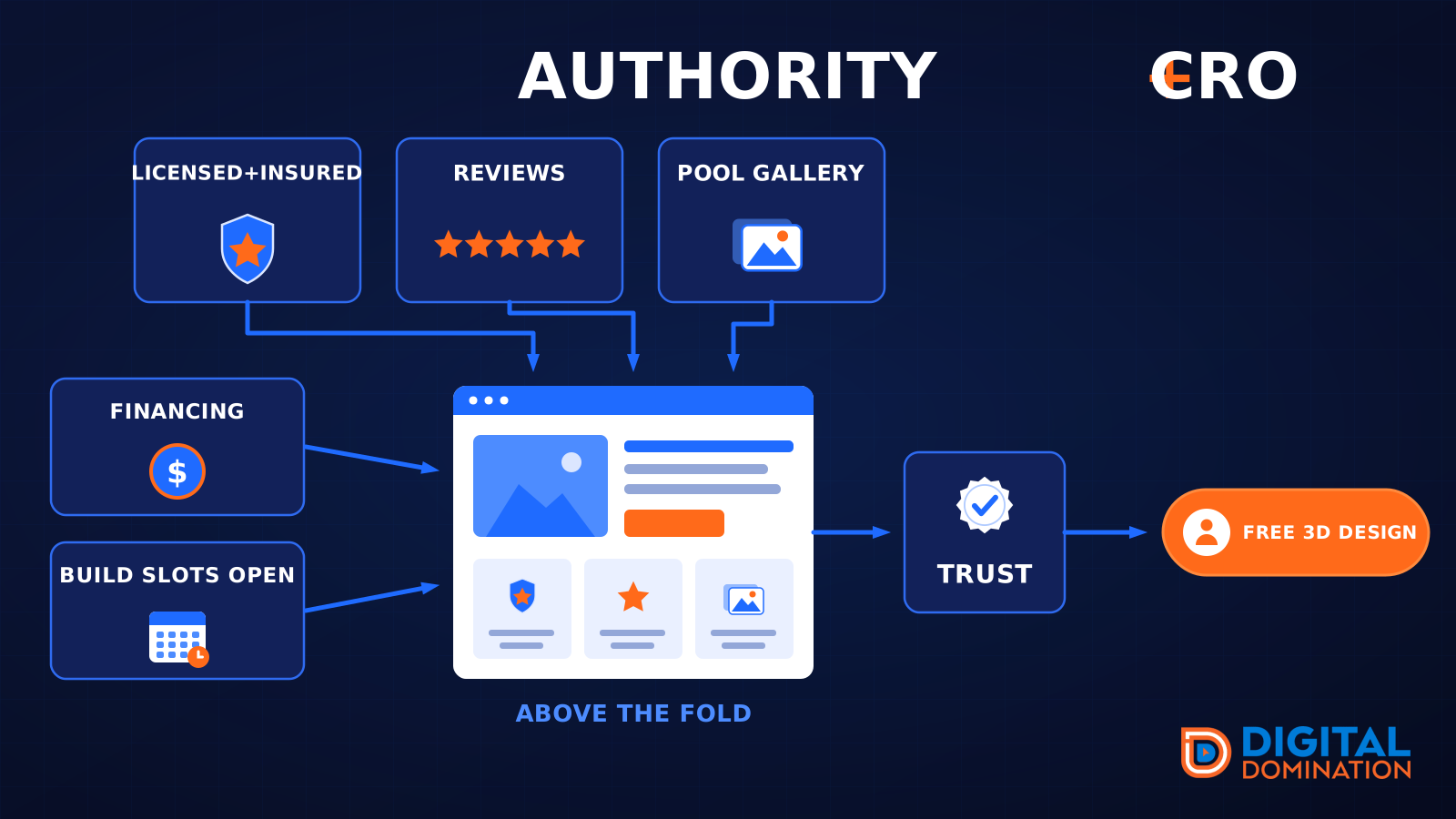
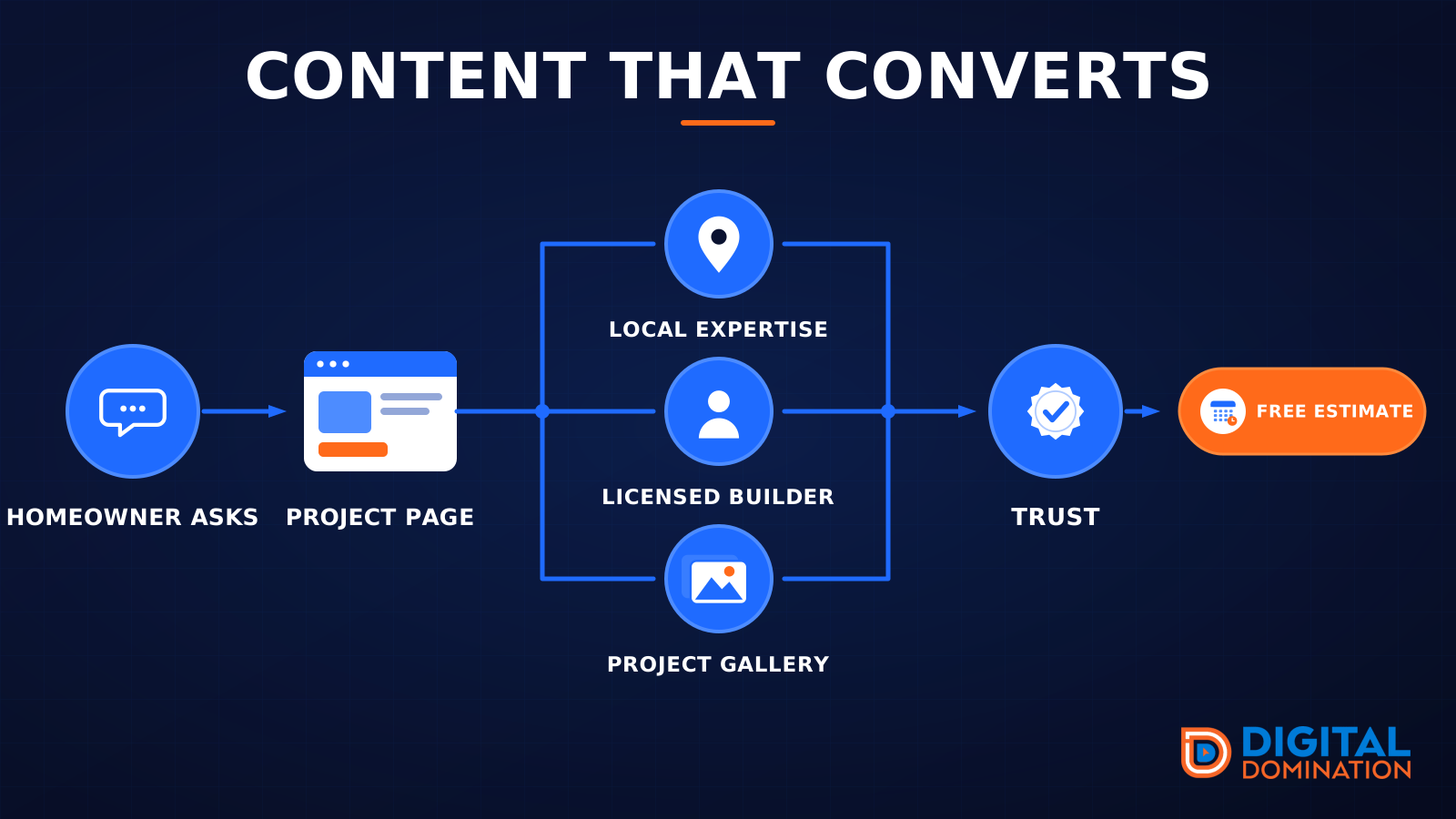
Every pool buyer has heard about a builder who took a deposit and left a hole in a backyard for a year, and that fear is the center of the decision. "Family owned" and "quality craftsmanship" do nothing against it. A state contractors board license number that matches the board's record, a named project manager and a written structural warranty do.
The first screen should show the service and city in the headline, a live star rating with the count, the license number and classification (in Nevada, for example, the State Contractors Board's A-10 pool classification), years in business and pools completed, the shell warranty and a button to book a design consultation. An illustrative authority strip (placeholder figures, not real results) might read: Licensed and Bonded Pool Contractor No. 000000 | 4.9 Stars From 200+ Google Reviews | 22 Years, 1,100+ Pools Built | Lifetime Structural Warranty | Financing Available. Below that, the proof has to be checkable:
- ▸The license linked to the state board lookup, with bond, general liability and workers' compensation stated, since heavy equipment is coming through her side yard.
- ▸Named owner, designer and project managers with photos, years in the trade and any Pool and Hot Tub Alliance credentials such as Certified Building Professional.
- ▸Dealer or applicator status with Pentair, Hayward, Jandy, Pebble Tec or a fiberglass shell maker, verifiable on the manufacturer's locator.
- ▸Warranty terms in plain language, plus the deposit and draw schedule, because some states cap the deposit by law and every homeowner is nervous about it.
- ▸A realistic timeline from contract to swimming with permit and HOA steps named, and a portfolio of finished pools in her city rather than renderings.
Reviews that mention the project manager, the dig date and the day the water went in
A builder who finishes forty pools a year cannot match a service route's review volume and does not need to. Velocity for a builder is a steady trickle that never stops for a season, spread across Google, Houzz, the BBB and Facebook, in language that describes a build: it started when they said it would, the project manager answered texts while the yard was mud, and the finished pool looks like the rendering.
Ask at the emotional peak, fill day, when the water is going in and the family is standing at the edge. A second ask after pool school and a third after the one-year warranty check keep the profile moving between builds, and remodel and equipment jobs add the volume construction cannot. A useful pool review tends to mention:
- ▸The project type: new gunite pool and spa, pebble replaster, deck resurfacing or a pump and heater swap.
- ▸The project manager or designer by name, and how communication went during permitting and construction.
- ▸The timeline, especially whether the pool was ready for the season the family was promised.
- ▸The neighborhood or city, which reinforces the service area and matches how the next buyer searches.
- ▸How the punch list and first warranty call were handled, answered by an owner response that names the project and the area without arguing.
Schema architecture for a pool builder, anchored on HomeAndConstructionBusiness
Schema is JSON-LD that labels what is already visible on the page so search engines and AI systems stop guessing. With it, Google understands that the company is a HomeAndConstructionBusiness, that the license belongs to it, that a named project manager works for it, that gunite pool construction is a Service it offers at a stated starting price, and that the service is available in specific cities. Most pool builder sites we audit run no schema or the generic LocalBusiness output of a page builder theme, which models none of those relationships. The structure that works:
- ▸The company: HomeAndConstructionBusiness with name, telephone, showroom address or service-area designation, priceRange, openingHoursSpecification and a permanent @id such as yourdomain.com/#business.
- ▸The license: hasCredential pointing to an EducationalOccupationalCredential, with the number as a PropertyValue under identifier and the state contractors board as recognizedBy.
- ▸People: Person nodes for the owner, designers and project managers, with worksFor pointing back to the business @id, a jobTitle, a photo and knowsAbout for gunite, fiberglass or automation.
- ▸Each service: a Service node (custom pool construction, pool and spa, remodel, replaster, decking, equipment upgrades) with serviceType, a description matching the page and its own @id.
- ▸Pricing: an Offer on each Service with a PriceSpecification carrying the starting price, the currency and what the base package includes.
- ▸Service area: areaServed on the business and on each Service, listing cities and counties as City or AdministrativeArea entries rather than a radius.
- ▸Corroboration: sameAs to the state board record, Google Business Profile, Houzz, the BBB, the Pool and Hot Tub Alliance directory, manufacturer dealer pages and social profiles.
- ▸Proof: ImageObject for portfolio photos captioned with feature and city, VideoObject for build timelapses, Review and AggregateRating drawn only from reviews shown on the page, and BreadcrumbList on every city and service page.
PageSpeed for a site built around a drone reel and a 3D render
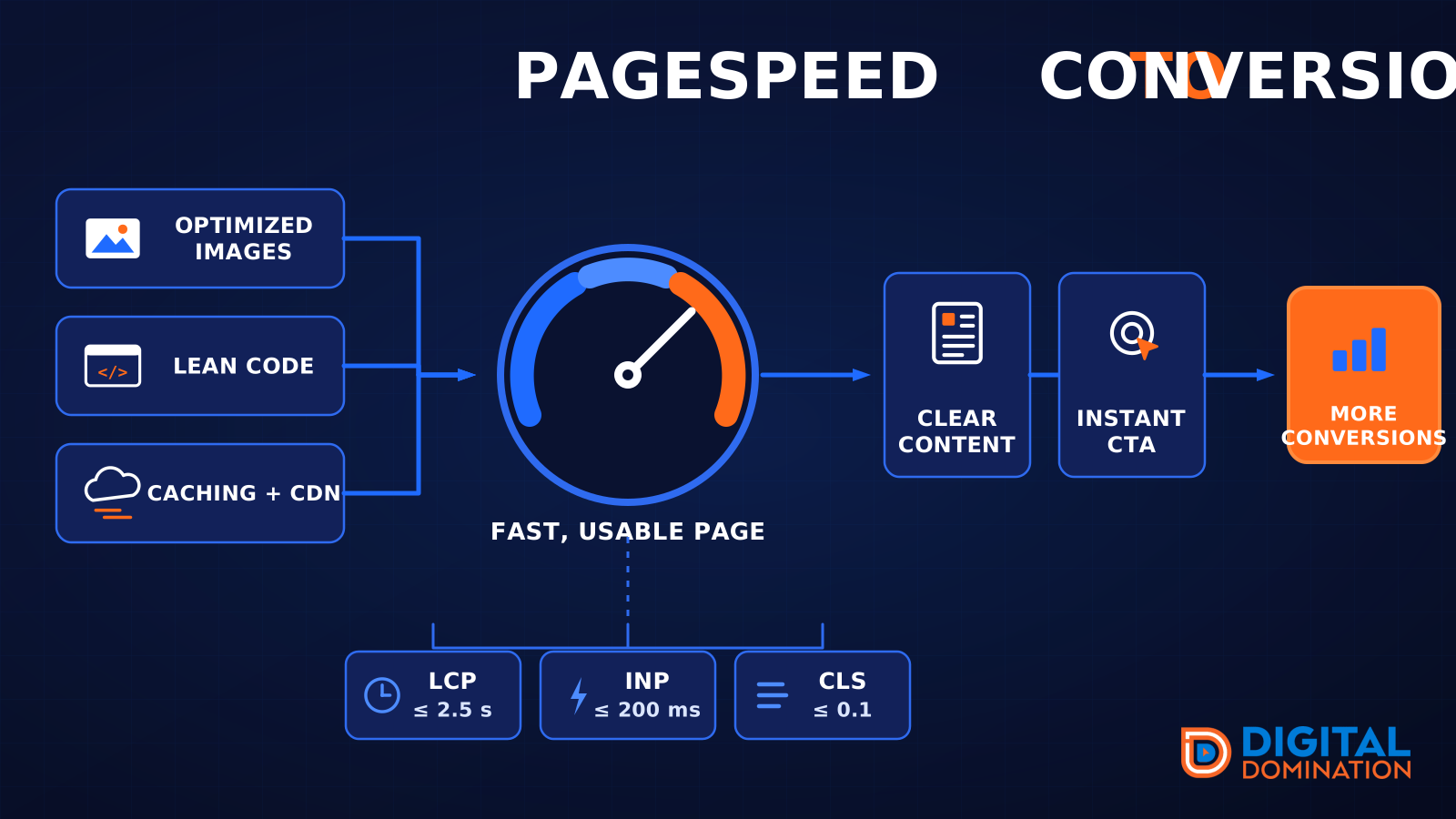
Pool builder websites are among the heaviest we test in home services, and it is always the same weight: an autoplaying drone video in the hero, a second autoplaying 3D walkthrough, a hundred full-resolution photos straight off a phone, a Houzz badge, an Instagram feed embed, a financing iframe and a chat bubble, all loading before the phone number. Google's good thresholds for Core Web Vitals are a Largest Contentful Paint of 2.5 seconds or less, an Interaction to Next Paint of 200 milliseconds or less and a Cumulative Layout Shift of 0.1 or less, measured at the 75th percentile of real field data. At Digital Domination we target a PageSpeed Insights performance score of 90 or higher and a 2/2 result on the agentic browsing check, because AI agents now open builder pages on a homeowner's behalf to compare quotes. The fixes with the biggest payoff on a pool site:
- ▸Replace the hero video with one static photo of your best finished pool, preloaded and never lazy loaded, with the headline, license number and consultation button as text on top. Offer the drone reel as click-to-play below the fold.
- ▸Resize every portfolio photo to the size it displays at, convert to WebP or AVIF, and lazy load everything below the first screen. A 6 MB photo shown at 400 pixels wide is the most common single failure.
- ▸Reserve width and height on every image, the review widget and the financing iframe so the call and book buttons do not jump while she is trying to tap them.
- ▸Delay chat, heatmap, pixel and Instagram feed scripts until first interaction, and load the financing application only when someone clicks Apply.
- ▸Self-host and subset fonts, strip unused theme CSS and JavaScript, turn on caching and compression, and swap the auto-loading map for a click-to-load map on city pages.
Starting-at pricing that AI Overviews can quote without scaring anyone
The question AI answers get asked most about your trade is how much a pool costs, and when your site says nothing, the answer quotes a national average or a competitor. Publishing a starting range does not commit you to a price. It qualifies the homeowner before the consultation. Put the language on the construction, remodel and financing pages, in the FAQ and in GBP services, and connect it to schema through the Offer and PriceSpecification above. Language that works for a pool builder:
- ▸A starting price for the base gunite pool, a separate one for pool and spa, and one for fiberglass if you install it, each with the size, depth and finish the price assumes.
- ▸What moves the number: decking square footage, tanning ledge and water features, automation and a heater, rock or caliche excavation, tight side-yard access, engineering, permit and HOA review fees.
- ▸Remodel starting ranges for a pebble replaster, tile and coping replacement and deck resurfacing, since those searches carry a different budget.
- ▸Whether the 3D design consultation is free or carries a fee credited to the contract, plus the deposit percentage, draw schedule and financing partners.
Content that follows the homeowner from the dirt lot to the first cannonball
A pool buyer researches for weeks and searches at every stage, and every stage is a page. Most builder sites have a homepage, a gallery, a contact form and a financing page, so the buyer learns everything else from a national blog or a competitor. The pages that pull their weight answer the question at each step, name your city and its rules, and link to the next step. Publish them with a named author, a photo of the real project and a dated update:
- ▸Cost and shell pages: how much a pool costs in your city, gunite versus fiberglass versus vinyl, what a spa adds, and what financing looks like month to month.
- ▸Rules pages: setbacks, barrier and fence requirements, permit steps and inspections for each city and county, and how HOA architectural review changes the timeline.
- ▸Process pages: the phases from design and permitting through excavation, steel, shotcrete, tile and coping, decking, plaster, fill and startup, with what the yard looks like during each.
- ▸Local conditions and ownership pages: caliche excavation, hard water and scale, monsoon debris, pool school, the first thirty days of new plaster, and when a nineties pool is due for a remodel.
- ▸City pages for every place you pull permits, each with real finished pools there, that city's permit path and reviews from that neighborhood.
Search Console, GA4 and the CRM: which searches became signed contracts
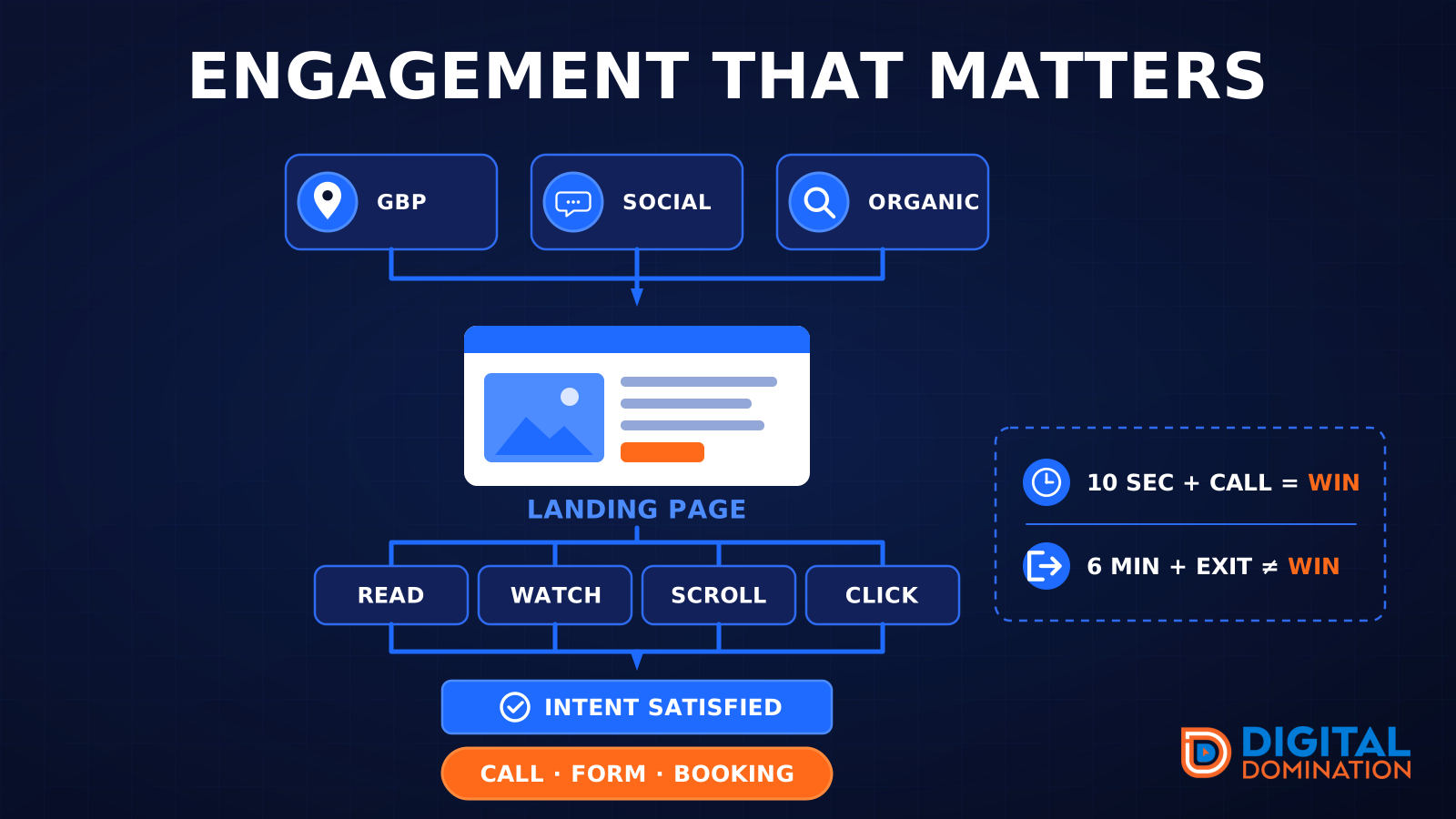
A pool sale can take three months from first search to signed contract and another four to swimming, so a loop that only counts calls will mislead you. Search Console shows which queries and pages earn impressions and clicks by city. GA4 shows which landing pages produce consultation bookings, calls, financing clicks and portfolio views. The CRM shows which consultations were presented a design, which signed and for how much, and that record has to carry the original source all the way through. Run the loop monthly, one focused change at a time, annotated on the date it shipped:
- ▸Impressions but few clicks in a city: rewrite the title, meta and first screen with the license, rating and starting price, and confirm the profile links to that city page.
- ▸Clicks but few consultations: test speed on a phone, move the booking button above the video, and stop asking for a budget before a name.
- ▸Consultations but few contracts: the traffic is right and the sales process or pricing page is wrong, which is a CRM fix, not an SEO fix.
- ▸Remodel or equipment queries landing on the construction page: build the dedicated page and the matching GBP service.
Timelapse reels, Houzz and the neighbor who asks who built your pool
A pool build produces content for four months without a photographer. A weekly progress reel from dig to plaster, a drone reveal on fill day, a before-and-after on the remodel and a short from the project manager explaining shotcrete do the work of a brochure across Instagram, YouTube, Facebook, Pinterest and Houzz, and Google's Search Console now reports supported social and video platform properties, so that content is measurable next to your pages. The yard sign out front for four months and the neighbor who leans over the wall to ask who built the pool produce branded searches nothing else can.
Brand mentions corroborate the entity without a link. "Example Pools did our pool in Henderson, Marco was the project manager and we were swimming by June" ties a company, a person, a service, a city and a timeline together in one Nextdoor or Facebook group post. Axios reported in August 2026 that Reddit's share of visible ChatGPT Search citations fell roughly 86 percent, while OpenAI keeps a Reddit data partnership, so treat any single platform as one input. The mentions worth pursuing:
- ▸Houzz, the Pool and Hot Tub Alliance directory and manufacturer dealer locators, matched to the site's name, phone and license.
- ▸Neighborhood Facebook groups and Nextdoor, where the who-built-your-pool thread decides more contracts than any ad.
- ▸Home shows, home builders association membership and a local news segment on pool safety or permits.
- ▸Reddit pool and home improvement communities, answered as a licensed builder under a real name, never as an ad.
A 90-day roadmap timed to sell in winter and dig before the heat
Pool buying runs ahead of pool weather. Homeowners who want to swim in June sign in January through March, and in hot markets the smartest builders dig in fall and plaster in spring. Start this roadmap in the fall so the entity is complete before the consultation calendar fills. The four phases:
- ▸Days 1-14, baseline: run a GeoGrid scan for pool builder and remodel queries, audit every GBP field and photo, match the license, name, address and phone to the state board and every directory, test Core Web Vitals on the five pages that matter, and set up GA4 booking events with source carried into the CRM.
- ▸Days 15-30, foundation: correct categories and services, publish the city pages the profile links to, rebuild the first screen with license, rating and starting price, write the pricing language, ship the schema graph and fix the hero video and gallery weight.
- ▸Days 31-60, relevance and authority: publish the cost, shell, rules and process pages, launch the fill-day and pool-school review asks, start the weekly progress reel, claim and match Houzz, PHTA, BBB and manufacturer listings, and add remodel and equipment pages with their own GBP services.
- ▸Days 61-90, the loop: pull high-impression, low-click queries by city, find pages with traffic and no bookings, compare presented designs to signed contracts in the CRM, expand what the data points to, re-test speed and the agentic check, and re-run the GeoGrid before the spring rush.
One pool builder, one entity, from the first search to the first swim
None of this is a profile project, a website project or a schema project. It is one licensed pool builder, described the same way everywhere a homeowner or a machine might check: the state board record, the profile, the landing page, the schema, the reviews, Houzz, the manufacturer locator, the neighborhood thread and the yard sign. When the license number, the project manager's name, the packages, the starting prices, the warranty and the cities all match, Google can rank you with confidence, an AI answer can cite you, and the homeowner on the patio step can book without a second search.
At Digital Domination that is the system we install for pool companies, and the commitment on it is plain: top 3 in the Google Map Pack in 12 weeks or you do not pay. Most builders rank well within a mile of the showroom and disappear in the subdivisions where the new backyards are, and the free GeoGrid scan checks 169 points across your market so you can see which of those backyards can find you before the season starts.
Keep reading
Related guides
- ▸Google review management near me
- ▸Google review management vs doing local SEO yourself
- ▸Google review spam alerts can pause your new reviews
Put it into action
Frequently Asked Questions
What is the right Google Business Profile primary category for a pool builder?
Swimming pool contractor. Add secondaries only for divisions you run with your own crews or permits, such as Swimming pool repair service, Pool cleaning service or Masonry contractor. Choosing General contractor as the primary, or adding service categories you do not perform, blurs the entity and pulls the profile into searches that never become a build.
Should a pool builder publish prices when every pool is custom?
Yes, as starting ranges tied to a defined base package: a stated size, depth and finish for a gunite pool, another for pool and spa, and remodel ranges for replaster, tile and coping and decking. The range qualifies the homeowner before the consultation and gives AI Overviews your number instead of a national average. List what moves the price and connect it to schema through an Offer with a PriceSpecification.
How does a builder get review velocity when it only finishes a few dozen pools a year?
Ask at the moments a family is most likely to write: fill day, after pool school, and after the one-year warranty check. Three asks per project across forty projects is a steady trickle that never stops for a season, which is what velocity means for a builder. Remodel and equipment jobs add the volume construction cannot, and every review should be nudged to name the project type, the project manager and the city.
Do I need separate pages for gunite, fiberglass and vinyl pools?
If you install more than one shell type, yes. Homeowners search the comparison first and then the type they have chosen, and those are different questions with different budgets and timelines. Each page should carry its own Service node, starting price and portfolio, with one comparison page linking the three.
Does my contractor license number belong on the website and the profile?
It belongs on both, matched exactly to the state board record, and in the schema as an identifier under a credential. Pool buyers check the license because they have heard the half-dug-hole stories, and Google and AI systems use the same number to confirm the profile and the board record are the same company. A mismatch across the site, the profile and a directory is a common, easily fixed reason a legitimate builder stalls just outside the top 3.
Why does a pool builder's website need to be fast when the decision takes months?
Because the first contact happens on a phone, often outside on cellular, while the homeowner compares three builders in a row. An autoplaying drone reel and a gallery of uncompressed photos can bury the consultation button under several seconds of loading, and she taps the next listing. The Core Web Vitals targets are LCP under 2.5 seconds, INP under 200 milliseconds and CLS under 0.1 at the 75th percentile of field data, and the payoff usually shows up in booked consultations more than in rankings.
Does schema directly improve pool builder rankings?
Schema is not a ranking boost on its own. It helps Google and AI systems understand that the company, its license, its project managers, its packages, its warranty and its service area are one connected entity, and it makes pages eligible for supported search features. It works only when it describes facts a homeowner can verify on the page.
Are Houzz, Nextdoor and Reddit still worth a builder's time for AI visibility?
Yes, as part of a diversified footprint rather than a single bet. Axios reported in August 2026 that Reddit's share of visible ChatGPT Search citations fell roughly 86 percent, and OpenAI still holds a Reddit data partnership, so citation patterns change faster than a builder can chase them. A matched Houzz profile, a manufacturer dealer listing and a neighborhood thread that names your company, your project manager and the city corroborate the entity whichever platform an answer engine cites this quarter.
Ready to dominate your map?
Top 3 in the Google Map Pack in 12 weeks, or you don't pay.