Digital Domination Marketing

For any local business

The Local SEO Trinity

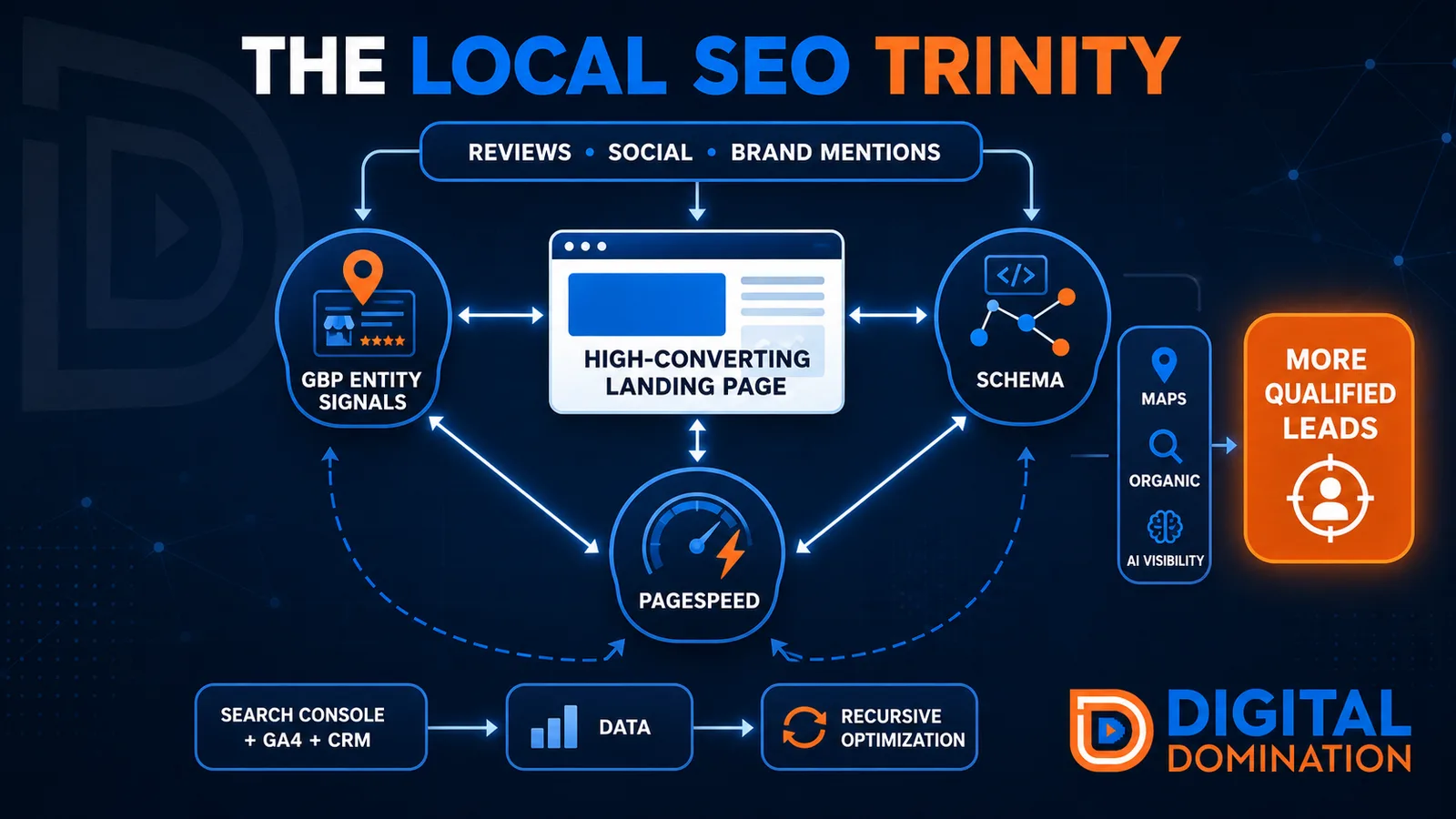
Three legs have to work together. Your Google Business Profile. Your website. Your reviews and reputation.

Think of a three-legged stool. If one leg is short, the whole thing wobbles. A pretty website cannot hold you up when the profile is thin. A pile of reviews cannot hold you up when the phone page is slow.

Diagram of the Local SEO Trinity: GBP entity signals, schema and a high-converting landing page connected through PageSpeed, feeding Maps, organic and AI visibility

The Local SEO Trinity

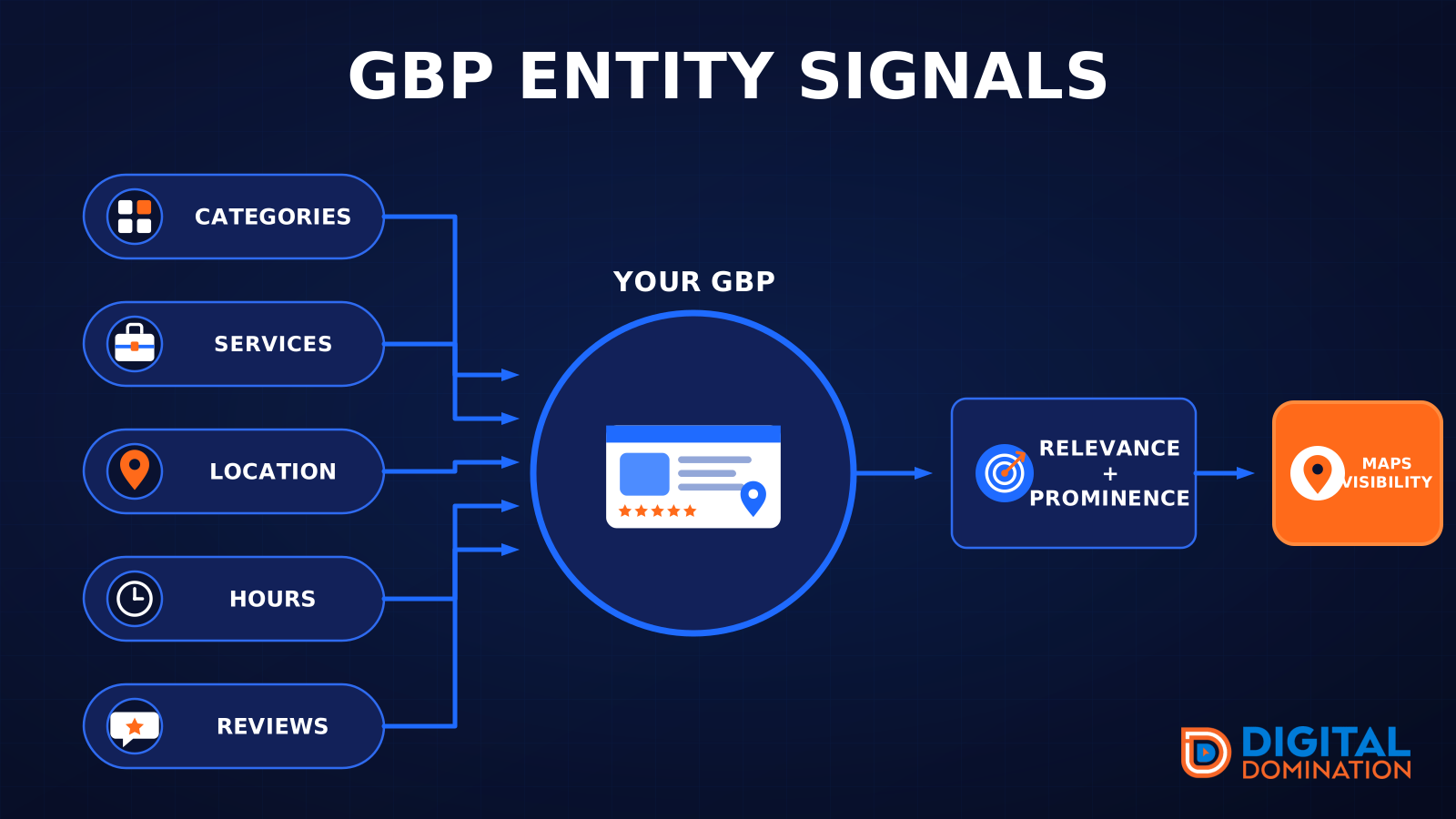
GBP entity signals diagram: categories, services, location, hours and reviews feed relevance and prominence, which drive Maps visibility

GBP entity signals

This leg is your Google Business Profile. GBP means Google Business Profile. It covers your categories, your services, your location, your hours, and your reviews. Google uses those facts to decide who to show.

Your Google profile is your storefront sign. If the sign is missing, or it names the wrong shop, people drive past.
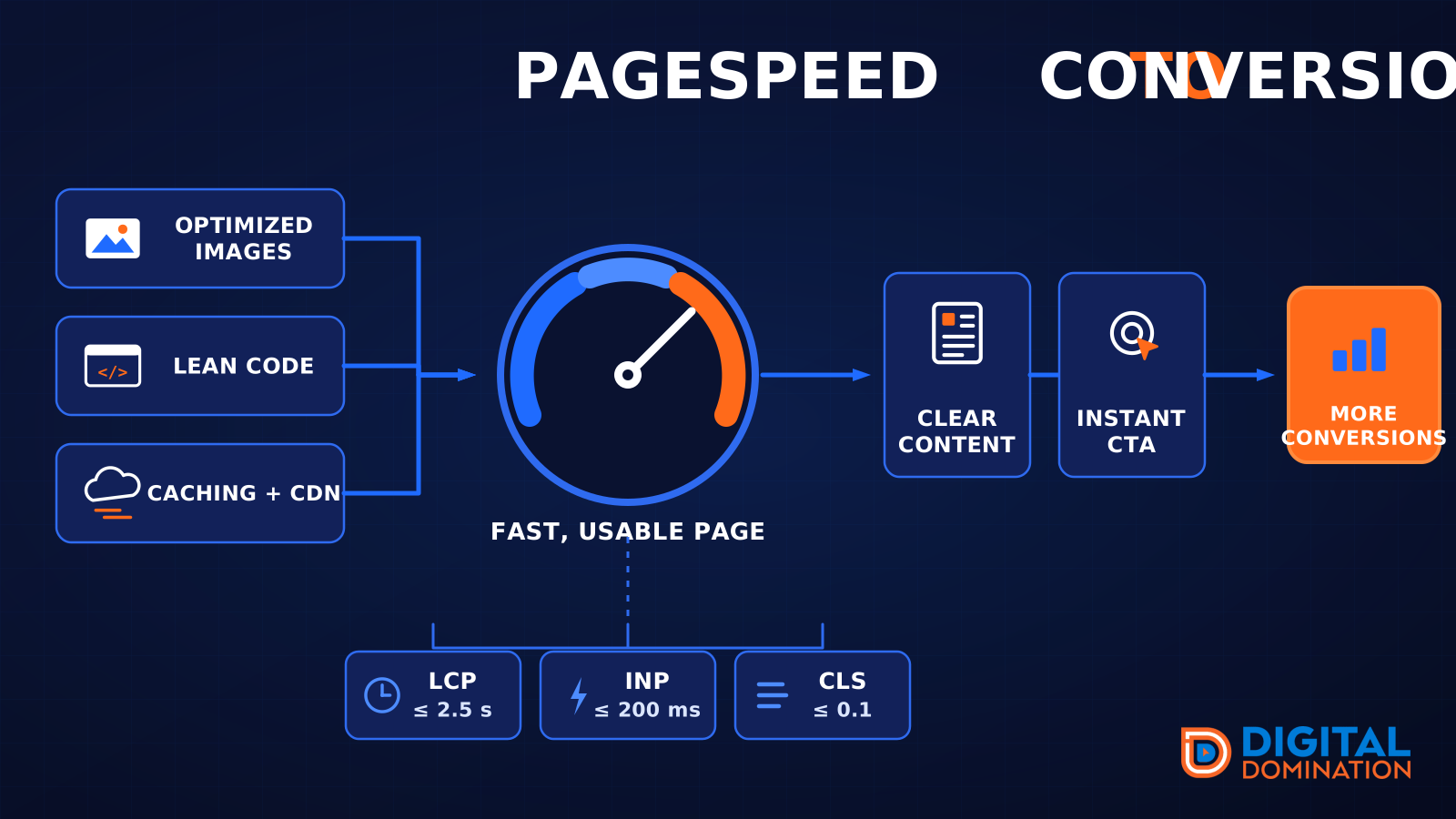
PageSpeed to conversion diagram: optimized images, lean code and caching produce a fast page with LCP under 2.5 seconds, leading to clear content, an instant CTA and more conversions

PageSpeed to conversion

This leg is your website, above all on a phone. Small images, lean code, and caching make a page fast. A fast, clear page is what turns a visit into a call. Phone speed is one of the 12 Trinity checks because a slow page loses the call before anyone sees your offer.

Your website is the showroom. If the door sticks, people leave before they look around.

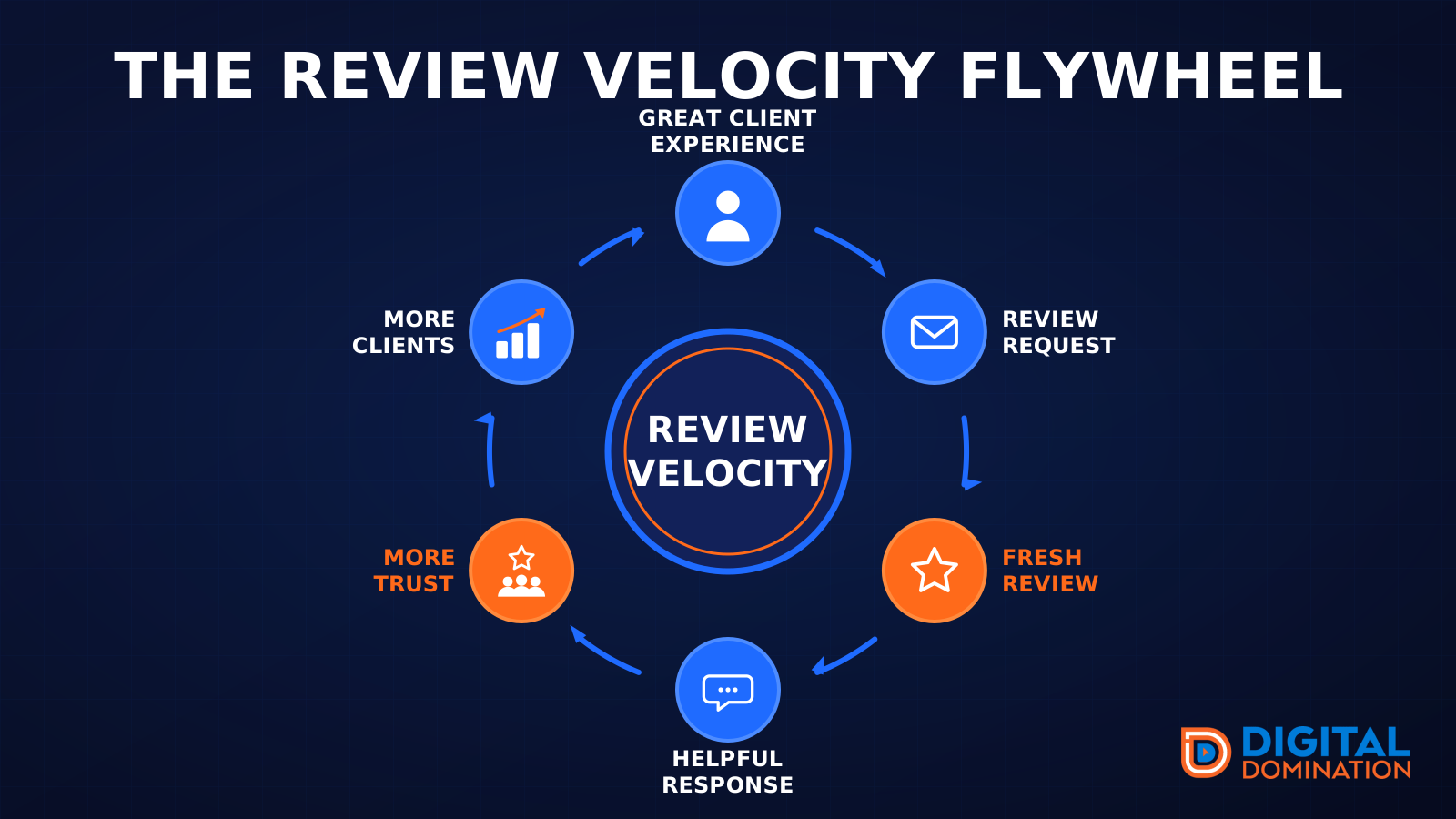
Review velocity flywheel: great client experience leads to review requests, fresh reviews, helpful responses, more trust and more clients

The review velocity flywheel

This leg is reviews and reputation. A good visit leads to a review request, then a fresh review, then a helpful reply, then more trust, then more customers. When the scan can find your Google listing, it shows your rating, your recent reviews, and how many you answered.

Reviews are word of mouth. One kind word helps. A steady stream of real reviews, and a reply from you, helps more.

Why all three have to work together

Google looks at all three before it decides who to show. A strong profile with a slow site still wobbles. A fast site with no reviews still wobbles. A pile of reviews and a profile that lists the wrong category still wobbles.

The pictures name the three legs: GBP entity signals, PageSpeed to conversion, and the review velocity flywheel. In plain words, that is your Google profile, your website, and your reviews. One scan looks across the set and shows which leg to fix first.

How this turns into revenue

Being found in more searches leads to more calls. More calls lead to more booked jobs. More booked jobs lead to more revenue.

Example numbers, not a real business: 40 calls from search in a month, a 25 percent close rate, and a $400 average job. That is 10 booked jobs. That is $4,000. Type your own numbers below. The math is the lesson. It is not a promise.

Example numbers

These starting numbers are an example. They are not a real business. Type your own average job value and close rate.

Booked jobs10

Revenue from those jobs$4,000

At these numbers, 40 calls and a 25 percent close rate is 10 booked jobs. At $400 a job, that is $4,000. This is arithmetic. It is not a promise of calls, jobs, or revenue.

From a real case study

“Medina Auto Group went from invisible on Google Maps to dominating every high-intent search across their market. The turnaround spanned all four of their rooftops at once.”

“Along the way, the team eliminated 89 unfair one-star reviews that had been dragging the dealership's reputation down and keeping it out of the Map Pack.”

The case study page says: “Results described here are exceptional and non-typical. Outcomes vary based on market conditions, competition, and implementation. No guarantees are made regarding earnings, rankings, or conversions.”

Read the car dealership case study

What a Trinity Scan checks

The scan reads your public homepage. It does not change your site. It sorts the findings into three groups.

  • Schema

    Schema is code on your site that states who you are and what you do. The scan looks for schema that is missing, broken, or thin.

  • Website & mobile speed

    This covers your page titles, descriptions, headings, and links, plus your Google speed score on a phone. Phone speed passes at a Google speed score of 90 or higher.

  • GBP website signals

    These are the details on your site that let Google match it to your Business Profile: a map, your hours, your services, and the same name and phone. This group reads your website. It is not a full check of the Google profile itself.

How a business gets scored

The scan runs 12 checks. Each check passes, needs work, or cannot be measured. If a check cannot be measured, it is marked unavailable. It does not count as a fail.

The report shows the proof, why it matters, and what to do next. You see the first results without an email, a phone number, or a call. The scan does not promise a ranking, more traffic, or more calls.

Example

Example score card

Example only. Not a real business. Not a real scan. No real numbers.

Example

Sample card only

  • SchemaNeeds attention
  • Website & mobile speedNeeds review
  • GBP website signalsNeeds review

Example. Not a real business. Not a real score.

Free Trinity Scan

See which leg is short

Run a free Trinity Scan on your website. You get a clear list of what to fix first.

More calls. More booked jobs. More revenue. Paste your website. The scan reads your public site and shows the gap. It does not change your website or your Google profile. You do not need an email, a phone number, or a call to see the first results.

You can fix the list yourself. Or you can have us build a new website that passes all 12 Trinity checks at launch, for $499. That part is optional.

Free. Read only. No call required to see the first results.