
Workers comp attorney local SEO: how GBP entity signals, schema and PageSpeed decide who the injured worker calls after the denial letter
Injured workers do not search when they get hurt. They search when the checks stop and a letter hands them a deadline. This is how to be the firm Google, the AI answer and the worker on his phone all agree on.

A letter arrives on a Thursday and the deadline is printed on it
It is 6:40 on a Thursday evening in a warehouse break room. An order picker who hurt his back six weeks ago has been on light duty since. A letter from the carrier was waiting at home: the claim is denied as degenerative and pre-existing, benefits end with the last check, and any request for a hearing must be filed by a date printed in the second paragraph. He photographs it with a phone at nine percent battery, on two bars of warehouse signal, and searches: they said my back injury is pre existing can they deny my claim.
That search does not contain the word attorney and will not for another day. He will ask whether the company doctor can cut him off, whether he can be fired for filing, and whether the deadline is real. Only then does he type workers comp attorney near me and look at a Map Pack, and a firm with a certified specialist and twenty years before the state commission can lose him at every step to one that answered the questions and loaded on an old Android.
Google and the AI systems run the same evaluation at scale, collecting facts from the Business Profile, the website, the structured data and the bar directory, then deciding whether the firm is relevant, prominent and trustworthy enough to surface. Workers compensation local SEO is the work of making all of those sources say the same true thing.
The short version for a practice paid on a fee a judge has to approve
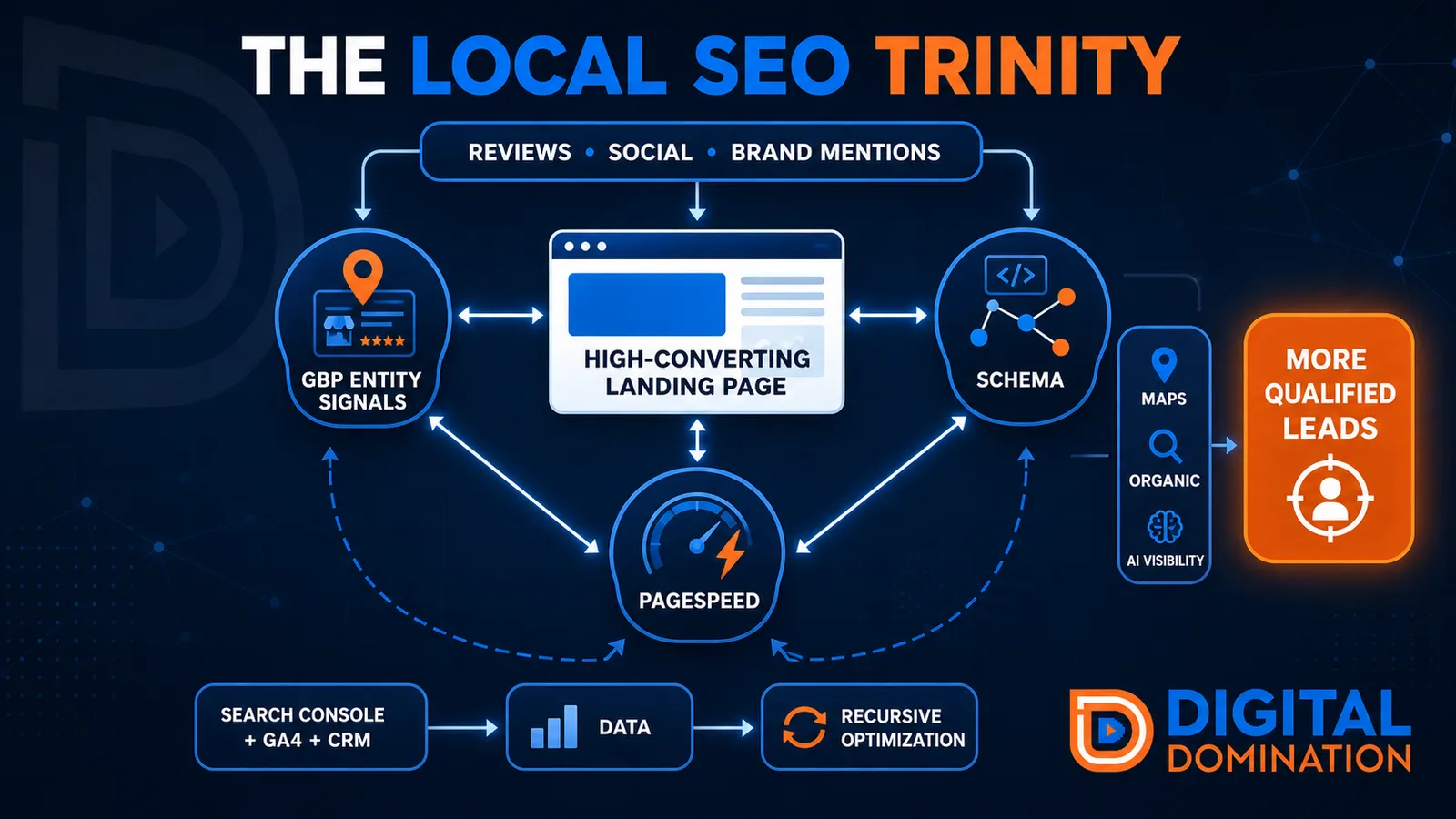
Google's local ranking factors are relevance, distance and prominence. A comp firm cannot move its office closer to every warehouse, resort and job site in the county, so the work is relevance and prominence, plus a third thing this practice area demands: qualification. When the fee is a statutory share of disputed benefits that a judge approves, a medical-only claim with no dispute burns the same intake hour as a denied back injury with a hearing date. At Digital Domination we treat the foundation as a trinity, supported by the landing page and fed by a measurement loop.
- ▸Google Business Profile entity signals: who the firm is, which benefit disputes it handles, which commission districts it appears in. Outcome: Map Pack visibility and denial letters in your inbox.
- ▸Schema: how the firm, its attorneys, their certification, the benefit types and the fee connect in machine-readable form. Outcome: the AI answer names the firm and gets the fee right.
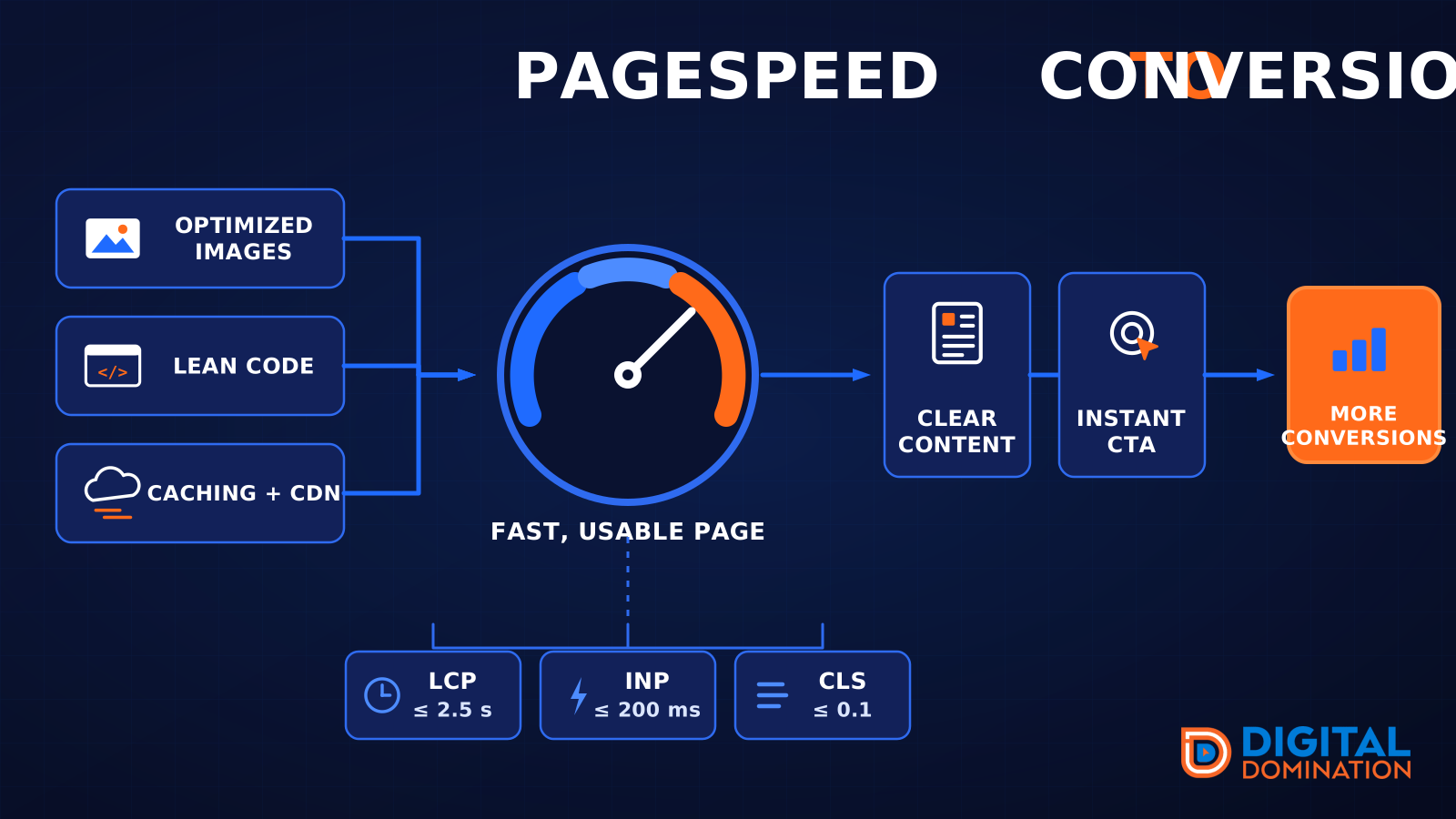
- ▸PageSpeed: whether a worker on an older phone and a metered plan can read the page before the battery runs out. Outcome: the proof is seen, not abandoned.
- ▸The landing page: first-screen proof, a fee sentence that removes the money fear, and a next step that fits somebody holding a letter with a date on it. Outcome: retained files rather than calls.
- ▸Reviews and authority: whether workers, unions and peers validate the claims. Outcome: prominence, and the nerve to call a lawyer at all.
- ▸Search Console, GA4 and the intake log: what drew people in, what they did, which contacts became fee-eligible files. Outcome: the next change is chosen from data.
Teaching Google you argue claims before a commission, not crashes on the freeway
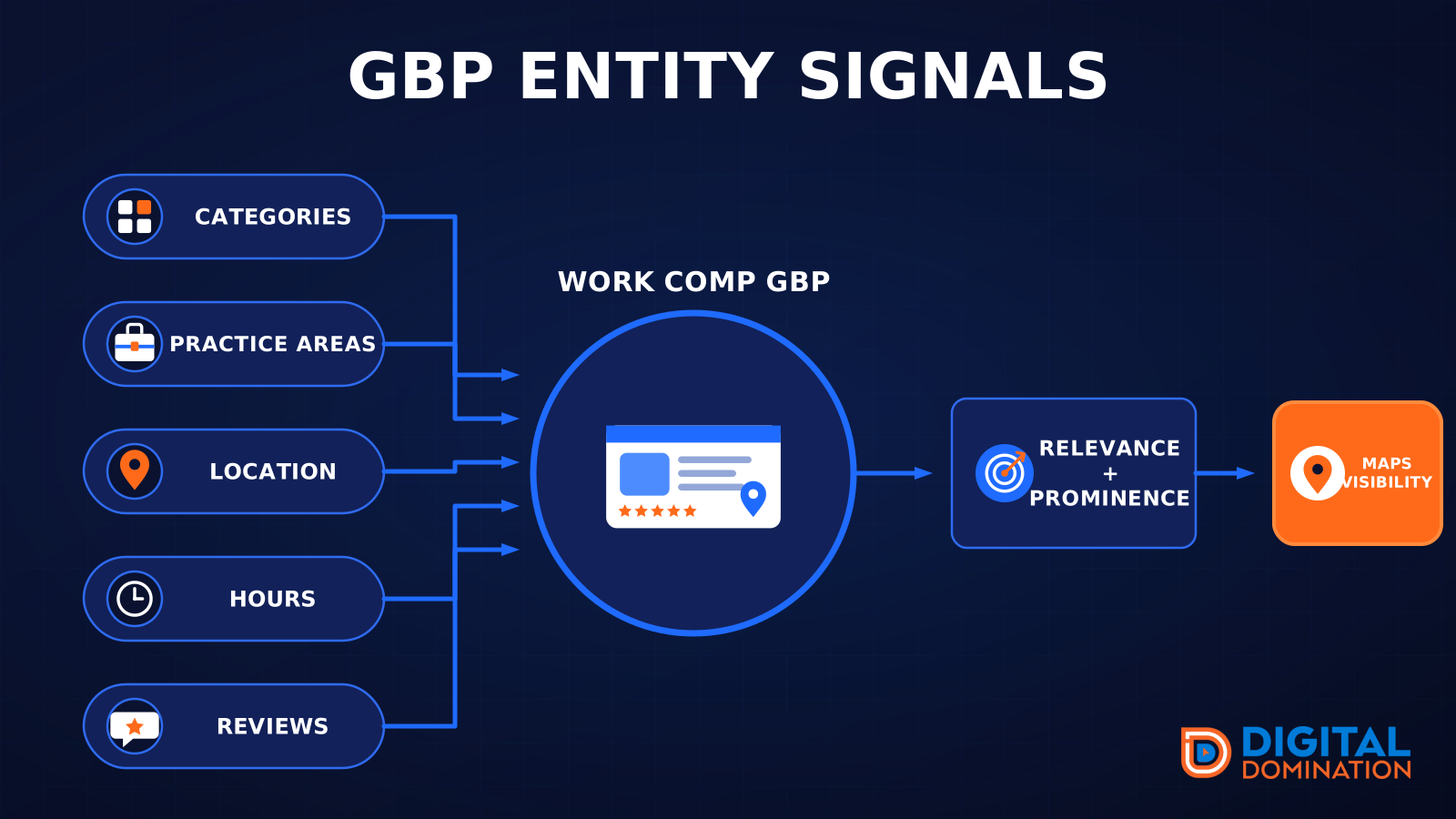
Most comp firms sit inside a Business Profile built for a personal injury practice, and Google treats them accordingly. The category list does include a workers compensation attorney category, and where it appears in your dashboard it belongs in the primary slot. Confirm it rather than assuming, because the list changes quietly. Secondaries should be the ones actually true of the practice: personal injury attorney for the third-party claim, social security attorney for the disability crossover, employment attorney for retaliation matters.
The category does the broad work only. Telling Google you fight a denied claim, a stopped check and a low impairment rating falls to the services list, the posts, the photos and the page the profile points to. List every dispute you take, named the way a worker would say it rather than the way the statute says it, and use those names as headings on the matching site pages.
- ▸Services in the worker's words: denied claim appeals, benefits stopped or reduced, light duty disputes, changing the treating physician, disputing an independent medical exam, rating disputes, occupational disease, claim reopening, retaliation, plus separate entries for third-party claims and Social Security disability.
- ▸A service area that matches jurisdiction rather than ambition: the counties you file in and the commission districts where hearings are held.
- ▸Attributes that matter to this client: an accessible entrance and parking, because many visitors arrive on crutches, phone appointments, and every language your staff genuinely speaks.
- ▸Hours that state what the phone does outside them, because a worker on second shift reads his mail at 11 p.m. and a call that reaches voicemail goes to the next firm.
- ▸A Q and A section seeded with what intake answers daily: can they force me to use their doctor, how long do I have to appeal, can I be fired for filing, what if my employer says I am a contractor.
- ▸One landing page per office naming the attorneys there, the disputes handled and the commission district, with a UTM-tagged profile link so each location is measured separately.
Proof a worker checks before calling a lawyer from the parking lot
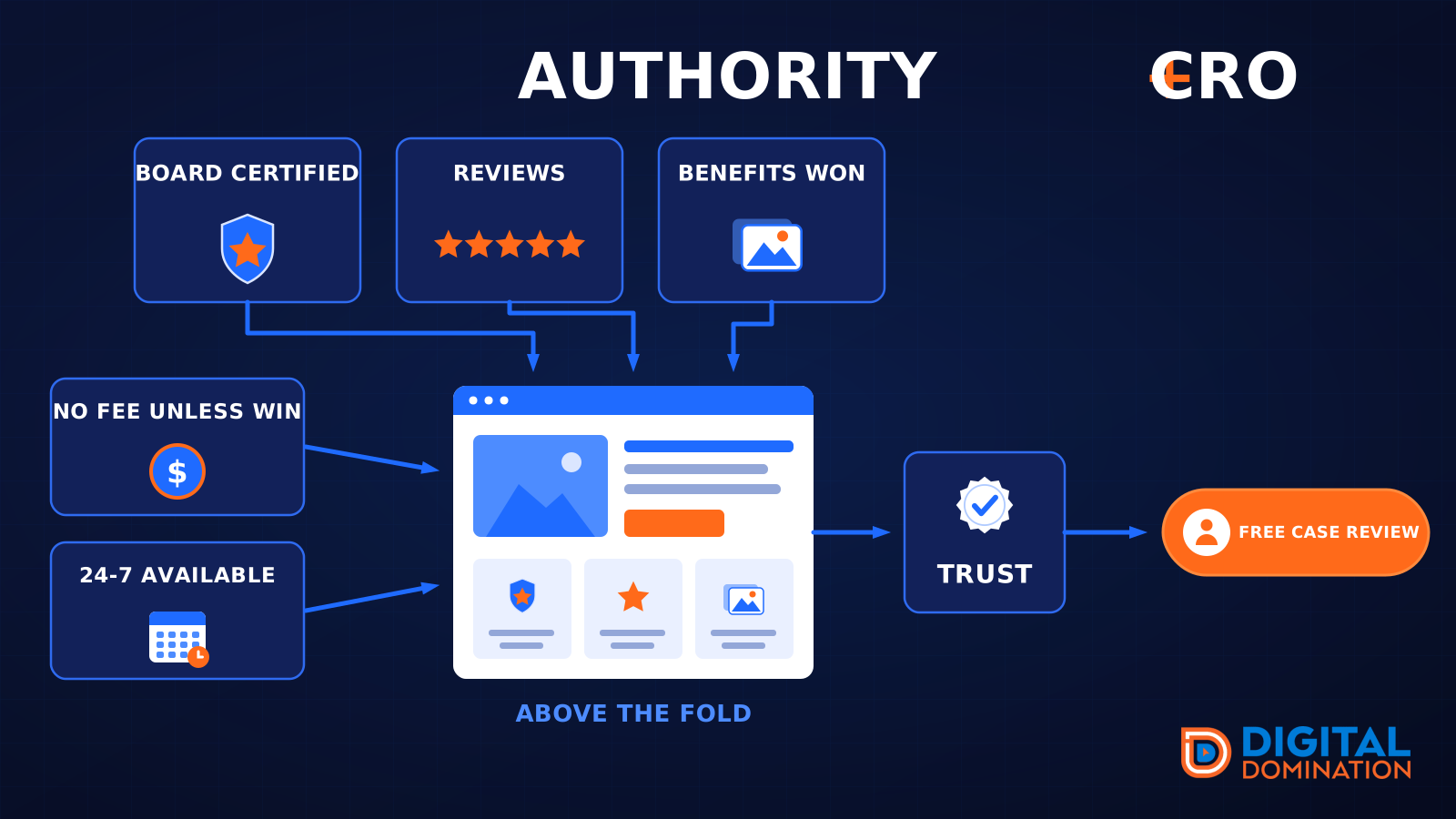
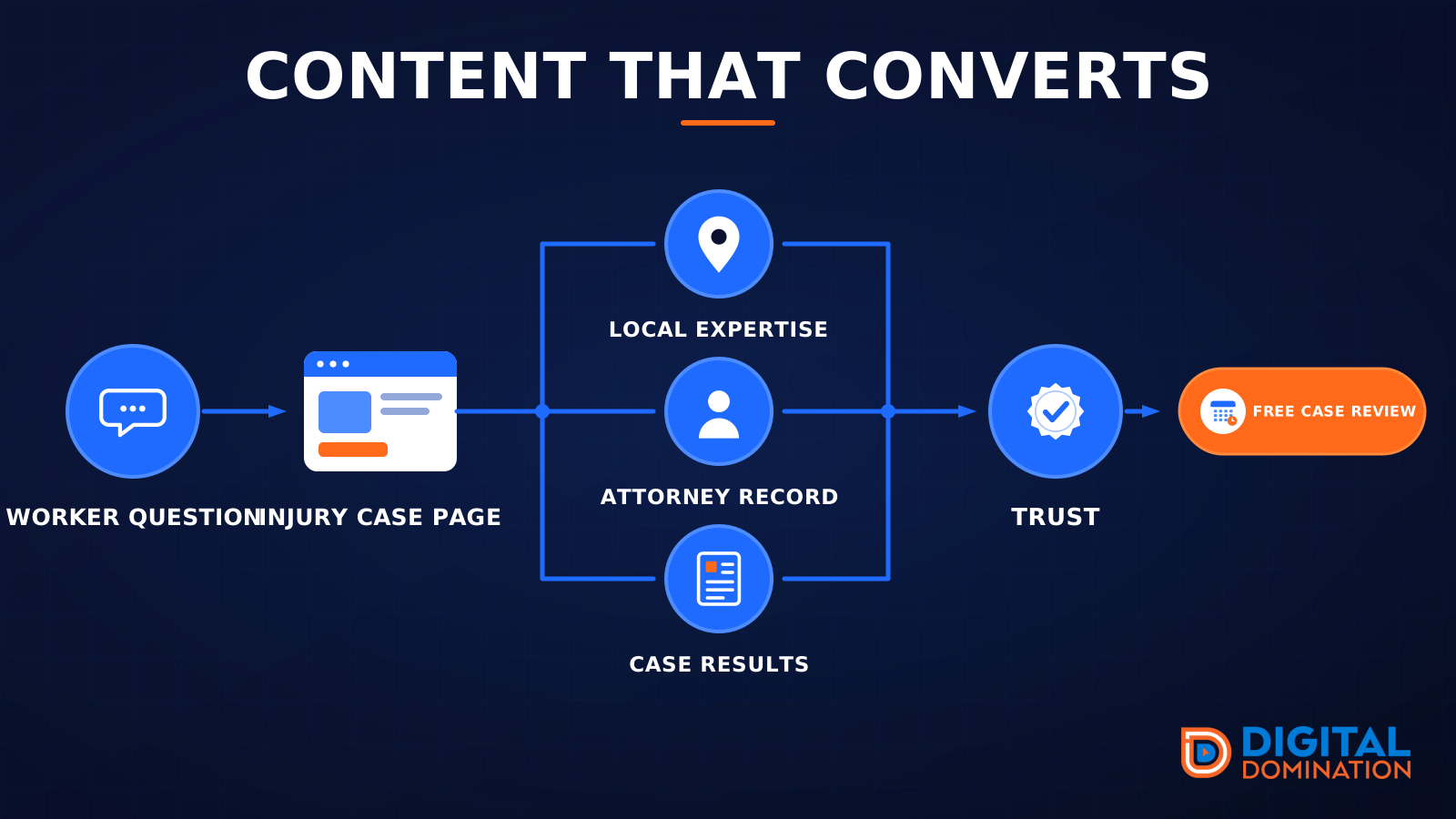
The person reading your first screen was just told by a doctor he did not choose, paid by an insurer he did not hire, that he is fine. He is short a paycheck, he may still work for the employer on the other side of the file, and he assumes a lawyer costs money he does not have. The first screen answers three things fast: do you do this every day, will this cost me anything, and can you talk to me in my language.
- ▸Board certification or specialist designation in workers compensation law where your state bar offers one, linked to the certifying body's directory rather than merely asserted.
- ▸Years appearing before the state's industrial commission and the number of contested hearings handled, not years in practice generally.
- ▸Prior insurance-defense or carrier-side experience stated plainly, because knowing how the other side values a file is the most persuasive credential here and almost nobody puts it above the fold.
- ▸Memberships peers recognize: the Workers' Injury Law and Advocacy Group, the state bar's workers compensation section, the state trial lawyers association.
- ▸The money promise in plain words, free consultation and no fee unless benefits are recovered, beside the Google rating, the Avvo and Martindale ratings, and a bar number linking to the state bar profile.
Review velocity in a market that is relieved, repeat and talkative
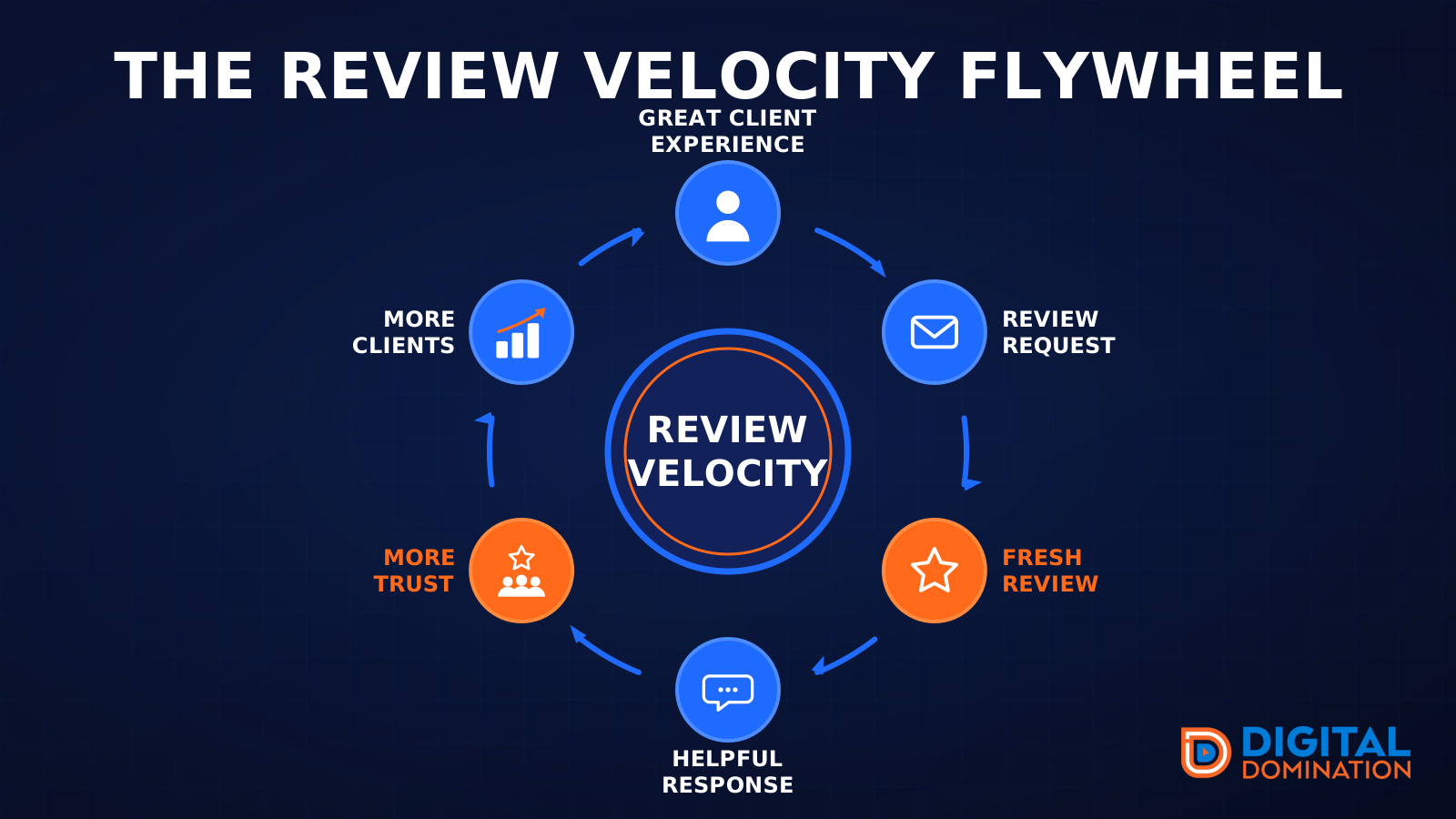
Comp is an unusual vertical for reviews. Files run for years, but the moments that produce gratitude arrive early: the check that restarts, the surgery that gets authorized, the exam that gets countered. Clients also cluster, since a housekeeper works a floor with dozens of housekeepers and a lineman belongs to a local. That makes review velocity, the steady arrival of new reviews rather than one large old pile, more attainable here than in most practice areas. The risk runs the other way: a review naming the employer or the adjuster creates a problem for a client who still has a job.
- ▸Ask at moments of relief rather than at the end: when benefits restart, when treatment is authorized, after a favorable hearing decision, and at the close of a declined intake handled kindly.
- ▸A strong review names the attorney, the benefit restored, the city and the kind of work, without naming the employer, the insurer or a diagnosis.
- ▸Reply without confirming the person was a client and without referencing the claim, the employer or any medical fact: thank them, state the firm's approach in one sentence, stop.
- ▸Summarize the combined rating above the fold, put attorney-specific reviews on the biography pages, and display reviews in another language as written.
A LegalService graph that names the benefit types, the certification and the Spanish pages
Without structured data a crawler sees a firm name, a bar number and a run of acronyms. With it a search system reads that Example Workers Compensation Law is a LegalService, that Ana Example is a Person who worksFor it, hasCredential a workers compensation specialist certification and knowsAbout impairment rating disputes, and that the firm makesOffer of denied claim representation in a named county. Two cautions for this niche. A benefit dispute page is about a legal service, not a medical condition, so do not mark an occupational disease page up as MedicalWebPage. And the translated site is the same firm, not a second one: those pages reference the same node identifiers with inLanguage set correctly, never a duplicate firm node. The architecture, node by node.
- ▸The firm: a LegalService node with name, telephone, address, openingHours, a plain fee note and a permanent identifier such as https://examplefirm.com/#firm, with each office as its own location node.
- ▸Each attorney: a Person node with jobTitle, alumniOf, hasCredential for the law degree and any specialist certification, identifier as a PropertyValue carrying the bar number, memberOf for the advocacy associations, knowsAbout for the benefit disputes, worksFor pointing at the firm, and sameAs to the state bar, Avvo and Justia.
- ▸Each dispute type: a Service node for denied claims, stopped benefits, exam disputes, rating disputes, occupational disease and reopening, each with areaServed listing the counties and commission districts, tied back through makesOffer.
- ▸The crossovers as their own Service nodes, third-party claims and Social Security disability, so a search system can tell those carry a different fee arrangement.
- ▸The fee: an Offer with a PriceSpecification stating that the consultation is free, that the fee is contingent on benefits obtained and approved by the judge, and that the worker pays nothing up front, in sentences a search system can quote whole.
- ▸Guides as Article with about pointing at the Service and author at the Person, plus WebPage and BreadcrumbList everywhere, so one attorney stays one entity across every page and both languages.
PageSpeed on a five-year-old phone with two bars in a break room
Comp sites are usually built on personal injury templates and carry that weight: a settlement counter, an autoplay video of partners walking a courthouse hallway, a translation widget, two chat vendors and three call-tracking scripts. Then consider who is loading it. An injured worker is off the job or on reduced pay, which means an older phone, a metered plan and whatever signal reaches a break room. He is holding a letter with a deadline on it, so he will open three firms and keep the one that loads.
Google's good thresholds are LCP 2.5 seconds, INP 200 milliseconds and CLS 0.1, measured at the 75th percentile of field data. At Digital Domination we target a PageSpeed Insights performance score of 90 or higher and a 2/2 agentic-browsing check, because the AI agents that fetch a page to answer who handles denied claims in a county abandon heavy scripts as readily as a worker at nine percent battery does.
The fixes that pay most here.
- ▸Replace the translation widget with genuinely translated HTML pages at their own URLs. This is the rare fix that solves a speed problem and an indexing problem at once, since a widget renders after JavaScript and leaves nothing to rank.
- ▸Swap the autoplay hallway video for a preloaded WebP or AVIF still of the attorney who answers the phone, load video on click, and compress the certification badges.
- ▸Keep one chat vendor and one call-tracking script, load both after first interaction, and delete pixels for channels you no longer run.
- ▸Reserve fixed dimensions for the review widget, the case evaluation form and the sticky call bar, so nothing shifts under a thumb already reaching for the phone number.
- ▸Publish claim forms and deadline explanations as HTML rather than embedded PDFs, self-host the fonts, lazy load the office map, and keep the phone number and the upload button as plain HTML.
Fee language that answers the only money question an injured worker has
The question a worker asks an AI Overview before calling anybody is not what percentage you charge. It is whether he can afford a lawyer at all with no check coming and rent due. Comp fees are unlike almost every other legal fee: in most states they are set by statute, calculated on disputed or past-due benefits rather than the whole claim, and approved by a judge before a dollar moves. If your site never says so, the answer he reads gets assembled from a directory, and he arrives at intake bracing for a retainer you never intended to ask for.
You do not have to publish a percentage to be quotable, and in several states the number is not yours to set. Put plain, crawlable sentences on every dispute page, the fee page and the Business Profile services, connected through the Offer on the Service node.
- ▸The consultation is free and the denial letter, the exam report or the rating will be reviewed at no cost.
- ▸There is no fee unless benefits are obtained, the fee is set by state law and approved by the judge, and it is calculated on the benefits in dispute rather than the entire claim.
- ▸The worker pays nothing up front and nothing out of pocket, with a plain statement of how case costs are handled if nothing is recovered.
- ▸Where your state has the carrier pay attorney fees in defined situations, say so, because it answers the fear directly.
- ▸A separate sentence for each crossover, since the third-party claim runs on an ordinary contingency and the disability fee is capped and paid from past-due benefits.
Content for the calendar a claim actually runs on
A comp claim is a sequence of dated events, and each one sends somebody to search: the report deadline, the first clinic visit, the light duty offer, the exam the insurer scheduled, the check that stops, the letter, the hearing, the rating, the settlement, the reopening. A site with a single workers compensation page is absent from all of them except the last. Each stage deserves a page that gives the direct answer under a descriptive heading, cites the statute or commission rule it relies on, names its attorney author, and shows published and updated dates. Written properly these pages also screen out the calls nobody can charge for.
- ▸The first 30 days: how quickly an injury must be reported, what an incident report should say, what the employer's clinic is and is not, and what to expect from the first adjuster call.
- ▸Benefits stopped or reduced: temporary disability ending, a wage calculation that looks wrong, a light duty offer the worker cannot physically perform, and what happens to treatment during the fight.
- ▸The exam you did not choose: what an independent medical examination is, how to prepare, what to do when the report contradicts the treating doctor, and when a treating physician can be changed.
- ▸The denial and the clock: how to read the letter, what the appeal deadline printed on it means, what a hearing looks like, and what evidence decides these cases.
- ▸The rating and the money: how an impairment rating is produced and disputed, lump sum versus continuing benefits, vocational rehabilitation, and the right to reopen a closed claim.
- ▸The fear pages, which quietly draw the most traffic: retaliation and termination while on a claim, what to tell an employer you still work for, eligibility for workers whose immigration status worries them, and what happens when the employer claims no coverage.
The language your market actually works in
In most comp markets a substantial share of injured workers do not search in English. Warehousing, hospitality, construction, agriculture and janitorial work generate the claims, and they are the sectors where a second language is the household language. A translation plugin is not a translated site: the widget renders after JavaScript, creates no separate URL to index, carries no title or structured data of its own, and mangles claim vocabulary badly enough to cost trust.
- ▸Real URLs for each translated page with their own titles, meta descriptions, headings and hreflang annotations, translated by somebody who knows what a hearing, an adjuster, an impairment rating and light duty are called in that language.
- ▸Business Profile language handling: post in both languages, answer the Q and A section in both, and list the languages spoken as an attribute so the profile itself signals it.
- ▸An intake path in the same language as the page, including whoever answers at 11 p.m., because the fastest way to lose a bilingual lead is to answer that call in English.
- ▸Reviews left in another language displayed as written, with replies in the same language.
- ▸Measurement of translated pages as their own segment in Search Console and GA4, since their queries, devices and conversion patterns rarely match the English pages.
Search Console, GA4 and the intake log: measuring fee-eligible files, not calls
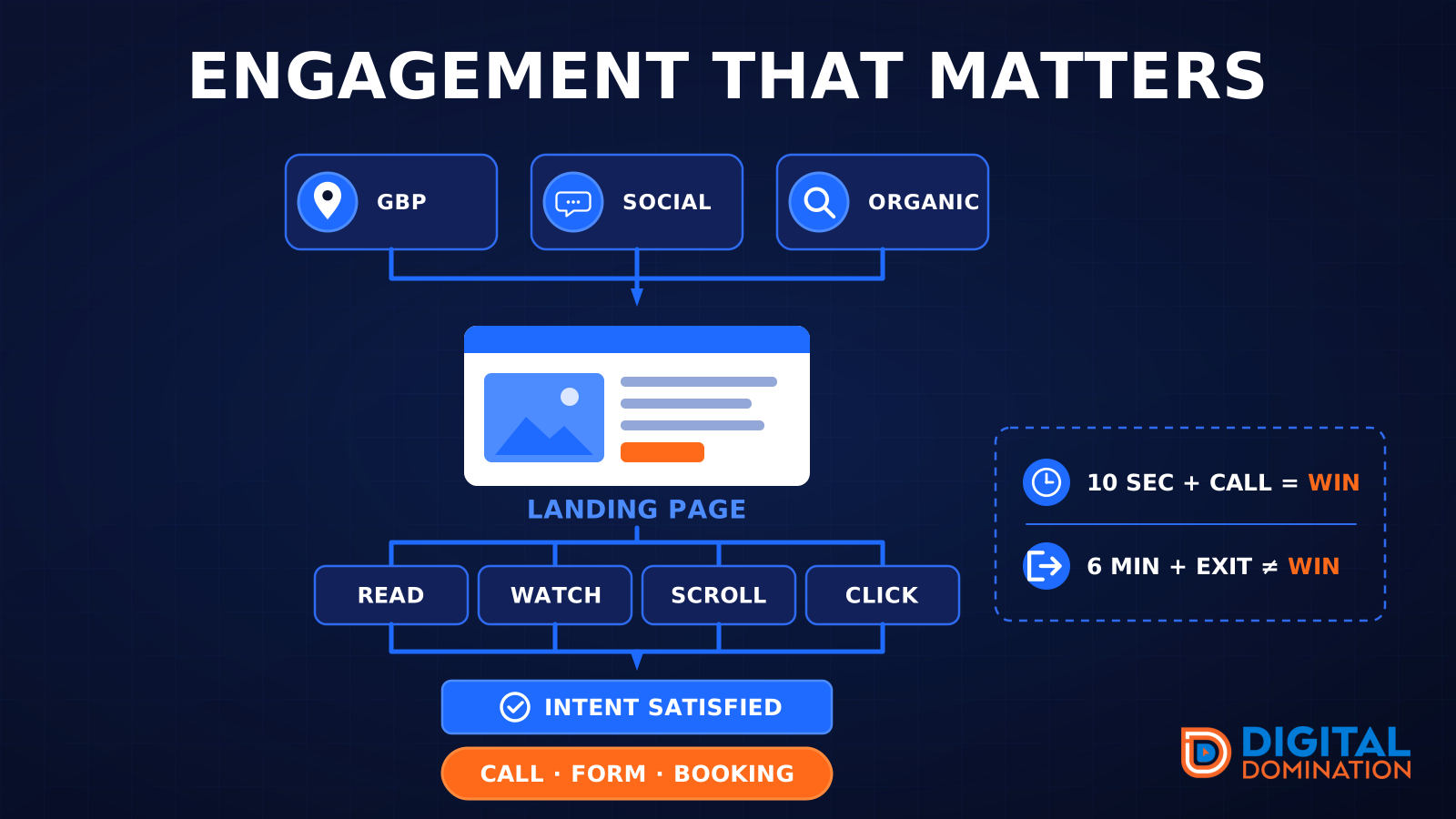
None of these tools ranks a page. Their value is that they turn the work into a loop. Search Console shows how Google found the firm: which pages earn impressions for denial queries versus rating queries, which office page ranks in which county, which translated pages are indexed at all, and which URLs fail Core Web Vitals in the field. GA4 shows what visitors did next: click-to-call, letter uploads, form completions, and the gap between the phone visitor at 11 p.m. and the desktop visitor at noon.
The intake log makes the loop honest. Record every contact with its source, the industry, the claim stage at contact, whether a denial or benefit stop exists, whether the file was retained and, if declined, why. Those declined reasons are content instructions in disguise: if a third of your calls are medical-only claims with no dispute, the early-stage pages are pulling the wrong stage. The loop, in order.
- ▸Measure the baseline: GeoGrid position for the top three trigger queries, impressions by query class, calls, letters uploaded and files retained.
- ▸Diagnose by stage: impressions without clicks means the title, snippet or proof is losing the click; clicks without contacts means speed, fee clarity, language or trust; contacts without files means the screening content or the intake script.
- ▸Change one group of things, annotate the deployment date in GA4, and compare the next 30 to 60 days against the baseline before touching anything else.
- ▸Feed the winners back: a query that starts producing retained files becomes a longer page, a Business Profile post, a short video in both languages and a structured data update.
Union halls, safety rooms and the mentions that corroborate a comp firm
A comp firm's audience clusters by workplace rather than by neighborhood, which changes where corroboration comes from. Union locals, apprenticeship programs, building trades councils and worker centers convene the exact people who will need you next year. An attorney who presents a know-your-rights session at a local, writes it up on the site with photos of the real room, and posts a two-minute answer to what happens when the checks stop is building corroboration Google can attribute to the same entity the profile and the schema describe. Search Console now reports supported social and video platform properties, a sign of how far social content and search discovery have converged.
Worker forums matter too, since groups for injured workers reward useful explanation and punish anything that reads as solicitation. An unlinked sentence saying a named firm in a named city restarted somebody's benefits after a denial still connects the firm, the location, the service and a trait. On Reddit specifically, Axios reported in August 2026 that Reddit's share of visible ChatGPT Search citations fell roughly 86 percent, yet OpenAI keeps a Reddit data partnership, so fewer visible citations do not prove those conversations stopped informing retrieval.
- ▸Short vertical video answering exactly one trigger question, filmed in both languages, with transcripts on the matching page and the clips reused as Business Profile posts.
- ▸Union newsletters, apprenticeship safety curricula and worker center partnerships, each written up as a page so the mention has something on your site to point at.
- ▸Directories carrying the same name, address, phone and benefit vocabulary as the profile and the schema: the state bar profile, the Workers' Injury Law and Advocacy Group directory, Avvo, Justia and Martindale.
A 90-day roadmap paced to the appeal deadline
The roadmap is paced to the shortest clock your clients live under, the appeal window printed on a denial letter. Speed and intake come first because they lose contacts you already earned, the entity is repaired second, content and reviews third, and the last month belongs to data.
- ▸Days 1-14, baseline and stop the losses: run GeoGrid scans, 169 points each, for your top three trigger queries, log 30 days of intakes with declined reasons, benchmark calls and retained files, strip the heaviest scripts and the autoplay video, confirm what the phone does at 11 p.m. and in which languages, and audit every Business Profile field for mismatches.
- ▸Days 15-30, repair the entity: set the categories, build the services list in the worker's vocabulary, publish one page per office, rewrite the first screen around certification, hearings handled, defense experience, languages and the fee promise, complete every biography with bar number and sameAs links, and deploy the LegalService, Person, Service and Offer graph.
- ▸Days 31-60, expand relevance and prominence: publish the stage pages from the first 30 days through reopening, add the fear pages and the crossover pages, translate the highest-volume ones properly, launch the review ask at each moment of relief, and start a weekly video cadence in both languages.
- ▸Days 61-90, optimize on data: pull high-impression low-click queries and high-traffic low-contact pages, compare declined reasons against the stage content, rewrite the weakest proof and calls to action, recheck Core Web Vitals, re-run the GeoGrid scan and repeat whatever moved.
One firm, one entity, from the incident report to the award
The order picker in the break room will never see your structured data or your Search Console report. He will see an AI answer that either names your firm or does not, a Map Pack, a rating, a first screen that loads or does not, a certification he can click, a sentence telling him this costs nothing up front, a page in the language he thinks in, and a phone somebody answers. A workers compensation practice is one entity, and its attorneys, certifications, benefit disputes, fee arrangement, offices, languages and reputation should read identically everywhere they appear.
At Digital Domination we build and run this system for workers compensation firms under one promise: top 3 in the Google Map Pack in 12 weeks or you do not pay. If your profile looks strong from your own office and disappears across the warehouse district and the construction belt where the injuries happen, the first step is to see the whole market rather than one point on it. Run the free GeoGrid scan and find out where injured workers are searching without ever seeing your firm.
Keep reading
Related guides
- ▸A free agency roster review near me
- ▸Free agency roster review vs DIY local SEO with Google tools
- ▸A free GeoGrid scan near me
Put it into action
Frequently Asked Questions
What primary Google Business Profile category should a workers comp firm choose?
Google's list includes a workers compensation attorney category, and where it is available in your dashboard it belongs in the primary slot rather than the generic personal injury or law firm options. Confirm it directly rather than assuming, since Google adds and renames categories without announcing it. Use secondaries only where they are true, such as social security attorney for the disability crossover.
How do we earn reviews when a comp file takes two years and the client still works for the employer?
Ask at the moments of relief rather than at the end of the file: when benefits restart, when treatment is authorized, after a favorable hearing and when a settlement is approved. Give the client something safe to say, which means naming the attorney, the benefit restored and the kind of work, never the employer, the adjuster or the diagnosis. Reply without confirming the reviewer was a client.
Should we publish our fee when the state sets it and a judge approves it?
Publish the arrangement even when you cannot publish a number. The sentences that answer the worker's real fear are that the consultation is free, that there is no fee unless benefits are obtained, that the fee is set by state law and approved by the judge, and that nothing is paid up front. Those statements are quotable by AI systems in a way that a vague promise to fight for you is not.
Should we build real translated pages or use a translation widget?
Build real pages. A widget renders after JavaScript, produces no separate URL for Google to index, carries no title or structured data of its own, and slows the page for exactly the visitors on the weakest devices. Translated pages need their own URLs, titles, headings and hreflang annotations, a human translator who knows the claim vocabulary, and an intake path that answers in the same language.
Why does PageSpeed matter more for a workers comp site than for other legal sites?
Because of who is loading it. An injured worker is off the job or on reduced pay, usually on an older phone, often on a metered plan and a weak signal, and usually holding a letter with a deadline on it. He will open two or three firms and stay with the one that becomes usable first, which is why the good thresholds of LCP 2.5 seconds, INP 200 milliseconds and CLS 0.1 at the 75th percentile of field data are worth chasing here.
Should a comp firm publish content about third-party claims and Social Security disability?
Yes, structured as its own track rather than mixed into the comp pages. The crossover files are frequently the most valuable matters arriving through a comp intake, and the questions that surface them, such as whether a subcontractor's vehicle or defective equipment was involved, are searchable in their own right. Give each crossover its own Service node and its own fee sentence.
Ready to dominate your map?
Top 3 in the Google Map Pack in 12 weeks, or you don't pay.