
Artificial turf installer local SEO: how GBP entity signals, schema and PageSpeed decide who gets to measure the yard
A turf company sells a product and an installation in the same breath, to a buyer who was already quoted a price per square foot by a machine. Here is how the profile, the schema and the site decide whether she calls you or the dealer down the road selling the same roll.

Two dogs, a mud line along the fence and a search typed from the back step
The third rain of the month stops around four on a Sunday, and the retriever comes through the slider before anyone reaches the door. There is a worn track along the back fence where two dogs have run the same line for three years, and it has not been grass since the first summer: dirt in July, mud in February, and now on the hallway rug. The homeowner sits on the back step with a towel in one hand and types "dog friendly turf backyard cost" with the thumb of the other.
The AI Overview answers before she finishes, with a range per square foot installed and two local companies in the citations. She taps the Map Pack profile rated 4.9 whose services list actually says pet turf installation, whose photos show a backyard the size of hers with a dog on it rather than a putting green on an estate, and whose site opens before the towel is back on the hook. The first screen names the turf line, its face weight and its fifteen year warranty, and offers to mail four samples.
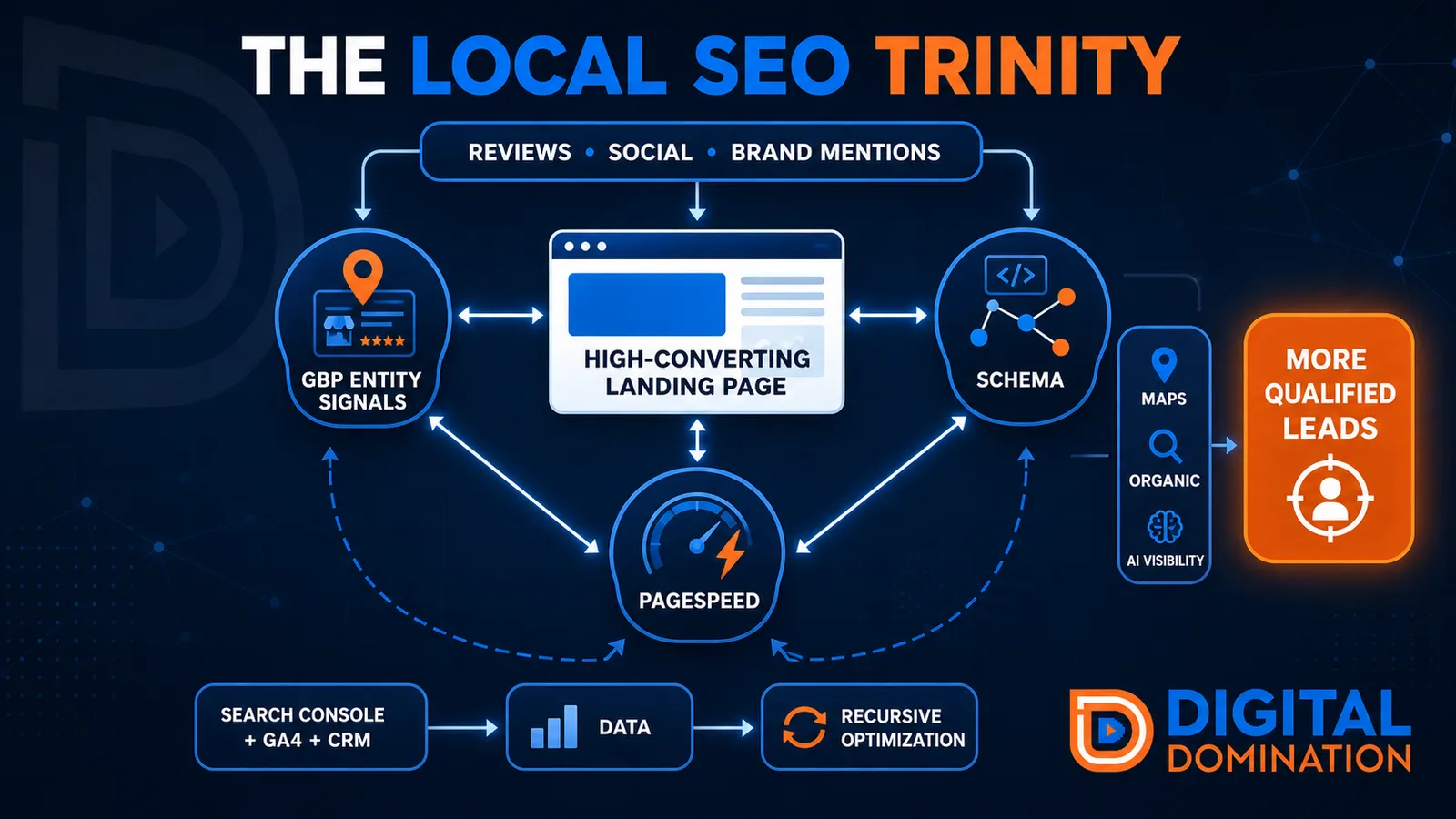
The company that should have won compacts four inches of base and has never had a seam open. Its profile still says Lawn care service from the mowing route years, and its product pages are the distributor's spec sheets pasted in the same week as forty other dealers. It sat sixth. Turf gets judged twice, as construction and as a product, by a buyer with a number already in her head and by machines working from whatever facts you hand them. At Digital Domination we build that foundation as profile entity signals, schema and PageSpeed, wrapped in a converting landing page and a measurement loop.
The short version, and why a turf install fails from the bottom up
Google ranks local results on relevance, distance and prominence. Distance is wherever the buyer is sitting, so the winnable part is relevance, prominence and conversion in the neighborhoods your crews already drive to. A turf install fails from the bottom up: the base is short, the turf ripples, the seams show, the subdivision hears about it. Local SEO fails in the same order:
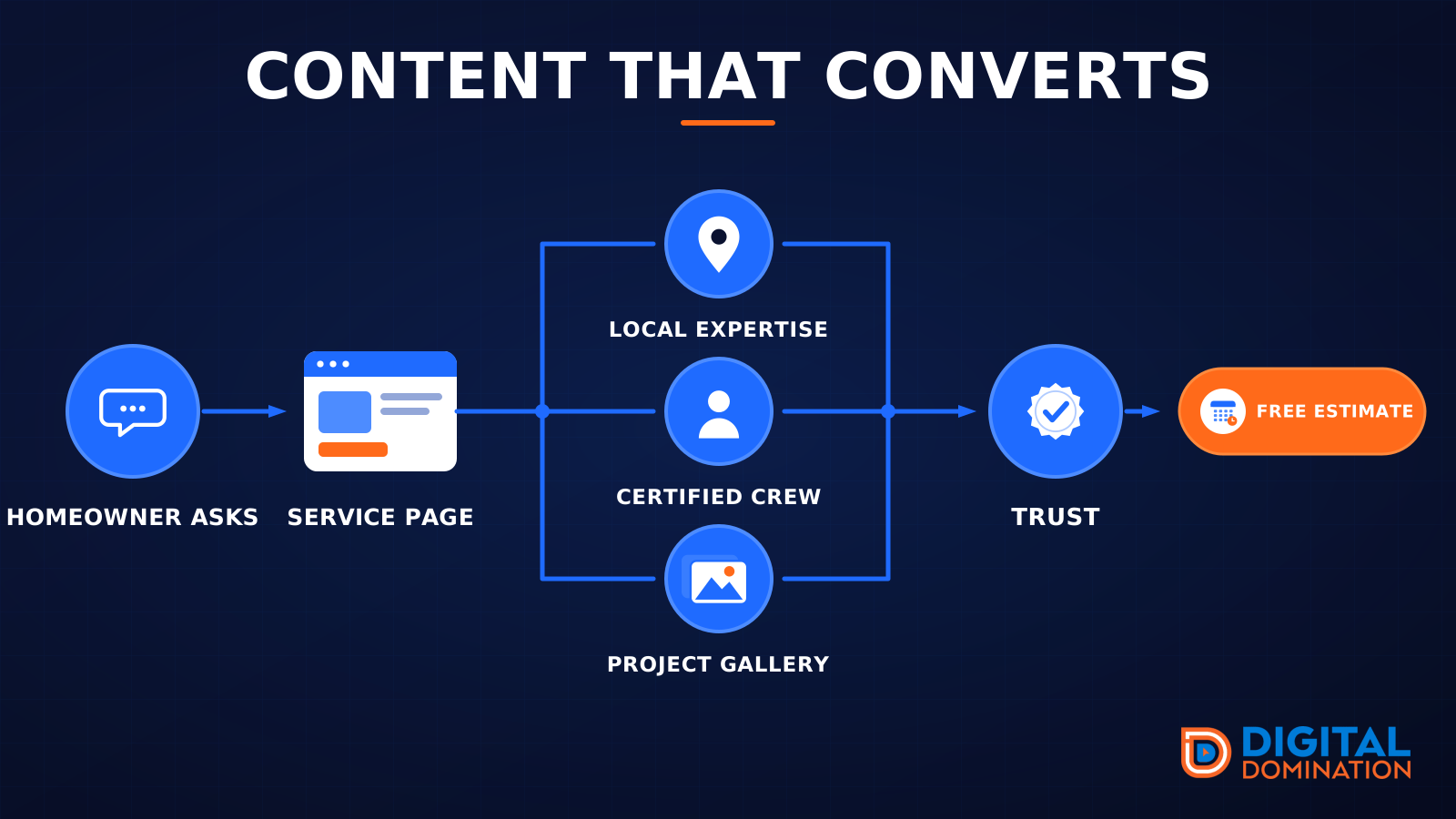
- ▸Google Business Profile: are you a turf installer, a landscaper who lays turf when asked, or a supplier selling rolls, and where do you install.
- ▸Landing page: why a stranger should let a crew cut out her lawn, and what the finished yard costs per square foot installed.
- ▸Schema: how the company, the license, the crew, each turf line with its face weight and warranty, and each city connect into one entity.
- ▸PageSpeed: whether the sample form and the phone number work on a phone, outside, on cellular, before she taps the next listing.
- ▸Search Console, GA4 and the CRM: which searches produced samples and measures, and which measures became signed square feet.
The category problem: Google's list has no artificial turf installer button
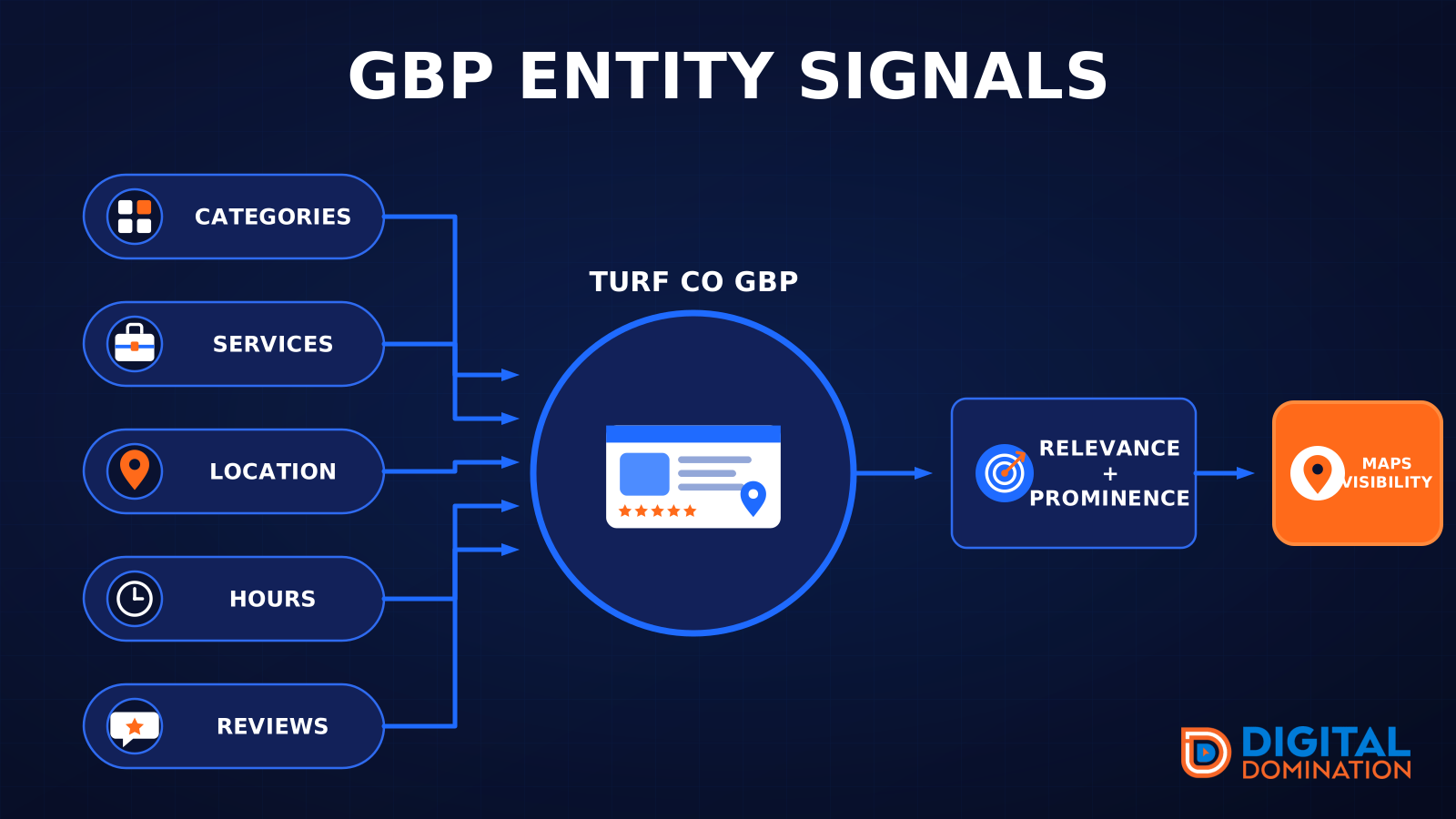
Google's picker has no entry meaning precisely what you do. The candidates are Landscaper, Lawn care service, Turf supplier and Sod supplier, and they pull very different searches, so read the live list inside your own profile before committing. An installation category belongs in the primary slot when the crews are yours, with a supplier category secondary only if you sell material. Leaving Lawn care service as the primary because the company started as a mowing route tells Google you maintain living grass, which is why a landscaper who lays two yards a year outranks you.
Buyers search by application, not by "artificial grass", so build the services list from what the phone rings for and give every entry a real page, because a service named on the profile and never mentioned on the site is a relationship Google has no reason to trust:
- ▸Pet turf, dog run and kennel turf with the drainage and odor system named, since pet work is the largest slice of residential demand in most markets.
- ▸Backyard putting greens, with fringe, cups and chipping pads as their own line items, and playground turf described by the fall height rating you install to.
- ▸Sod removal, base preparation and drainage correction, plus commercial work such as medians, dog parks and batting cages if you do them.
- ▸Turf cleaning, sanitizing, infill top off, re-seaming and repair, which almost no competitor lists and which existing turf owners search for every spring.
Samples in the hand, a display yard and photos that are not the manufacturer's
Turf is bought with the hands. A serious buyer wants to feel the difference between a 60 ounce landscape blade and a 90 ounce pet grade, in daylight, against her own house. If people visit a showroom or sample yard, claim a storefront profile with real hours and photograph the sample wall. If nobody visits, run a service area profile and hide the address rather than dressing a storage lot up as a showroom, because Google verifies addresses and a suspension costs more than the listing earns.
Photos are the second place turf companies lose, and the failure is specific to this trade: most dealers use the manufacturer's photo library, so the same eight images of the same anonymous green backyard sit on a hundred dealer profiles and a hundred dealer sites. Google can see that. Shoot your own, and set the rest of the profile to describe the company a buyer would meet:
- ▸Your own sequence: the sod cutter, the compacted base with the plate compactor on it, the bender board edge, the seam before infill, and the finished yard from the before shot's angle.
- ▸A one-year-later photo of every job whose owner lets you back in, captioned with the application and the neighborhood, because a yard that still looks right is proof no competitor can fabricate.
- ▸One profile per real location. A second yard in the next county earns its own profile and reviews; a putting green division at the same address does not.
- ▸A UTM-tagged link to a page about turf installation in that city rather than the homepage, so profile clicks separate from organic clicks in GA4.
Base specs, warranties and the proof that separates you from a staple gun
A turf yard is a five figure decision that cannot be undone cheaply, and every buyer has heard the stories: the lawn that rippled by the second summer, the seam that opened into a trip hazard, the dog run that smelled by August, the installer who took a deposit and stopped answering. Phrases like "quality installs" and "family owned" do nothing against that. Numbers, license records and a written warranty do.
The first screen should carry the application and the city in the headline, a live rating with its count, the license, the base spec, the product specs and a way to get samples in the mail today. An illustrative authority strip, using placeholder figures rather than real results, might read: Licensed Contractor No. 000000 | 4.9 Stars From 300+ Google Reviews | 15 Year Manufacturer Warranty | 4 Inch Compacted Base | Free Samples. Everything in it has to be checkable further down:
- ▸The contractor license number and classification written the way the state board writes it and linked to the board's public lookup, plus liability and workers compensation coverage.
- ▸The base specification in writing: depth and material, the compaction you hit, the weed barrier, the edge restraint and the fastening schedule. It explains why you are not the cheapest bid.
- ▸Product specs on every line: face weight in ounces, pile height, blade shape and thatch, backing type and drainage rate, UV stabilization, and lead-free testing where it applies.
- ▸The manufacturer warranty per product in years and in what it covers, kept clearly separate from your workmanship warranty on base, seams, edges and drainage.
- ▸Infill options and what each is for: coated sand for ballast and blade support, zeolite for ammonia and pet odor, and what goes under a playground or putting surface.

Review velocity when the product is warrantied for fifteen years and judged in year three
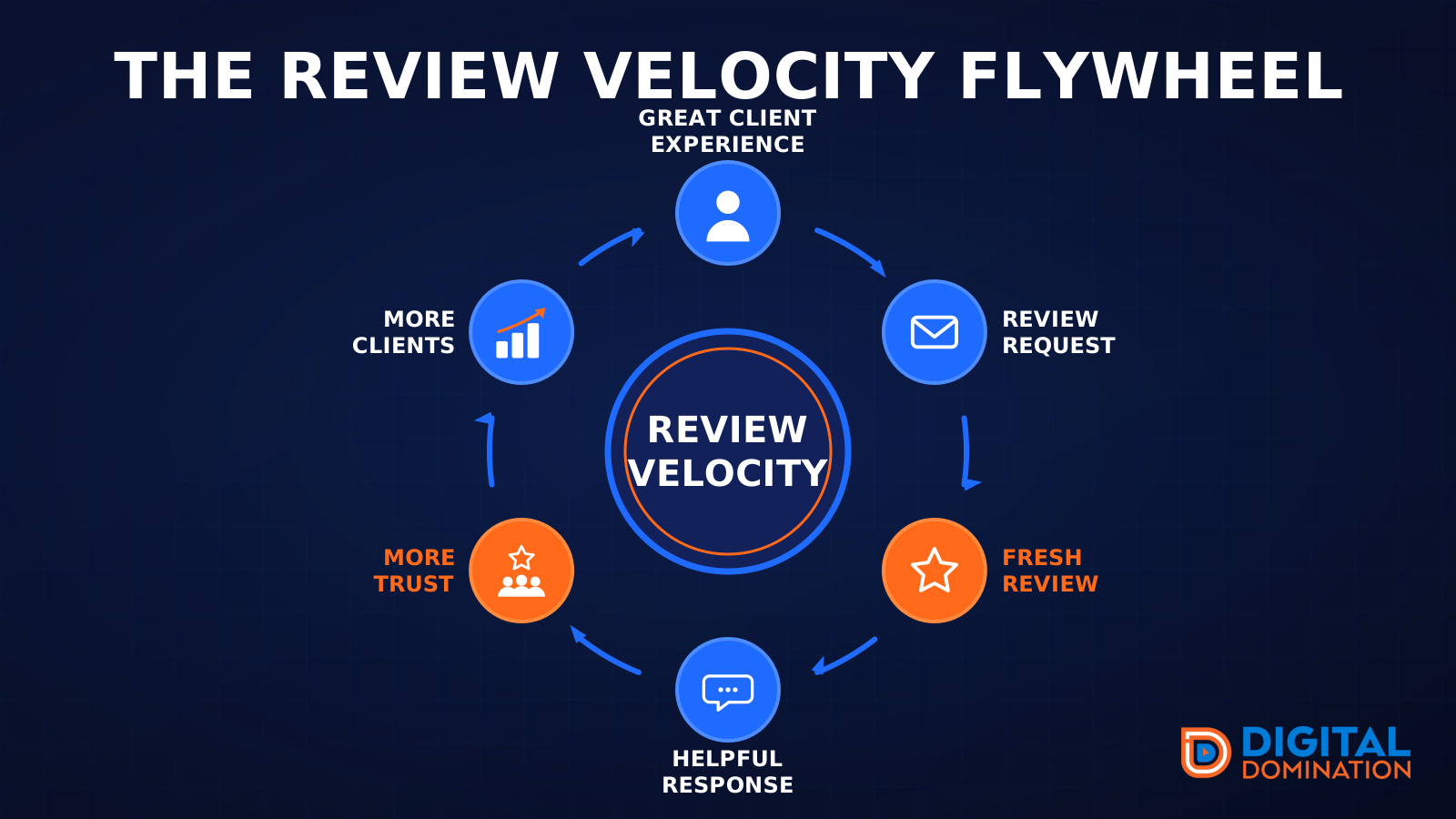
A turf install finishes in a day or two, the customer is standing on it while the crew loads the trailer, and it will never look better than it does that afternoon. Ask then, by text, with the direct review link. That is half a program, because the questions buyers are asking are about years two and three: did it ripple, do the seams show, does it still drain, does the dog run smell in August. A second ask at the first cleaning appointment produces exactly those reviews. Coach the content by asking which yard did we do and what surprised you, because the reviews that carry weight in this trade do the following:
- ▸The review names the application and the neighborhood, tying your entity to that service in that place in a sentence somebody else wrote.
- ▸It answers the failure modes in the positive: still flat after two summers, seams you cannot find, water gone twenty minutes after a storm, no odor with two dogs.
- ▸It names the crew lead, and the owner's reply names them back and repeats the application and the area without reading like a keyword list.
Schema on HomeAndConstructionBusiness, with the product and the warranty in the same graph
Schema is JSON-LD that labels what your pages already say so a machine stops guessing. A turf company needs more of it than most trades, because you are describing a service and a product at once and almost every turf site models only the service half. With it, Google can read that Example Turf is a HomeAndConstructionBusiness, that its license number is an identifier issued by a named board, that pet turf installation is a Service in three named cities, and that the 90 ounce pet grade is a Product with a permeable backing and a fifteen year warranty:
- ▸The company: HomeAndConstructionBusiness with name, telephone, address or service area designation, priceRange, openingHoursSpecification and a permanent @id such as https://exampleturf.com/#company.
- ▸The contractor license: PropertyValue under identifier with the issuing board named, plus hasCredential for installer and playground safety certifications.
- ▸Each application: a Service node for artificial grass, pet turf, putting greens, playground turf and turf cleaning, each with provider, serviceType, areaServed and its own @id.
- ▸Each turf line: a Product node with brand, sku and additionalProperty PropertyValue entries for face weight, pile height, backing and drainage rate, so the specs are machine readable rather than trapped inside a picture of a spec sheet.
- ▸Pricing: an Offer on each Service and Product carrying a UnitPriceSpecification with the installed starting price per square foot, the unit and any minimum job size.
- ▸The warranty: WarrantyPromise attached to the Offer with durationOfWarranty and warrantyScope, written separately for the manufacturer warranty and your workmanship warranty.
- ▸Corroboration: areaServed as City nodes matching the profile, sameAs to the dealer locator, Houzz, Yelp and the Synthetic Turf Council directory, and BreadcrumbList under one WebSite node.
PageSpeed when every page is a photograph of green grass
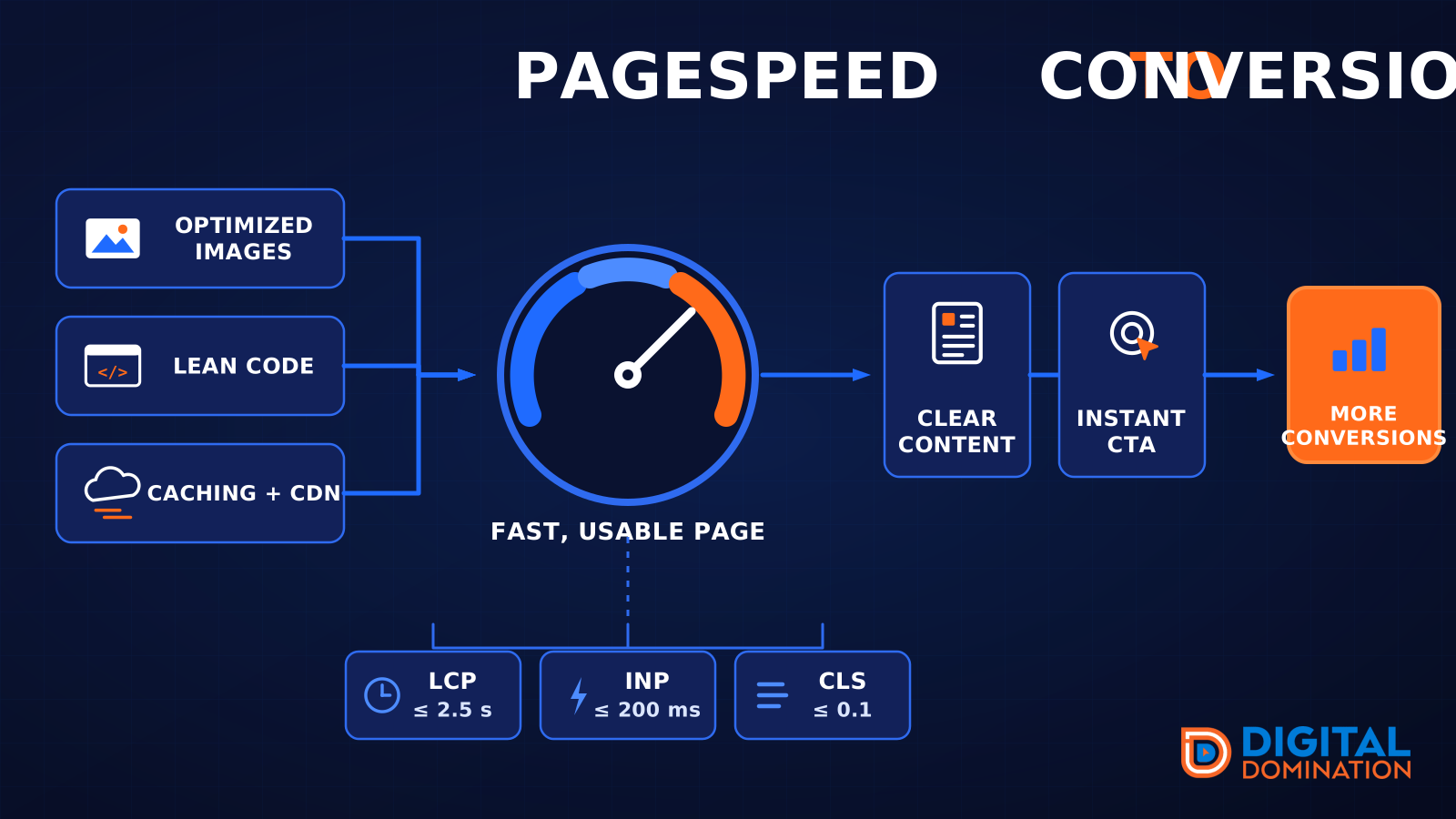
The typical turf website carries a drone video of a green backyard, a drag-to-compare slider on every project, a square footage calculator widget, a gallery of every job since the company opened, and the manufacturer's product images at four thousand pixels wide. Grass is close to the worst case for image compression, since it is fine, high frequency detail. Stack sixty of those photos, hand the page to a woman standing in a muddy backyard on cellular, and the sample form arrives after she has moved on.
Google's good thresholds for Core Web Vitals are a Largest Contentful Paint of 2.5 seconds or less, an Interaction to Next Paint of 200 milliseconds or less and a Cumulative Layout Shift of 0.1 or less, measured at the 75th percentile of real field data rather than in a lab. At Digital Domination we build to a PageSpeed Insights performance score of 90 or higher and a 2/2 result on the agentic browsing check, because an AI agent asked to find a licensed installer carrying pet grade turf has to be able to read the page:
- ▸Convert every gallery and product image to WebP or AVIF, serve responsive sizes through a srcset, and stop uploading originals straight off the phone. This one change usually accounts for most of the problem.
- ▸Replace the drone hero with one static image of your best finished yard, preloaded and never lazy loaded, with the headline, phone number and sample button as real text on top of it.
- ▸Drop drag-to-compare sliders in favor of a fixed before and after pair, since those libraries load JavaScript on every page and shift the layout while they initialize.
- ▸Rebuild the square footage calculator as a few lines of your own script, or put it behind a tap, rather than loading a third party widget for every visitor.
Per square foot, installed: the number every AI answer is already being asked for
Nearly every question an AI Overview or a chatbot gets about synthetic turf is a price question, and it is almost always the same one: how much does artificial turf cost per square foot installed. The buyer gets an answer from a machine before she calls, then measures every quote against it. A site that says call for a free quote is not present in that answer at all, and the first conversation starts against a number a national average put in her head.
You do not have to publish a rate card, and you should never publish a number you will not honor. Publish how you price, an honest installed starting range per square foot for each grade, and the variables that move it, in the same words on the application pages, the FAQ, the profile services list and the Offer nodes:
- ▸A starting price per square foot installed for each grade, with the face weight it assumes, so a buyer can tell a 60 ounce landscape turf from a 90 ounce pet grade.
- ▸Why the price per foot falls as the yard grows, and your minimum job size stated plainly, so tiny jobs stop consuming measures you will not win.
- ▸What moves the number: sod removal, base depth, drainage correction, access through a gate too narrow for a machine, seam count, infill and any pet drainage layer.
- ▸Putting greens priced separately per square foot, because a green is a different product at a different labor rate, and cleaning priced per visit as recurring revenue.
The objections turf buyers research before they will call anyone
Turf has a longer and more skeptical research phase than most home services, because everyone has seen a bad install and everyone arrives with an objection. Those objections are the searches. How hot does it get. Does it smell if you have dogs. Does it drain in heavy rain. What does year ten look like. Can it go over concrete or straight over dirt. Do weeds come up in the infill. Will my HOA allow it in the front yard. Will it melt if the neighbor's window reflects onto it.
That last one is real, and answering it well is how a company earns trust: reflected sunlight off low-emissivity window glass can concentrate enough heat to distort turf, and the remedies are screens, films or shade. Most turf sites fail this at the product level rather than the blog level, because the product pages are the distributor's copy pasted unchanged the same week as every other dealer carrying that line. Rewriting them in your own words, with your own installed photos, is the highest value writing a turf company can do:
- ▸One page per application (pet, putting green, playground, front yard, pool surround, rooftop, commercial) with its own cost section, process and photos.
- ▸A comparison page putting your turf lines side by side on face weight, pile height, backing, infill and warranty, as visible text rather than an image.
- ▸A maintenance page covering what the owner does and what you come back and do, which sells the cleaning service and preempts the most common complaint about turf online.
- ▸A page per city naming that market's HOA norms, municipal rules on synthetic turf in front yards, and whether the local water authority's rebate covers it.
Search Console, GA4 and the CRM: which searches became measured yards
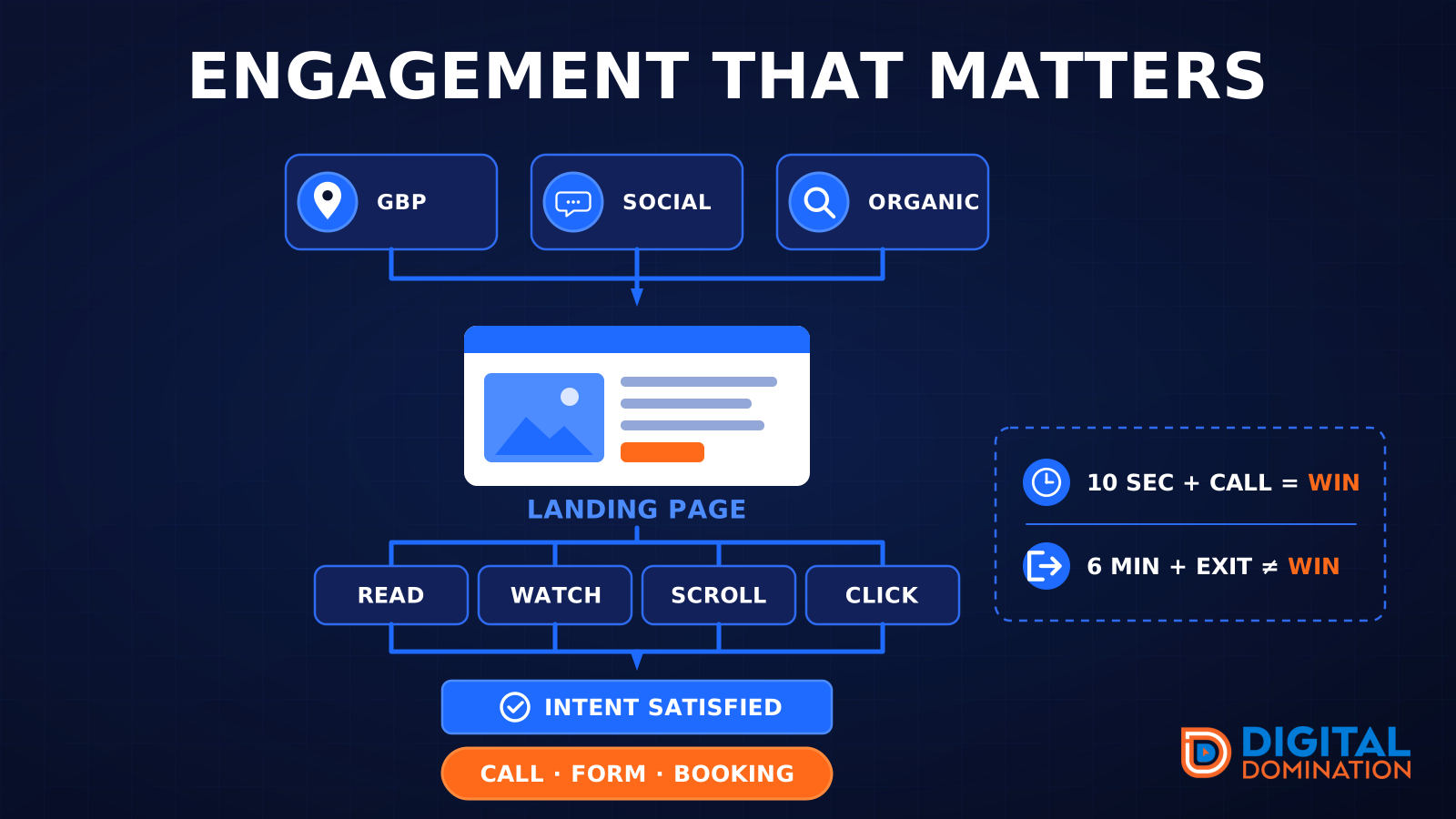
Search Console and GA4 do not rank anything. They turn the website from a project into a loop. Search Console shows which queries produce impressions and clicks, which page Google chose, average position, Core Web Vitals status and structured data errors. If the homepage picks up impressions for pet turf cost while the pet turf page does not, that page needs the cost section, the internal links and its Service and Offer nodes.
GA4 shows what happened after the click, and a turf company has several conversions worth counting: click-to-call, sample requests, measure bookings and financing clicks all behave differently. The CRM closes the loop with what no marketing tool can see: which measures became signed jobs, the square footage, the application and the street. Square footage decides whether a source is any good, because a two hundred foot dog run and a two thousand foot backyard cost about the same to acquire:
- ▸Measure the baseline: GeoGrid position for artificial turf, pet turf and putting green terms separately, since they rank differently across one market, plus samples, measures and signed square feet by source.
- ▸Impressions without clicks: rewrite the title, the opening and the proof. Clicks without samples: check field speed and price language. Calls without signed jobs: check service area fit and minimum job size.
- ▸Treat sample requests as their own funnel. A buyer who takes samples and never books is telling you the follow up sequence is the leak, not the website.
Install videos, dealer locators and the neighbor who asks if it is real
Turf is the rare trade whose finished product provokes a question from every visitor to the house: is that real. That is free demand generation, but only if the company is visible somewhere other than its own website. The content that performs is not the finished yard, which every competitor posts and which all looks identical. It is the part nobody else films: the base going in, the plate compactor, the seam being taped and glued, the infill being brushed:
- ▸Short install videos and one-year-later clips on Instagram, Facebook, YouTube and TikTok, captioned with the application and the neighborhood.
- ▸A profile post every week tied to a real job and linked to the matching page. Google Search Console now reports supported social and video platform properties, which shows how far social content and search discovery have converged.
- ▸Your entry on the manufacturer's dealer locator, the Synthetic Turf Council directory, Houzz, Yelp and the chamber, all repeating the same name, phone, license number and service list.
- ▸A claimed Nextdoor page, because the thread asking who did that turf is where this trade's referrals live, and a mention with no link still connects the brand, the application and the neighborhood.
- ▸Reddit as one input rather than a plan. Axios reported in August 2026 that Reddit's share of visible ChatGPT Search citations fell roughly 86 percent, and OpenAI still holds a Reddit data partnership, so a thread naming your company still corroborates the entity.
A 90-day roadmap timed to land before the buying window opens
Turf demand concentrates. It rises with the first stretch of warm weather, with watering restrictions in the news, and with the run up to graduations and summer, then falls off when the weather turns. Ninety days of work finished the week before the season starts is worth several times the same work finished in the middle of it:
- ▸Days 1-14, baseline: run GeoGrid scans separately for artificial turf, pet turf and putting green terms; settle the primary category in the live picker; audit every profile field, photo and service; check license, insurance, certifications and warranty documents against the issuing records; run PageSpeed on the home page and the top application page; and make samples, calls and measures separate GA4 events reaching the CRM with square footage attached.
- ▸Days 15-30, the base layer: fix the category, rebuild the services list around applications, and replace supplier stock photos with your own base, seam and finished shots; rewrite the first screen with license, base spec, product specs, warranty and the sample offer; publish installed starting ranges per square foot; and deploy the schema graph with permanent identifiers.
- ▸Days 31-60, applications and proof: publish a real page per application with its own cost and process sections; rewrite every distributor product page in your own words; answer the heat, odor, drainage and maintenance objections; launch the walkthrough ask and the first-cleaning ask; and match the dealer locator, Houzz and Nextdoor listings to the profile exactly.
- ▸Days 61-90, the loop: rewrite the pages with impressions but no clicks and clicks but no sample requests; compare lead sources against signed square feet and build the next city pages where the jobs are biggest; add the HOA and water authority answers per city; then rerun the GeoGrid scan and compare it with day one.
One turf company, described the same way on the sample, the profile and the schema
The goal is not a completed profile, a fast website or a schema plugin. It is one clearly described artificial turf company whose license, crew leads, base specification, product lines with their real face weights and warranties, installed pricing, service area, reviews and photographs say the same thing on the Google Business Profile, the website, the structured data, the manufacturer's dealer page and the sample you hand across the tailgate. When all of those agree, relevance and prominence follow, and the measure gets booked with you.
That is the entity a woman on a back step with a towel and a muddy dog decides to trust, and the entity an answer engine cites when someone asks who installs pet turf in her city. At Digital Domination we build it in that order and stand behind it with one promise: top 3 in the Google Map Pack in 12 weeks or you do not pay. If your company shows up from its own yard and disappears three subdivisions over, start with the free GeoGrid scan. It checks 169 points across your market and shows which streets can see you.
Keep reading
Related guides
Put it into action
Frequently Asked Questions
What Google Business Profile category should an artificial turf installer use?
Google's picker has no category meaning artificial turf installer, so read the live list in your own profile before deciding, because the options change without notice. In most markets an installation category should be primary, with Turf supplier or Sod supplier secondary only if you genuinely sell material. Leaving Lawn care service as the primary because the company started as a mowing route tells Google you maintain living grass.
Should an artificial turf company publish prices per square foot?
Yes, as installed starting ranges tied to a stated grade and face weight, not as a rate card. Buyers are handed a per foot number by an AI answer before they call, so a page saying call for a quote is absent from that answer while a competitor's number becomes the anchor. Name the variables that move the price, then connect the same language to schema with an Offer and a UnitPriceSpecification.
My product pages came straight from my turf supplier. Does that actually hurt?
It does, and it is the most common structural problem on turf websites. Every dealer carrying that line publishes the same paragraphs and the same manufacturer photos, so nothing distinguishes your page and no search engine or AI answer has a reason to prefer it. Rewrite each product page in your own words, publish the specifications as visible text rather than an image, and use your own photos of that product installed in local yards.
Do I have to address heat and pet odor on the website?
Those two objections are the most searched questions in the category, and ignoring them sends the buyer to whoever will answer. Say what you actually do about each: infill selection and rinsing for surface temperature, and a permeable backing with a zeolite based infill plus a maintenance schedule for odor. A candid answer that admits a limitation builds more trust than a claim that turf never gets warm.
What schema type should an artificial turf company use?
HomeAndConstructionBusiness for the company, with a permanent @id, the contractor license as a PropertyValue identifier, Person nodes for the owner and crew leads, and a Service node per application. Add a Product node per turf line carrying face weight, pile height, backing and drainage rate as additionalProperty values, an Offer with a per square foot UnitPriceSpecification, and a WarrantyPromise for the warranty terms. The product half is what most turf sites lack entirely.
Why does site speed matter if a turf project takes weeks to decide?
Because the first contact is almost always on a phone, outdoors, on cellular, with competitors open in other tabs. Grass photographs compress badly, so a gallery of untouched originals plus a drone hero can push your phone number and sample form under several seconds of loading. The Core Web Vitals targets are LCP under 2.5 seconds, INP under 200 milliseconds and CLS under 0.1 at the 75th percentile of field data.
Should I list turf cleaning and repair if I would rather sell new installs?
List them. Existing turf owners search for cleaning, sanitizing, infill top off and re-seaming every spring, almost no competitor lists those services, and that visibility is cheap to win. A cleaning visit also puts your crew back on a street where the other yards are the same age, and re-seams and referrals come out of those appointments.
Does a showroom or sample display change how I set up the profile?
Yes. If customers can visit and handle samples, claim a storefront profile with real hours and photograph the sample wall and display panels. If nobody visits, run a service area business and hide the address rather than listing a storage lot, because Google verifies addresses and a suspension costs more than the listing gains. Either way, offer free mailed samples as a conversion step.
Ready to dominate your map?
Top 3 in the Google Map Pack in 12 weeks, or you don't pay.