
There Is No Longer One Position 1: The Dynamic SERP Update Explained
Google's May 2026 core update changed what a ranking even means. Here is what the data shows, why one scan now lies to you, and why covering the whole map beats chasing a single spot.
What Is the Dynamic SERP Update?
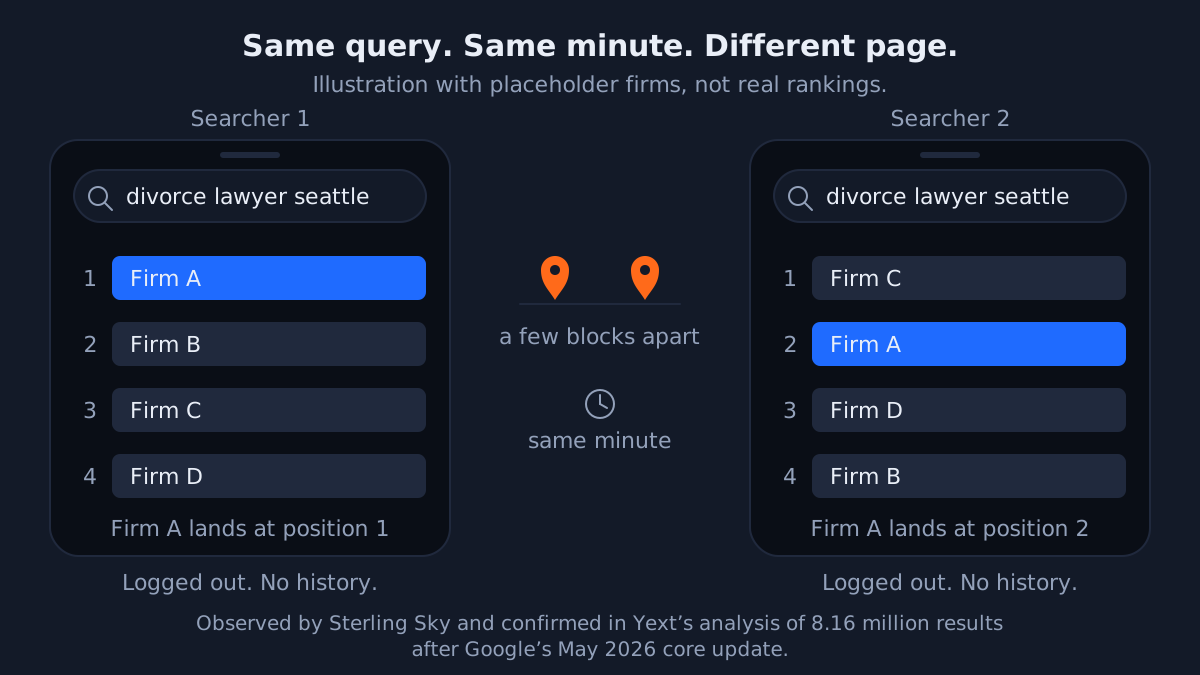
The Dynamic SERP Update is the name Sterling Sky's Joy Hawkins uses for a change that arrived with Google's May 2026 core update: two searchers a few blocks apart, typing an identical local query within the same minute, now routinely get different result pages, and that holds even when both are logged out with no click history.
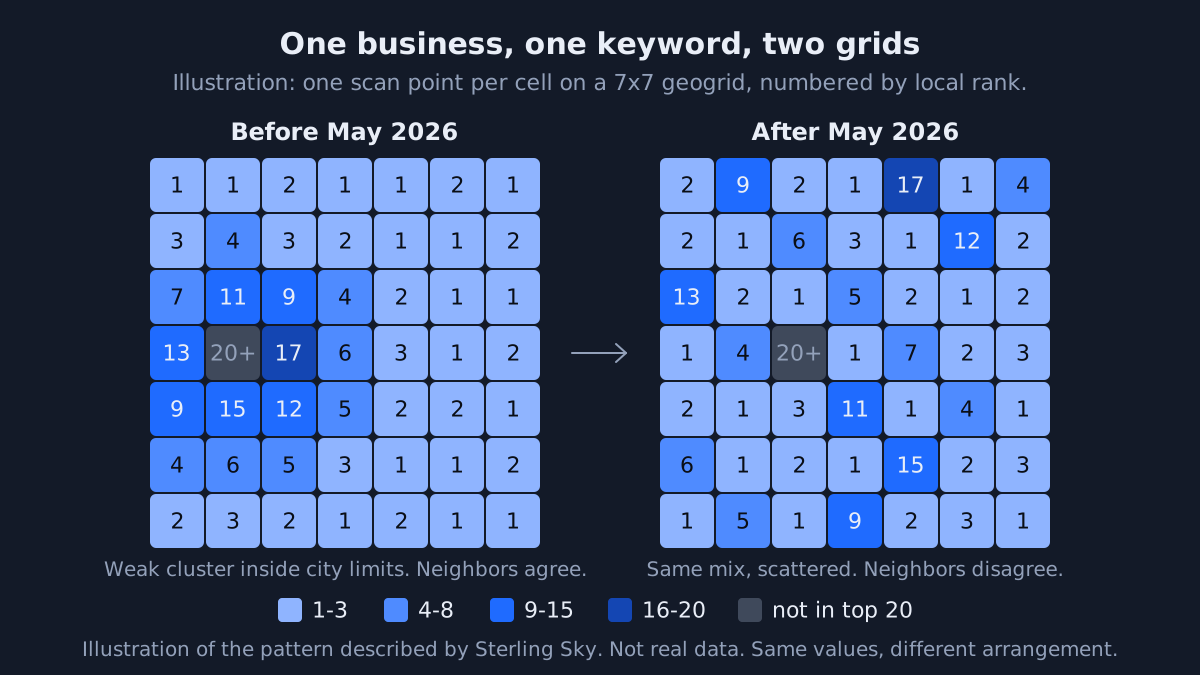
Before May 2026, organic results for a local query were reasonably stable across a city. After it, they shuffle by micro-location. A single rank check now tells you what one person saw at one spot at one moment, not what your market sees.
How it surfaced:
- ▸Working SEOs noticed two different results pages for the same keyword and started comparing notes.
- ▸Threads on the Local Search Forum and elsewhere: people who had tracked city-modified keywords for years reported their rank tracker said one thing while real searchers saw another.
- ▸Sterling Sky asked Yext to test the pattern at scale. The analysis confirmed a structural change in how Google assembles a local results page, not a handful of anomalies.
What Does the Data Show About Ranking Volatility After May 2026?
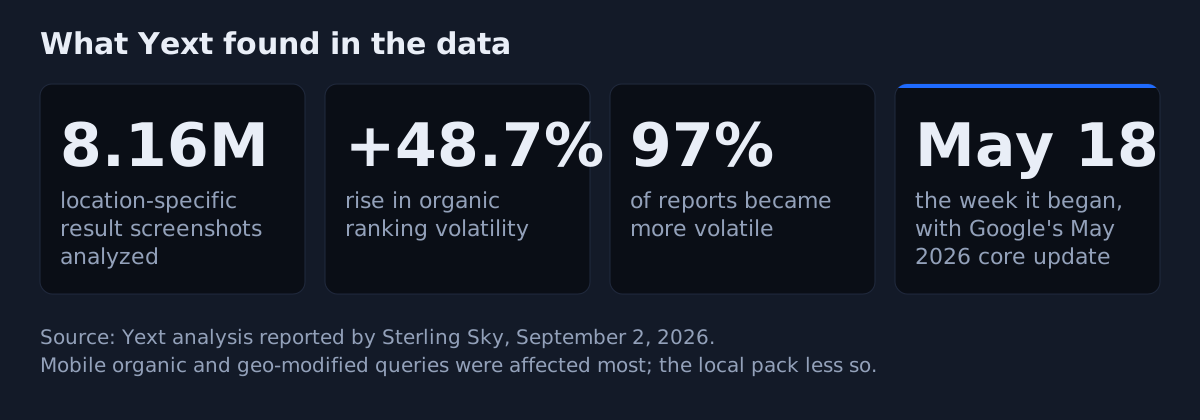
Yext examined 8.16 million location-specific search result screenshots and found that organic ranking volatility jumped 48.7% beginning in the week of May 18, 2026, the week Google's May core update rolled out. Of all the reports analyzed, 97% became more volatile.
The method matters. Instead of asking how far a ranking drifted from one day to the next, the analysis compared result pages captured at neighboring points during a single run and asked whether the organic order changed between them. That isolates the geographic shuffle from ordinary day-over-day drift.
Sterling Sky's video makes it concrete. A Phoenix business that had a logical, explainable grid before the update, ranking well everywhere except inside the city limits, now shows a scattered pattern: it ranks well in one area, ranks poorly in the next, and jumps back in the one after. They kept checking into August 2026 and the pattern had not settled. This was not a rollout wobble. It is the new shape of the results page.
Three patterns stood out in the findings Sterling Sky published:
- ▸Mobile organic results were hit hardest.
- ▸Keywords with a geo-modifier (a service plus a city name, the way real customers search) fluctuated more than the same keyword without the city.
- ▸The local pack, the map with three listings, was affected too, but less severely than the organic results beneath it. The organic results, which many people still pictured as a fixed list, were the part of the page the update shook hardest.
What Our Own Volatility Index Shows
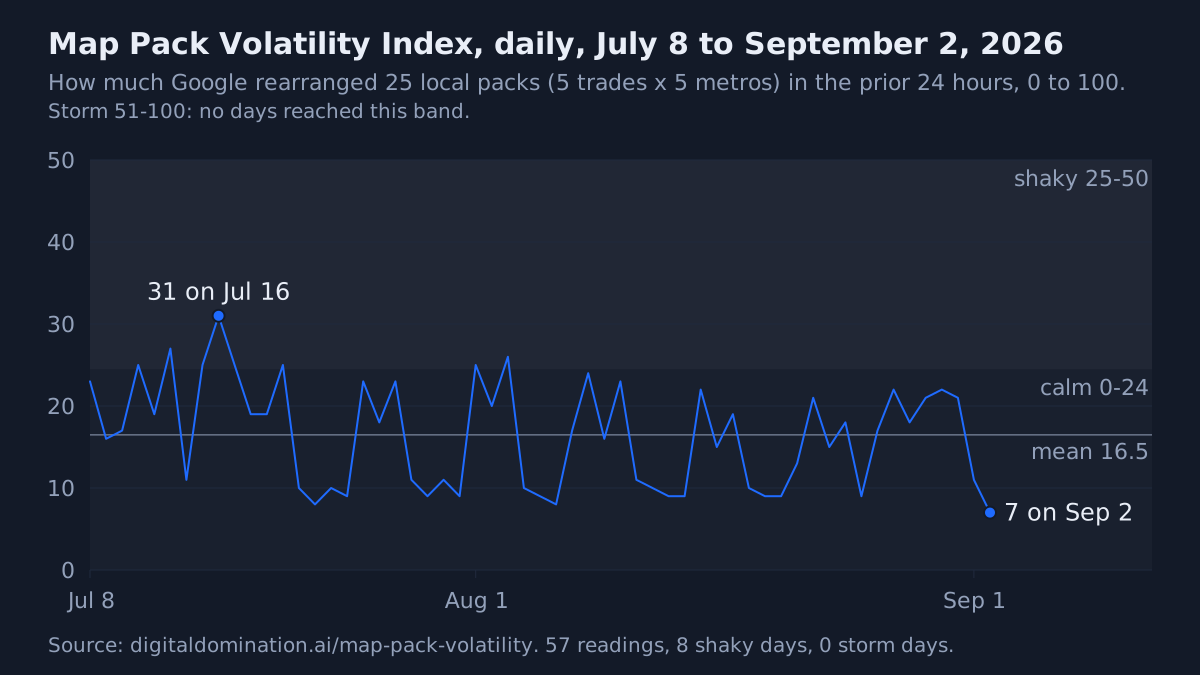
Our own data agrees, from a different angle. Digital Domination runs a daily Map Pack Volatility Index that re-scans 25 local packs (five trades: plumber, dentist, HVAC, barber, electrician, across five metros: Las Vegas, Phoenix, Denver, Dallas, Tampa) and scores how much Google rearranged them in the prior 24 hours on a 0 to 100 scale. It came online in July 2026, after the update, so it cannot show the May spike itself. What it shows is the steady state that followed.
In plain terms, the local pack is not being torn up every night. It is being nudged constantly, at a low but persistent level. That is exactly the kind of movement that makes a single scan unreliable while leaving the real winners identifiable over time.
Across 57 daily readings through September 2:
- ▸Index average: 16.5 out of 100.
- ▸Highest single day: 31 (July 16).
- ▸Days in the shaky band (25 to 50): 8 of 57.
- ▸Days in the storm band (51 to 100): none.
Is the Dynamic SERP Just Personalization?
No. Personalization, in the sense Google has used for years, means favoring results you have clicked before or tailoring to your account history. The Yext data that Sterling Sky relied on came from logged-out searches with no click history, and the variation still appeared. Two strangers with clean browsers, standing a few blocks apart, are being served different orderings of the same local query.
The more useful way to think about it: Google has long treated the local pack as location-sensitive, and local SEOs have long accepted that the map results depend on where the searcher stands. What changed in May 2026 is that the same sensitivity now applies, more aggressively, to the organic results. The idea of a single citywide ranking list for a local query no longer describes what Google is doing.
Sterling Sky is careful to say this is not randomness. Some complicated logic is presumably doing the assembling. But from the outside, the practical consequence is unambiguous, and Joy Hawkins put it in eight words worth remembering: "there is no such thing as position 1." There are only positions, plural, distributed across the geography of your market.
How Should a Business Measure SEO When Rankings Move by the Block?
Stop treating one search as the truth. Measure how often you appear, and how often you outrank the competition, across a large number of searches.
Sterling Sky's central point is sample size. A single scan captures one moment at one spot. Only a large volume of scans lets the pattern show through the noise. When they aggregated thousands of results for a competitive legal query, clear winners and losers emerged: certain firms were present most of the time, others surfaced only now and then, and no single check could have told the two groups apart.
What to measure instead:
- ▸Geogrid coverage, not a rank. A geogrid scan runs the same query from dozens or hundreds of points across a market and shows visibility as a coverage map. Our free GeoGrid scan checks 169 points across your service area for exactly this reason, and our guide to S2 cells explains the geography underneath the grid.
- ▸Share of visibility: how often you appear, and how often above your competitors, across all those points.
- ▸Call tracking on your pages, so you know which ones produce calls.
- ▸UTM parameters on every Google Business Profile link, so you can see which clicks and leads actually come from your profile.
- ▸Revenue, calls and leads as the scoreboard. A ranking was only ever a proxy for the business it brought in, and under a dynamic SERP those are the only numbers that cannot be an artifact of where someone happened to be standing.
What This Means If You Own the Business
Four rules for reading any ranking information from here on:
- ▸Searching for your own business is not an audit of your campaign. Your phone and your browser are one location and one moment.
- ▸If your ranking tool disagrees with what you see, that is now expected, not a malfunction.
- ▸Before you act on any report, ask how many data points sit behind it.
- ▸Give a lone check the same weight whether it flatters you or alarms you: it is a single reading, nothing more.
Why Coverage Beats Position: Multiple Locations, Multiple Sites, and AI Search
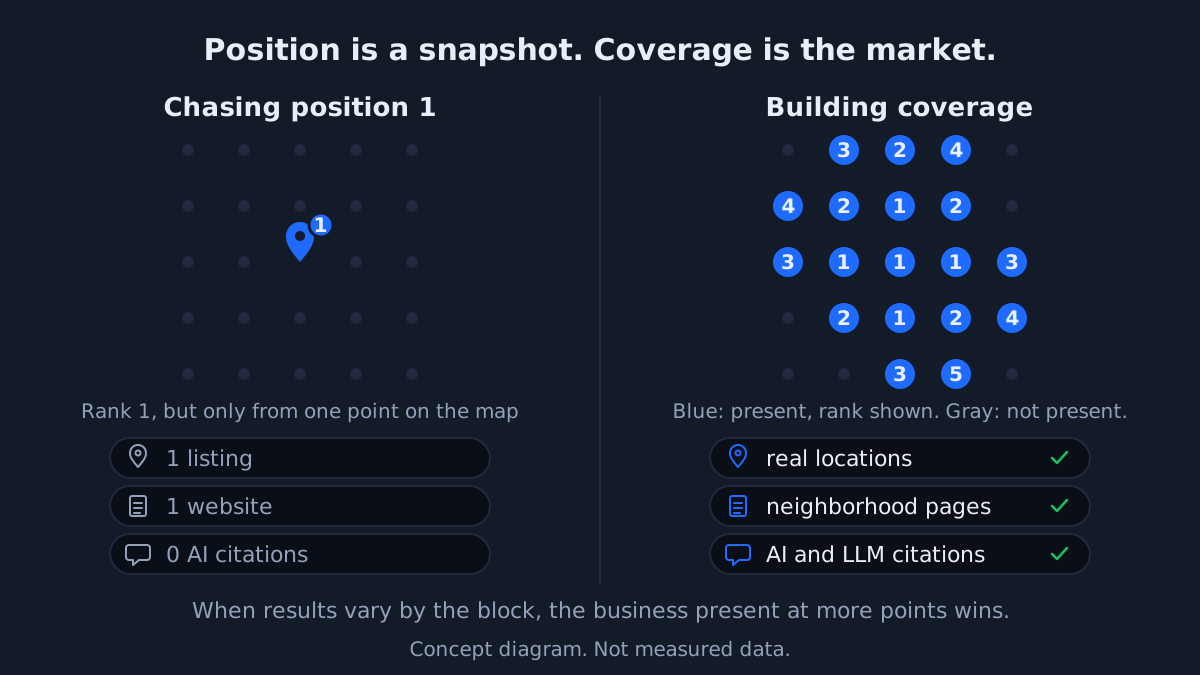
If results vary by micro-location, the businesses that win are the ones present at more points, on more surfaces, under more entities. A single listing and a single website optimized to hit one spot is a strategy built for a results page that no longer exists. Coverage is the rational response to volatility, and it works along four dimensions:
- ▸Real locations. Google's local results are anchored to physical points, and proximity has always been a heavy factor in the map pack. A business with legitimate locations in more parts of a metro has more anchors in the proximity math, so when the pack shuffles by neighborhood it is present in more of those neighborhoods.
- ▸Multiple pages, structured deliberately. A hub-and-spoke site architecture gives Google a dedicated, location-specific page for each neighborhood you serve, so the organic results, the part of the page the update shook hardest, have many relevant pages of yours to choose from rather than one. Where it makes sense, separate properties for distinct service lines or regions extend the same logic. Our hub-and-spoke silo guide covers the structure, and it is what we deploy in weeks five through seven of our program.
- ▸AI search. Google AI Overviews, ChatGPT, Perplexity and the rest have not been shown to shuffle by city block the way the ten blue links now do. They cite entities: businesses with consistent information, strong review signals, clear service definitions and structured data. As the classic results page becomes less stable, being the cited business in the AI answer layer is worth more. Our AI SEO for local business playbook and our guide to ranking in AI Overviews cover how those engines choose who to name.
- ▸LLM SEO as its own discipline. Large language models build a picture of your business from everything crawlable about it: your site, profile, reviews, citations and mentions. Making that picture accurate, complete and consistent is different work from chasing a keyword position, and far less exposed to by-the-block variation. A business the models understand well is recommended regardless of which micro-SERP a searcher happens to load.
Proof at Scale: A1 Garage Door Across Phoenix
Coverage through locations only works with genuine locations that meet Google's Business Profile guidelines: real premises where your staff are present during the hours you list and where customers are actually served. Fake addresses, virtual offices, mailboxes, and any address set up only to earn a listing are a policy violation and a suspension risk, and a suspended profile has a visibility of zero everywhere. If a location could not pass a Google verification visit, do not list it.
With that rule in place, here is the strategy at scale, in the same metro as Sterling Sky's grid example. On September 2, 2026, Reuters reported that KKR had agreed to acquire A1 Garage Door Service, founded in 2007 by Tommy Mello, for around $2 billion. The same day, Noah Igler (@noahiglerSEO) posted a map showing more than 15 A1 Google Business Profiles spread across the Phoenix metro, from Anthem and Cave Creek in the north to Casa Grande in the south, and from Peoria in the west to Queen Creek and Fountain Hills in the east, each pin drawn with the radius a single listing can realistically rank inside. His read, offered as his read: one location can only rank so far from its address, so A1 kept adding pins until a Phoenix homeowner could barely search for garage door repair without finding them.
Whatever else went into a $2 billion valuation, A1's Phoenix footprint is the coverage strategy in practice. Many locations, each anchoring proximity in its own part of the metro, mean the company appears in far more of the result pages Phoenix searchers actually load than any single-location competitor can. Will Schryver of SchryverCo, who tracks acquisitions in the trades, estimated from the Reuters report that A1's earnings had grown from about $30 million in EBITDA at Cortec's 2022 investment to more than $80 million at this exit. Terms were not disclosed, so treat that as an estimate. The lesson is the footprint, not a shortcut, and the guideline test above applies to every one of those addresses.
Put together, the conclusion is simple. When there is no single position one, you cannot win by aiming at it. You win by being present at more points on the map, on more pages in the organic results, and as the named entity in the AI answers that sit above both.
Why Single-Tactic SEO Breaks Under a Dynamic SERP
A lot of local SEO is sold as one trick: a driving-directions engagement hack, a burst of citations, a review campaign with no follow-through, a batch of backlinks. Each tries to move one signal and hopes the rest of the system follows. Under the old, relatively stable results page, a single lever could sometimes produce a visible bump that looked like success in a rank tracker. Under a dynamic SERP, that same bump is indistinguishable from noise, because the tracker was going to move anyway.
Driving directions is the clearest example. The tactic tries to simulate proximity and engagement by generating direction requests to a listing. It targets exactly one input. It does nothing for the organic results, the part of the page the update shook hardest, nothing for the AI answer layer, nothing for whether the business is understood as an entity, and nothing for whether a visitor converts once they arrive. Whatever Google does or does not do about manufactured engagement, a tactic that addresses one signal on one surface cannot produce durable coverage across a results page that varies by the block.
This is why we built our program around the whole system rather than any single hack. Real local visibility rests on six pillars working together:
- ▸Google Business Profile optimization
- ▸Review velocity and sentiment
- ▸Citation and directory consistency
- ▸Hub-and-spoke website architecture
- ▸Inbound link authority
- ▸Schema markup and technical SEO
The 12-Week Protocol Behind It
The authority point is not that we do more things. It is that the results page Google now serves rewards businesses present everywhere the searcher might be looking, while the ones that optimized for a single spot that no longer exists simply appear in fewer of the pages people actually load. Measuring by geogrid instead of by rank, tracking calls and UTMs instead of positions, and building coverage across locations, pages and AI surfaces are not separate tactics. They are the same response to the same change, and they are the whole of what we do.
Our 12-week protocol runs the six pillars as one system, with weekly reporting and an independent verification at week twelve:
- ▸Weeks 1 to 2: baseline geogrid audit and S2 mapping
- ▸Weeks 3 to 4: BERT-optimized service pages with schema
- ▸Weeks 5 to 7: neighborhood spoke pages deployed
- ▸Weeks 8 to 10: review velocity and entity trust building
- ▸Weeks 11 to 12: ranking stabilization and independent verification
See Your Real Footprint, Not One Snapshot
If your ranking reports have started disagreeing with what you and your customers actually see, you are not imagining it, and you are not doing anything wrong. The results page changed. The honest next step is to measure it the way it now works: run a geogrid scan and look at coverage, not a single position.
Our free GeoGrid scan covers 169 points across your service area and shows exactly where you appear, where you vanish, and who is sitting in the spots you are missing. If you would rather talk it through, book a free 15-minute call and we will pull up your market live. We work with one client per trade per service area, and our program is built to put you in the top 3 of the Google Map Pack within 12 weeks or you do not pay.
Sources
Joy Hawkins, Sterling Sky, The Dynamic SERP Update: How the May 2026 Core Update Changed SEO, published September 2, 2026: https://www.sterlingsky.ca/the-dynamic-serp-update-may-2026-core-update-changed-seo/
Sterling Sky, Google's May Core Update: Why Local Rankings Suddenly Changed, video published September 2, 2026: https://www.youtube.com/watch?v=2KAFu2xf-Og
Yext ranking volatility analysis of 8.16 million location-specific search result screenshots, as reported by Sterling Sky in the sources above.
Reuters, KKR to acquire A1 Garage Door Service for around $2 billion, sources say, September 2, 2026: https://www.investing.com/news/stock-market-news/kkr-to-acquire-a1-garage-door-service-for-around-2-billion-sources-say-4886052
Noah Igler (@noahiglerSEO), map of more than 15 A1 Garage Door Service Google Business Profiles across Phoenix, posted September 2, 2026: https://x.com/noahiglerseo/status/2095212630143336955
Will Schryver (@Will_Schryver), SchryverCo, analysis of the KKR and A1 Garage Door deal citing Reuters, posted September 2, 2026: https://x.com/Will_Schryver/status/2095149589351240078
Digital Domination Map Pack Volatility Index, daily readings across 25 local packs in five trades and five metros, July 8 to September 2, 2026: https://digitaldomination.ai/map-pack-volatility/
Keep reading
Related guides
- ▸Google Maps Dining List Review Optimization
- ▸Google Maps Ocean Pin Bug Service Area Businesses
- ▸Google Maps optimization services near me
Put it into action
Frequently Asked Questions
What is the Dynamic SERP Update?
It is the name Sterling Sky uses for a change that arrived with Google's May 2026 core update, in which searchers a few blocks apart who run an identical local query at the same moment get different results, even when logged out with no search history. Organic results for local queries now vary by micro-location instead of being roughly stable across a city.
When did the May 2026 core update start affecting local rankings?
The week of May 18, 2026. Yext's analysis of 8.16 million search result screenshots found organic ranking volatility rose 48.7% starting that week, with 97% of the reports examined becoming more volatile. Sterling Sky reported the pattern was still present in August 2026.
Did the update affect the Google Map Pack or organic results more?
Organic results, and mobile organic results most of all. The local pack was affected too, but less severely. Queries that include a city or location word fluctuated more than the same query without one, which means the searches real customers actually type were hit hardest.
Is this just Google personalizing my results?
No. Personalization favors results tied to your account or click history. The data behind this finding came from logged-out searches with no history, and the variation was still there. Two strangers with clean browsers a few blocks apart now see different orderings of the same local query.
How should I track my rankings after the Dynamic SERP Update?
Use many scans, not one. A geogrid scan runs the same query from dozens or hundreds of points and shows coverage as a map. Alongside it, put call tracking on your pages and UTM parameters on your Google Business Profile links so you can tie visibility to actual calls and leads, which cannot be an artifact of where one searcher was standing.
Does the Dynamic SERP Update mean SEO is dead?
No. When Sterling Sky looked at thousands of results for a competitive query, clear winners and losers still emerged: some businesses appeared consistently, others only occasionally. SEO still decides who those winners are. What died is the idea that one rank check describes your market.
Why do multiple locations and multiple pages help under a dynamic SERP?
Because results now vary by micro-location, the businesses present at more points, on more relevant pages, and as the named entity in AI answers show up in more of the results people actually load. Real, staffed locations that meet Google's guidelines add anchors to Google's proximity math, a hub-and-spoke site gives the volatile organic results many pages of yours to choose from, and AI surfaces tend to cite consistent entities rather than shuffle by block.
What does the A1 Garage Door example show?
That coverage is what the market rewards. A1 Garage Door Service, founded by Tommy Mello, runs more than 15 Google Business Profiles across the Phoenix metro, according to a map posted by Noah Igler on September 2, 2026, the same day Reuters reported KKR had agreed to acquire the company for around $2 billion. Igler's read, which he offered as his read, is that each location can only rank so far from its address, so A1 kept adding locations until Phoenix homeowners could barely search for garage door repair without finding them. The same guideline rules apply to every address: real premises, staffed, serving customers.
Why is a single tactic like driving directions not enough anymore?
A driving-directions hack targets one signal on one surface. It does nothing for organic results, the part of the page the update shook hardest, nothing for AI answers, and nothing for conversion. Under a results page that varies by the block, one lever cannot produce durable coverage, and any bump it creates is indistinguishable from the shuffle that was going to happen anyway.
Ready to dominate your map?
Top 3 in the Google Map Pack in 12 weeks, or you don't pay.