
Home remodeler local SEO: how GBP entity signals, schema and PageSpeed win the remodel before the first design consultation
The crew that cuts the tightest miters does not automatically get the kitchen. The remodeler Google can read, a homeowner can vet from the edge of a bathtub and a phone can load before she gives up does.

Five weeks to discharge and a tub wall her mother cannot step over
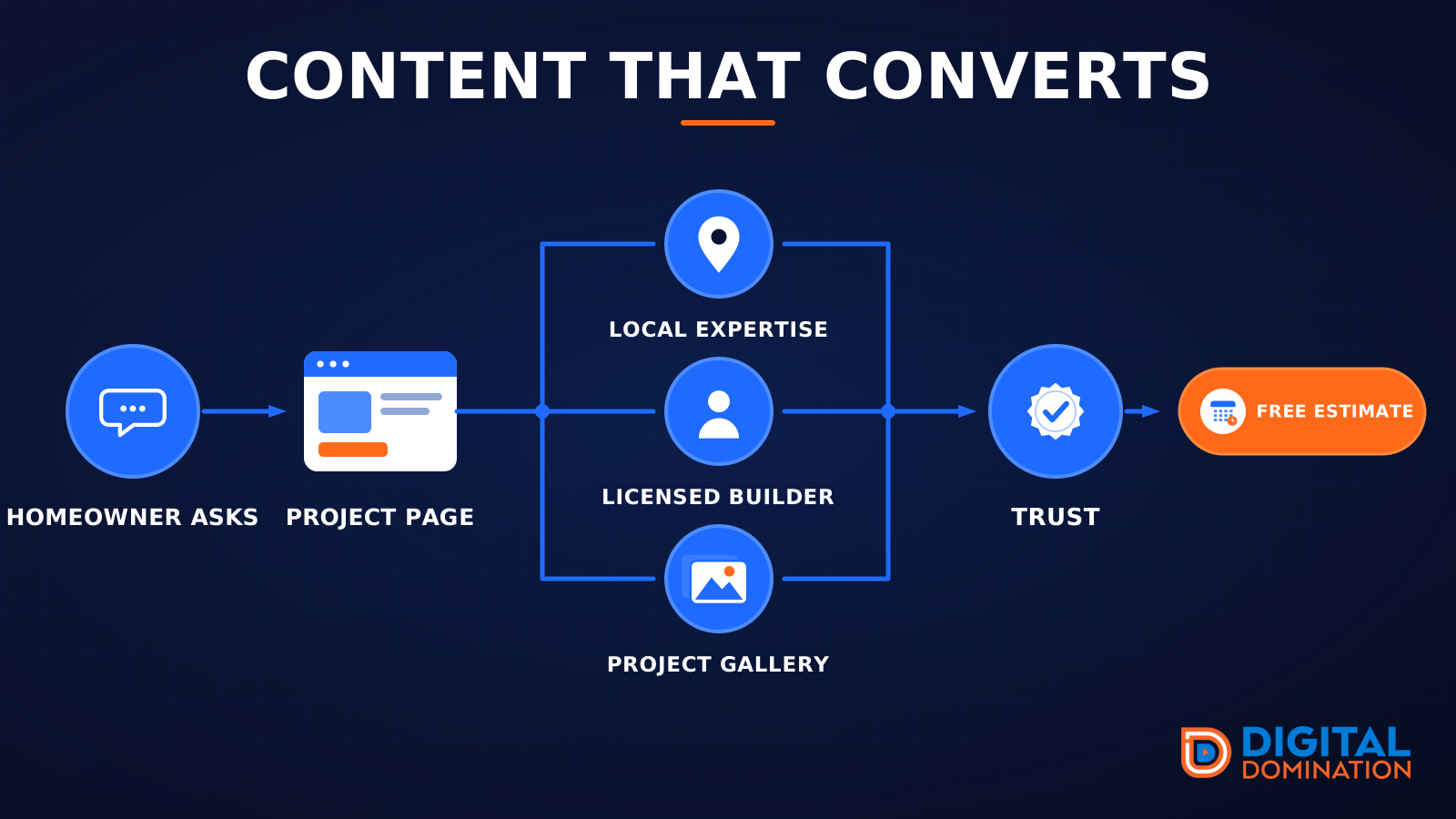
The call comes from the rehab facility on a Tuesday: her mother can come home in five weeks if the house has a bathroom she can enter without stepping over a tub wall. That night the daughter sits on the edge of that tub and searches walk-in shower conversion near me, then bathroom remodel for elderly parent. She reads two ratings, opens the profile that shows a curbless shower with a fold-down bench and a service called Aging-in-place bathroom remodel, notices a designation she can look up (Certified Aging-in-Place Specialist), and books a design consultation for Thursday. Nine minutes, start to finish.
The remodeler across town who has built two hundred of those showers may never have appeared in that three-pack. Its profile says General contractor and lists no services, so Google has no reason to connect it to a shower conversion. Its website opens on a full-screen kitchen video and a before-and-after slider that takes eight seconds to become usable on a phone. No license number on the first screen, no name of the person who would run the job, and the only price language is a button that says request a quote. She did not hire the better remodeler. She hired the one she could evaluate from the edge of a bathtub.
The short version, written on the back of a change order
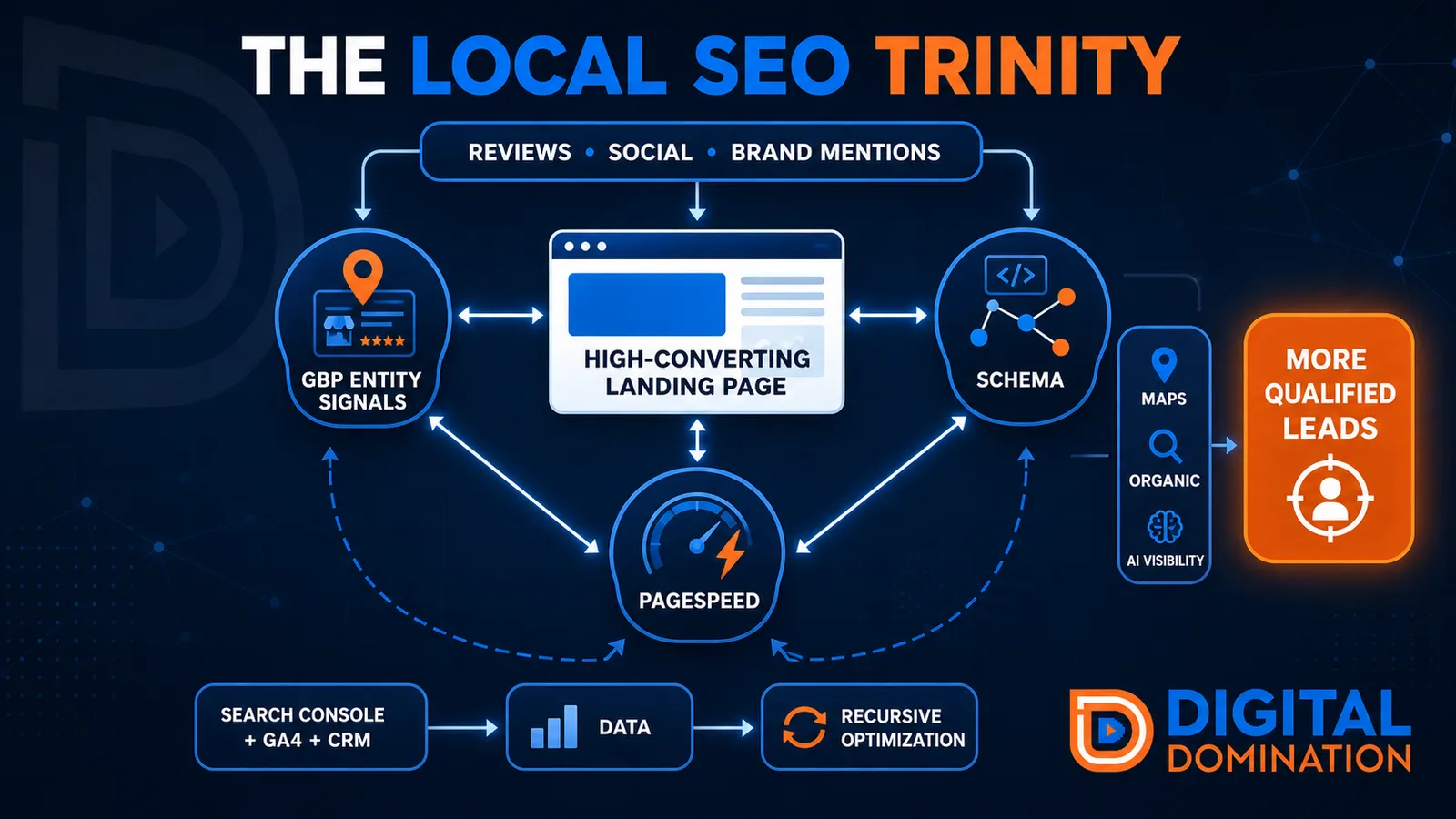
Google ranks local results on relevance, distance and prominence. Distance is set by where the homeowner is sitting, so the fight you can win is relevance, prominence and conversion across every neighborhood your crews actually mobilize to. Remodeling adds a wrinkle the emergency trades never face: the buyer takes weeks or months to decide and checks you three or four times along the way, so every piece has to hold up on the third visit, not just the first. At Digital Domination we build remodeler local SEO as three pillars with a measurement loop around them:
- ▸Google Business Profile entity signals establish that you are a remodeler, which rooms and project types you take on, who runs the work and where you build.
- ▸Schema turns the company, its license, its designers and project managers, each room service, its starting ranges and its service area into a machine-readable graph with permanent identifiers.
- ▸PageSpeed makes the portfolio, the license and the consultation button usable on a phone before the homeowner gives up, and readable by the AI agent shopping on her behalf.
- ▸Search Console, GA4 and the CRM show which searches became consultations, which consultations became design agreements and which agreements became signed contracts.
GBP entity signals: the Remodeler category, the rooms you rebuild and the streets you drive to
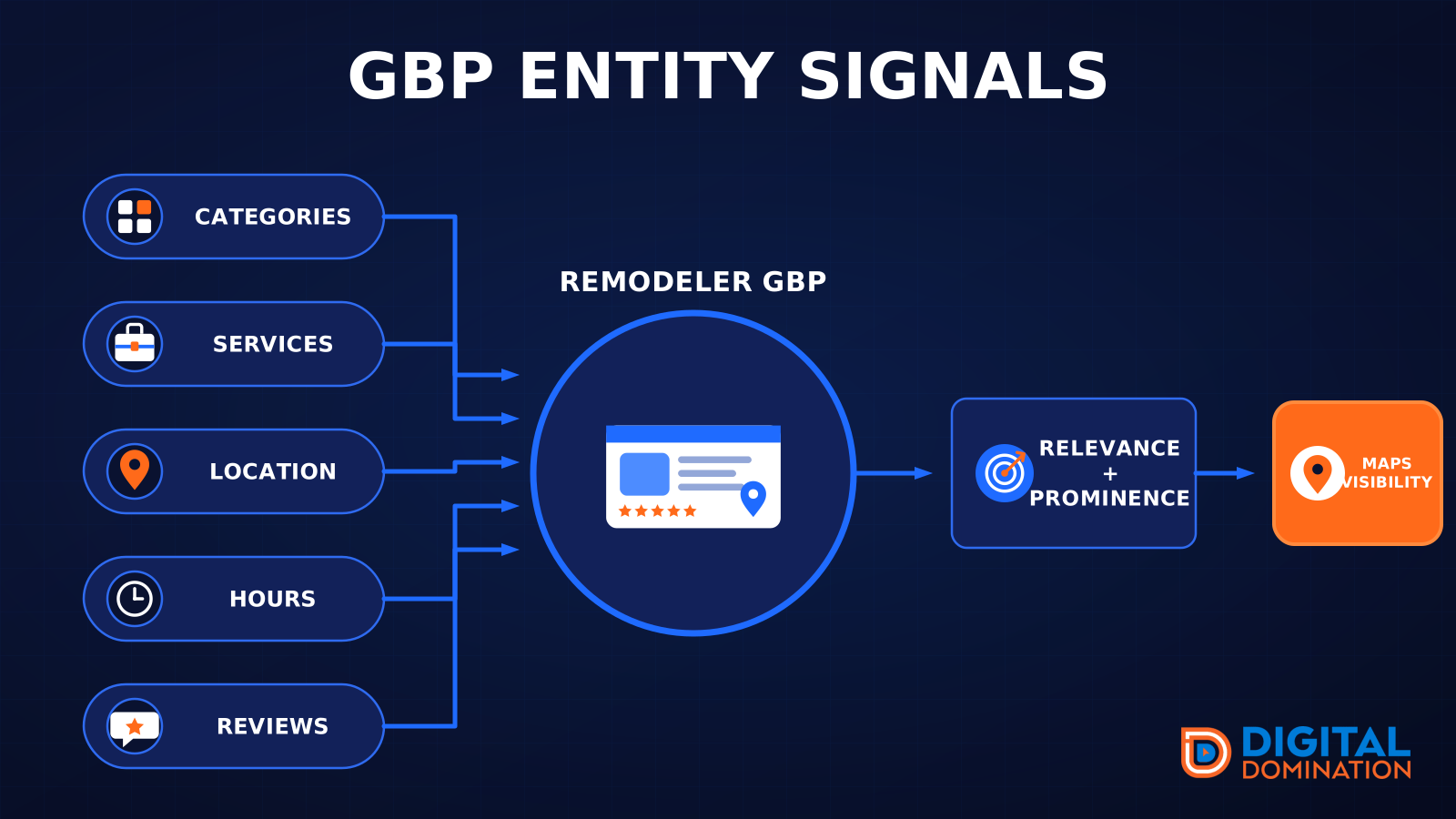
The primary category is Remodeler. If one room is most of your revenue, Kitchen remodeler or Bathroom remodeler can be primary with Remodeler as a secondary. Add General contractor only if you hold that license and want that work; it pulls in handyman and commercial calls and blurs what the entity is. Other secondaries that fit: Countertop contractor, Tile contractor, Interior designer for a design-build firm, and Construction company if you build additions.
Photos do the selling. Upload before-and-after pairs shot from the same angle, captioned with the room, the scope and the neighborhood, plus progress shots of demo, rough-in and the inspection tag on the wall, because those prove permits were pulled. Add the designer, the project manager and the trucks, and skip stock kitchens. Set the service area by the cities and neighborhoods you will actually send a crew to, and give each one a landing page with that jurisdiction's permit process, its HOA realities, local project photos and reviews from that area. That page, tagged with UTM parameters, is the link the profile should carry, not the homepage.
Services are where most remodeler profiles sit empty. Homeowners search by room and by problem, never by the word remodeler, and Google needs the same vocabulary on the profile and on the page it links to. Build the list from what the design consultations are actually about:
- ▸Kitchen remodel, with separate entries for cabinet refacing, cabinet replacement, countertop replacement and full renovation with a layout change, because each is searched and priced differently.
- ▸Bathroom remodel, tub-to-shower conversion, walk-in shower installation, primary bathroom renovation and aging-in-place bathroom remodel with curbless showers and grab bars.
- ▸Whole home remodel, home addition, garage conversion, casita or accessory dwelling unit, and basement finishing where your market has basements.
- ▸Design-build services, 3D renderings and permit drawings, so the homeowner learns you handle the design phase and not only the construction. Leave off flooring, painting and drywall unless you sell them alone, or you will attract single-trade calls.
- ▸Attributes and hours that match reality: onsite estimates, online consultations, languages spoken, and hours that show when a person answers, including Saturday design appointments if you take them.
The proof a homeowner checks before writing the deposit check
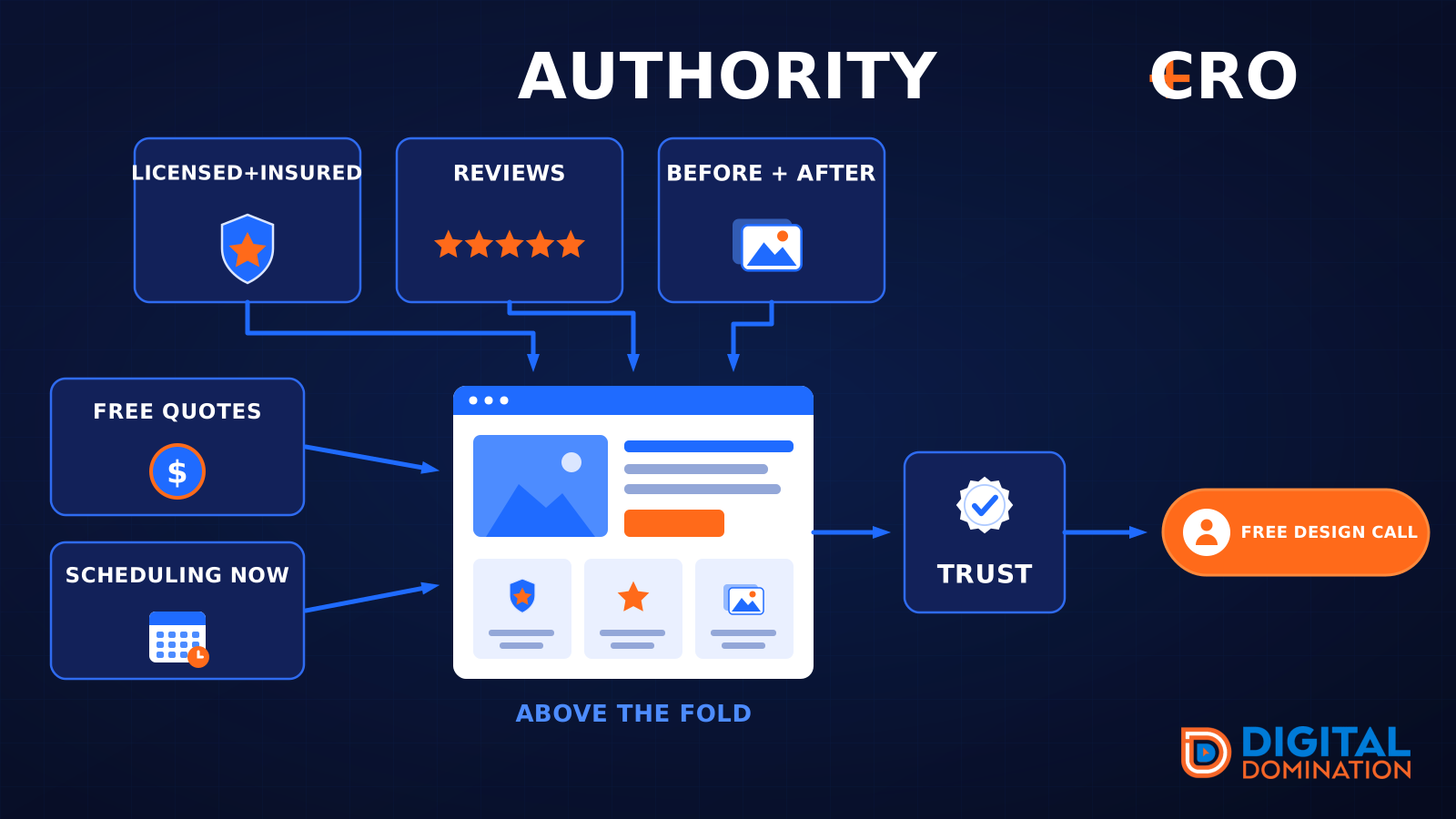
A remodel is the largest check most families ever write to a company they found on a phone, and the story they have all heard is the contractor who took the deposit and vanished. The first screen has to answer two questions before it says a word about dream kitchens: are you allowed to do this work, and will you still exist when the warranty is needed. Put the credentials in an authority strip under the headline. An illustrative strip for a generic company might read: Licensed B-2 contractor, NARI member, 18 years remodeling the valley, 4.9 stars from 200+ reviews, two-year workmanship warranty. Those are example figures only. The details to put at the top:
- ▸State contractors board license number, classification and monetary limit, written exactly as the board lists them and linked to your board record. In Nevada that is the Nevada State Contractors Board, where most remodelers hold a B-2 Residential and Small Commercial license with a monetary limit a homeowner planning an addition will check.
- ▸Bond, general liability and workers compensation, because a remodel puts your crew and your subcontractors inside an occupied house for weeks, and EPA Lead-Safe Certified Firm status if you work on homes built before 1978, which the renovation rule requires and almost no competitor mentions.
- ▸Memberships and designations that are real for this trade: NARI or NAHB Remodelers, Certified Kitchen and Bath Remodeler, Certified Aging-in-Place Specialist, and NKBA for the design staff.
- ▸Workmanship warranty length in plain words, separate from the manufacturer warranties on cabinets, countertops and fixtures, plus the cabinet lines and quartz brands you carry, because those names are already in her saved photos.
- ▸Who designs, who runs the job and who answers the phone, with names and real photos, and a plain statement that you pull permits, schedule inspections, handle HOA submittals and tie payments to completed milestones rather than to the calendar.
Reviews that mention the schedule, the dust and the change orders
Remodelers have a review problem the emergency trades do not: you may finish four projects a month, not four a day, so every job has to produce a review and the timing has to be right. Ask in person at the final walkthrough, while the homeowner is standing in the finished room, then text the direct link that evening. Design-build firms can ask twice, once when the design is approved and again at completion. A company with 300 reviews and nothing since last spring looks dormant next to a competitor earning two a week; recency and velocity count alongside the average.
What the review says matters as much as the stars. A homeowner considering a remodel is afraid of three things: the schedule slipping, the house becoming unlivable and the price growing. A review that says the Henderson kitchen finished on the promised date, the crew sealed off the living room and vacuumed every night, and the only change order was one the homeowner asked for, answers all three and ties the room, the city and the project manager together for Google. Coach it by asking which room we remodeled and what surprised you about the process. Respond to every review naming the room and area, and quote the best ones on the matching service page.

Schema architecture for a design-build remodeler, anchored on HomeAndConstructionBusiness
Schema is JSON-LD that labels what is already visible on the page so search engines and AI systems stop guessing. With it, Google understands that the company is a HomeAndConstructionBusiness, that a named designer and project manager work for it, that the license belongs to it, that a tub-to-shower conversion is a Service it offers from a stated starting range, and that the service is available in specific cities. Most remodeler sites we audit run the default LocalBusiness output of a page builder plus a Houzz badge, which models none of those relationships. The graph that works:
- ▸The company: HomeAndConstructionBusiness with name, telephone, address or service-area designation, priceRange, openingHoursSpecification and a permanent @id such as yourdomain.com/#business, referenced on every page instead of redeclared.
- ▸The license: hasCredential pointing to an EducationalOccupationalCredential, the license number as a PropertyValue under identifier, the state board as recognizedBy, and memberOf for NARI, NAHB or NKBA.
- ▸People: Person nodes for the owner, lead designer and project managers with worksFor pointing to the business @id, a jobTitle, a photo, knowsAbout for kitchens, baths or additions, and their own hasCredential for CKBR or CAPS.
- ▸Each project type: a Service node (kitchen remodel, bathroom remodel, tub-to-shower conversion, whole home remodel, addition, ADU) with serviceType, a description matching the page, its own @id, and an Offer whose PriceSpecification carries the starting range, the currency and the scope it assumes, plus a separate Offer for the design fee.
- ▸Service area and corroboration: areaServed on the business and each Service as City or Place entries rather than a radius, and sameAs to the board record, Google Business Profile, Houzz, the NARI directory, BBB, Instagram and YouTube.
- ▸Proof: ImageObject for captioned before-and-after pairs, Article for each project story with about pointing at the Service and author at the Person, VideoObject for reveal videos, Review and AggregateRating only from reviews shown on the page, and BreadcrumbList everywhere.
PageSpeed when the before-and-after slider is the whole website
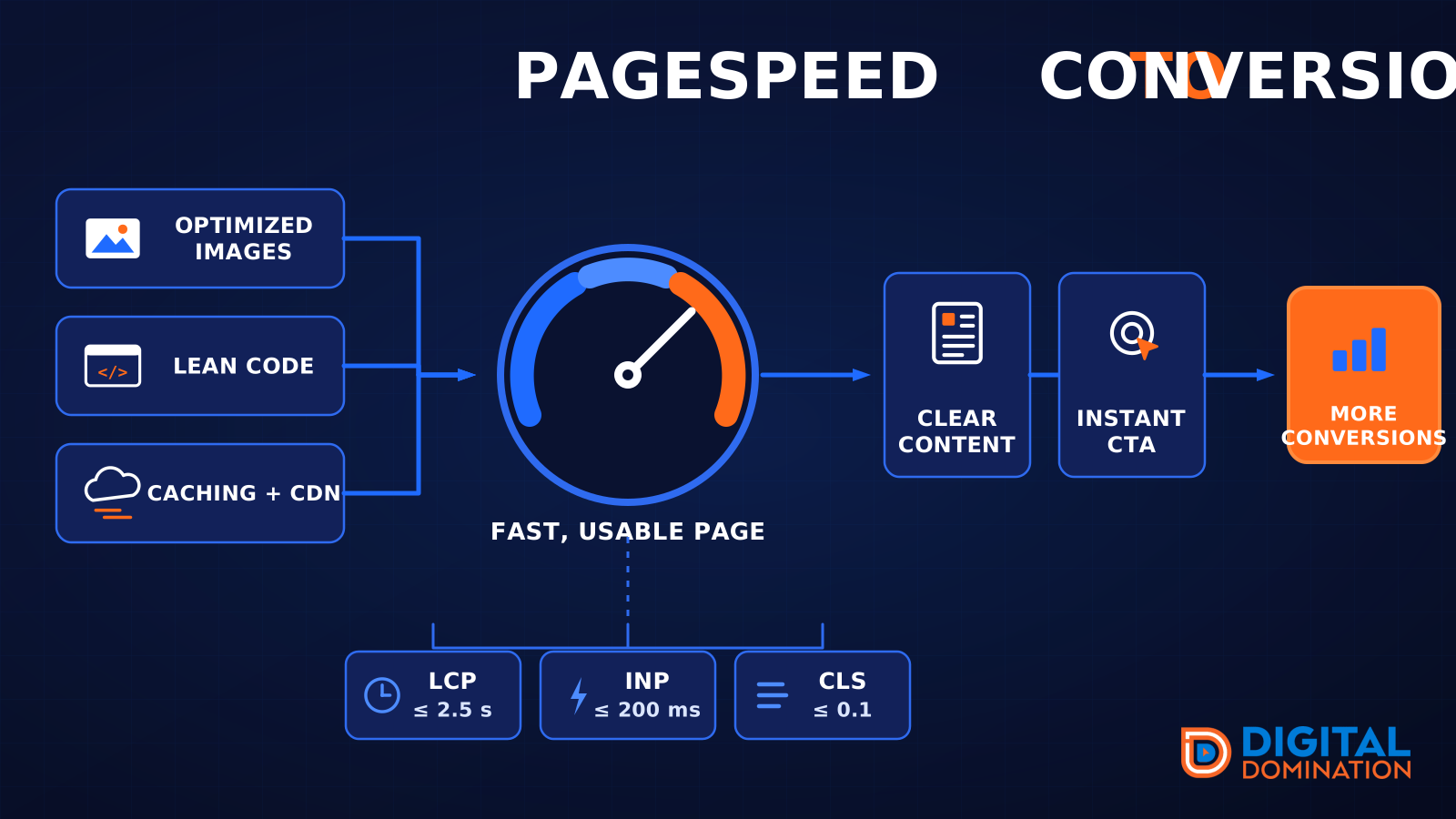
Remodeler sites are built to be looked at, and that is exactly why they are slow. The typical one opens on an autoplay kitchen video, then a JavaScript before-and-after slider, eighty full-resolution photos straight off a phone, a live Instagram feed, a Houzz badge, a financing widget and a chat bubble, all loading before the license number or the consultation button. Google's good thresholds for Core Web Vitals are a Largest Contentful Paint of 2.5 seconds or less, Interaction to Next Paint of 200 milliseconds or less and Cumulative Layout Shift of 0.1 or less, measured at the 75th percentile of real field data. At Digital Domination we target a PageSpeed Insights performance score of 90 or higher and a 2/2 result on the agentic browsing check, because AI agents now open contractor pages on a homeowner's behalf, and a slider they cannot read is a portfolio they cannot cite. The fixes that pay off most on a remodeler site:
- ▸Resize every portfolio photo to the size it displays at, convert to WebP or AVIF, and lazy load everything below the first screen. A 5 MB kitchen photo shown at 600 pixels wide is the most common single failure.
- ▸Replace the autoplay video and the slider with one static hero image of your best finished room, preloaded and never lazy loaded, with the headline, license line and phone number rendered as text on top. Show before-and-after as two labeled images side by side instead of a script that blocks rendering.
- ▸Swap the live Instagram embed for a static grid of six captioned images linking to your profile, and load the financing widget and chat only after the first interaction.
- ▸Reserve width and height on every image, badge and form so the consultation button does not jump under her thumb, self-host fonts, use click-to-load for maps and video, and turn on caching and compression.
Starting ranges, design fees and allowances that AI Overviews can quote
Every remodel is custom, and that has become the industry's excuse for saying nothing about price. So when a homeowner asks an AI assistant what a kitchen remodel costs in her city, the answer comes from a national magazine or from the competitor who published a range. Honest starting ranges tied to scope do not commit you to a number; they qualify the lead before the consultation, which matters when every consultation costs a designer's afternoon. Put it on each room page, the FAQ and GBP services, and connect it to the Offer schema above. Language that works for remodelers:
- ▸A starting range per project type tied to a defined scope: a pull-and-replace kitchen that keeps the layout versus a full renovation that moves plumbing and walls, or a tub-to-shower conversion versus a primary bath taken to the studs.
- ▸What the design fee covers (measurements, renderings, selections, permit drawings), whether it is credited toward construction, and how allowances for tile, cabinets, countertops and fixtures work when the homeowner selects above them.
- ▸What changes the price: moving plumbing or gas lines, structural work on load-bearing walls, electrical panel upgrades, permit and plan check fees, asbestos or lead abatement in older homes, and HOA requirements.
- ▸How the payment schedule is tied to milestones such as demo complete, rough inspection passed and cabinets installed, whether financing is available, and how far out your next start date is, because the wait list is a real buying consideration before the holidays.
Content that follows the homeowner from saved photos to the final punch list
A remodel buyer moves through five stages before she signs, and most remodeler sites speak only to the first. She saves photos for months, asks whether it is feasible (cost, permits, can that wall come out), vets contractors (license lookup, how design-build differs from hiring an architect and then a builder), lives through construction (how long, how dusty, where the family cooks), then owns the result (warranty, care of quartz and tile). Each room page should answer all five in scannable sections with direct answers under descriptive headings, because that is what AI systems retrieve and what a homeowner reads at 10 pm. Local depth separates you from a national article: the permit process in each jurisdiction, the architectural review rules of specific communities, and the slab, plumbing and wiring quirks of your housing stock by decade. Add the elements that turn pages into evidence:
- ▸A project story for every completed job worth showing: the homeowner's problem, the scope, the obstacle (the load-bearing wall, the slab leak found at demo, the cabinet lead time), the timeline and the result, with before-and-after photos captioned by room and neighborhood.
- ▸Named authors, meaning the owner or lead designer with a bio page, published and updated dates, citations to the local building department and manufacturer specifications, and short walkthrough videos with transcripts.
- ▸Comparison tables (refacing versus replacement, tub-to-shower versus full bath), plain definitions of allowance, change order and rough-in, and internal links that connect each room page to the people who build it, the cities where you built it and the project stories that prove it.
Search Console, GA4 and the CRM across a sales cycle that takes months
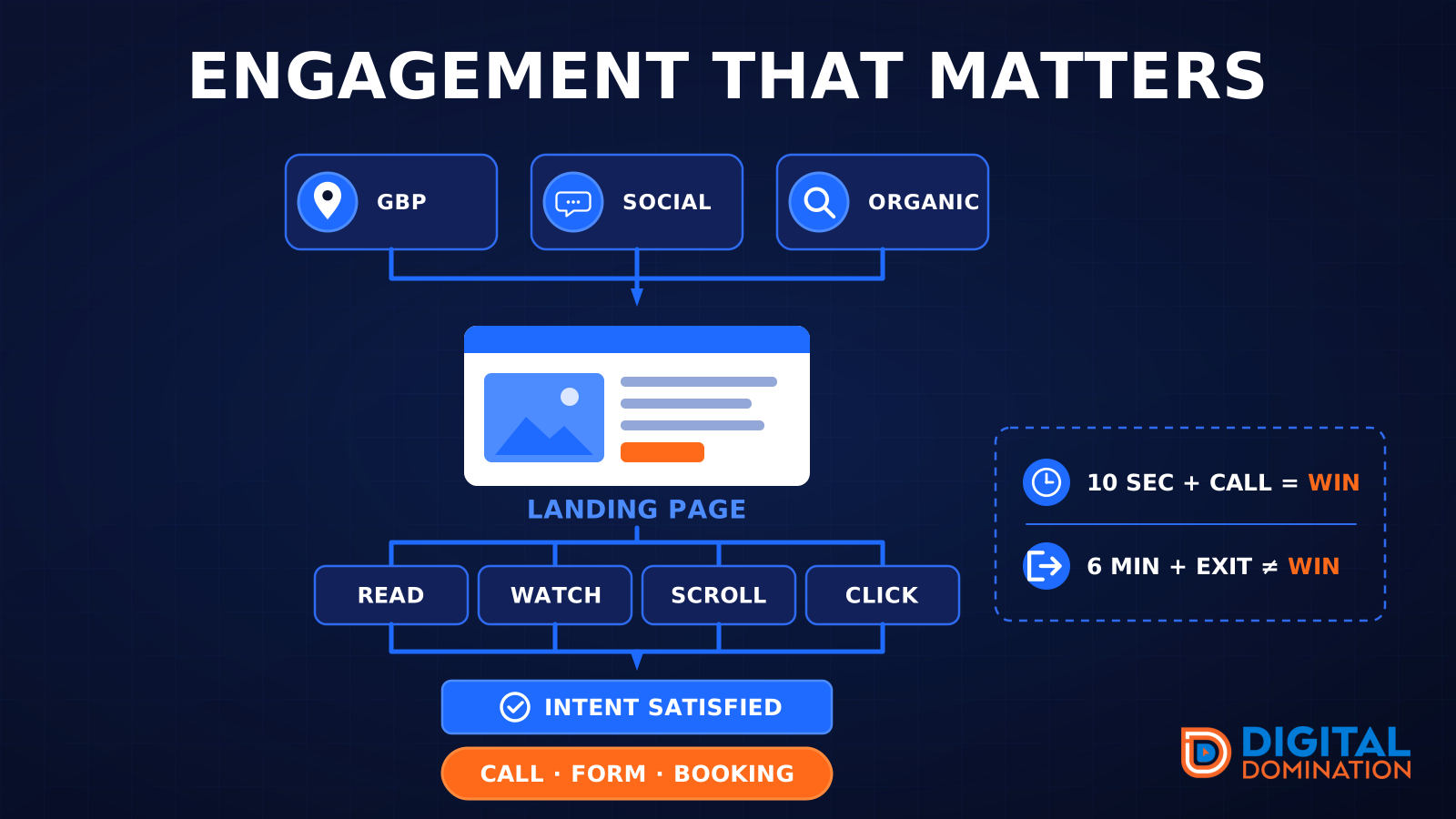
A plumber knows within an hour whether a search became revenue. A remodeler may not know for four months: the search happens in January, the consultation in February, the design agreement in March and the construction contract in May. If you only measure calls, you will optimize for the wrong thing. Search Console shows which queries and pages earn impressions and clicks, by room and by neighborhood. GA4 shows what visitors did: portfolio views, project story reads, click-to-call, consultation form starts and completions, and which landing pages produced them. The CRM carries each lead through consultation booked, consultation held, design agreement signed, contract signed and project completed, with the original source and landing page attached. Read the three together by cohort rather than by calendar month, and note every deployment date. The diagnostic is simple:
- ▸Impressions without clicks for kitchen remodel plus a neighborhood: fix the title, the opening copy, the local proof and the schema on that page.
- ▸Clicks without consultation requests: check speed, the authority strip, the pricing language and whether the form actually works on a phone.
- ▸Consultations that do not become design agreements: check lead quality by source, and whether your categories or services are attracting handyman and single-trade calls.
- ▸Design agreements that do not become contracts: a pricing expectation or process problem, and the fix usually belongs on the website, in the allowances and payment schedule copy.
Reveal videos, Houzz, Nextdoor and the mentions that name your project manager
Remodeling is the most photogenic trade in home services, and the social footprint should amplify the same people, rooms and neighborhoods the website and profile describe. A reveal video or time-lapse of a kitchen, posted to Instagram, TikTok and YouTube and as a GBP post linked to the project story, is the format that travels. Google's Search Console now reports supported social and video platform properties, so that content is measurable alongside search. Off the platforms you control, the mentions that corroborate the entity happen in Nextdoor threads asking who did your kitchen, on your Houzz profile, on the cabinet dealer's or tile showroom's featured-projects page, in the NARI chapter directory, and in a realtor's recommendation to a buyer who just closed on a dated house. A neighbor writing that Example Remodeling redid her Green Valley kitchen and that Maria the project manager texted every morning connects a company, a person, a room, a city and a trait in one sentence, with or without a link.
Do not build the plan around one platform. Axios reported in August 2026 that Reddit's share of visible ChatGPT Search citations fell roughly 86 percent, even though OpenAI has a Reddit data partnership; visible citations, retrieval and training are related but not the same thing. Spread the footprint across owned pages, the board record, trade directories, video, community groups and local press, and keep the company name, license number and phone identical in every one of them.
A 90-day roadmap built around the design consultation calendar
Because the remodel sales cycle is long, this roadmap front-loads the assets a homeowner checks on her second and third visit (license proof, project stories, pricing language) and measures consultations and design agreements rather than raw calls, knowing that the contracts signed in the last month came from searches in the first. The sequence we use:
- ▸Days 1-14, baseline: run a GeoGrid scan for kitchen remodel, bathroom remodel and tub-to-shower conversion across the market, audit every GBP field and category, inventory license, insurance, Lead-Safe, NARI and warranty proof, run PageSpeed on the home, portfolio and top room pages, and confirm GA4 consultation events reach the CRM with the source attached.
- ▸Days 15-30, foundation: complete GBP services with starting ranges, upload captioned before-and-after pairs and progress photos, replace the video and slider with a static hero, publish the authority strip and people pages, and ship HomeAndConstructionBusiness, Service, Offer and Person schema with permanent identifiers.
- ▸Days 31-60, expansion: publish a page per project type and a page per city with permit and HOA answers, write the first project stories, launch the walkthrough and design-approval review asks, and start weekly reveal posts across GBP, Instagram and YouTube.
- ▸Days 61-90, loop: compare Search Console queries and GA4 consultation requests against design agreements and contracts by room and city, rescan the GeoGrid, fix the pages with impressions but no consultations, recheck Core Web Vitals, and lock the review and publishing cadence before the pre-holiday rush.
One remodeling company, one entity, from the first saved photo to the final walkthrough
The daughter on the edge of the bathtub, the Google crawler and the AI agent shopping on her behalf are all asking the same question: is this a real, licensed, well-reviewed remodeler that builds the room I need, in my neighborhood, on the schedule I have, and will still be here when the warranty matters. The profile, the board record, the website, the schema, the reviews, the Houzz page and the Nextdoor thread should all describe one company in the same words, with the same license number, phone number and list of rooms. When they do, relevance and prominence follow, the page loads before she looks away, and the consultation lands on your calendar instead of a competitor's.
Digital Domination builds that system for remodelers under a simple promise: top 3 in the Google Map Pack in 12 weeks or you do not pay. The first step costs nothing. Run the free GeoGrid scan, which checks 169 points across your market, and see where your company shows up when a homeowner searches from her own bathroom instead of from your showroom.
Keep reading
Related guides
- ▸Who Owns Your Website SEO Agency
- ▸Why Chatgpt Recommends Competitors
- ▸Why Did My Google Maps Ranking Drop
Put it into action
Frequently Asked Questions
What is the right Google Business Profile primary category for a home remodeler?
Remodeler, or Kitchen remodeler or Bathroom remodeler if one room is most of your revenue, with Remodeler as a secondary. Add General contractor only if you hold that license and want that work, because it attracts handyman and commercial calls and blurs what the entity is. Then fill the services list with the rooms and project types you actually sell, in the words homeowners search.
Should a remodeler publish prices when every project is custom?
Yes, as starting ranges tied to a defined scope, such as a pull-and-replace kitchen versus a full renovation that moves walls. Ranges qualify the lead before a designer spends an afternoon on the consultation and give AI Overviews your number instead of a national magazine's. Explain the design fee, the allowances and what changes the price, and mark it up with an Offer and PriceSpecification.
How does a remodeler build review velocity when it only finishes a few projects a month?
Make every completion produce a review by asking in person at the final walkthrough and texting the direct link that evening. Design-build firms can also ask at design approval, which doubles the opportunities. Ask which room we remodeled and what surprised you about the process, so the review mentions the schedule, the cleanup and the project manager by name.
What schema type should a remodeling company use?
HomeAndConstructionBusiness for the company with a permanent @id, hasCredential for the state license, memberOf for NARI or NKBA, Person nodes for the designer and project managers, a Service node per project type with an Offer carrying the starting range, areaServed for the cities you build in, and sameAs to the board record, Houzz and your social profiles. The default LocalBusiness output of a page builder models none of those relationships.
Do NARI membership, CAPS or EPA Lead-Safe certification help a remodeler rank?
Not as direct ranking inputs, but they corroborate the entity when the directory listing matches your name, phone and license and is connected with sameAs, and they raise conversion because a homeowner vetting a five-figure contractor wants exactly that kind of third-party proof. Lead-Safe certification is also required for work on pre-1978 homes and almost no competitor mentions it, which makes it a differentiator in older neighborhoods.
Why does PageSpeed matter for a remodeling website that is mostly a portfolio?
Because the portfolio is what makes it slow, and the homeowner is on a phone comparing three companies in a row. An autoplay video, a JavaScript slider and eighty uncompressed photos can push the license and the consultation button below several seconds of loading. The good thresholds are LCP under 2.5 seconds, INP under 200 milliseconds and CLS under 0.1 at the 75th percentile of field data, and a fast portfolio usually pays off more in consultations than in rankings.
Do Houzz, Instagram and Nextdoor affect Google Maps rankings for a remodeler?
Google does not confirm that social activity directly moves local rankings. Those platforms generate branded searches, referral visits, reviews and contextual mentions that connect your company to rooms, neighborhoods and named people. Treat them as corroboration and demand, keep your name, phone and license identical across them, and do not depend on any single platform staying a preferred AI citation source.
Ready to dominate your map?
Top 3 in the Google Map Pack in 12 weeks, or you don't pay.