
Why Did My Google Maps Ranking Drop, and How Do I Get It Back?
Most drops are self-inflicted and reversible. The order you investigate in decides whether you fix it in a week or chase the wrong cause for a quarter.
Did Something Change on My Profile Right Before the Drop?
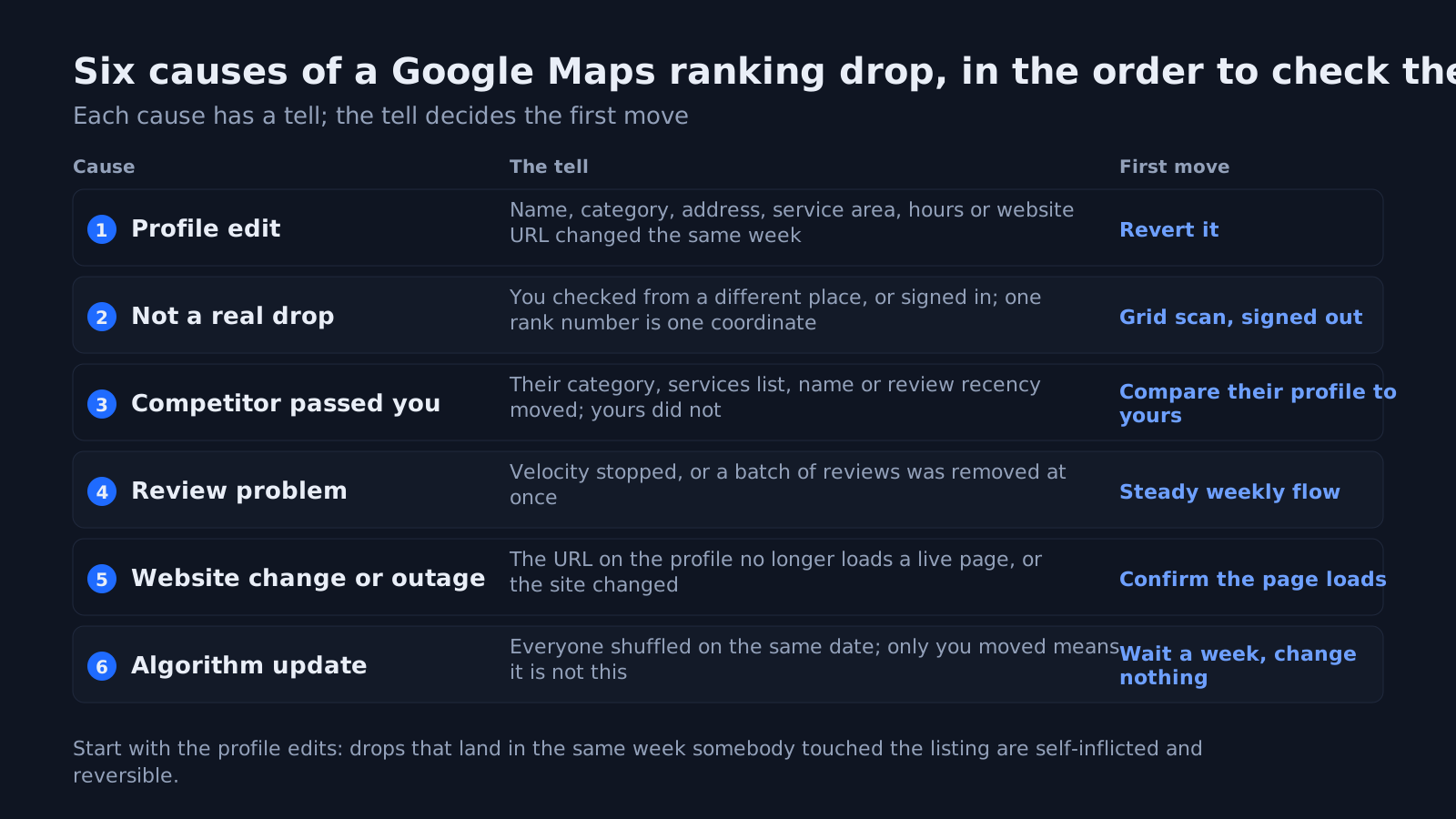
A Google Maps ranking drop almost always traces to one of six causes: an edit to your Google Business Profile (name, category, address, service area, hours, or website URL), a competitor improving or a new competitor arriving, a review problem, a website change or outage, an algorithm update, or a quality flag on the profile itself. Start with the profile edits, because drops that land in the same week somebody touched the listing are self-inflicted and reversible. Open the profile, review the current name, primary category, address, and website URL against what they were, and revert anything that changed.
The edit may not have been yours. Google applies suggestions from the public and from its own data sources, so a category can shift, an address can gain or lose a suite number, hours can be marked temporarily closed, and a website URL can be redirected to a page that no longer exists. A new web vendor swapping the site over a weekend and breaking the URL on the profile is one of the most common drops we see, and it has nothing to do with SEO.
Watch the primary category above everything else. It is the strongest single lever on the profile: it determines which searches you are even eligible to compete in. Changing it from what your customers search to what you personally prefer to be called will cost you positions immediately, and switching it back does not always restore them at the same speed.
- ▸Compare the current primary category to the one that was in place before the drop
- ▸Check the business name for words that were not on your signage
- ▸Confirm the website URL on the profile still loads a live page
- ▸Check whether the profile was marked temporarily closed by an edit or a holiday setting
- ▸Look at the service area list and the address for unexpected changes
Did I Actually Drop, or Am I Looking at a Personalized Result?
A large share of the drops reported to us turn out not to be drops at all. Google personalizes local results by where the searcher is standing, so your position changes as you move across town, and a single rank number never describes a service area. If you checked from your desk last month and from your truck this month, you compared two different searches and one of them is not evidence.
Being signed into your own Google account makes your self-checks worse, not better, because Google knows how often you have looked at your own profile. Check signed out, on cellular data, away from your address, and have someone in a different part of town run the same search.
The reliable version of this is a grid scan: the same query run from dozens of coordinates across your service area, returning your Map Pack position at each point. Run it now and you have a real baseline. Compare two scans a month apart and you can see whether you lost the whole map, lost one direction, or never held the area you thought you held.
- ▸One rank number is a snapshot from one coordinate, not a ranking
- ▸Check signed out, off your own network, away from your address
- ▸Run a grid scan to see the shape of the loss, not just a single position
- ▸A loss in one direction is a footprint problem, a loss everywhere is a profile problem
Why Would a Competitor Suddenly Pass Me?
The Map Pack shows three businesses. Nothing has to go wrong with you for you to lose a seat: someone else only has to get better. A competitor who hired an agency, added the right primary category, filled in a services list they had left blank, or started collecting reviews weekly will climb, and the business in third place falls out of view even though its own signals never moved.
Some of it is not fair play. Competitors add keywords to their business name on Google, which violates Google's guidelines and works often enough that people keep doing it. Others run listings at addresses where nobody works. You can report both: the public route is Suggest an edit on their profile, and the escalation route is Google's Business Redressal Complaint Form, which is the one that tends to get action when it is filed with evidence and a clear description of the violation.
Be realistic about the timeline on spam reports. Some get actioned in weeks, some never do, and the businesses that recover fastest are the ones that report the violation and keep building their own signals at the same time rather than waiting for Google to fix their ranking for them.
- ▸Compare their primary category, services list, and business name against yours
- ▸Check whether their review count and recency have moved since your drop
- ▸Report keyword-stuffed names through Suggest an edit, then the Business Redressal Complaint Form
- ▸Keep building your own signals while any report is pending
Can Reviews Cause a Google Maps Ranking Drop?
Yes, in two directions. Review velocity, meaning a steady flow of new reviews over time, carries more weight than a large pile of old ones. A business that collected reviews hard for one quarter and then stopped will slide as competitors keep going, and the owner experiences that as an unexplained drop months after the real cause.
The other direction is reviews disappearing. Google removes reviews it classifies as spam or policy violations, reviews from deleted accounts, and sometimes reviews caught in a filter after an unusual burst. Losing a batch of reviews at once takes both the count and the trust signal with it. It also frequently means the collection method broke: a kiosk, a shared device, a bulk request blast, or an incentive that crossed Google's rules.
Then there is the part that is not ranking at all. A run of one-star reviews may leave your position untouched while your calls fall off a cliff, because searchers still see you and choose someone else. That feels identical to a ranking drop from inside the business, which is why measuring position and measuring calls separately matters.
- ▸Steady weekly review flow beats a large stale total
- ▸Reviews removed in a batch usually mean the collection method broke
- ▸Never gate, incentivize, or bulk-collect reviews on one device
- ▸A drop in calls with no drop in position is a reputation problem, not a ranking problem
Was It an Algorithm Update, or Something I Did?
Google updates local ranking regularly and confirms very little of it. The local search industry names the ones it can measure, the best known being the Vicinity update, which visibly increased how much proximity mattered and reduced the benefit some businesses were getting from keywords in their business names. Broad core updates also reach local results indirectly through the website signals that feed them.
There is a simple test for whether an update hit you. Look at the whole result set, not just your own position. If the businesses above and below you also shuffled, if new names appeared in the pack, and if the change happened across your market on roughly the same date, it is an update. If you are the only thing that moved, it is your profile, your website, or your reviews.
Either way, the response is the same and it is not panic. Do not change your category, rename your business, or rebuild your website in the first week. Document what changed, wait for the market to settle, and then fix the specific signal you can prove is weak.
- ▸Everyone shuffled on the same date: probably an update
- ▸Only you moved: look at your profile, site, and reviews
- ▸Do not make major profile edits during the first week of a suspected update
- ▸Keep a dated log of every change so future drops have a timeline to check against
Get the Cause Identified on a Free 15-Minute Call
If your ranking dropped and you are losing calls right now, book a free 15-minute call with Digital Domination. We will look at the profile and the map live, tell you which of the six causes fits the evidence, and tell you plainly if it is something you can revert yourself today.
If the fix is bigger than that, our program puts clients in the top 3 of the Google Map Pack in 12 weeks or you do not pay. We take one client per trade per service area, so the competitor who passed you cannot hire us next month to do the same thing to you.
Come to the call with the date you noticed the drop and anything that changed on the profile or the website around it. That timeline usually settles the diagnosis inside the first five minutes.
Keep reading
Related guides
- ▸When To Choose The Trinity AI Accelerator Instead Of Doing Local SEO Y
- ▸When To Choose White Label Local SEO Instead Of Doing Local SEO Yourse
- ▸White label local SEO for HVAC
Put it into action
Frequently Asked Questions
How do I check whether my Google Maps ranking really dropped?
Run a grid scan, which checks your Map Pack position from many coordinates across your service area instead of one. A single search from your own address, signed into your own account, is the least reliable check available and it is the one most owners rely on.
Why did my ranking drop right after I edited my business information?
Edits to the name, primary category, address, or service area change what Google thinks you are and where you belong, and edits made soon after verification can also trigger a manual review. Revert the edit first and give it a couple of weeks before concluding anything else caused the drop.
Why did my Google reviews disappear?
Google removes reviews that trip its spam filters or violate its policies, reviews left by accounts that were later deleted, and reviews that get caught after an unusual burst of activity. A batch disappearing at once usually means the way they were collected broke a rule, such as gating, incentives, or many reviews from one device or network.
Can a website redesign hurt my Google Maps ranking?
Yes. A new site that changes URLs without redirects, removes your city and service pages, drops your name, address, and phone from the footer, or slows the site down weakens the signals the Map Pack reads from your website. Confirm the URL on your profile still loads a real page, not a redirect chain or a 404.
How long does it take to recover a Google Maps ranking?
A reverted edit or a restored website URL can recover within days to a few weeks. A drop caused by thin content, stalled reviews, or a competitor genuinely outbuilding you takes the same kind of sustained work that earns a position in the first place, which is a matter of weeks to months.
Do Google Business Profile posts help me recover a ranking?
Posts are not a meaningful direct ranking lever. They help conversion and they show a live, active business, but if you dropped, posting daily will not bring the position back. Fix the category, the reviews, the site, or the competitor gap that actually caused it.
My competitor added keywords to their business name and passed me. What can I do?
Report it, first through Suggest an edit on their profile and then through Google's Business Redressal Complaint Form with evidence such as photos of their signage and their website. Reports are worth filing, but they are unpredictable, so keep improving your own signals while you wait rather than treating the report as the plan.
Should I wait it out or start changing things?
Wait a week before making structural changes, because rankings fluctuate and updates settle. Reverting an unintended edit is the exception: do that immediately, since it restores the state that was ranking before.
Ready to dominate your map?
Top 3 in the Google Map Pack in 12 weeks, or you don't pay.