
How Many 5-Star Reviews Does It Take to Cancel a 1-Star Review on Google?
The arithmetic is brutal at low review counts and almost irrelevant at high ones, which is the entire reason volume matters more than any single review.

How Much Does One 1-Star Review Actually Cost You?
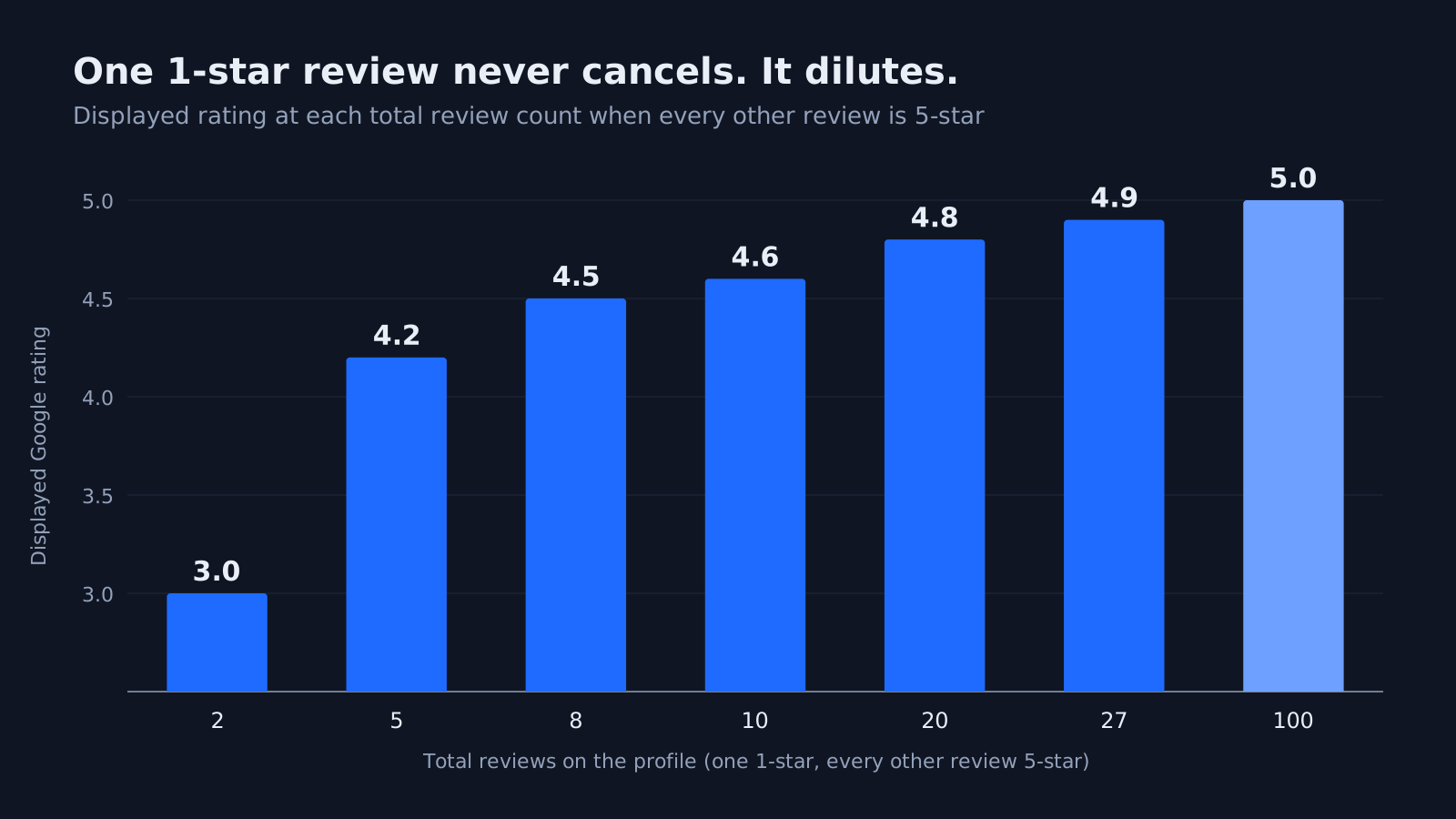
No number truly cancels a 1-star review. It stays in your average permanently, and five-star reviews only dilute it. If every other review on your profile is a 5-star, you need 8 total reviews to sit at a displayed 4.5, about 27 total to display 4.9, and about 100 total to round back to 5.0.
You can run this on your own profile in thirty seconds. Multiply your current review count by your current average, add 1 for the new one-star, then divide by your count plus one. That is your new average, and Google displays it rounded to one decimal place, so movement in the hundredths is real but invisible until it crosses the next tenth.
The damage scales inversely with volume. A business sitting at 5.0 with 10 reviews drops to 4.6 the moment a single 1-star lands. The same 1-star on a profile with 200 reviews moves the average by about two hundredths of a point and usually does not change the displayed number at all. That gap is the whole strategy: you do not fight a bad review, you outgrow it.
- ▸2 total reviews (one 5-star plus the 1-star): 3.0 displayed
- ▸5 total reviews: 4.2 displayed
- ▸8 total reviews: 4.5 displayed
- ▸10 total reviews: 4.6 displayed
- ▸20 total reviews: 4.8 displayed
- ▸27 total reviews: 4.9 displayed
- ▸100 total reviews: 5.0 displayed
Is a 4.8 Google Rating Good?
Yes. A 4.8 is a strong rating, and the only benchmark that decides anything is what the three businesses currently holding your Map Pack are showing. Search your service plus your city and compare against those three. Owners chasing 5.0 in the abstract are usually optimizing the wrong number.
Two things around the rating matter more than the rating itself: how many reviews produced it, and how recent they are. A 4.8 from 250 reviews reads as a real business with a long track record. A 4.8 from 5 reviews tells a shopper almost nothing, and it tells Google even less, because review count feeds the prominence side of how local results are ranked.
There is also a credibility ceiling at the top. A flawless 5.0 across a large review count can read as filtered rather than perfect, and many shoppers comparing three businesses open the lowest reviews first to see how the owner handled them. A 4.8 with a thoughtful owner response sitting under the 3-star review frequently converts better than a silent 5.0.
- ▸Benchmark against the businesses actually in your Map Pack, not against 5.0
- ▸The volume behind the rating carries more weight than the decimal itself
- ▸Recency counts: a 4.8 whose newest review is 14 months old reads as a business in decline
- ▸Owner responses on the imperfect reviews do more conversion work than the average does
What Happens When You Hit 100 Reviews on Google?
Nothing is unlocked at 100 reviews. There is no Google badge, feature, or ranking tier that activates at 100, 500, or 1,000, and anyone presenting a milestone as a switch is selling a package rather than describing how the system works.
What genuinely changes at 100 is stability. Your average becomes hard to move, so one furious customer stops being an emergency and becomes a line item. At a 4.8 average, a new 1-star costs you roughly 0.04 of a point at 100 reviews versus about 0.12 at 30. The second thing that changes is perception: a three-digit review count reads differently to a shopper than a two-digit one, especially next to a competitor showing 30.
On the ranking side, review count and review score feed prominence, which is one of the three things Google weighs for local results alongside relevance and distance. More reviews help, but they help as one input among many. A business with 400 reviews can and does lose the Map Pack to one with 90 that has a cleaner category setup, tighter location signals, and a profile someone actually maintains.
- ▸No Google feature or ranking tier activates at any review milestone
- ▸At a 4.8 average, a new 1-star costs about 0.04 at 100 reviews and about 0.12 at 30
- ▸Review count is part of prominence, one of three factors Google weighs locally
- ▸A stale 100 is worth less than an active 60 that adds reviews every month
At What Number of Reviews Do You Start Getting Google Leads?
There is no threshold review count that turns leads on. Leads start when your profile appears in the top 3 of the Map Pack for searches people in your area actually run. Reviews are one of the inputs that help get you there, not the switch that does it.
The only benchmark worth using is the one on your own screen. Search your main service plus your city from a phone, look at the three businesses Google is already showing, and write down their review counts and ratings. That range is your real target, because those are the profiles Google has already decided are prominent enough for that query.
In most categories, the moment owners describe as the phone starting to ring is two things landing at once: the profile enters the top 3, and its review count is close enough to the incumbents that a shopper comparing all three does not discount it on sight. Reviews alone will not put you in the pack. Reviews are what keep you from being the one of the three nobody calls.
- ▸Step 1: search your primary service plus your city on a phone, not a desktop
- ▸Step 2: record the review count and rating of all three Map Pack businesses
- ▸Step 3: treat the lowest of the three as your floor and the highest as your target
- ▸Step 4: repeat the search from different parts of your service area to see where you vanish
How Do You Rebuild a Rating Without Breaking Google's Rules?
Two levers exist. The first is removal, which only works when a review actually violates a Google content policy: spam, off-topic content, a conflict of interest, or a reviewer who was never a customer. Being unfair is not a policy violation, and a flag filed on that basis will fail and waste two weeks.
The second is volume, added at a rate that matches how many customers you genuinely serve. That means asking every customer, every time, with the request going out while the job is still fresh and a direct link that takes one tap. What it cannot mean is a discount, a gift card, a raffle entry, or a survey that only routes the happy ones to Google. Incentives and gating both violate Google's review policy, and reviews collected either way can be removed retroactively, taking the rating you just repaired with them.
Pace is where most owners miss in both directions. Asking three customers a month will never repair a rating. Adding forty reviews in a week to a profile that has averaged two a month is the exact pattern automated spam detection is built to catch, and the punishment for that is watching them disappear.
- ▸Ask every customer, not a hand-picked subset
- ▸Send the request within 24 hours of the job, while the experience is fresh
- ▸Use a direct review link so leaving one takes a tap, not a search
- ▸Reply to every review you get, including the five-star ones
- ▸Keep the pace steady and proportional to your actual job volume
- ▸Never offer anything of value in exchange for a review
Want the Math Run on Your Own Profile?
If you want to know exactly how many reviews it will take to move your displayed rating, and how your count stacks up against the three businesses currently holding the Map Pack in your area, we will run both numbers with you on a free 15-minute call. No deck, no audit fee: just your arithmetic and your competitors' on the same screen.
Digital Domination works with one client per trade per service area, so we are either open in your category or we are not, and we will tell you which on the call. If we are open, we will show you what a compliant collection pace looks like for a business your size, and what the timeline to a top 3 Map Pack spot looks like. We guarantee that top 3 spot within 12 weeks or you do not pay.
Reviews and follow-up, handled
Get the 5-Star Reputation System for $297 a Month
Every customer asked for a review at the right moment, every review answered, every lead and missed call followed up automatically, with a free custom website included. Watch the short video and see how it works for a business your size.
Watch the Video »Keep reading
Related guides
- ▸Why Is My Competitor Ranking Higher On Google Maps
- ▸Why Law Firm Website Not Showing Up On Google
- ▸Why Isn't My Business Showing Up in ChatGPT Answers?
Put it into action
Frequently Asked Questions
How many 5-star reviews do I need to negate a 1-star review?
None of them fully negate it, because the 1-star stays in your average permanently. Assuming every other review is a 5-star, you need 8 reviews total to reach a displayed 4.5, about 27 total for a 4.9, and about 100 total to round back to 5.0.
Does one 1-star review hurt my Google Maps ranking?
Barely, on its own. Review score is one part of the prominence signal Google uses for local results, so a single low review among many changes very little, while a rating that sits well below your competitors' over the long run does matter.
Is a 4.9 rating better than a 5.0?
For conversion, often yes. A perfect 5.0 across a large number of reviews can read as filtered or solicited, while a 4.9 with a couple of imperfect reviews and thoughtful owner responses tends to look more credible to someone comparing three options.
How do you get 1,000 reviews on Google?
By systemizing the ask instead of remembering to do it: every completed job triggers a request within 24 hours, using a one-tap direct link, at a pace proportional to how many customers you actually serve. A profile at 1,000 reviews is running on years of consistency, not on a campaign.
Does Google show my exact star average?
No. Google displays the average rounded to one decimal place, so real movement in the hundredths stays invisible to the public until it crosses the next tenth.
Can I get a 1-star review with no comment removed?
Only if the reviewer's profile shows a policy violation such as an obvious spam pattern or a conflict of interest, since a star-only rating gives Google almost nothing to evaluate. Star-only ratings do count toward your average.
How fast can I add reviews without triggering Google's filter?
There is no published limit, and the risk is not a fixed number but a sudden departure from your own baseline. A profile that has averaged two reviews a month and suddenly posts forty in a week is the exact pattern automated spam detection looks for.
Can I offer a discount to a customer who leaves a 5-star review?
No. Google's review policy prohibits offering anything of value in exchange for reviews, and in the United States undisclosed incentives also raise issues under the FTC's rule on consumer reviews. Reviews collected that way can be removed later, without appeal.
Ready to dominate your map?
Top 3 in the Google Map Pack in 12 weeks, or you don't pay.