
Is SEO Worth It for Law Firms, or Should You Spend the Money Elsewhere?
There is a real answer to this, and for some firms the honest answer is no.

The Short Answer: Is Law Firm SEO Worth the Money?
SEO is worth it for a law firm that can wait three to six months for meaningful case flow, practices in an area people actively search for, and answers its phone reliably. It is not worth it for a firm that needs cases this month, works in a practice area with almost no local search volume, or has broken intake, because SEO only sends more calls into the same leak. For most established local firms the honest answer is yes, but only if it is treated as an asset you are building rather than a fee you are renting.
The reason the question keeps getting asked is that law firm SEO has a genuinely bad hit rate. A lot of firms have paid for it, seen a monthly report full of impressions, and never traced a single signed case back to it. That experience is real and it is not the firm's fault. It usually comes from buying activity instead of an outcome, and from nobody ever connecting the work to the phone.
So the useful version of the question is not whether SEO works in the abstract. It is whether it works for your firm, in your market, at your patience level, with your intake. Those four things decide it, and you can assess all four before spending anything.
- ▸Worth it: established local firm, real search demand, functioning intake, months of patience
- ▸Not worth it: cases needed this month, negligible local search volume, or broken intake
- ▸The failure mode is buying activity instead of a defined outcome
- ▸You can assess your own fit before spending a dollar
When Is SEO Not Worth It for a Law Firm?
If you need signed cases in the next thirty days to make payroll, SEO is the wrong instrument. It is slow by construction. Paid ads, referral relationships and direct outreach are what produce cases on a short clock, and starting an SEO program while under that kind of pressure usually ends with the firm cancelling in month three, right before the compounding starts, having wasted the whole spend.
If almost nobody searches for what you do in your area, the ceiling is genuinely low. Some practice areas run on referrals and relationships rather than search. Before hiring anyone, look at how many pages exist targeting your practice area in your city and whether there are paid ads running against those phrases. Ads running consistently for a term are the clearest available sign that the term makes somebody money. Silence in a market usually means silence in demand.
If your intake is broken, fix that first, because it is cheaper and faster and it multiplies everything else. If calls go to voicemail during business hours, if nobody follows up on a form submission the same day, or if there is no consistent process for turning a consultation into a signed engagement, then more visibility just produces more missed opportunities. A firm that answers every call and follows up quickly can often outperform a better-ranked competitor with the same lead volume.
And if you are unwilling to be involved at all, be honest about it. The pages that win are the ones that contain things only your firm knows: how a particular process actually works in your county, what clients get wrong, what happens in the first week of a matter. An agency can structure and write all of it, but it needs an hour of an attorney's time a month to have anything real to work with.
- ▸You need cases within 30 days: use ads and referrals, not SEO
- ▸Negligible search demand for your practice area locally: the ceiling is low
- ▸Calls going to voicemail or follow-up taking days: fix intake first
- ▸No attorney willing to give an hour a month: the content will be generic
- ▸Planning to stop after 90 days: you will pay the cost and skip the return
How Long Before Law Firm SEO Pays for Itself?
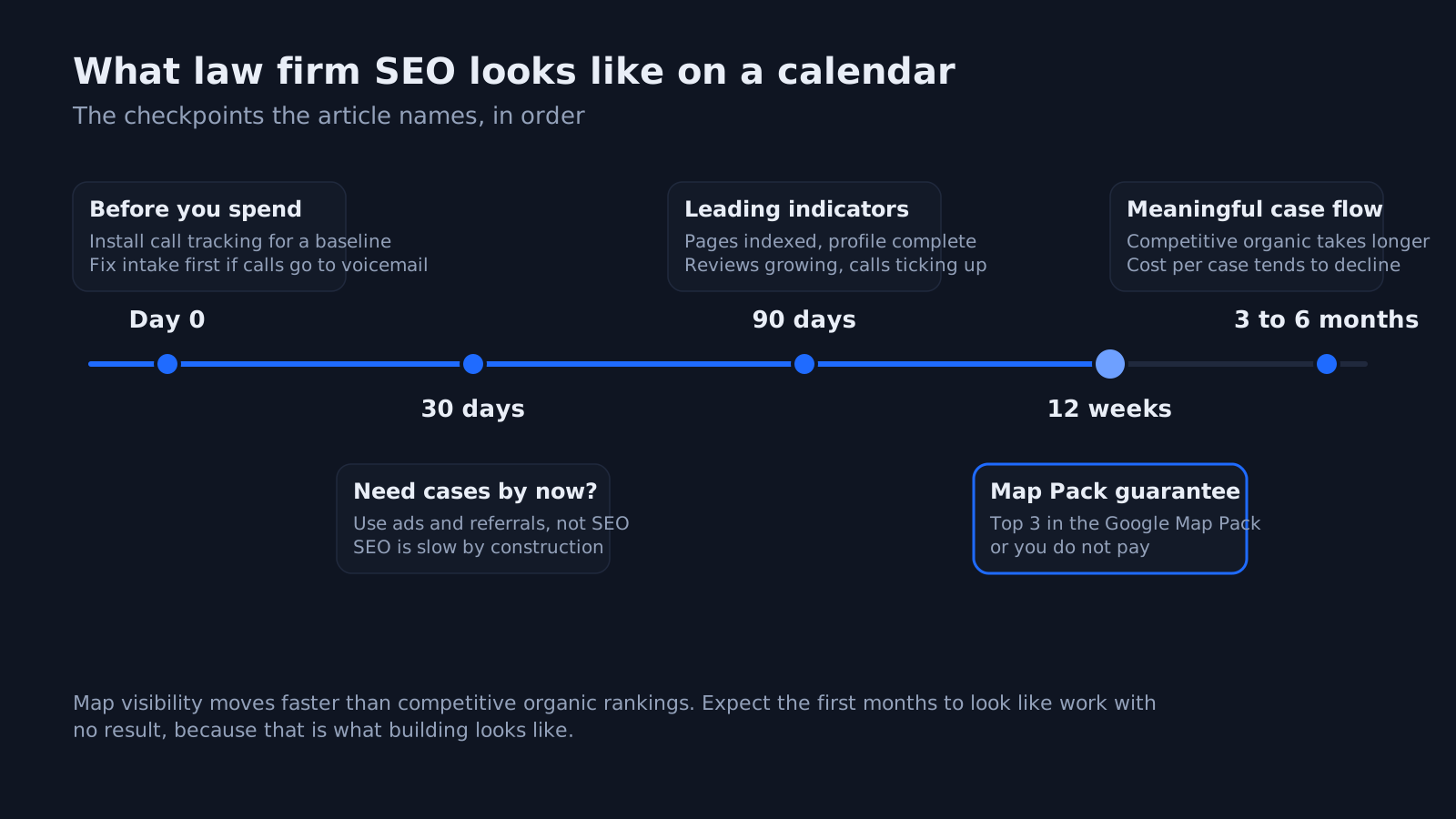
The two halves of local search move at very different speeds, which is why the timeline question gets such inconsistent answers. Map visibility can move relatively quickly, because much of it depends on things you control directly: profile verification and categories, listing consistency, review depth, and coverage pages for the areas you serve. Competitive organic rankings for the phrases directories currently own take considerably longer, because you are accumulating trust rather than flipping settings.
That distinction is why our guarantee is written the way it is: top 3 in the Google Map Pack in 12 weeks or you do not pay. It names the surface, the position, the timeframe and the consequence. Be skeptical of any timeline promise that is missing one of those four, and be especially skeptical of guaranteed organic rankings, which nobody can deliver.
For payback, the arithmetic is firm-specific and you should run it yourself rather than accept an industry average. Take your average revenue per signed case, multiply by your historical rate of turning consultations into signed cases, and work out how many additional cases per month cover the monthly fee. In most practice areas the number is small, which is why the model works at all. If the number of extra cases needed to break even makes you wince, that is a real answer and you should trust it.
- ▸Map visibility moves faster than competitive organic rankings
- ▸A credible timeline names surface, position, timeframe and consequence
- ▸Calculate break-even from your own case value and conversion rate, not an average
- ▸Expect the first months to look like work with no result, because that is what building looks like
- ▸If break-even needs an implausible number of extra cases, do not sign
What Does SEO Get a Law Firm That Ads Don't?
Ads rent attention and SEO builds an asset. That distinction sounds like a slogan until you pause a campaign: paid leads stop the same day, while pages and a map position that have earned their standing keep producing while you decide what to do next. That durability is the entire economic argument, and it is also why SEO looks worthless for the first stretch and disproportionately good later.
The second difference is what the click costs over time. Legal is among the most expensive categories in all of paid search, and the price does not fall as you get better at it. Organic and map visibility have the opposite shape: heavy investment up front, then a declining cost per case as the same asset produces more. Firms that run both usually find the blended cost per case falls as the organic side matures.
The third difference is trust. A firm that appears in the map results with substantial reviews reads differently than an ad, and legal is a high-anxiety purchase where that gap matters. The same signals now also determine whether AI assistants name your firm when someone asks who to call, which is covered at /how-trial-attorneys-get-found-in-ai-answers/.
None of this makes ads a mistake. The common sensible arrangement is ads for immediate case flow while the durable side is built, then rebalancing as organic and map visibility carry more of the load. The tradeoff is worked through in detail at /law-firm-seo-vs-ppc/.
- ▸Paid leads stop the day the budget stops; earned position persists
- ▸Legal paid clicks are among the most expensive anywhere and do not get cheaper
- ▸Cost per case tends to decline as the earned asset matures
- ▸Map presence with real reviews reads as more credible than an ad
- ▸The same signals influence whether AI assistants name your firm
How Do I Know If My Law Firm SEO Is Actually Working?
Measure calls and signed cases, not impressions. The report that shows traffic climbing while your phone stays quiet is describing something that is not your business. Get call tracking in place before the program starts so there is a baseline, and make sure every new inbound call is attributed to a source. Without that, month six becomes an argument nobody can win.
Measure map position across your whole service area rather than from your office. Your own searches are personalized and your office is the one place you are most likely to rank, so checking from your desk systematically overstates your position. A grid-based scan across the metro shows the truth, including the more common pattern of ranking well within a couple of miles and disappearing beyond that.
Watch the leading indicators in the first 90 days, because the lagging ones are too slow to steer by. Are new pages being published and indexed? Is the Google Business Profile complete, correctly categorized and consistent with other listings? Is review volume growing steadily? Are calls rising even slightly? A program with movement on those is on track. A program with none of them at 90 days will not be rescued by month six.
- ▸Install call tracking before the program starts, so there is a real baseline
- ▸Attribute every inbound call to a source and review it monthly
- ▸Measure map position across the metro with a grid scan, not from your office
- ▸90-day leading indicators: pages indexed, profile complete, reviews growing, calls ticking up
- ▸Traffic climbing while calls stay flat means the traffic is the wrong traffic
Find Out Whether It Is Worth It for Your Firm
The fastest way to answer this for your specific firm is to look at your actual market rather than at industry generalities. How much of the map do you own today, which firms hold the positions you want, and how far does your visibility reach beyond your office? Those three facts settle whether there is a gap worth paying to close.
Book a free 15-minute call and we will run your live Map Pack position across your metro while you are on the call. If the honest read is that SEO is not your bottleneck, we will tell you that, because we only take one client per practice area per service area and a poor fit costs us the slot.
If it is a fit, our terms are simple: top 3 in the Google Map Pack in 12 weeks or you do not pay, and our AI system at $297 per month includes a free custom website you keep. More on the method at /how-it-works/, on results at /case-studies/, and on the legal-vertical specifics at /seo-for-law-firms-las-vegas/.
Keep reading
Related guides
Put it into action
Frequently Asked Questions
How long does law firm SEO take to work?
Map visibility usually moves first because much of it depends on things you control directly, while competitive organic rankings take considerably longer because they depend on accumulated trust. Any firm quoting a single number for both is oversimplifying. Our commitment is specific: top 3 in the Google Map Pack in 12 weeks or you do not pay.
How much does law firm SEO cost per month?
It varies widely with market competitiveness and practice area, so the number matters less than what it buys and whether an outcome is attached to it. Judge a price by the deliverables named in writing and by what happens if the target is missed. Our AI system runs at $297 per month and includes a free custom website, which gives you a concrete floor to compare other proposals against.
Does SEO work for solo attorneys and small firms?
Yes, and often better than for large firms, because local search is a bounded competition. A solo attorney competing for one practice area in one metro is up against a countable set of firms, not a national field. The constraint is usually patience and intake capacity rather than firm size, since a solo practice can only take so many cases before more visibility stops helping.
Is SEO or PPC better for a brand-new law firm?
A brand-new firm that needs cases immediately should generally start with paid ads and referrals, because SEO cannot produce on that timeline. The stronger move is to start the SEO work at the same time so the durable asset is compounding while ads carry the near term, then rebalance as earned visibility takes over. Running only ads means restarting from zero the day the budget stops.
Can I do law firm SEO myself?
You can do the highest-value parts yourself: verify and complete the Google Business Profile, pick the correct primary category, make your name, address and phone identical across every listing, and build a compliant process for requesting reviews. Those are owner-level tasks with real impact and no cost. Sustained content and coverage work across a metro is where most firms run out of time rather than ability.
What happens to my rankings if I stop paying for SEO?
They do not vanish the way paid ads do, but they decay. Existing pages keep ranking for a while and your map position holds as long as the profile stays accurate and reviews keep arriving, then competitors who are still publishing and still gathering reviews pass you. Think of it as an asset that depreciates without maintenance rather than a switch that turns off.
Is local SEO different from regular SEO for lawyers?
Yes, and for most firms local is the half that matters. Local SEO decides whether you appear in the map results at the top of a search, which is driven by your Google Business Profile, listing consistency, reviews and area coverage. Traditional SEO decides where your website ranks in the links below. Local intent searches send most of their clicks to the map, so a firm serving one metro should start there.
Is SEO still worth it now that AI answers the question directly?
The work matters more, but the target has widened. AI assistants name a small number of firms and skip the rest, and they choose based on entities they can identify and corroborate: consistent listings, real reviews, third-party confirmation and pages that answer specific questions directly. Those are the same signals that drive map rankings, so a firm doing this properly usually gains in both places at once.
Ready to dominate your map?
Top 3 in the Google Map Pack in 12 weeks, or you don't pay.