
Where Can I Find Straight Answers to Local SEO Questions?
Every question below links to a full answer on this site, grouped by what owners actually call us about: the map and the profile, the reviews, AI search, and whether their agency is doing anything.
How to Use This Local SEO Question Library
Digital Domination keeps a grouped question library covering the five things local business owners actually ask about search: Google Maps and the Map Pack, the Google Business Profile, reviews and reputation, AI search visibility in tools like ChatGPT and AI Overviews, and hiring or evaluating an agency. Every question below links to a page that answers it directly in the first few sentences, so you get the answer without reading a full article.
The reason we built the library this way is that local search questions are almost never abstract. Nobody wonders about ranking factors in general. They wonder why they dropped last Tuesday, why the competitor two miles away is above them, why the profile got suspended, or whether the agency they are paying is doing anything at all. Those are the questions indexed here.
If you are troubleshooting something urgent, start with the symptom rather than the topic. Not showing up at all, sudden drop, suspended profile, reviews disappearing and calls falling while views stay flat are all distinct problems with distinct causes, and each has its own page below.
- ▸Google Maps and the Map Pack: why you rank where you do and how to move
- ▸Google Business Profile: setup, suspensions, verification and recovery
- ▸Reviews and reputation: removals, disappearances, gating rules and math
- ▸AI search: ChatGPT, AI Overviews and why they recommend someone else
- ▸Hiring and budgets: choosing, evaluating, firing and paying an agency
Google Maps, the Map Pack and Your Google Business Profile
The map results are where most local buying decisions get made, because they sit above the organic listings and carry the phone number, the reviews and the directions in one block. Almost every question in this group comes down to one of three things: you are not in the candidate pool, you are in it but ranked below competitors, or you were ranked and something changed.
Start with why the ranking is what it is, then work outward to service-area coverage. Ranking from your own address tells you almost nothing, because your position changes block by block across a metro, which is why measuring across a grid is the first honest step in any diagnosis.
Google Business Profile questions live in the same group because the profile is the asset the map results are drawn from. Category selection, verification and suspension recovery are the highest-stakes settings in local search, and the most common cause of a business vanishing overnight.
- ▸How do I rank higher on Google Maps? See /how-to-rank-higher-on-google-maps/
- ▸What are the actual Google Maps ranking factors? See /google-maps-ranking-factors/
- ▸Why is my business not showing up on Google Maps? See /why-is-my-business-not-showing-up-on-google-maps/
- ▸Why did my Google Maps ranking drop? See /why-did-my-google-maps-ranking-drop/
- ▸Why is my competitor ranking higher than me? See /why-is-my-competitor-ranking-higher-on-google-maps/
- ▸How do I rank in surrounding cities? See /how-to-rank-in-surrounding-cities-google-maps/
- ▸How do I check my ranking across my service area? See /google-maps-ranking-checker/
- ▸What is the Map Pack and how does it work? See /google-map-pack-seo/ and /google-maps-seo-2026/
- ▸How does Google divide the map into ranking zones? See /s2-cells-google-maps/
- ▸How do near me searches actually resolve? See /near-me-seo/ and /near-me-domination/
- ▸How do I optimize my Google Business Profile? See /google-business-profile-seo/
- ▸My profile was suspended, how do I get it back? See /gbp-suspension-recovery/ and /gbp-reinstatement-checklist/
- ▸Why does Google keep suspending my profile? See /why-google-keeps-suspending-my-profile/
- ▸How does video verification work? See /gbp-video-verification-guide/
- ▸I get profile views but no calls, why? See /google-business-profile-views-but-no-calls/
- ▸How should my site be structured to support the map? See /hub-and-spoke-silo/ and /bert-local-seo/
Reviews and Online Reputation
Reviews do two jobs at once: they influence where you rank and they decide whether the person looking at the map results calls you or the business next to you. That dual role is why review questions come up more than any other topic, and why the answers are usually more constrained than owners expect.
The hardest truth in this group is that you cannot simply remove a review you dislike. What you can do is understand the narrow grounds on which Google removes content, respond in a way that changes how the review reads to the next person, and build enough recent positive volume that a single bad rating stops being the first thing anyone sees.
The second hardest truth is that the tactics many businesses use to protect their rating, particularly filtering who gets asked, carry real legal exposure. Read the gating page before you install any review request process.
- ▸Can I get a bad Google review removed? See /how-to-remove-google-reviews/
- ▸Why did my Google reviews disappear? See /why-did-my-google-reviews-disappear/
- ▸How many 5 star reviews cancel out a 1 star? See /how-many-5-star-reviews-cancel-one-star/
- ▸Is review gating illegal? See /is-review-gating-illegal/
- ▸How do I manage reputation over time? See /online-reputation-management/
AI Search: ChatGPT, AI Overviews and Getting Cited
A growing share of local buying research now starts in an AI assistant rather than a search box, and the answer it gives names two or three businesses without showing a list of ten. That compresses the field further than the Map Pack does, which makes being one of the named businesses a distinct problem worth its own work.
The most common questions here are also the most uncomfortable: why does ChatGPT recommend my competitor, why does it not know my business exists, and why is the information it repeats about me out of date. All three usually trace back to what the model can find and verify about you elsewhere, not to anything you can change inside the chat itself.
The pages below cover both the diagnosis and the work: how AI Overviews assemble their answers, what visibility in AI search actually depends on for a local business, costs to pursue.
- ▸How do AI Overviews decide what to show? See /ai-overviews/
- ▸Why does ChatGPT recommend my competitors? See /why-chatgpt-recommends-competitors/
- ▸Why does my business not show up in ChatGPT? See /why-my-business-doesnt-show-up-in-chatgpt/
- ▸How do I fix wrong business information in ChatGPT? See /fix-wrong-business-info-in-chatgpt/
- ▸What is AI SEO and how does it differ from local SEO? See /ai-seo/ and /ai-seo-for-local-business/
- ▸How much does AI SEO cost? See /ai-seo-cost/
- ▸How does a local business get visible in AI answers? See /ai-search-visibility-for-local-business/
- ▸How do trial attorneys get found in AI answers? See /how-trial-attorneys-get-found-in-ai-answers/
Hiring an Agency, Budgets and Contracts
This is the group where the most money gets lost, because these questions get asked after signing rather than before. Ownership of the domain, the website, the profile and the tracking data is settled in a sentence during a sales call or discovered painfully during an exit, and there is no third option.
The evaluation questions are worth reading even if you are happy with your current provider. The quarterly page list, specific URLs published or changed with dates, is the single cheapest accountability habit you can install, and it takes an honest agency a few minutes to produce.
The comparison pages below include ones where we are listed alongside other providers. We have tried to describe every category on the same terms, including where we are the wrong choice, because a page that trashes a named competitor is an advertisement rather than an answer.
- ▸How do I choose a local SEO company? See /how-to-choose-a-local-seo-company/
- ▸How do I choose a law firm marketing agency? See /how-to-choose-a-law-firm-marketing-agency/
- ▸Is my SEO company actually doing anything? See /how-to-tell-if-your-seo-company-is-working/
- ▸How do I fire my SEO company? See /how-to-fire-your-seo-company/
- ▸What contract terms should I refuse? See /seo-contract-red-flags/
- ▸Who owns my website if the agency built it? See /who-owns-your-website-seo-agency/
- ▸What should $2,000 a month of SEO include? See /what-2000-a-month-seo-should-include/
- ▸How much should a contractor spend on marketing? See /how-much-should-a-contractor-spend-on-marketing/
- ▸Are Angi leads worth it for contractors? See /are-angi-leads-worth-it-for-contractors/
- ▸Is SEO worth it for law firms? See /is-seo-worth-it-for-law-firms/
- ▸SEO or PPC for a law firm? See /law-firm-seo-vs-ppc/
- ▸What are the alternatives to Scorpion Marketing? See /scorpion-marketing-alternatives/
- ▸What are the alternatives to Rankings.io? See /rankings-io-alternatives/
- ▸Which agencies rank best in Las Vegas? See /best-seo-companies-las-vegas/
- ▸Which Google Maps agencies compare well nationally? See /best-google-maps-seo-agencies/
- ▸Which agencies suit contractors? See /best-seo-agencies-for-contractors/
- ▸What does a full local SEO engagement include? See /local-seo-services/
Ask Us Your Question Directly in 15 Minutes
If your question is not on this page, or the answer you found raised three more, book a free 15-minute call and ask it live. We will pull your Map Pack position across a grid of your metro while you are on the phone, so the conversation starts with what is actually happening in your market rather than with a pitch.
That baseline is useful whether you hire us, stay with your current provider, or decide the problem is somewhere other than search. We would rather give you a correct diagnosis than an engagement we cannot deliver on.
Our terms in one line: stronger visibility on Google Maps, one client per trade per service area, the AI system at $297 per month including a free custom website you keep, and 24-hour turnaround available. More on the method at /how-it-works/, and on results at /case-studies/.
Frequently Asked Questions
What is the most common local SEO question business owners ask?
Why a competitor ranks above them on Google Maps when their own business is closer, older or better reviewed. The answer is almost always that proximity is a weaker signal than owners assume, and that the competitor is stronger on category selection, service-area content, review velocity or profile completeness. /why-is-my-competitor-ranking-higher-on-google-maps/ walks through the diagnosis in order.
Where do I start if my business does not appear on Google Maps at all?
Start with the profile rather than the rankings, because not appearing at all is usually a verification, suspension or category problem rather than a competitive one. Check whether the profile is verified and live, whether the primary category matches what people actually search, and whether the listing has been suspended. /why-is-my-business-not-showing-up-on-google-maps/ covers each cause and the order to check them in.
How do I check my Google Maps ranking properly?
Measure across a grid of points spread over your service area rather than from your own address, because map position changes block by block and a single-point check tells you almost nothing about where you are invisible. Grid scanning shows the coverage gaps that matter, which are usually the areas where you would happily take work but never appear. /google-maps-ranking-checker/ explains how the measurement works.
Is local SEO different from AI search visibility?
They overlap heavily but are not the same job. Local SEO decides whether you appear in the map results, while AI search visibility decides whether an assistant names you when someone asks for a recommendation with no list attached. The signals feed each other, since both depend on what can be found and verified about your business elsewhere. /ai-search-visibility-for-local-business/ covers the differences in detail.
Can I do local SEO myself instead of hiring an agency?
Yes for the foundational work, which genuinely moves the needle and costs nothing but time: correct primary category, complete profile, real photos, consistent business information, and a steady review process. It gets harder when you need service-area content at scale, grid measurement, and continuous work in a competitive market, which is where the time cost usually exceeds the fee. Start with the profile pages in this library before deciding.
How do I know whether the agency I am paying is doing real work?
Ask for the specific URLs published or changed in the last 90 days, your map position measured across the metro rather than from your office, and the count of inbound calls with their sources. If all three arrive quickly, work is happening. If you get a dashboard of impressions with no page list, that is your answer. /how-to-tell-if-your-seo-company-is-working/ is the full self-audit.
What is the fastest local SEO fix for most businesses?
Reviewing the primary category on the Google Business Profile, because it is a single field that determines which competitive set you appear in, it can be changed today, and getting it wrong makes every other tactic work uphill. After that, completing the profile fully and installing a consistent review request process are the next fastest. /google-business-profile-seo/ covers the settings in order of impact.
Do these answers apply outside Las Vegas?
Yes. The mechanics of the Map Pack, the Google Business Profile, reviews and AI answers work the same way in every market, and only the competitive intensity changes. The pages in this library are written to be market-neutral, with city-specific pages available separately for the metros we serve. What differs by market is how much work it takes, not what the work is.
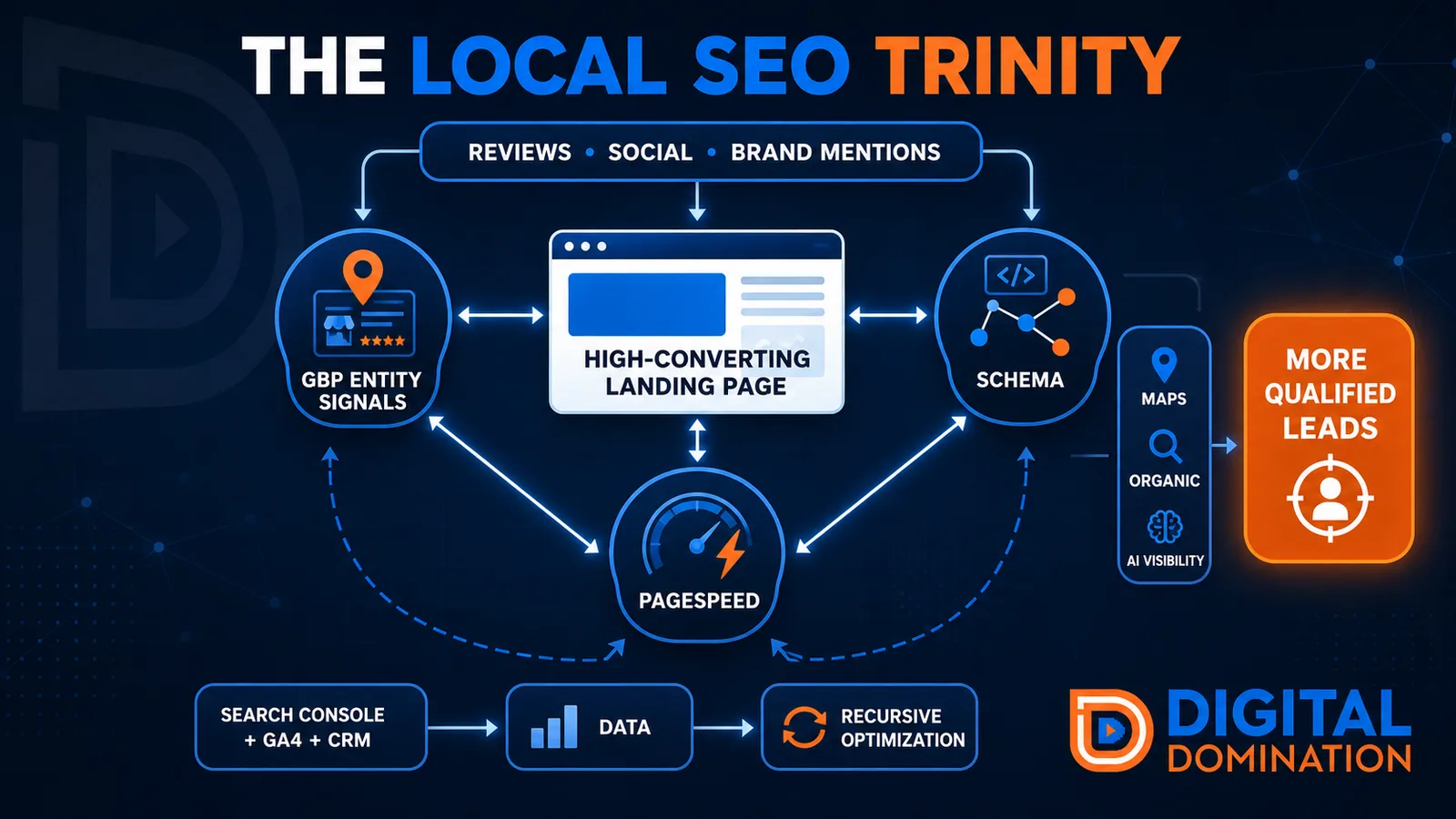
The Local SEO Trinity
Think of a three-legged stool. Your Google profile, your website, and your reviews all have to hold you up. If one leg is short, the whole thing wobbles.
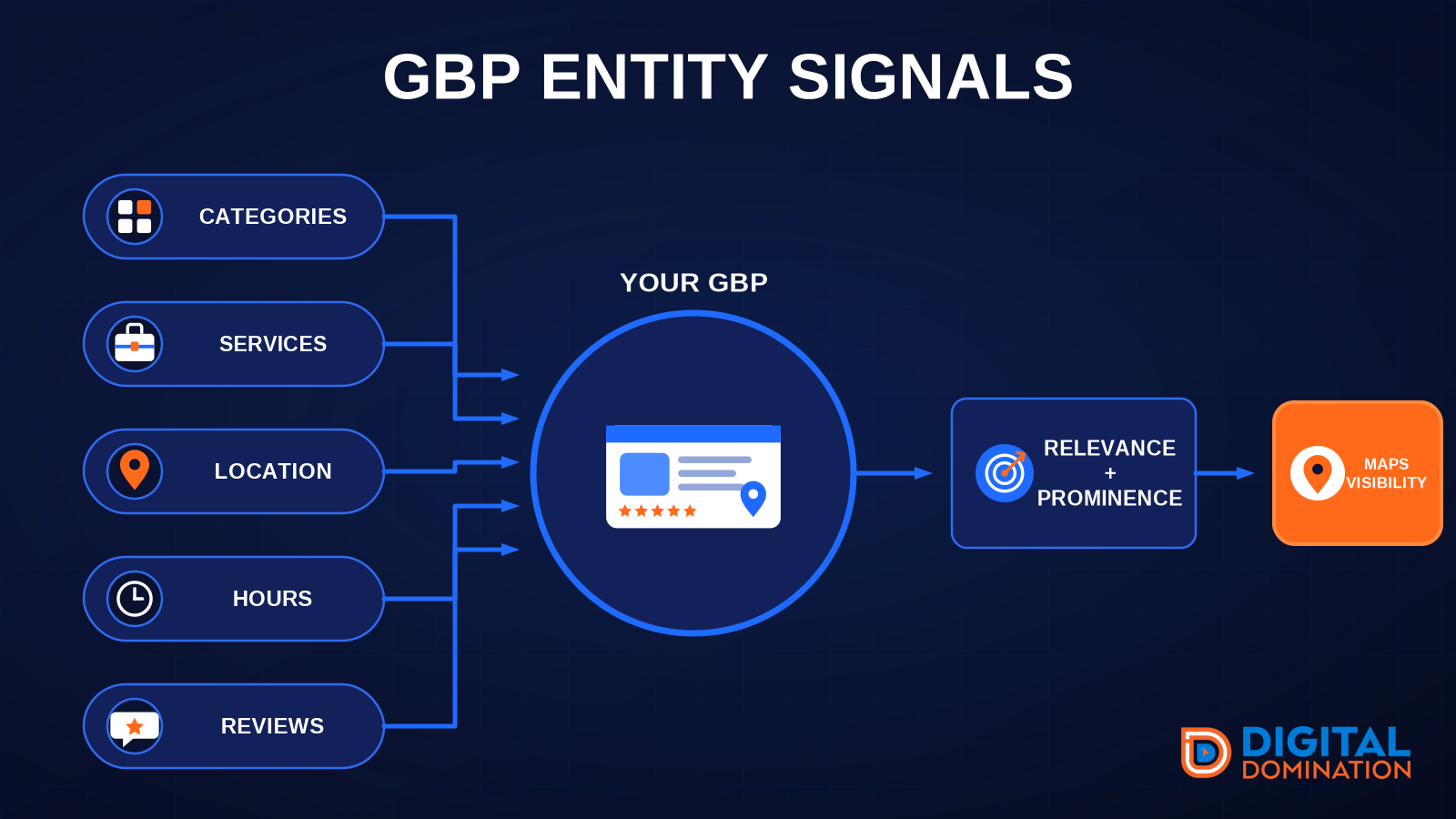
GBP entity signals
This leg is your Google Business Profile. GBP means Google Business Profile. It covers your categories, your services, your location, your hours, and your reviews. Google uses those facts to decide who to show.
Your Google profile is your storefront sign. If the sign is missing, or it names the wrong shop, people drive past.
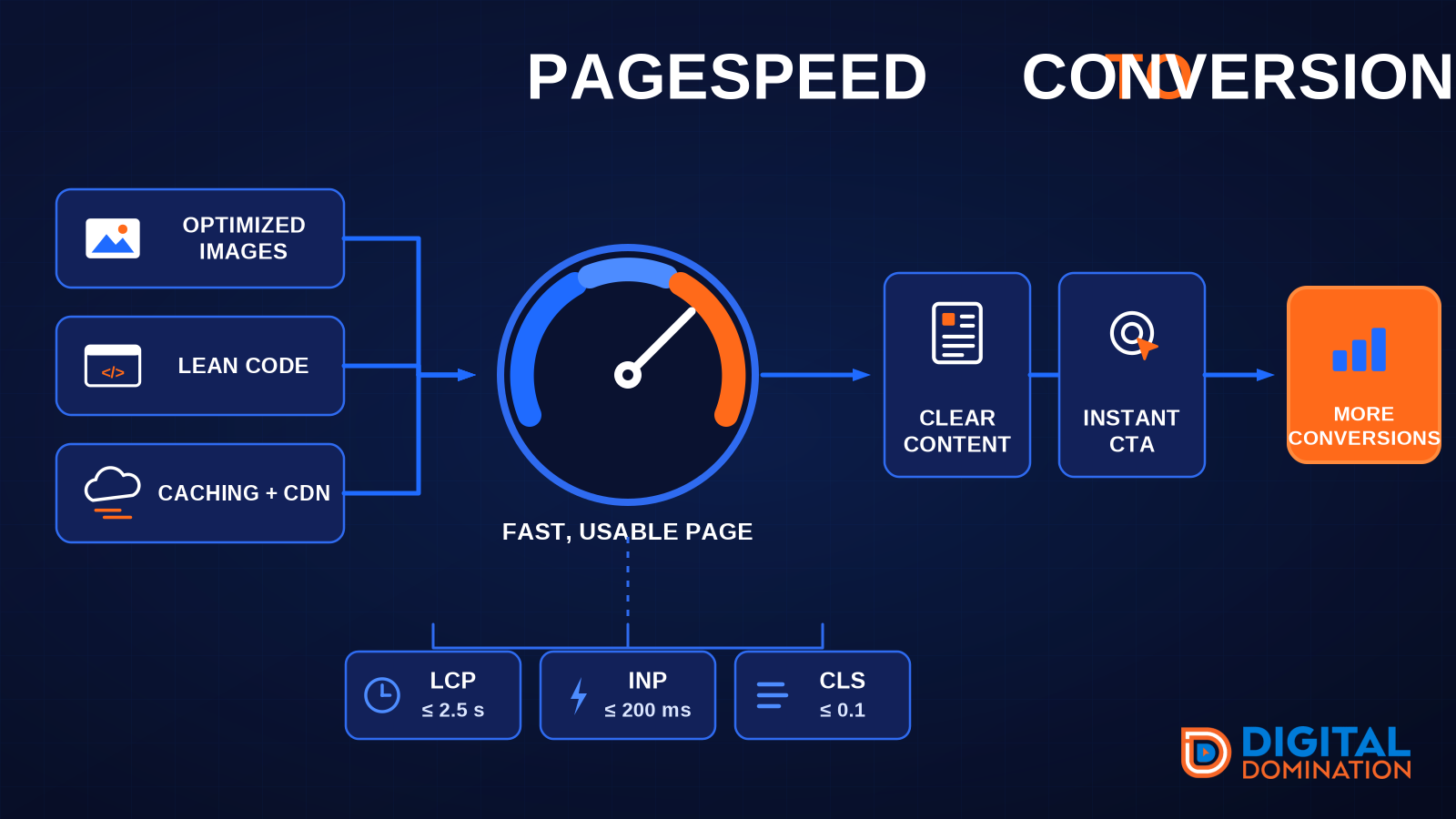
PageSpeed to conversion
This leg is your website, above all on a phone. Small images, lean code, and caching make a page fast. A fast, clear page is what turns a visit into a call. Phone speed is one of the 12 Trinity checks because a slow page loses the call before anyone sees your offer.
Your website is the showroom. If the door sticks, people leave before they look around.
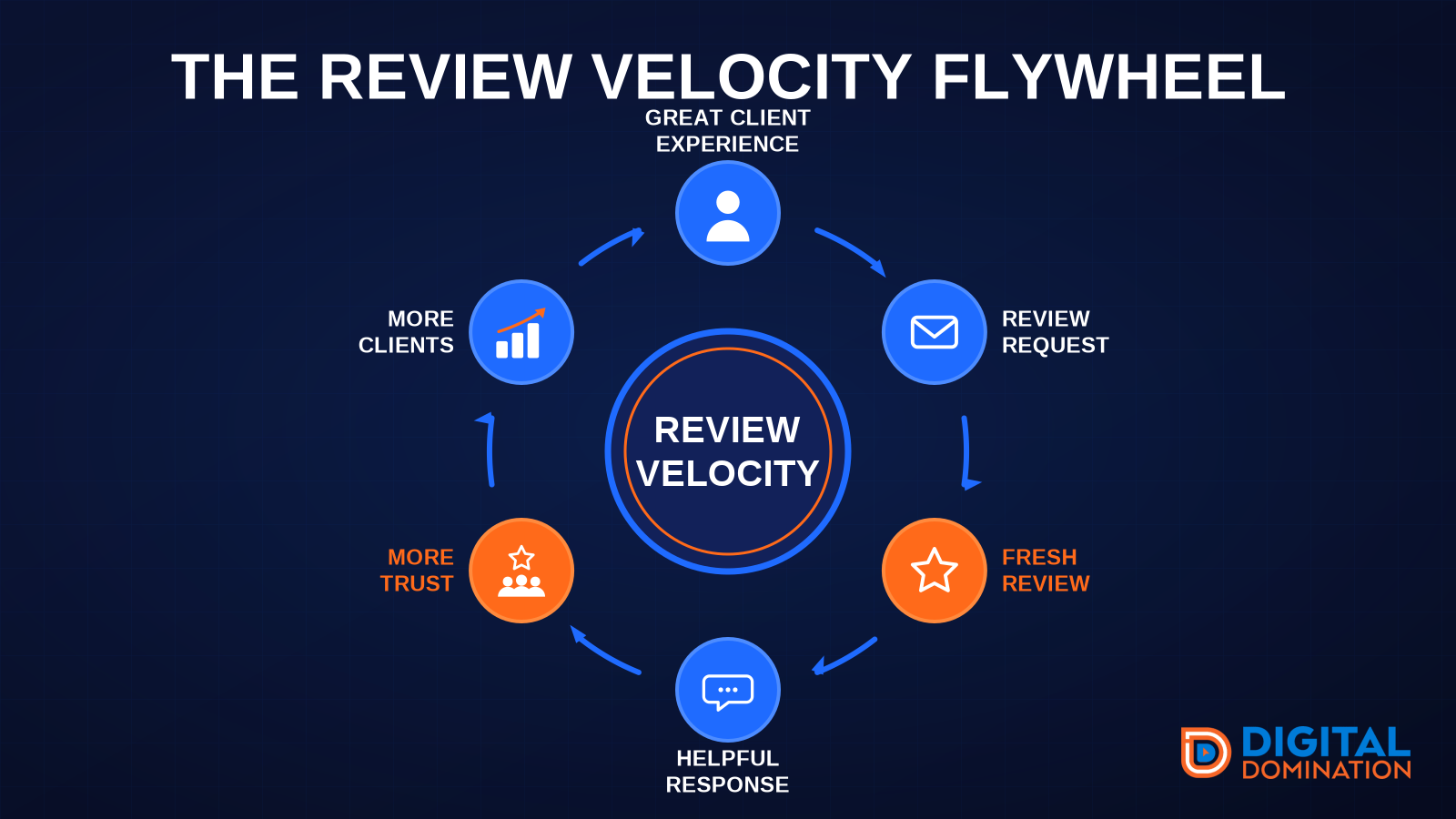
The review velocity flywheel
This leg is reviews and reputation. A good visit leads to a review request, then a fresh review, then a helpful reply, then more trust, then more customers. When the scan can find your Google listing, it shows your rating, your recent reviews, and how many you answered.
Reviews are word of mouth. One kind word helps. A steady stream of real reviews, and a reply from you, helps more.
How this turns into revenue
Being found in more searches leads to more calls. More calls lead to more booked jobs. More booked jobs lead to more revenue.
Example numbers, not a real business: 40 calls from search in a month, a 25 percent close rate, and a $400 average job. That is 10 booked jobs. That is $4,000. The math is the lesson. It is not a promise.
The full page has a box where you can type your own average job value and close rate.
One real story, from our car dealership case study: Medina Auto Group went from invisible on Google Maps to dominating every high-intent search across their market. The turnaround spanned all four of their rooftops at once. The same page says the team eliminated 89 unfair one-star reviews that had been dragging the dealership's reputation down and keeping it out of the Map Pack. It also says: “Results described here are exceptional and non-typical. Outcomes vary based on market conditions, competition, and implementation. No guarantees are made regarding earnings, rankings, or conversions.”
Free strategy call
More booked jobs start with a clear plan
Book a free strategy call. We look at your Google profile, your website, and your reviews, and we tell you what to fix first.
Free. You pick the time. A real person shows up.