
Local SEO services for HVAC companies
Get found in the Google Map Pack where your HVAC company actually wants calls, with service-area tracking, Business Profile work, reviews, citations, and local content.
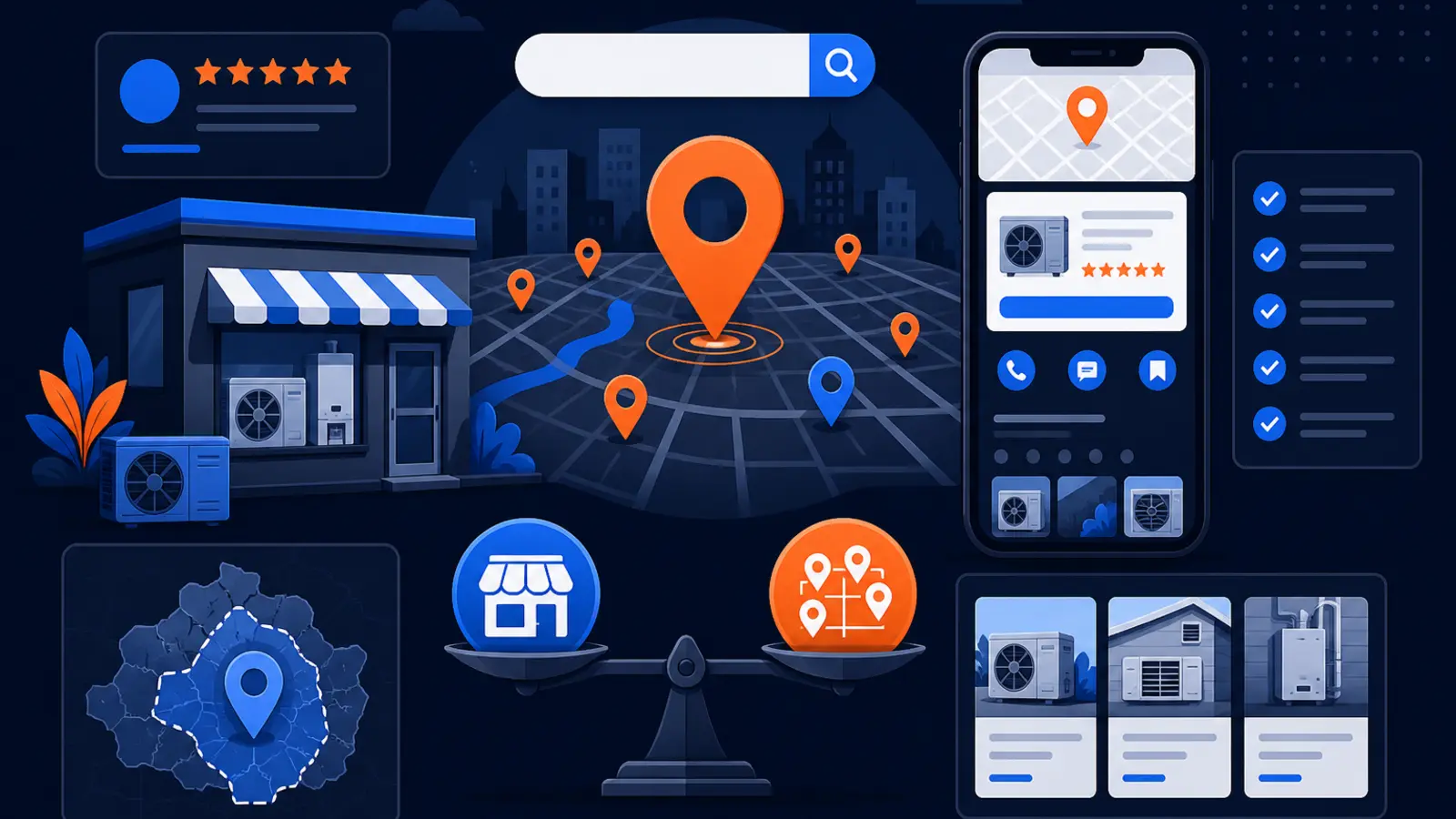
Can this get my HVAC company found in the Google Map Pack?
Yes, the right local SEO service can help an HVAC company compete for Google Map Pack visibility in the service areas that matter most. The work has to be local, practical, and tied to how people search for heating and cooling help near them, not just a few broad website keywords.
For an HVAC company, that usually means fixing and managing the Google Business Profile, choosing the right service areas, building trust through reviews, cleaning up name, address, and phone mentions, and publishing useful service and location content. It also means tracking rankings across the actual towns, neighborhoods, and suburbs you serve, because one rank from your office does not show what homeowners see across your market.
Digital Domination starts with a 169-point GeoGrid scan so you can see where your company already appears and where competitors are winning. From there, the plan is built around your service area, your trade, and the calls you want, such as AC repair, furnace repair, heat pump installation, maintenance plans, or emergency HVAC service.
How Google decides who shows up locally
Google Business Profile Help says a Business Profile can be used to improve a business's local ranking on Google Maps and Search. Google also says local results are mainly based on relevance, distance, and prominence, with prominence meaning how well-known a business is.
That matters for HVAC because Google is trying to match the searcher with a nearby company that looks relevant and trusted. A complete profile, accurate services, consistent information, and a steady review process all support that goal. Google Business Profile Help also says there is no way to request or pay for a better local ranking on Google, so the work has to improve the signals Google can evaluate.
For an owner, the practical takeaway is simple: local SEO should make your company easier for Google and customers to understand. The main ranking inputs to think about are:
- ▸Relevance: your profile, services, pages, and content match the HVAC job being searched.
- ▸Distance: your location and service areas line up with where the customer needs help.
- ▸Prominence: your company looks known and trusted through reviews, mentions, content, and authority.
- ▸Completeness: your profile has accurate hours, categories, services, photos, and contact details.
What local SEO for HVAC should include
BrightLocal says local SEO services commonly include Google Business Profile management, citation building, local content strategy, and review management. For HVAC companies, those are not optional extras. They are the basic building blocks of getting seen in the Map Pack and converting that visibility into calls.
A strong service should cover the parts of the job that affect both rankings and customer confidence. If a homeowner sees your company in the Map Pack but the profile is thin, the hours look wrong, or the reviews are not current, that click can go to a competitor.
A practical HVAC local SEO plan should include:
- ▸Google Business Profile setup, cleanup, and ongoing management.
- ▸Primary and secondary category review.
- ▸Service listings for jobs like AC repair, furnace installation, ductless mini-splits, maintenance, and emergency service.
- ▸Review request systems that follow platform rules.
- ▸Citation cleanup across directories and third-party sites.
- ▸Service-area and location content on your website.
- ▸Photo updates, question monitoring, and review responses.
- ▸GeoGrid reporting that shows where you rank across the market.
Service-area setup matters for HVAC companies
Many HVAC companies are service-area businesses. That means the customer does not come to your office to buy a repair. Your technicians go to the home, rental property, office, or jobsite.
Google Business Profile Help says a service-area business can set up to 20 service areas and should keep the overall area within about 2 hours of driving time from where the business is based. Google also says a business that does not serve customers at its business address should remove its address from its Business Profile and list a service area instead.
This is one of the first places an HVAC profile can go wrong. If the profile setup does not match how you actually serve customers, you can confuse both Google and homeowners. The service-area review should check:
- ▸Whether your address should be shown or hidden.
- ▸Whether your service areas are realistic for dispatch.
- ▸Which cities, suburbs, and neighborhoods are most valuable.
- ▸Whether the profile is trying to cover too wide an area.
- ▸Whether your website supports the service areas shown on the profile.
What timeline should you expect?
Local SEO is not instant, but you should not be left guessing. Google Business Profile Help says new business rankings can take up to a month to appear in search results, Business Profile edits can take up to 3 days to appear in search results, and profile photos and videos can take up to 24-48 hours to show after upload.
Google Search Central says some SEO changes may take effect in a few hours, others could take several months, and site owners should usually wait a few weeks to assess impact in Google Search results. That is why a serious local SEO plan should separate fast fixes from longer-term authority work.
For HVAC, the first few weeks often focus on profile accuracy, service setup, tracking, reviews, and citation cleanup. Over the following weeks and months, the work should keep building relevance and trust across your service area. A reasonable timeline should be explained like this:
- ▸First days: audit the profile, website, citations, reviews, and current Map Pack footprint.
- ▸First weeks: fix profile details, services, categories, tracking, and major citation issues.
- ▸First month: compare GeoGrid movement across the service area, not just one keyword from one location.
- ▸Ongoing months: publish local content, grow reviews, improve authority, and adjust based on ranking data.
What to look for before you hire a provider
A good HVAC local SEO provider should make the work visible. You should know what is being changed, why it matters, and how progress will be measured. You should not have to accept vague reports about impressions without seeing whether your company is showing up where your best customers live.
Google Business Profile Help says third parties may charge to manage a Business Profile and may offer services such as keeping the profile up to date, providing customer insights, answering questions, and responding to reviews. Google also warns that a red flag is a provider claiming special placement on Google through direct influence or payment.
Use concrete checkpoints before you sign:
- ▸Ask for a baseline map of your current rankings across your real service area.
- ▸Confirm who owns the Google Business Profile and website accounts.
- ▸Ask what profile changes will be made in the first month.
- ▸Ask how reviews will be requested and handled.
- ▸Ask how citation errors will be found and fixed.
- ▸Ask what service pages or location pages are recommended.
- ▸Ask how calls, rankings, and profile activity will be reported.
- ▸Ask whether the provider works with another HVAC company in your same service area.
Questions to ask before you sign
The easiest way to compare providers is to ask practical questions. You do not need technical jargon. You need clear answers that connect the work to calls, rankings, and the neighborhoods you care about.
Before you sign a local SEO agreement for your HVAC company, ask these questions:
- ▸What towns, ZIP codes, or neighborhoods will you track for Map Pack rankings?
- ▸Will I see a GeoGrid report or only a general ranking report?
- ▸What exactly will you change on my Google Business Profile?
- ▸How will you handle services like AC repair, heating repair, installation, and maintenance?
- ▸How do you help me request reviews without breaking platform rules?
- ▸Which citations or directories will you clean up first?
- ▸Will you create service-area content for my website?
- ▸Do you work with any other HVAC company in my service area?
- ▸What should I expect in the first 30 days, 60 days, and 90 days?
- ▸How do you explain ranking changes when competitors move too?
When the cheaper DIY path makes sense
The cheaper DIY path can make sense if you have time and someone on your team can keep the work consistent. An HVAC owner can verify and maintain the Business Profile, request compliant reviews, clean up citations, and publish service or location content without a hands-off provider.
The tradeoff is time and follow-through. During busy heating and cooling seasons, local SEO tasks can get pushed behind dispatch, estimates, callbacks, and inventory. If the work stops, competitors with a steady review and content process may pass you in the Map Pack.
DIY is more realistic when you can handle these tasks every month:
- ▸Check Business Profile hours, categories, services, and service areas.
- ▸Upload current job photos and team photos when appropriate.
- ▸Request reviews after completed jobs in a compliant way.
- ▸Respond to reviews and common profile questions.
- ▸Find and fix incorrect name, address, and phone mentions.
- ▸Publish helpful service pages or local content.
- ▸Track Map Pack rankings from more than one location.
How reporting should prove progress
For HVAC, a single ranking screenshot is not enough. A company can rank well near the office and be invisible in the subdivision, suburb, or town where it wants more calls. Reporting should show the whole service area.
Digital Domination uses weekly GeoGrid tracking reports with visual proof of rankings and call volume. The Free GeoGrid scan checks 169 real Google results across the service area, which gives an owner a clearer view of the market before committing to a plan.
Good reporting should answer the questions an owner actually has:
- ▸Where do we rank in the Map Pack today?
- ▸Which parts of the service area are improving?
- ▸Where are competitors still stronger?
- ▸Which searches are tied to our best services?
- ▸Are calls and profile actions moving with ranking gains?
- ▸What work was completed since the last report?
- ▸What is the next priority?
How Digital Domination works for HVAC
Digital Domination builds local SEO around the Google Map Pack, not vanity traffic. For an HVAC company, that means starting with the territory you want to win, checking where you stand on the map, and then working on the profile, reviews, citations, content, and reporting that support local visibility.
Digital Domination works with one client per trade per service area, so territory exclusivity is part of the model. Pricing for the Maps Domination Program is set per market on a qualification call and tied to the ranking outcome. The guarantee reads exactly: top 3 in the Google Map Pack in 12 weeks or you do not pay.
The process is designed for owners who want a hands-off provider but still want proof. You should expect:
- ▸A 169-point GeoGrid scan before the plan is built.
- ▸A review of your Google Business Profile and service-area setup.
- ▸A plan tied to the HVAC services and towns you care about.
- ▸Ongoing work on reviews, citations, profile updates, and local content.
- ▸Weekly GeoGrid tracking reports with visual proof of rankings and call volume.
- ▸Clear territory rules so your provider is not helping your direct same-trade competitor in the same service area.
Next step for HVAC owners
If you want to see the full offer for heating and cooling companies, visit Digital Domination's HVAC industry page. It explains the local SEO service for HVAC businesses, what is included, and how the Map Pack-focused program is built around your service area.
If you are not ready for a call yet, start with the Free GeoGrid scan page. The scan shows 169 real Google results across your service area, so you can see where your HVAC company is visible, where it is missing, and which competitors are taking the Map Pack spots you want.
Keep reading
Related guides
- ▸GBP Reinstatement Checklist
- ▸Google GBP support misuse policy raises SEO vendor risk
- ▸GBP Suspension Recovery
Put it into action
Frequently Asked Questions
How long does HVAC local SEO take to work?
Some profile edits can appear quickly, but meaningful ranking movement often takes weeks or months. Google Business Profile Help says new business rankings can take up to a month to appear, and Google Search Central says some SEO changes can take several months. A good provider should show early setup work, then track Map Pack movement across your service area.
Can I pay Google to put my HVAC company in the Map Pack?
No. Google Business Profile Help says there is no way to request or pay for a better local ranking on Google. Local SEO works by improving the signals Google can evaluate, such as profile relevance, distance, prominence, reviews, accuracy, and helpful content.
What should be on my HVAC Google Business Profile?
Google Business Profile Help says complete information should include details like address when customers can visit, business hours, business category, and attributes. For HVAC, your profile should also list the services customers search for, such as AC repair, heating repair, installation, maintenance, and emergency service. If customers do not visit your office, your address may need to be hidden and your service area shown instead.
Do reviews help HVAC companies rank locally?
Google Business Profile Help says more reviews and positive ratings can help a business's local ranking. Reviews also help homeowners decide who to call when several HVAC companies appear in the Map Pack. The key is to request reviews consistently and respond professionally.
What are citations for an HVAC company?
Semrush defines local citations as online mentions of a business's name, address, and phone number on third-party websites and directories. For an HVAC company, citation cleanup means making sure those details are consistent across the web. Bad or mismatched information can confuse customers and weaken trust.
Should my HVAC company show its address on Google?
It depends on whether customers can visit that address. Google Business Profile Help says a business that does not serve customers at its business address should remove its address and list a service area instead. Many HVAC companies are service-area businesses, so this setup should be reviewed carefully.
What is a GeoGrid scan for HVAC SEO?
A GeoGrid scan checks how your company ranks from many points across your service area instead of from one location. Digital Domination's Free GeoGrid scan checks 169 real Google results across the service area. That helps you see where you are visible, where you are weak, and which competitors are winning the Map Pack.
Can I do HVAC local SEO myself?
Yes, if you have time to maintain the Business Profile, request reviews, clean up citations, and publish service or location content. The DIY path is cheaper, but it requires steady work and tracking. A hands-off provider makes more sense when you want the work managed and reported every week.
Ready to dominate your map?
Top 3 in the Google Map Pack in 12 weeks, or you don't pay.