
Local SEO services vs doing local SEO yourself
A practical comparison for local business owners deciding whether to hire a local SEO service or use free Google tools and a rank tracker to get more trackable calls.
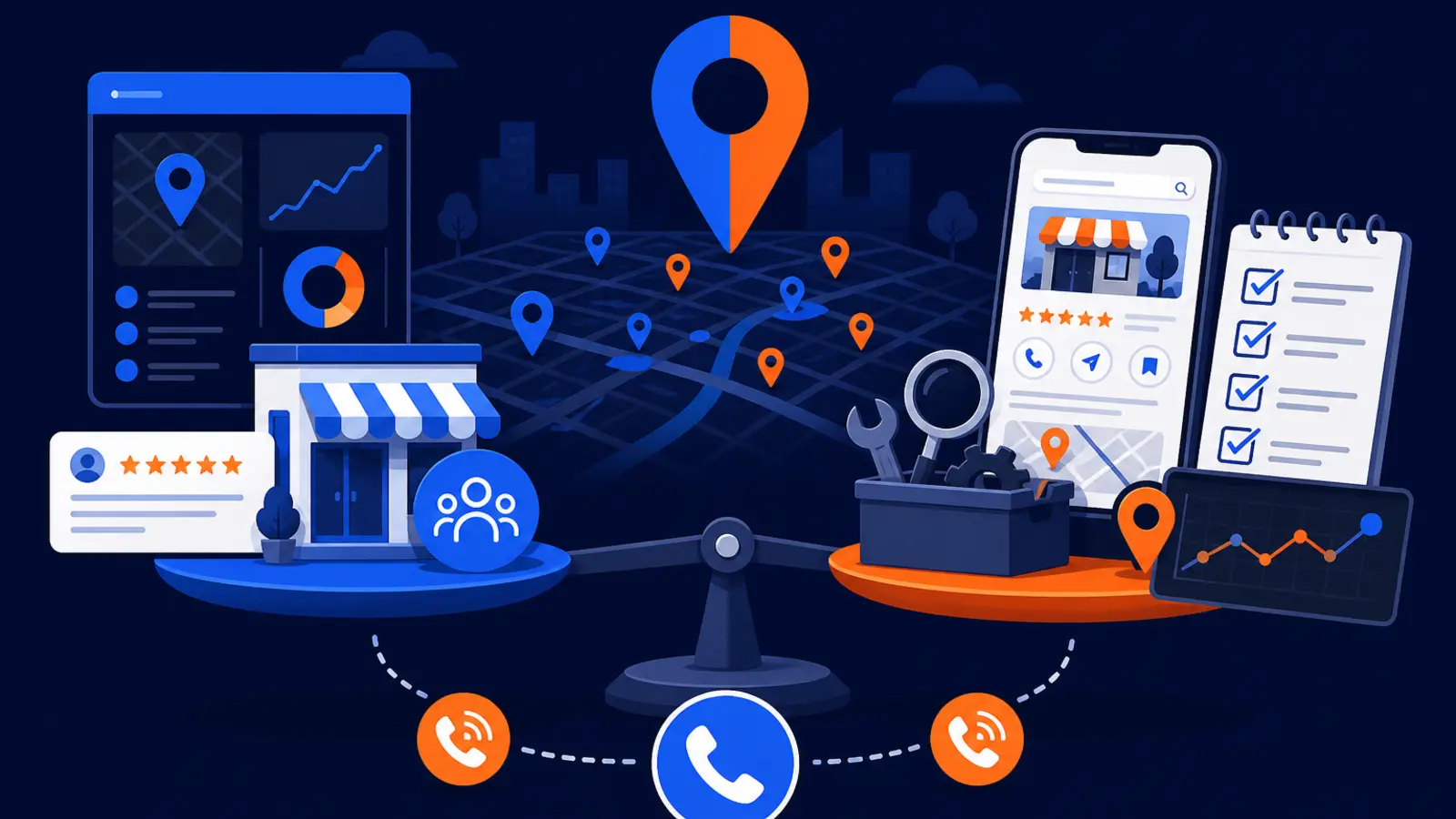
The direct answer
A local SEO service is more likely to produce more trackable calls when the work required to improve Map Pack visibility is not getting done every week. A DIY setup can work, but only if the owner has time to maintain the Google Business Profile, request and answer reviews, improve local pages, watch Search Console and Analytics, and use a rank tracker to measure progress.
The reason is simple. Google Business Profile Help says local results are mainly based on relevance, distance, and prominence. You cannot request or pay Google for a better local ranking, according to Google Business Profile Help. So the question is not whether a tool or a vendor has a shortcut. The question is who will consistently improve the signals Google says matter.
If you are a one-location owner with time and discipline, DIY can be the right move. If your phone depends on Map Pack visibility and you are already stretched thin, a managed local SEO service usually gives you a better shot at more trackable calls because it turns ranking work into a managed process.
What the DIY path really includes
DIY local SEO starts with free Google tools. Google Business Profile Help says a Business Profile lets a business manage how it shows up on Google Maps and Search at no charge. Google Search Console Help says Search Console is a free service for monitoring, maintaining, and troubleshooting a site’s presence in Google Search results. Google Analytics Help says GA4 traffic acquisition reports show where users come from, including organic and paid traffic source dimensions.
A rank tracker adds measurement, not execution. Semrush says a Map Rank Tracker can show Google Maps rankings as a heatmap around a target area, along with ranking changes over time and improvement recommendations. That can help you see where you are weak, but it will not answer reviews, rewrite a service page, fix business information, or earn more local prominence for you.
For a local owner, a basic DIY setup usually means these jobs are on your plate:
- ▸Keep business name, address, phone, hours, categories, services, and service areas accurate
- ▸Post updates, photos, products, services, and other profile details when they change
- ▸Request reviews from real customers and answer reviews professionally
- ▸Check Search Console for site issues and search performance trends
- ▸Check GA4 for traffic sources and user behavior
- ▸Use a Maps rank tracker to see where visibility is strong or weak
- ▸Improve local service pages and make sure customers can call easily
What a managed local SEO service adds
A managed local SEO service is not just a paid rank tracker. The service should be doing the work that affects visibility, then reporting whether that work is improving rankings and calls. BrightLocal’s managed local SEO service page lists Google Business Profile optimization, website optimization, citations, content, links, and reporting as parts of a full local SEO campaign.
Google Search Central says hiring an SEO can improve site visibility and save time, but an irresponsible SEO can damage a site and reputation. That is the tradeoff. A good provider gives you process, accountability, and speed. A poor provider can waste time or create risk.
When comparing a managed service to DIY, look for execution across these areas:
- ▸Google Business Profile optimization and maintenance
- ▸Review generation support and review response habits
- ▸Local service page improvements
- ▸Citation cleanup and business data consistency
- ▸Local content tied to real services and locations
- ▸Link and prominence work that does not rely on spam
- ▸Clear reporting on rankings, calls, and completed work
How calls are tracked, and what the number means
Google Business Profile performance reports define Calls as the number of times a customer clicked the call button on the Business Profile, according to Google Business Profile Help. That is useful, but it is not every phone call your business receives. Someone may dial after seeing your number elsewhere, call from your website, or call from a saved contact.
This matters because the buying question is about trackable calls. A DIY owner and a service provider should agree up front which call sources will be watched and how they will be interpreted. Profile call clicks, website calls, form fills, and direction requests can tell a fuller story than one number alone.
The cleanest comparison is to track the same signals before and after work starts, then compare trend lines rather than one busy or slow day.
The work required to improve Map Pack visibility
Google Business Profile Help says businesses with complete and accurate information are more likely to show up in local search results. It also says prominence is based on information such as how many websites link to the business and how many reviews the business has. BrightLocal’s Consumer Search Behavior research says 67% of consumers often or always look at business reviews after a local business search.
That means Map Pack work is part profile cleanup, part reputation, part website quality, and part local authority. Google Search Central’s LocalBusiness structured data documentation says Local Business structured data can tell Google about business hours, departments, reviews, and other business details. For some businesses, structured data is another way to make business details clearer to search engines.
The repeatable work usually looks like this:
- ▸Make the profile complete, accurate, and compliant
- ▸Choose categories and services that match what customers search for
- ▸Add useful local pages for core services and nearby areas
- ▸Ask customers for reviews without pressuring or filtering them
- ▸Respond to reviews in a calm, specific way
- ▸Fix inconsistent business information across important listings
- ▸Build real-world prominence through trusted local mentions and links
- ▸Measure rankings across the service area, not only from your office
Who should choose DIY
The DIY path genuinely suits a one-location owner who has time to maintain the Business Profile, request and answer reviews, update local pages, check Search Console and Analytics, and use a rank tracker for measurement rather than execution. Google Search Central says a small local business can probably do much of the SEO work itself by starting with the SEO Starter Guide.
DIY is also a smart choice if your market is not very competitive, your profile already gets steady calls, and you want to learn how local search works before hiring anyone. It can be especially practical for an owner who likes operational checklists and can protect a few hours each week for marketing tasks.
DIY is a good fit when these are true:
- ▸You have one location and a simple service area
- ▸You can update your profile without needing a staff meeting
- ▸You can ask for reviews as part of normal customer follow-up
- ▸You are comfortable reading basic reports
- ▸You can wait several weeks to judge changes
- ▸You will act on what the rank tracker shows
- ▸You do not need a provider to manage local SEO tasks for you
Who should choose a local SEO service
A local SEO service makes more sense when local search is a major source of leads and the owner cannot consistently do the work. If reviews, local pages, profile updates, and measurement keep getting pushed behind operations, the cost of DIY is not zero. It is missed execution.
A service can also help when you serve multiple neighborhoods, have several locations, or compete against businesses with stronger review profiles and better local pages. In those situations, a rank tracker may show the problem clearly, but you still need someone to fix it.
A service is usually the better fit when these are true:
- ▸You need more calls, not more reports
- ▸Your profile has not been updated in months
- ▸You do not have a steady review request process
- ▸Your website does not explain each core service clearly
- ▸You serve a wider area than your office address
- ▸Your rankings change sharply across town
- ▸You want one accountable team watching rankings and call trends
What to look for and what to expect
A fair provider should show you what they are measuring, what they are changing, and how long you should wait before judging results. Google Search Central’s SEO Starter Guide says some Search changes can take effect in a few hours while others can take several months, and it suggests waiting a few weeks to assess effects.
For service-area businesses, compliance matters. Google Business Profile Help says service-area businesses should have one profile for the central office or location with a designated service area and cannot list a virtual office unless it is staffed during business hours. A provider should not push shortcuts that put the profile at risk.
Concrete checkpoints you can verify include:
- ▸Your Business Profile fields are complete and accurate
- ▸Your service area follows Google’s business representation guidelines
- ▸Your review request process is active and ethical
- ▸Your website has clear pages for major services
- ▸Your reporting separates rankings, profile calls, website traffic, and leads
- ▸Your rank tracking shows multiple points across the service area
- ▸Your provider explains what changed each month in plain language
- ▸You can see whether visibility is improving in the areas you actually serve
Questions to ask before you sign
This is the listicle section to keep handy before you hire a provider or commit to DIY. The goal is not to trap anyone. It is to make sure the plan is tied to work, measurement, and accountability.
Ask these questions before you sign:
- ▸How will you measure Map Pack visibility across my service area
- ▸Which calls will count as trackable calls
- ▸What will you do inside my Google Business Profile each month
- ▸How will reviews be requested and answered
- ▸What website pages need to be improved first
- ▸What tools will I be able to see or verify
- ▸How often will I receive ranking and call reporting
- ▸What work is included, and what is only a recommendation
- ▸How do you avoid tactics that could damage my profile or site
- ▸Who owns the account access, content, and reporting history
How Digital Domination approaches this decision
Digital Domination is built for owners who want local SEO tied to Map Pack visibility, call volume, and proof across the service area. The free 169-point GeoGrid scan checks 169 real Google results across the service area, so an owner can see where the business appears and where it is missing.
Digital Domination works with one client per trade per service area, which means territory exclusivity. The Maps Domination Program pricing is set per market on a qualification call and tied to the ranking outcome. The guarantee is: top 3 in the Google Map Pack in 12 weeks or you do not pay.
The reporting focus is practical. Digital Domination provides weekly GeoGrid tracking reports with visual proof of rankings and call volume, so the discussion is about where visibility is improving and whether more calls are being created.
The bottom line
DIY can absolutely be the right answer for a one-location owner who has time, discipline, and a willingness to learn. The free Google tools are legitimate, and a rank tracker can help you see where your Maps visibility is strong or weak. But the rank tracker is not the work. It is the scoreboard.
A local SEO service is the better choice when you need execution, accountability, and clearer reporting on rankings and calls. That is especially true when your service area is competitive, your review process is inconsistent, or your local pages and Business Profile have been neglected.
If you are comparing options, read the Digital Domination local SEO services page. It explains the service, the outcome focus, and how the Maps Domination Program is evaluated. Then start with the free GeoGrid scan page to see your current visibility across 169 real local search results before you decide whether DIY or managed service is the better fit.
Keep reading
Related guides
- ▸Google AI Mode alerts change local search visibility
- ▸Google AI Visibility Search Console Local SEO
- ▸Google Business Profile 4 Day Edits
Put it into action
Frequently Asked Questions
Can I do local SEO myself with free Google tools?
Yes, many one-location owners can handle a meaningful amount of local SEO themselves. Google Search Central says a small local business can probably do much of the SEO work itself by starting with the SEO Starter Guide. The challenge is doing the work consistently, not just checking the tools.
Is Google Business Profile really free?
Yes. Google Business Profile Help says a Business Profile lets a business manage how it shows up on Google Maps and Search at no charge. That does not mean rankings are automatic, because Google says local results are mainly based on relevance, distance, and prominence.
Can I pay Google to rank higher in the Map Pack?
No. Google Business Profile Help says there is no way to request or pay for a better local ranking on Google. Paid ads can show in search results, but organic local rankings depend on the local ranking factors Google describes.
Does a rank tracker get me more calls?
A rank tracker helps you measure visibility, but it does not do the work that improves visibility. Semrush says a Map Rank Tracker can show Google Maps rankings as a heatmap and show changes over time. You still need profile work, reviews, local pages, and prominence signals.
What calls can I track from local SEO?
Google Business Profile performance reports define Calls as the number of times a customer clicked the call button on the Business Profile. You can also watch website calls, form fills, and traffic sources in other reporting tools. For a fair comparison, track the same call sources before and after changes begin.
How long does local SEO take to show results?
Google Search Central says some Search changes can take effect in a few hours while others can take several months, and it suggests waiting a few weeks to assess effects. Local SEO is not instant because reviews, content, profile updates, links, and user behavior build over time.
When should I hire a local SEO service instead of doing it myself?
Hire a service when local search matters to your revenue and you do not have time to manage the work every week. Google Search Central says hiring an SEO can improve visibility and save time, while warning that an irresponsible SEO can damage a site and reputation. Ask for clear reporting, plain explanations, and proof of work.
What should a local SEO report show?
A useful report should show Maps rankings across the service area, Business Profile call clicks, website traffic sources, and completed work. It should help you see whether visibility is improving where your customers actually are. A single ranking checked from one location is usually not enough.
Ready to dominate your map?
Top 3 in the Google Map Pack in 12 weeks, or you don't pay.