
Online reputation management vs DIY local SEO with Google tools and a rank tracker
A practical comparison for local business owners who want more calls from Google Maps and local search.
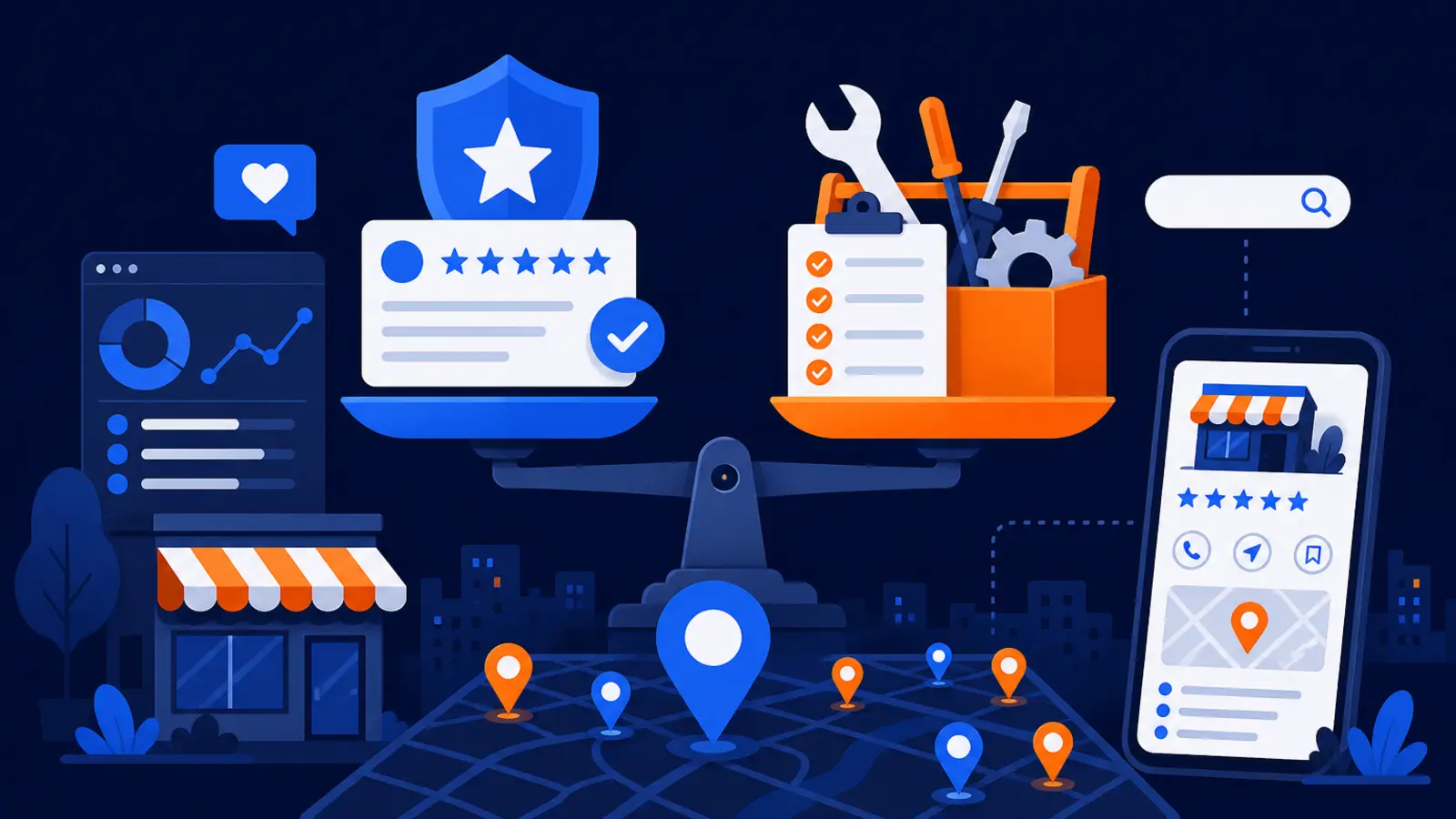
Direct answer: which path gets more calls
If your goal is more calls from local search, managed online reputation management is usually the better first priority when your Google Business Profile is already verified but your reviews are inconsistent, unanswered, outdated, or thin compared with nearby competitors. Reviews influence whether people trust you enough to call, and Google Business Profile Help says more reviews and positive ratings can help local ranking as part of prominence.
DIY local SEO with free Google tools and a rank tracker can work well for an owner-led business that has time every week to request reviews, answer reviews, keep profile information current, watch calls and rankings, and make small improvements without being reminded. It is the lower control cost path, but the owner pays with time and consistency.
The simplest way to decide is this: if your profile is incomplete or you have never used Google Business Profile, start with the DIY basics. If the basics are done and calls still depend on trust, reviews, and local visibility, managed reputation management is usually the more practical next move.
What each option really includes
DIY local SEO starts with your Google Business Profile. Google Business Profile Help says an eligible local business can manage how it appears on Google Maps and Search at no charge. A verified profile can show hours, website, phone number, location, photos, videos, products, services, reviews, booking links, social links, and other links.
A rank tracker adds visibility measurement. BrightLocal explains that a local rank tracker tracks organic and map rankings for local keywords, while a geo-grid rank tracker simulates searches from multiple points in a city or neighborhood. That helps you see where you appear, but it does not request reviews, answer customers, correct profile drift, or improve trust by itself.
Managed online reputation management is the ongoing work of making review requests consistent, helping the business respond to feedback, monitoring reputation signals, keeping the process compliant, and giving the owner a clear view of whether more people are choosing to call. In plain terms, one path gives you tools. The other gives you a process.
Why reviews affect calls and rankings
Reviews matter for two separate reasons. First, people use them to decide who deserves the call. BrightLocal's Local Consumer Review Survey reports that 97% of consumers read reviews for local businesses and 41% always read reviews when browsing for businesses. If a customer sees weak, stale, or ignored reviews, that can stop the call before it starts.
Second, reviews can be part of local visibility. Google Business Profile Help says local results are mainly based on relevance, distance, and prominence, and that there is no way to request or pay for a better local ranking. Google also says prominence can be based on information such as links, articles, directories, review count, and review score.
That means reviews are not the only factor, but they are one of the few reputation inputs a business owner can improve with a steady, ethical process. Here are the review signals an owner should watch:
- ▸Review count on Google compared with visible local competitors
- ▸Average rating and whether recent reviews support it
- ▸Recency of reviews, not just total history
- ▸Owner responses to both positive and negative reviews
- ▸Whether customers mention real services, locations, and experiences
- ▸Whether reviews also appear on other platforms customers use
Where the DIY path can be the right choice
The DIY path suits an owner-led business with a verified profile, enough time to ask for and answer reviews, accurate profile information, and no immediate need to build review consistency across multiple platforms. It also suits a business that is still learning which services and neighborhoods matter most before hiring outside help.
Google gives owners useful free tools. Google Business Profile performance data can include searches, views, directions, calls, website clicks, messages, bookings, products, menus, and offers when those metrics apply. Google defines the Calls metric as the number of times a customer clicked the call button on the Business Profile, and a business must add its phone number to track that metric.
DIY is strongest when the owner can turn the work into a weekly routine. A simple DIY routine should include these tasks:
- ▸Check that hours, phone number, services, and links are accurate
- ▸Add or refresh photos when the work, staff, or location changes
- ▸Use Google’s review request link or QR code after genuine customer experiences
- ▸Respond to new reviews in a calm, specific, professional way
- ▸Check Business Profile performance for calls and other actions
- ▸Use a rank tracker to see where map visibility is weak
- ▸Review suggested profile edits before they publish
Where managed reputation management usually wins
Managed reputation management tends to win when the owner already knows reviews are important but cannot keep the system moving. Many good local businesses ask for reviews only when business is slow, forget to respond during busy weeks, or have no plan for negative feedback. That inconsistency can make the business look less trusted than it really is.
BrightLocal reports that the average consumer uses six review sites when choosing businesses, and that generative AI tools for local recommendations rose from 6% in 2025 to 45% in 2026. That does not mean every business needs to chase every site. It does mean reputation is no longer only about one star rating in one place.
A managed program is most useful when the business needs repeatable execution. It should help with these outcomes:
- ▸A steady review request process that staff can actually follow
- ▸Faster awareness of new reviews and customer complaints
- ▸Professional response guidance that sounds human, not canned
- ▸More complete tracking of reputation across the places customers check
- ▸A compliance guardrail so staff do not offer incentives or filter for happy customers
- ▸Clear reporting that connects reputation activity with calls and profile actions
A rank tracker is measurement, not momentum
A rank tracker is useful because local rankings change by search term and by search location. A business may show well near the office but disappear across town. A geo-grid rank tracker helps reveal those patterns by simulating searches from multiple points in a city or neighborhood, as BrightLocal explains.
But a rank tracker is closer to a scale than a diet plan. It tells you where you stand. It does not automatically fix missing services, weak categories, poor review habits, inconsistent photos, bad responses, or customer trust problems.
Use rank tracking to make better decisions, not to replace the work. The owner should expect a tracker to answer these questions:
- ▸Where do we show up in the map results for our main services
- ▸Which neighborhoods are weak even though we serve them
- ▸Do ranking changes line up with profile updates or review activity
- ▸Are calls increasing in the same areas where visibility improves
- ▸Are we tracking the terms customers actually use
Compliance matters because shortcuts are risky
Reputation management should never mean fake reviews, review gating, paid praise, or pressure on unhappy customers to stay quiet. Google Business Profile Help says offering free or discounted goods or services in exchange for posting, changing, or removing reviews is prohibited fake engagement.
Google Maps policy allows merchants to solicit reviews based on genuine experiences without incentives or attempts to influence the rating or review contents. The same policy prohibits merchants from discouraging negative reviews or selectively soliciting positive reviews from customers.
The Federal Trade Commission says the Consumer Reviews and Testimonials Rule went into effect on October 21, 2024 and authorizes courts to impose civil penalties for knowing violations involving deceptive reviews and testimonials. That makes compliance a business risk issue, not just a marketing detail.
Any option you choose should keep the business inside these rules:
- ▸Ask customers for honest feedback, not only five-star reviews
- ▸Do not offer discounts, gifts, or free services for reviews
- ▸Do not ask customers to change or remove a review in exchange for value
- ▸Do not route unhappy customers away from public review options
- ▸Do not post reviews from staff, family, vendors, or fake accounts
- ▸Keep responses professional and avoid sharing private customer details
What to expect: checkpoints an owner can verify
Whether you choose DIY or a managed provider, you should be able to verify the work without technical knowledge. A good process shows what changed, what customers did, and whether calls are moving in the right direction.
Google Business Profile Help says Google may update a Business Profile from sources such as user reports and licensed content. If Google notifies the owner of a suggested edit, it can be automatically published after 4 days if the owner does not respond and the edit is supported by public information. That is why profile monitoring is part of reputation management, not a separate chore.
Use these checkpoints before you judge either path:
- ▸Your profile phone number is present so call clicks can be tracked
- ▸Primary services, hours, website, and appointment links are correct
- ▸Review requests are sent after real customer interactions
- ▸New reviews receive timely, specific responses
- ▸Negative reviews are handled without incentives or pressure
- ▸Profile performance is checked for calls, website clicks, and directions
- ▸Rank tracking is reviewed by area, not just one keyword from one address
- ▸Suggested edits are reviewed before they change important information
Seven questions to ask before you sign
If you are considering a managed online reputation management provider, ask practical questions that reveal whether the service will produce steady work or just send you a dashboard login. The right provider should be able to explain the process in plain English and should not promise that reviews alone will control Google rankings.
Use these questions before you commit:
- ▸How will you help us request reviews from real customers without incentives
- ▸Which review platforms will you monitor besides Google, and why
- ▸Who writes or approves review responses
- ▸How will you handle negative reviews without violating Google or FTC rules
- ▸What reports will show calls, profile actions, reviews, and ranking movement
- ▸How often will we review the plan and decide what to change
- ▸What work must my staff do each week for this to succeed
A practical decision rule
Choose DIY local SEO if you are still setting up the basics, your profile is verified, your staff can ask every customer for an honest review, and you have one person who will check performance and rankings every week. It is also the better choice if cash is tight and your immediate issue is simple profile completeness rather than reputation consistency.
Choose managed online reputation management if your business depends on calls, your competitors look more trusted, reviews arrive randomly, responses are inconsistent, or you do not know what customers see across the places they check. It is also the better choice when the owner should be selling, serving customers, or managing crews instead of chasing review tasks.
Here is the short version:
- ▸DIY is best when time is available and the basics are not done yet
- ▸Managed reputation is best when consistency is the problem
- ▸A rank tracker helps diagnose visibility, but it does not create trust
- ▸Google tools are free, but the work still needs an owner
- ▸Reviews should be requested ethically from real customers
How Digital Domination fits this decision
Digital Domination focuses on helping local businesses earn attention, authority, trust, and rankings online. The company offers a 5-Star Review System at $297/month, with no setup fee, cancel anytime, and monthly billing through Stripe. That published offer is built for owners who want a simple, managed review process without trying to build one from scratch.
For local visibility, Digital Domination also uses a 169-point GeoGrid scan to check real Google results across a service area. The Maps Domination Program is priced per market on a qualification call and tied to the ranking outcome. Its guarantee is: top 3 in the Google Map Pack in 12 weeks or you do not pay.
This matters because reputation and local ranking are connected, but they are not identical. Reviews help people choose you, while geo-grid tracking shows where you are actually visible. A business that wants more calls usually needs both trust and visibility measured in the real service area.
Next step if reviews are holding back calls
If your profile is verified and the missing piece is a steady, compliant review process, read Digital Domination’s Online Reputation Management page. It explains what the service covers, who it is for, and how a local business can build a more trustworthy presence without relying on sporadic review requests.
If you are not sure whether reviews, rankings, or service area visibility are the main issue, start with the free GeoGrid scan page. Digital Domination’s free GeoGrid scan checks 169 real Google results across your service area so you can see where you show up before deciding what to fix first.
Keep reading
Related guides
- ▸Google Business Profile post view counts are back
- ▸Google review management for HVAC companies
- ▸Google review management in Las Vegas
Put it into action
Frequently Asked Questions
Can I do local SEO myself with Google Business Profile?
Yes, many owner-led businesses can start with Google Business Profile at no charge. You can verify the profile, update hours and services, add photos, request reviews, respond to reviews, and watch performance data. The hard part is doing those tasks consistently while running the business.
Does online reputation management help my Google ranking?
It can support ranking, but it is not the only factor. Google Business Profile Help says local results are mainly based on relevance, distance, and prominence, and that prominence can include review count and review score. A good reputation process also helps customers feel safer calling you.
Is a local rank tracker enough to get more calls?
No. A rank tracker measures where you show up for local keywords and map results, but it does not improve your profile or ask customers for reviews. It is useful for diagnosis and tracking, not as a complete call generation plan.
Should I ask every customer for a Google review?
You can ask customers with genuine experiences for reviews, but you should not offer incentives or try to influence the rating or wording. Google Maps policy also prohibits discouraging negative reviews or selectively asking only happy customers. The safest process is simple, honest, and consistent.
What should I track if my goal is more phone calls?
Start with your Google Business Profile Calls metric, which Google defines as clicks on the call button when your phone number is added. Also watch website clicks, direction requests, messages if you use them, review growth, review responses, and map rankings by area. Calls are the goal, but the supporting signals explain what is changing.
When should I choose DIY instead of managed reputation management?
Choose DIY if you have a verified profile, a clear weekly routine, and enough time to request and answer reviews yourself. It is also a good fit when you do not yet need review consistency across multiple platforms. If the work keeps getting skipped, managed help usually makes more sense.
What is the biggest risk in reputation management?
The biggest risk is using shortcuts that violate review rules, such as incentives, fake reviews, or filtering only happy customers toward public reviews. The Federal Trade Commission can pursue civil penalties for knowing violations involving deceptive reviews and testimonials. Any provider you hire should explain how it keeps your process compliant.
How do I know if reviews or rankings are the bigger problem?
Look at both trust and visibility. If you rank in the map results but competitors have stronger recent reviews, reputation may be the bottleneck. If your reviews look solid but you are not visible across your service area, a geo-grid scan can show where ranking coverage is weak.
Ready to dominate your map?
Top 3 in the Google Map Pack in 12 weeks, or you don't pay.