
What Does a Good $2,000 to $3,000 a Month SEO Service Actually Deliver?
At this price you are buying senior attention on a defined list of work, not a tier name and a monthly report.

What should a $2,000 to $3,000 per month SEO retainer include?
A $2,000 to $3,000 per month local SEO retainer should include a written strategy for your specific market, ongoing Google Business Profile management, new content published every month rather than merely recommended, technical and on-page work actually implemented on your site, link and citation acquisition, a review generation system that runs, and reporting that leads with calls and form fills instead of rankings. If the scope is described as "ongoing optimization" with no counts and no named deliverables, you are paying for time that nobody has committed to spending.
The test is whether you can convert the proposal into a checklist. A real scope tells you how many pages get published, how many citations or links are targeted, who manages the profile and how often, what gets fixed technically, and what the reporting shows. A vague scope is not a sign of flexibility, it is a sign that the deliverables were never planned in the first place.
Price alone tells you very little. Two agencies can both charge $2,500 and deliver work that differs by a factor of ten, because one is doing the work and the other is running a template across forty accounts. Ask what happens in a specific month, ask who personally does it, and ask what you will be able to see from the outside.
- ▸A written strategy naming your target service area, priority services, and priority competitors.
- ▸Google Business Profile management: categories, services, products, photos, posts, and Q and A upkeep.
- ▸Published content: a defined number of new or rewritten pages per month, live rather than queued.
- ▸Technical and on-page work implemented on your site, not handed over as a recommendation list.
- ▸Link and citation acquisition with named targets rather than an unlabelled count.
- ▸A review generation system that actually runs, with a request cadence and response handling.
- ▸Rank measurement across your whole service area, not one ranking check from one location.
- ▸A monthly report leading with calls, form fills, and booked jobs, plus a named person to ask about it.
- ▸A scheduled call with somebody who can change the plan, not just read the report aloud.
What does an SEO company do every month?
In a healthy retainer the month has a shape: an analysis block, a production block, an off-site block, and a reporting block. Analysis is checking what moved and why. Production is content, on-page changes, and technical fixes shipped to your website. Off-site is links, citations, profile posts, and reviews. Reporting closes the loop and sets the next month's priorities.
Month one is different, and it should be. Expect an audit, a competitor and service-area analysis, profile and citation cleanup, tracking setup, and a plan you can actually read. Very little of month one is visible from the outside, which is normal, and it is also why the first invoice often feels like the worst value in the whole engagement.
By month three the mix should have shifted heavily toward production. If your agency is still auditing and still planning in month three, that is the thing worth raising on the next call, because the compounding only starts once pages and profile work are live.
- ▸Analysis: rank movement across the service area, traffic, calls, and competitor changes.
- ▸Production: new pages, rewritten pages, on-page fixes, schema, page speed, internal linking.
- ▸Off-site: citations, links, profile posts and photos, Q and A, review requests and responses.
- ▸Reporting: outcomes first, work log second, next month's priorities third.
Which SEO deliverables are just filler?
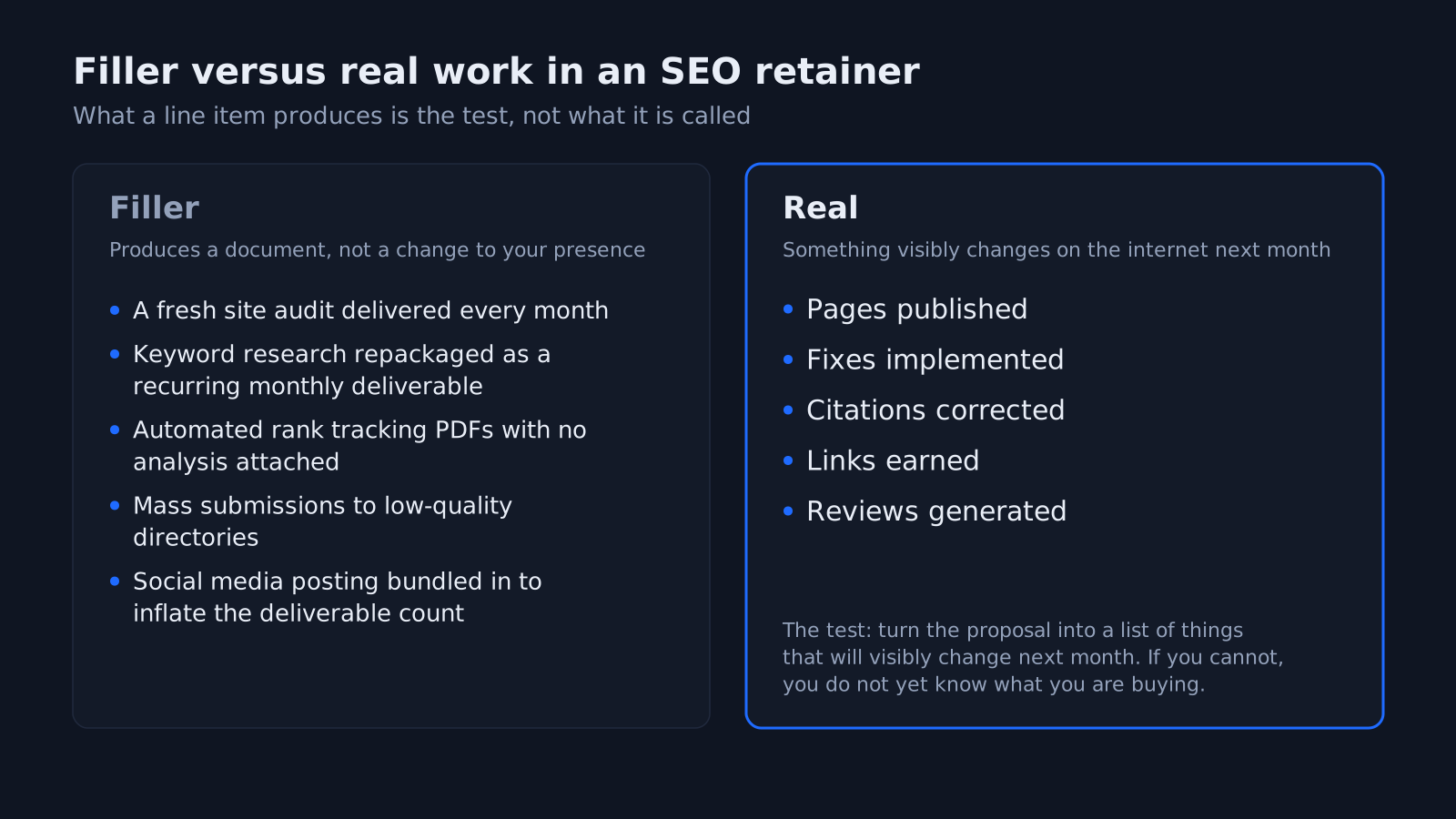
Anything that produces a document instead of a change to your online presence is usually filler. Recurring monthly audits, keyword research delivered again every quarter, automated rank tracking PDFs, social posting bundled into an SEO retainer, and submissions to directories nobody reads are the most common padding in local SEO scopes.
Filler is not the same as useless. An audit in month one is essential and keyword research has to happen once. It becomes filler when it recurs monthly as a headline deliverable, because at that point the line item exists to look like work rather than to produce a result.
The clean way to test any line item is to ask what changes on the internet as a result of it. If the honest answer is that a report now exists, it does not belong in a retainer you are paying four figures for every month.
- ▸Filler: a fresh site audit delivered every month.
- ▸Filler: keyword research repackaged as a recurring monthly deliverable.
- ▸Filler: automated rank tracking PDFs with no analysis attached to them.
- ▸Filler: mass submissions to low-quality directories.
- ▸Filler: social media posting bundled in to inflate the deliverable count.
- ▸Real: pages published, fixes implemented, citations corrected, links earned, reviews generated.
What can you actually get for $300 to $500 a month?
At $300 to $500 a month you are buying maintenance, not growth: profile upkeep, a small amount of citation work, occasional posts, and a report. That can be genuinely worthwhile for a business in a low-competition area that already has a solid profile, and it is close to worthless in a competitive metro where you are trying to displace established competitors with real budgets.
Do the arithmetic honestly. At that price the agency can afford only a few hours of junior time per month across everything, which in practice means templated work and automation. Nobody is doing original competitive analysis or writing genuinely local content for your city at that number, because the hours do not exist inside the budget.
That does not automatically make cheap SEO a scam. It makes it a specific product with a specific ceiling. The failure mode is buying maintenance while expecting growth, then concluding after a year of flat results that SEO does not work for your industry.
The real risk at the bottom of the market is not slow results, it is damage. Automated link building, duplicated city pages, keyword-stuffed content, and careless profile edits that trigger a suspension all cost more to undo than the year of savings was worth.
- ▸Reasonable at $300 to $500: profile upkeep, citation maintenance, occasional posts, basic reporting.
- ▸Not reasonable at that price: original content at volume, real link acquisition, competitive strategy.
- ▸Watch for: automated link building, spun or duplicated city pages, and bulk directory blasts.
- ▸Better use of a small budget: fix the profile properly once, then run reviews consistently yourself.
How much should a small service business really pay for SEO?
The honest range is wide because the number depends on competition rather than on your revenue: a single-location business in a quiet town can be well served for a few hundred dollars a month, while displacing entrenched competitors in a major metro trade usually takes a four-figure monthly commitment sustained across two or three quarters. The right number is whatever buys enough work to beat the specific businesses currently ranking above you.
Work backwards from a job rather than forwards from a budget. If an average job is worth $1,200 in profit and you close half of your inbound calls, a $2,000 retainer needs roughly four extra calls a month to break even. Every owner can run that calculation for their own business in about a minute, and it is far more useful than any published price range.
Budget for duration too, not just for month one. Local SEO compounds, and the honest planning assumption is six to twelve months of consistent spend before you can judge the outcome fairly. A budget that can only survive three months is usually better spent on ads, where the result arrives in the same week the money does.
If money is genuinely tight, the highest-return sequence is boring: get the Google Business Profile right, get review velocity going, make sure the phone gets answered every time, and only then buy content and links.
- ▸Set the budget from your competitors' effort, not from a percentage of your revenue.
- ▸Run the break-even math: retainer divided by profit per job, adjusted for your close rate.
- ▸Plan for at least two quarters of consistent spend before judging the results.
- ▸If the budget only covers one thing, cover the profile and the reviews first.
How do I check whether the quote in front of me is fair?
Take the proposal and turn it into a list of things that will visibly change on the internet next month. If you can do that, the quote is probably fair for the work described and the only remaining question is whether the agency can execute. If you cannot do it, the price is irrelevant, because you do not yet know what you are buying.
If you want an outside read, bring the quote to a free 15-minute call. We will tell you what that scope is worth in your market, what is missing from it, and which line items to push back on. If the quote is good, we will say so and you can go and sign it.
Our own structure works differently from a standard retainer: top 3 in the Google Map Pack within 12 weeks or you do not pay, one client per trade per service area, and a custom website included free with the AI system at $297 per month. Whether or not that fits your situation, the call should leave you able to judge any SEO proposal on its line items instead of on its price tag.
Keep reading
Related guides
- ▸Local SEO services near me
- ▸Local SEO services vs doing local SEO yourself
- ▸Most local business websites still lack LocalBusiness schema
Put it into action
Frequently Asked Questions
Is $2,000 a month a lot to pay for SEO?
For a local service business in a competitive metro, $2,000 a month is a mid-market number rather than a premium one. Whether it is a lot depends entirely on your average job value: if one extra job a month covers it, the real question is not the price but whether the scope can produce that job.
Are monthly SEO packages actually worth it?
Packages are worth it when the package is a defined list of work, and worth very little when it is a tier name attached to a vague scope. The retainer structure itself is not the problem, since SEO genuinely is ongoing work. The problem is packages that scale the price without scaling the deliverables.
How many hours of work does a $2,000 SEO retainer buy?
Ask the agency for their blended hourly rate and divide. That one question tells you more than any deliverable list, because it reveals whether you are buying a handful of senior hours, a larger block of junior hours, or software output with a person attached to the invoice.
Should content be included in an SEO retainer?
Yes. Published content is one of the few line items that reliably compounds, and a local SEO retainer with no new pages in it is mostly maintenance. Check whether content is inside the fee or billed separately, because the second version is how a $2,000 quote becomes a $3,500 invoice.
What should be in a monthly SEO report?
Calls, form submissions, and booked jobs first, then Map Pack position measured across your whole service area, then traffic, then a plain-language log of what actually shipped that month. If the report opens with impressions and keyword counts, it was written to look busy rather than to be read.
Is it normal to pay a setup fee on top of a monthly SEO retainer?
Yes, because month one carries the audit, the tracking setup, the profile work, and the citation cleanup, which is a much heavier month than the ones that follow. What is worth checking is whether a waived setup fee becomes payable again if you leave early.
Should my ad spend come out of the SEO retainer?
No, and any proposal that blends management fees with media spend should be separated before you sign. You want the retainer, the ad budget, and the management percentage as three distinct numbers, so you can see what you are paying the agency versus what you are paying Google.
Is cheap SEO worth it for a small business?
Cheap SEO is reasonable for maintenance in a low-competition market and a poor bet for growth in a competitive one. The genuine risk is not slow progress but damage: automated links, duplicated city pages, and careless profile edits can cost more to undo than a year of a higher retainer would have cost in the first place.
Ready to dominate your map?
Top 3 in the Google Map Pack in 12 weeks, or you don't pay.