
What is included in the Maps Domination Program?
A practical buyer’s guide for local business owners who want more visibility in Google Maps without guessing what a provider should actually do.
The short answer
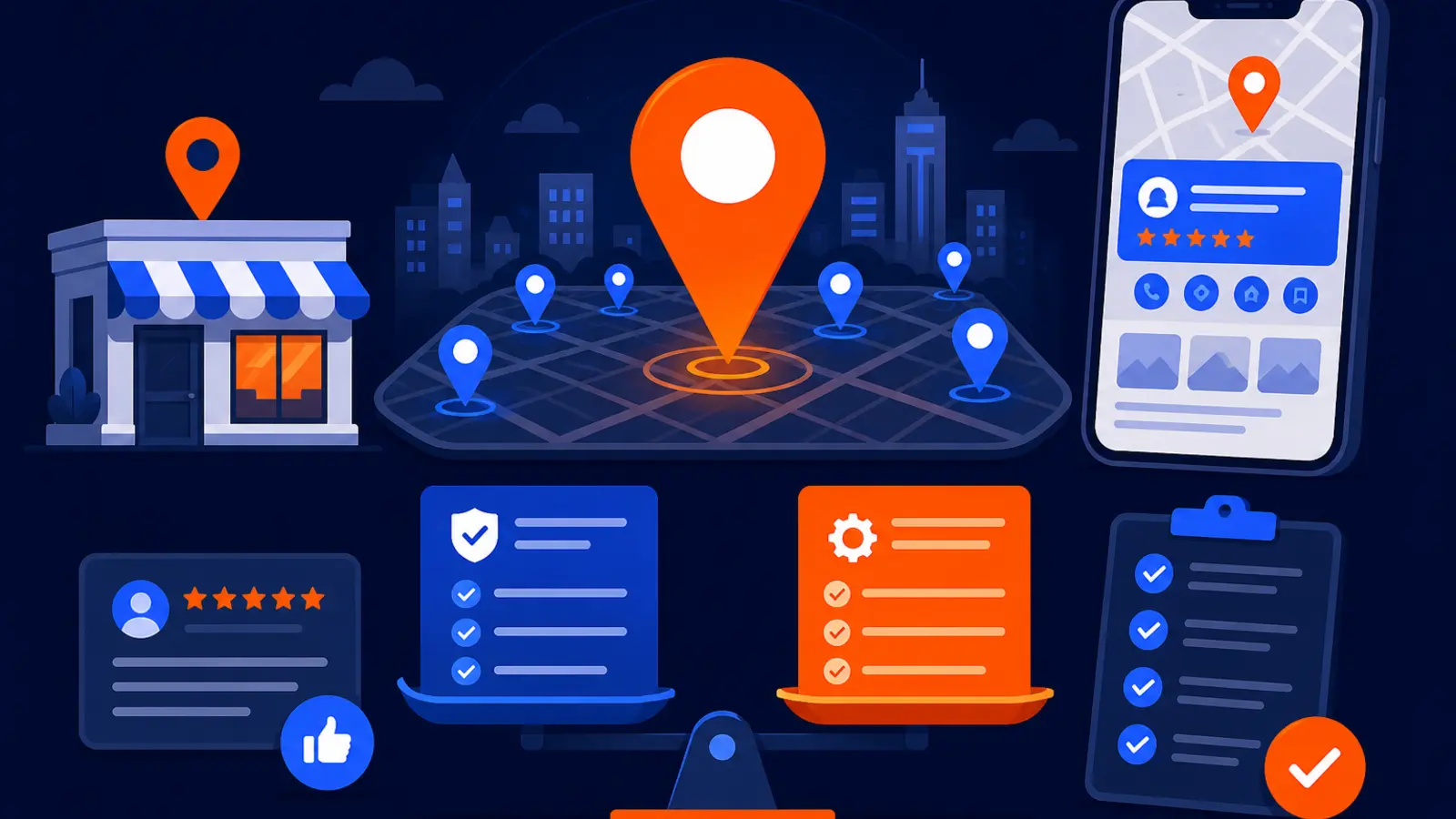
A proper Maps domination program should include a local ranking scan, a Google Business Profile audit, profile cleanup, category and service optimization, review growth support, listing consistency checks, photo and content guidance, weekly performance tracking, and clear reporting tied to calls and visibility. It should also explain what the provider can control, what Google controls, and what timeline is realistic.
The important point is this: you are not hiring someone to buy a better Google Maps ranking. Google Business Profile Help says local results are mainly based on relevance, distance, and popularity, and Google also says there is no way to request or pay for a better local ranking. A real program should improve the signals Google uses to understand and trust your business, then measure whether those changes are helping across your actual service area.
If a provider only says “we optimize your profile” but cannot show the work, the map positions, the review process, or the reporting schedule, you do not have enough information to make a buying decision.
Start with a real map ranking baseline
Before anyone changes your profile, you need to know where you already show up. Looking at Google Maps from one phone or one office computer is not enough because rankings change by search location. A business can rank well near its address and barely appear a few miles away.
Local Falcon says a map scan report shows where a business ranks in local search results for a keyword within an area set by the scan radius and grid size. That kind of scan helps you see the difference between “we rank somewhere” and “we are visible in the places where buyers actually search.”
Digital Domination’s free scan checks 169 real Google results across the service area. In a managed program, the baseline should make the starting point obvious before the rollout begins. A useful starting report should show these items:
- ▸The keyword or service being checked
- ▸The map area being scanned
- ▸The business’s position at each grid point
- ▸Where competitors are showing up instead
- ▸The strongest and weakest parts of the service area
- ▸A simple visual map an owner can understand
The Google Business Profile audit should be specific
A Maps domination program should include a full Google Business Profile audit, not a quick glance at the listing. Google Business Profile Help says businesses with complete and accurate profile information are more likely to show up in local search results. That means the basics matter: name, address, phone, website, hours, categories, services, service area, photos, and business details.
The audit should also check whether the profile is verified. Google Business Profile Help says verifying a business tells Google the owner is authorized to represent it, so the business is more likely to show up in search results. If verification is missing, broken, or controlled by an old employee or vendor, that becomes the first issue to fix.
BrightLocal Help Center says its Google Business Profile audit compares the profile name, address, and phone number with supplied business details to keep NAP data consistent. Whether a provider uses BrightLocal, another tool, or its own process, you should expect a clear check of the core business details. At minimum, the audit should cover these checkpoints:
- ▸Profile ownership and access
- ▸Verification status
- ▸Business name accuracy
- ▸Address and phone consistency
- ▸Website and appointment links
- ▸Hours and holiday hours
- ▸Primary and secondary categories
- ▸Services, service areas, and photos
Categories and services need careful work
Categories are one of the easiest places for a business owner to make mistakes. Google Business Profile Help says the primary category should be specific, while additional categories should describe departments or services rather than every product or service. In plain English, your main category should describe what you are, not every job you want.
Services also matter. Google Business Profile Help says businesses in certain categories can add predefined or custom services, and service details can include price and description. A good program should review the services buyers search for, match them to your real offerings, and avoid stuffing the profile with unrelated terms.
This part of the work should not be treated as a one-time checkbox. If you add a service, remove a service, expand a department, or change your focus, the profile should be updated in a way that still follows Google’s rules. Expect the provider to document these decisions clearly:
- ▸The chosen primary category and why it fits
- ▸Any added categories and why they are relevant
- ▸The core services added to the profile
- ▸Service descriptions written for real customers
- ▸Any services removed because they were off target
- ▸Whether prices belong on the profile for your business
Service area rules should be part of the plan
For plumbers, electricians, mobile mechanics, roofers, HVAC companies, cleaners, and other service-area businesses, the map strategy must follow Google’s service area rules. Google Business Profile Help says a service-area business should have one profile for the central office or location with a designated service area, and the overall service area should not extend farther than about 2 hours of driving time from the business base.
This matters because some providers try to create extra profiles, fake locations, rented addresses, or overly broad service areas. Those shortcuts can create risk. A legitimate Maps program should work from the real business location and real service footprint.
The right plan should define where you can reasonably compete and where you may need a different strategy. For a local owner, the provider should explain these items in plain language:
- ▸Whether the business is a storefront, service-area business, or hybrid
- ▸Which address should appear or be hidden
- ▸Which cities or ZIP codes belong in the service area
- ▸Whether the service area is too broad
- ▸Whether the business needs one profile or has a valid reason for more than one
- ▸What profile choices could create suspension risk
Reviews must be compliant and steady
Reviews are a major part of local trust, but review work must be done carefully. Google Business Profile Help says businesses can ask customers for reviews by sharing a Google review link or QR code and can reply to reviews from the Business Profile. That means a program should help you ask consistently and respond professionally.
Google Maps User Generated Content Policy Help prohibits review incentives, selective solicitation of positive reviews, and unusual volumes or patterns of reviews that indicate rating manipulation. In other words, do not buy reviews, do not offer discounts for reviews, and do not only ask happy customers while hiding the link from everyone else.
A Maps domination program should give you a review process you can actually keep using. It should help with timing, templates, links, QR codes, and replies while staying inside Google’s rules. A compliant review system should include these pieces:
- ▸A direct review link or QR code
- ▸A simple request process for recent customers
- ▸No incentives, gifts, or discounts for reviews
- ▸No filtering customers before they reach Google
- ▸Owner or staff training on when to ask
- ▸Professional responses to positive and negative reviews
- ▸A plan to keep requests steady instead of sudden and suspicious
Photos, videos, and profile content should be maintained
Photos and videos help customers understand what your business does before they call. Google Business Profile Help says photos and videos can show storefronts, products, and services, and uploaded photos and videos can take up to 24 to 48 hours to show on the profile.
This does not mean every business needs a studio photo shoot. It means the profile should look current and real. A roofing company can show jobsite conditions and finished work. A barbershop can show the shop, chairs, staff, and haircuts. An auto repair shop can show bays, technicians, equipment, and the front entrance.
A practical Maps program should give the owner a simple content standard, not a vague request for “more media.” The provider should tell you what to gather and how it will be used. Useful profile media includes:
- ▸Storefront or vehicle photos
- ▸Team and work environment photos
- ▸Service or product photos
- ▸Before and after photos when appropriate
- ▸Short videos that show real work
- ▸Photos that help customers find the location
- ▸Updated images when the business changes
Performance tracking should connect rankings to calls
Reporting should not be a monthly screenshot that says “traffic is up.” Google Business Profile performance reporting can include views, searches, directions, calls, website clicks, messages, bookings, products, menus, and offers when those metrics apply, according to Google Business Profile Help. Your provider should explain which metrics matter for your business type.
For a local service business, map visibility is useful because it can lead to calls, directions, website visits, bookings, or messages. A strong program should track both visibility and actions. If rankings improve but calls do not, that should trigger a conversation about search terms, offer, reviews, photos, hours, phone handling, or landing page quality.
Digital Domination’s Maps Domination Program includes weekly GeoGrid tracking reports with visual proof of rankings and call volume. The owner should be able to open the report and understand whether the market coverage is improving. The reporting package should show:
- ▸GeoGrid movement by keyword and area
- ▸Calls from the profile when available
- ▸Website clicks from the profile
- ▸Direction requests for storefront businesses
- ▸Search terms or queries when available
- ▸Review activity and response status
- ▸Work completed during the reporting period
- ▸Next priorities for the coming week
Seven questions to ask before you sign
The best buying questions are direct. You are not trying to become an SEO expert. You are trying to find out whether the provider has a real process, follows Google’s rules, and reports work in a way you can verify.
Use these questions before you hire a Maps domination provider:
- ▸What scan will you run before work starts?
- ▸Will I see rankings across my service area or only one search location?
- ▸Who owns and controls my Google Business Profile access?
- ▸Which categories and services will you change, and why?
- ▸How will you help us get reviews without violating Google policy?
- ▸How often will I receive ranking and call reports?
- ▸What happens if Google takes longer to review profile edits?
- ▸Do you work with more than one business in my trade and service area?
- ▸What work is included after the first profile cleanup?
- ▸What claims are you making about rankings, and what are you not claiming?
What timing should you expect?
A serious provider should explain timing without pretending Google moves instantly. Google Business Profile Help says edits to a verified profile usually take up to 10 minutes to review but can take up to 30 days. Google also says rankings for new businesses can take up to a month to appear in search results, and business information edits can take up to 3 days to update search results.
That means a managed Maps rollout should have a timeline, but it should also account for review windows, verification issues, profile edits, content updates, and ranking movement. If a vendor promises that every edit will show immediately, that does not match how Google describes the process.
Digital Domination’s guarantee, when a business qualifies, is exactly: top 3 in the Google Map Pack in 12 weeks or you do not pay. That guarantee is a business promise from the provider, not a claim that Google sells rankings or that any third party has a special button inside Google. Google Business Profile Help says third parties cannot promise or directly influence a business ranking on Google Search or Maps through special means.
When the cheaper DIY path makes sense
The cheaper DIY path can be a good fit for an owner who has time to verify and maintain the profile, add categories and services, request compliant reviews, track performance, and clean listings without needing a 12-week managed rollout. If your market is not very competitive, your profile is already clean, and you have someone on staff who will actually keep up with the work, you may not need a managed program yet.
DIY becomes harder when the owner does not know where the business ranks across the service area, reviews are inconsistent, competitors are stronger, categories are wrong, the profile has old data, or nobody is watching weekly movement. It also becomes harder when every missed call has real revenue attached to it.
A fair provider should tell you if you are not a fit for a managed campaign. Digital Domination works with one client per trade per service area, which means territory exclusivity is part of the model. Pricing for the Maps Domination Program is set per market on a qualification call and tied to the ranking outcome.
What to expect from Digital Domination
Digital Domination’s Maps work is built around local ranking visibility, not generic SEO reporting. The process starts with a 169-point GeoGrid scan so the owner can see how the business appears across the actual service area. The program also includes weekly GeoGrid tracking reports with visual proof of rankings and call volume.
Digital Domination has spent 20 years learning how businesses earn attention, authority, trust, and rankings online. The company shows Google Partner and Meta Business Partner badges on its roster page, offers one client per trade per service area, and publishes The Google Maps Domination Playbook. The team also offers a separate 5-Star Review System at $297 per month, with no setup fee, cancel anytime, billed monthly through Stripe.
If you are comparing providers, look for proof you can inspect instead of broad promises. In Digital Domination’s case, the program conversation should help you confirm these points:
- ▸Whether your business qualifies for the Maps Domination Program
- ▸What the 169-point GeoGrid scan shows now
- ▸Which keywords and areas matter most
- ▸What weekly reporting will look like
- ▸Whether your trade and service area are available
- ▸How the ranking outcome is tied to pricing
- ▸Whether the managed program or review system is the better fit
Next step if you want the managed route
If you want a provider to manage the rollout instead of doing it yourself, visit the Maps Domination Program page. It explains the program, the ranking guarantee, territory exclusivity, reporting, and how the qualification process works.
If you are not ready for a call, start with the free GeoGrid scan page. That scan shows 169 real Google results across your service area, so you can see whether your Maps visibility problem is small, serious, or somewhere in between before you decide what to do next.
Keep reading
Related guides
Put it into action
Frequently Asked Questions
What should a Google Maps SEO package include?
It should include a ranking scan, Google Business Profile audit, profile cleanup, category and service optimization, review process support, listing consistency checks, and reporting. The reporting should show map visibility and business actions such as calls or clicks when available.
Can someone guarantee my business will rank higher on Google Maps?
Google Business Profile Help says there is no way to request or pay for a better local ranking, and third parties cannot directly influence ranking through special means. A provider can still make a business promise based on its process, but it should be clear that the provider is not buying placement from Google.
How long does Google Maps optimization take?
Some profile edits can be reviewed quickly, but Google Business Profile Help says edits can take up to 30 days in some cases. Google also says rankings for new businesses can take up to a month to appear, so a managed program should have a realistic rollout instead of promising instant results.
Is Google Business Profile optimization enough by itself?
Sometimes it is enough to fix obvious profile problems, especially in a low-competition market. In a tougher market, you usually also need steady reviews, accurate business data, better service targeting, useful photos, and weekly tracking across the service area.
Should I do Maps optimization myself or hire someone?
DIY can work if you have time to verify the profile, maintain categories and services, request compliant reviews, track performance, and keep listings clean. Hiring makes more sense when you want a managed 12-week rollout, visual map tracking, and someone responsible for the process.
What is a GeoGrid scan?
A GeoGrid scan checks how your business ranks from multiple points across a local area instead of from one search location. This helps show where you are strong, where you are weak, and which competitors are showing up in the Map Pack around you.
What review practices should I avoid?
Avoid buying reviews, offering incentives for reviews, or only asking customers who you think will leave a positive review. Google Maps User Generated Content Policy Help prohibits review incentives, selective solicitation, and unusual review patterns that suggest manipulation.
What makes Digital Domination’s Maps Domination Program different?
Digital Domination uses a 169-point GeoGrid scan, weekly GeoGrid tracking reports with visual proof of rankings and call volume, and one client per trade per service area. When a business qualifies, the guarantee is: top 3 in the Google Map Pack in 12 weeks or you do not pay.
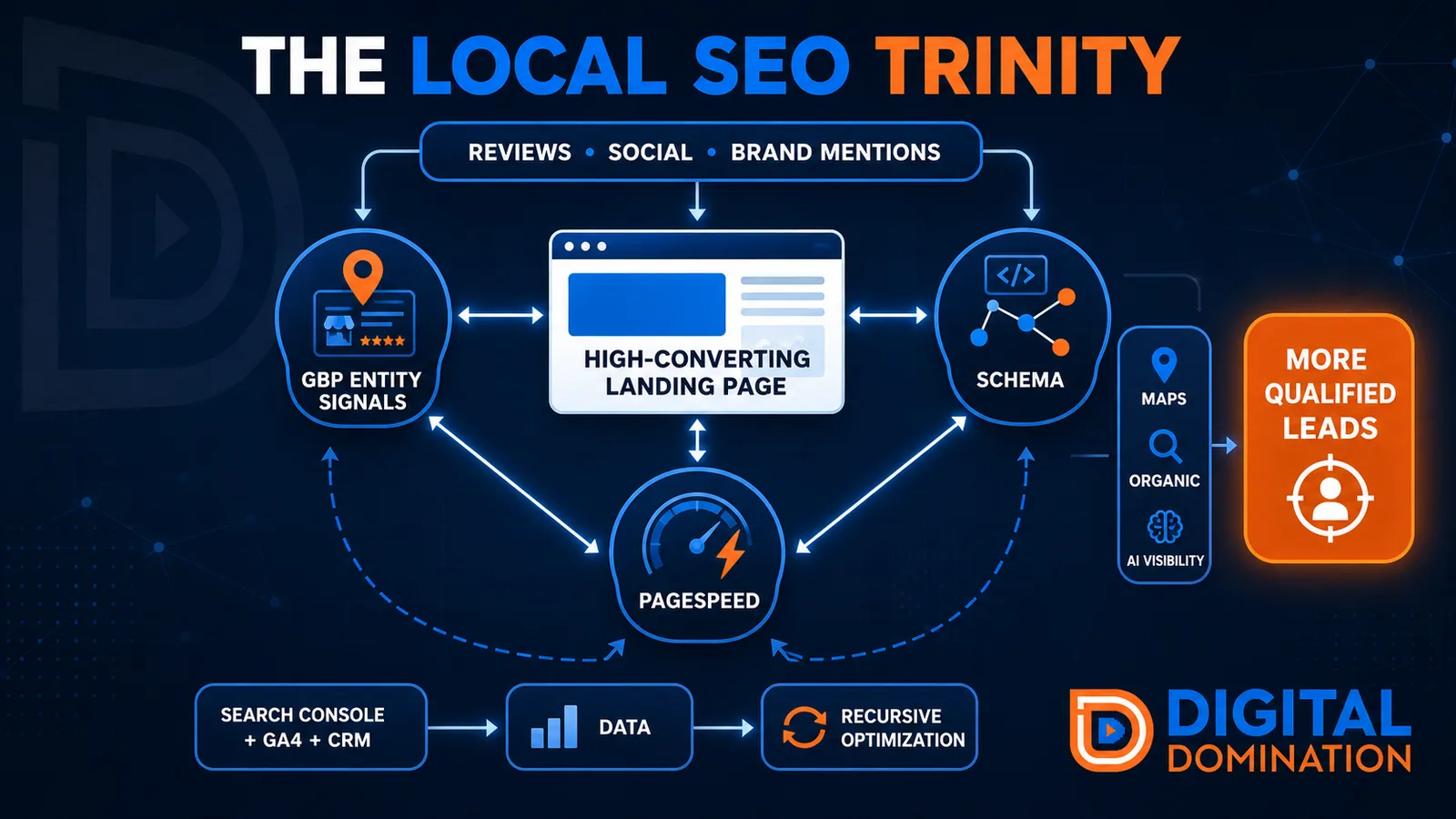
The Local SEO Trinity
Think of a three-legged stool. Your Google profile, your website, and your reviews all have to hold you up. If one leg is short, the whole thing wobbles.
GBP entity signals
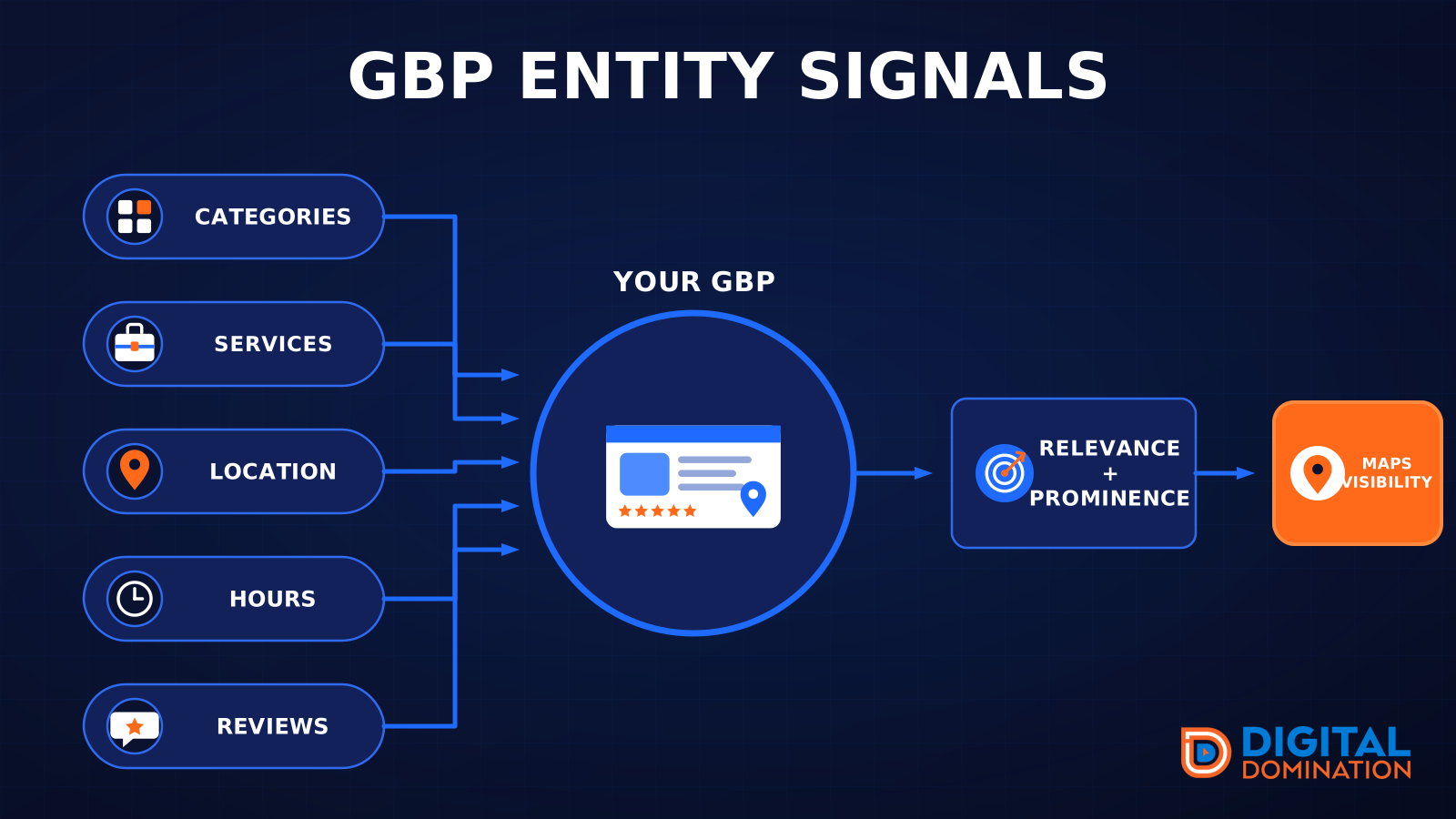
This leg is your Google Business Profile. GBP means Google Business Profile. It covers your categories, your services, your location, your hours, and your reviews. Google uses those facts to decide who to show.
Your Google profile is your storefront sign. If the sign is missing, or it names the wrong shop, people drive past.
PageSpeed to conversion
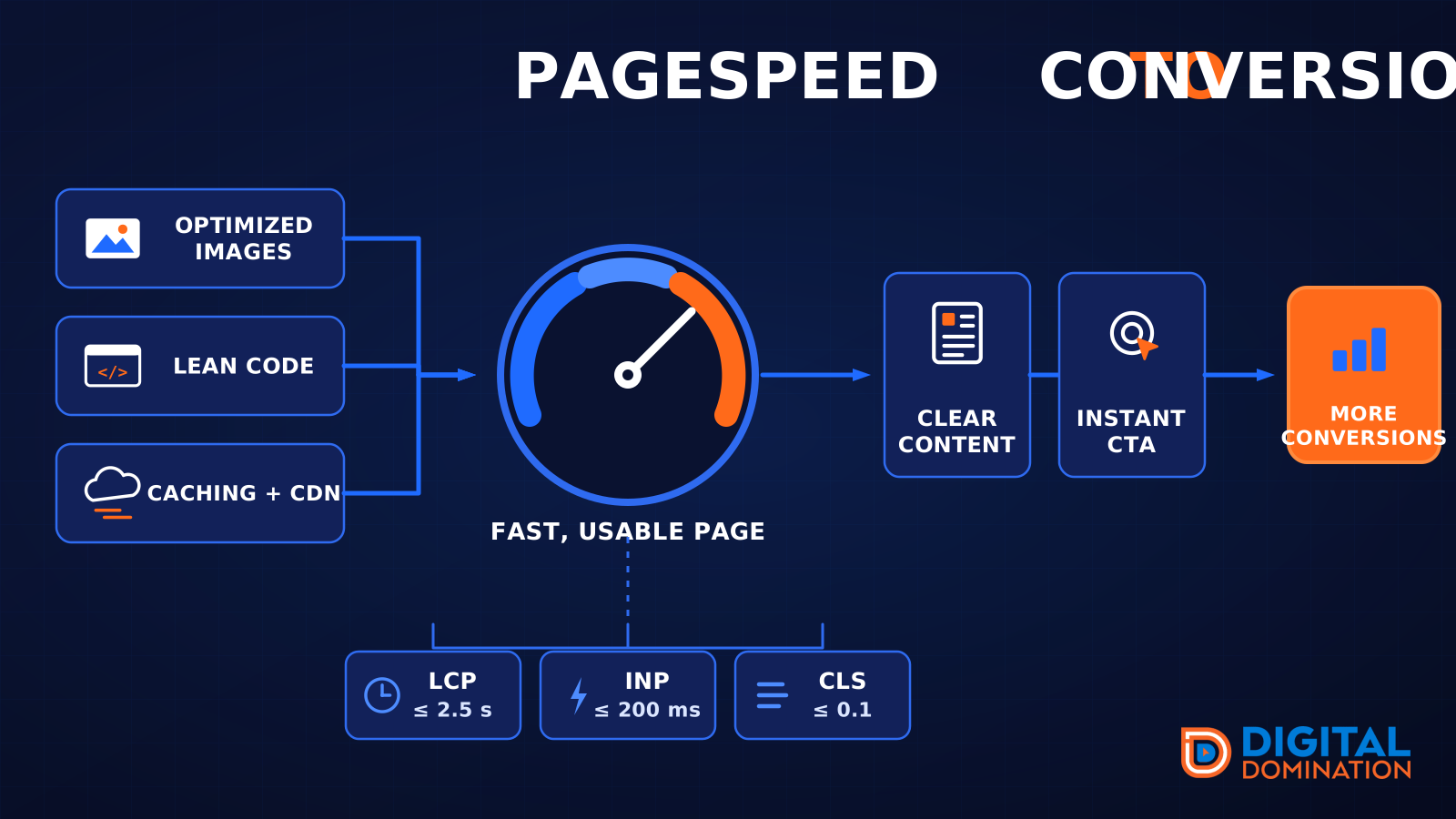
This leg is your website, above all on a phone. Small images, lean code, and caching make a page fast. A fast, clear page is what turns a visit into a call. Phone speed is one of the 12 Trinity checks because a slow page loses the call before anyone sees your offer.
Your website is the showroom. If the door sticks, people leave before they look around.
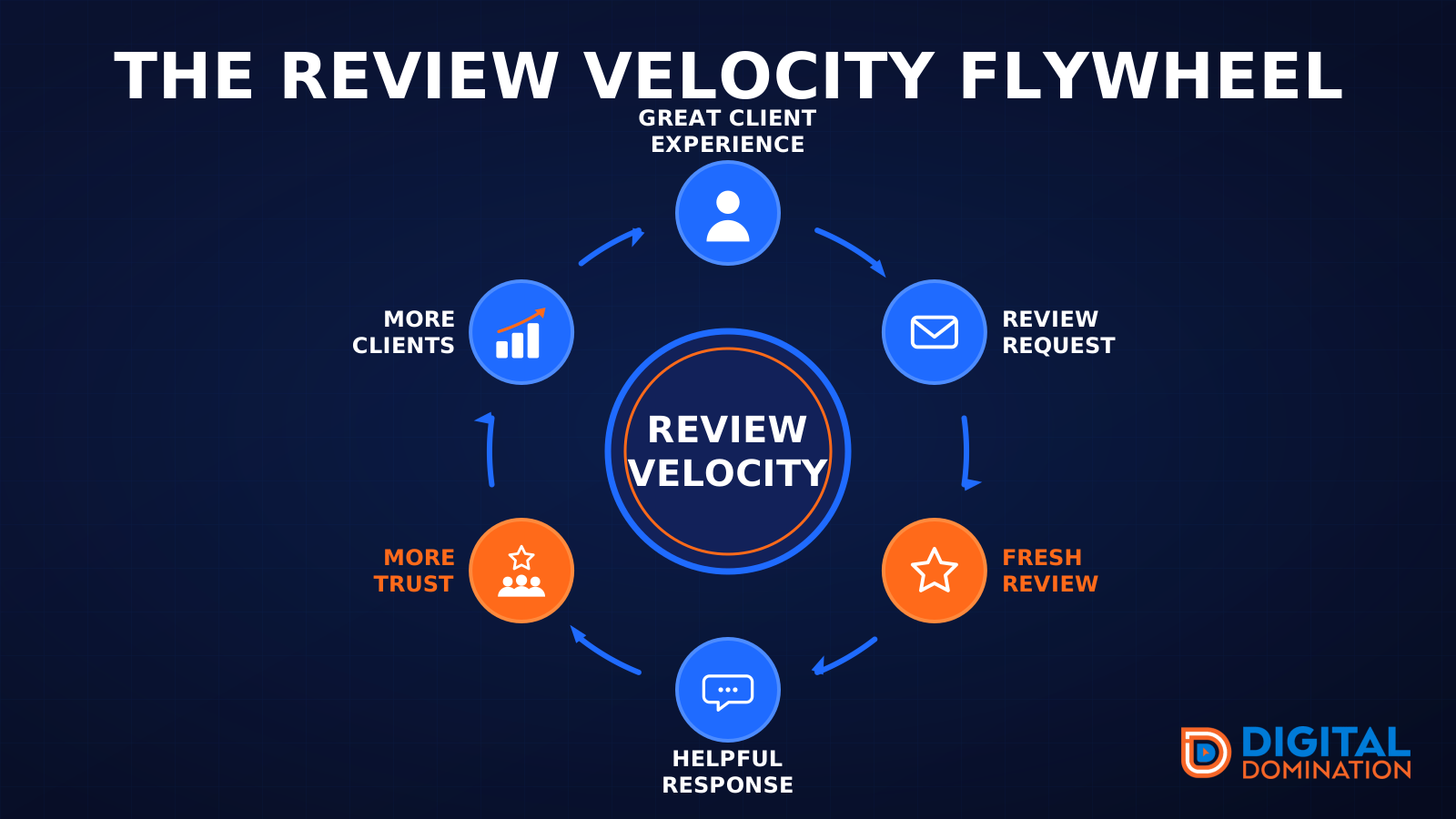
The review velocity flywheel
This leg is reviews and reputation. A good visit leads to a review request, then a fresh review, then a helpful reply, then more trust, then more customers. When the scan can find your Google listing, it shows your rating, your recent reviews, and how many you answered.
Reviews are word of mouth. One kind word helps. A steady stream of real reviews, and a reply from you, helps more.
How this turns into revenue
Being found in more searches leads to more calls. More calls lead to more booked jobs. More booked jobs lead to more revenue.
Example numbers, not a real business: 40 calls from search in a month, a 25 percent close rate, and a $400 average job. That is 10 booked jobs. That is $4,000. The math is the lesson. It is not a promise.
The full page has a box where you can type your own average job value and close rate.
One real story, from our car dealership case study: Medina Auto Group went from invisible on Google Maps to dominating every high-intent search across their market. The turnaround spanned all four of their rooftops at once. The same page says the team eliminated 89 unfair one-star reviews that had been dragging the dealership's reputation down and keeping it out of the Map Pack. It also says: “Results described here are exceptional and non-typical. Outcomes vary based on market conditions, competition, and implementation. No guarantees are made regarding earnings, rankings, or conversions.”
Free strategy call
More booked jobs start with a clear plan
Book a free strategy call. We look at your Google profile, your website, and your reviews, and we tell you what to fix first.
Free. You pick the time. A real person shows up.