
When to choose Google review management instead of DIY local SEO tools
A practical buyer guide for local business owners deciding whether to manage reviews themselves or pay for a system that keeps requests, replies, and follow-up consistent.
The short answer
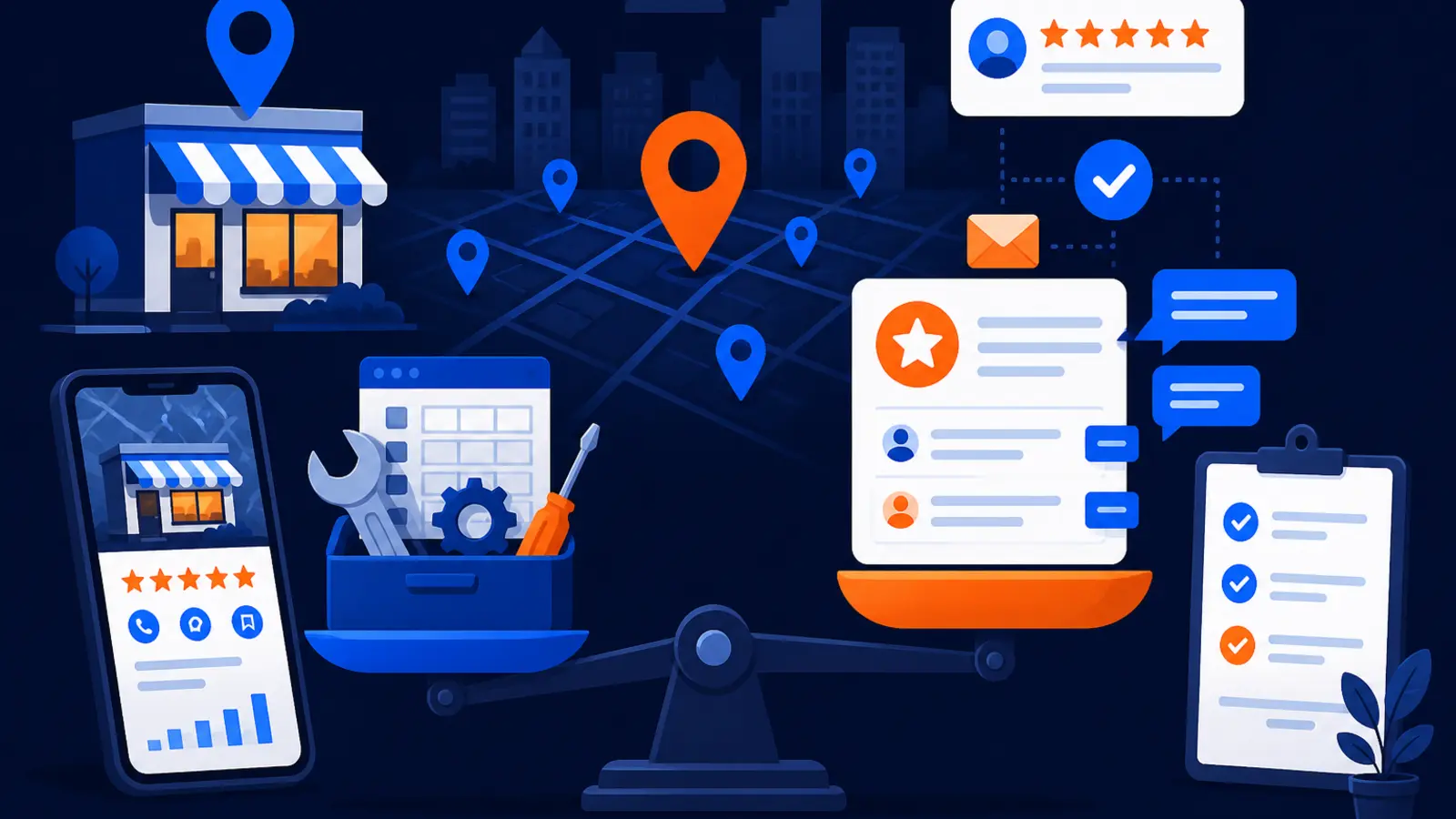
Paid Google review management is the better choice when reviews are no longer a small side task. If you have enough customers that asking, reminding, replying, and tracking starts slipping, a paid system can protect consistency, speed, and compliance.
The DIY path can work well for one location with low review volume, a disciplined owner, and a simple routine. Google Business Profile Help says owners can create and share a review request link or QR code, then use it on receipts, thank-you emails, chat interactions, or in-store displays. That is enough for many small operators.
The problem is not access to free tools. The problem is whether the work gets done every week without shortcuts that violate Google or FTC rules. Paid review management becomes a better buy when missed requests, late replies, generic responses, or staff confusion are costing trust.
Paid review management is usually the better choice when any of these are true:
- ▸You depend on Google reviews to win calls from new customers.
- ▸You have more than one employee asking customers for reviews.
- ▸You cannot personally reply to every review in a timely, specific way.
- ▸You have multiple locations or plan to add another one.
- ▸You are tempted to offer discounts, gifts, or perks for reviews.
- ▸You want review activity tied to local ranking visibility and call tracking.
- ▸You need a repeatable process that does not disappear when the owner gets busy.
What DIY with free Google tools really includes
DIY review work is not just copying a Google review link and hoping customers use it. It means choosing the right moments to ask, training staff on what they can and cannot say, checking reviews often, writing thoughtful replies, and watching whether review activity lines up with calls and visibility.
Google Business Profile Help says verified owners can reply to Google reviews, and approved replies appear publicly under the customer review without showing the owner’s personal name. That makes replies useful, but it also makes them public customer service. A rushed or copied response can send the wrong message to the next person comparing you against a competitor.
Google Business Profile performance reporting includes actions such as directions, calls, website clicks, messages, bookings, products, menus, and offers. Google Search Console Help says Search Console can show clicks, impressions, average click-through rate, average position, and queries for a property. These tools are helpful, but they do not run the review process for you.
Who should stay DIY for now
The DIY path is a reasonable choice when the review workload is light and the owner can personally keep quality high. A one-location business with steady but modest customer flow may not need paid software or a managed service yet.
DIY also makes sense if you already have a simple, legal, repeatable habit. For example, the owner sends the Google review link after each completed job, replies to every review in plain language, and checks the profile weekly. If that is happening consistently, paid management may not be urgent.
DIY is most likely to work when these conditions are true:
- ▸One location.
- ▸Low review volume.
- ▸The owner personally asks customers after real service experiences.
- ▸Every review gets a specific reply.
- ▸No incentives are offered for posting, changing, or removing reviews.
- ▸Someone checks Google Business Profile performance regularly.
- ▸A rank tracker or local grid report is used as a signal, not as the whole strategy.
Where DIY usually breaks
DIY review management often fails quietly. Nobody decides to neglect reviews. Instead, a busy week turns into a missed week, then a negative review sits unanswered, then newer happy customers are not asked. The profile starts looking less active than the real business is.
BrightLocal’s 2026 Local Consumer Review Survey found that 97% of consumers read reviews for local businesses. The same survey found that 89% expect business owners to respond to reviews, 19% expect a same-day response, and 81% expect a response within a week. That means slow replies are not just an internal process issue. They can affect how buyers judge you.
BrightLocal also found that templated or generic review responses make 50% of consumers unlikely to choose a business. That matters because many DIY systems turn into copy-and-paste replies when the owner is tired or the front desk is rushed.
The common warning signs are easy to spot:
- ▸Review requests depend on memory.
- ▸Only the happiest customers are asked.
- ▸Negative reviews get emotional replies or no replies.
- ▸Staff members use different wording when asking for reviews.
- ▸Replies sound identical from one customer to the next.
- ▸The owner checks ranking reports but not review quality.
- ▸There is no record of who was asked and when.
The compliance reason to avoid shortcuts
The biggest risk in review management is trying to speed up trust with the wrong kind of offer. Google Maps User Generated Content Policy Help says Google prohibits incentives such as payment, discounts, free goods, or services in exchange for posting a review, changing a review, or removing a negative review.
Google also allows merchants to solicit reviews that represent a genuine experience, as long as they do not offer incentives or attempt to influence the rating or content of the review. In plain English, you can ask real customers to share honest feedback, but you cannot pay, pressure, or steer them toward a certain rating.
The FTC Consumer Reviews and Testimonials Rule went into effect on October 21, 2024. The Federal Trade Commission says the rule prohibits incentives conditioned on reviews expressing a particular sentiment, and says paying incentives for five-star reviews on third-party review platforms violates Section 465.4 of the rule.
Paid review management is not valuable because it helps you bend the rules. It is valuable when it helps your team ask consistently while staying inside the rules.
What paid review management should do
A paid review management service should not be a mystery box. It should make the review process more consistent, more compliant, and easier for the owner to inspect. If it only gives you another dashboard to check, it may not be worth the cost.
BrightLocal says review management software can include automated review requests by email or SMS and direct replies to Google and Facebook reviews from one dashboard. Google for Developers says the Google Business Profile API supports listing reviews, getting a specific review, getting reviews from multiple locations, replying to a review, and deleting a review reply. Those capabilities matter most when you have volume, multiple staff members, or more than one location.
Before paying, ask what the system actually handles from request to response. At a minimum, you should be able to verify these checkpoints:
- ▸How customers are asked for reviews.
- ▸Whether requests go by email, SMS, or both.
- ▸Whether staff can use approved language without promising rewards.
- ▸How quickly new reviews are noticed.
- ▸Who writes or approves replies.
- ▸Whether replies are specific to the customer experience.
- ▸How negative reviews are escalated.
- ▸What reporting shows beyond star rating alone.
When a rank tracker is not enough
A rank tracker can be useful, especially if you care about visibility in different neighborhoods. But rankings are an output, not the workflow. A tracker can show that something changed, but it does not ask customers for feedback, write respectful replies, or prevent a team member from offering the wrong incentive.
Google Business Profile Help says local results are based mainly on relevance, distance, and popularity, and that more reviews and positive ratings can help a business’s local ranking. That does not mean reviews are the only ranking factor. It does mean review activity is tied to the trust signals local buyers and Google can see.
Free Google tools and rank tracking are better at measurement than execution. Paid review management is better when the execution is the bottleneck.
Seven questions to ask before you sign
Use this as a buyer filter. A good provider should answer plainly, without making review growth sound automatic or risk-free.
Ask these questions before you choose a paid review management provider:
- ▸How do you make sure review requests follow Google and FTC rules?
- ▸Do you ever offer, suggest, or automate incentives for reviews?
- ▸Can I see the exact request language customers receive?
- ▸Who replies to reviews, and how do you avoid generic responses?
- ▸How are bad reviews handled before anyone replies emotionally?
- ▸Can the system support more than one location if we grow?
- ▸What reports will show whether review work is improving visibility and calls?
What to expect in the first month
The first month should feel like setup and cleanup, not magic. Expect the provider to confirm your Google Business Profile access, review your current public replies, check your request process, and define who on your team is allowed to ask for reviews.
You should also expect a compliance conversation. If your current process includes discounts, gifts, drawings, or special treatment for reviews, that should be removed. The goal is to ask real customers for honest reviews after genuine experiences.
A practical first-month checklist should include:
- ▸Approved review request wording.
- ▸Clear rules for staff conversations.
- ▸A simple process for sending requests after service.
- ▸A reply standard for positive, neutral, and negative reviews.
- ▸A plan for reviews that mention service failures.
- ▸Baseline visibility and performance reporting.
- ▸A regular reporting cadence the owner can understand.
How to compare cost against owner time
The right question is not whether free tools exist. They do. The right question is what happens when the owner is the system. If the owner forgets, gets busy, avoids conflict, or writes rushed replies, the free path becomes expensive in missed trust.
For a very small business, owner time may be the best trade. For a busier local business, paid management can be the better buy because it turns review work into a scheduled process instead of an afterthought.
Think about the real cost in practical terms:
- ▸Time spent remembering who to ask.
- ▸Time spent sending review links one by one.
- ▸Time spent checking for new reviews.
- ▸Time spent writing careful replies.
- ▸Time spent training staff what not to say.
- ▸Time spent interpreting whether reviews connect to calls and visibility.
- ▸Stress from negative reviews sitting unanswered.
Where Digital Domination fits
Digital Domination’s 5-Star Review System is built for local businesses that want a simple, managed review process without committing to a full Maps Domination Program. It is listed at $297/month, with no setup fee, cancel anytime, and monthly billing through Stripe.
That offer is different from full local SEO. Pricing for the Maps Domination Program is set per market on a qualification call and tied to the ranking outcome. Digital Domination also offers a free 169-point GeoGrid scan that checks 169 real Google results across the service area, which helps show where you are visible and where you are not.
Digital Domination has spent 20 years learning how businesses earn attention, authority, trust, and rankings online. The company shows Google Partner and Meta Business Partner badges on its Roster page, has a 4.9 Google rating from 35 reviews in Las Vegas, and offers one client per trade per service area for territory exclusivity.
The practical recommendation
Choose DIY if you have one location, low review volume, enough time, and the discipline to ask every customer and reply to every review without incentives or generic responses. Free Google tools are enough when the owner can keep the process personal and consistent.
Choose paid Google review management when the review process has become too important to run from memory. That is especially true if calls depend on Google, staff members are involved, replies are late, or you want review work connected to local visibility reporting.
If you want to compare options, visit Digital Domination’s Reputation page. It explains the 5-Star Review System and what is included. If you also want to see how your business appears across your service area, request the free GeoGrid scan on Digital Domination’s scan page.
Keep reading
Related guides
- ▸Scorpion vs Thrive Internet Marketing Agency for local SEO
- ▸What Are the Red Flags in an SEO Contract Before You Sign?
- ▸The Biggest Mistakes Local Businesses Make With Google Maps SEO
Put it into action
Frequently Asked Questions
Can I just use my free Google review link instead of paying for review management?
Yes, if your review volume is low and you consistently ask every real customer. Google Business Profile Help says owners can create and share a review request link or QR code. Paid management is worth considering when consistency, replies, staff training, or reporting start slipping.
Is it legal to give customers a discount for leaving a Google review?
No, not if the discount is in exchange for posting, changing, or removing a review. Google prohibits incentives such as payment, discounts, free goods, or services for review actions. The FTC also says incentives conditioned on review sentiment are prohibited.
Do Google review replies help my business get more customers?
They can help buyers judge how you treat people after the sale. BrightLocal’s 2026 survey found that 89% of consumers expect owners to respond to reviews. Specific, calm replies can build trust, while generic replies can push buyers away.
Does getting more Google reviews help local rankings?
Google Business Profile Help says local results are based mainly on relevance, distance, and popularity, and that more reviews and positive ratings can help local ranking. Reviews are not the only factor. They are one visible trust signal that can support your local presence.
What is the difference between review management and a rank tracker?
A rank tracker shows visibility, but it does not run your review process. Review management helps with asking customers, monitoring new reviews, replying, and keeping the team inside the rules. The best setup uses tracking to measure outcomes and review management to keep the work moving.
When should a one-location business pay for review management?
Pay when the owner no longer has time to ask every customer and reply to every review properly. It also makes sense if staff are involved, negative reviews sit unanswered, or review requests happen only when someone remembers. If the process is still personal and consistent, DIY may be fine.
What should I look for in a Google review management service?
Look for clear request wording, no incentives, specific review replies, negative review escalation, and simple reporting. Ask who approves replies and how the provider avoids generic responses. You should be able to understand the process without technical knowledge.
Ready to dominate your map?
Top 3 in the Google Map Pack in 12 weeks, or you don't pay.