
White label local SEO vs doing local SEO yourself
A fair comparison for owners and agencies deciding whether free Google tools plus a rank tracker are enough, or whether managed white label fulfillment is the better path to more qualified local calls.
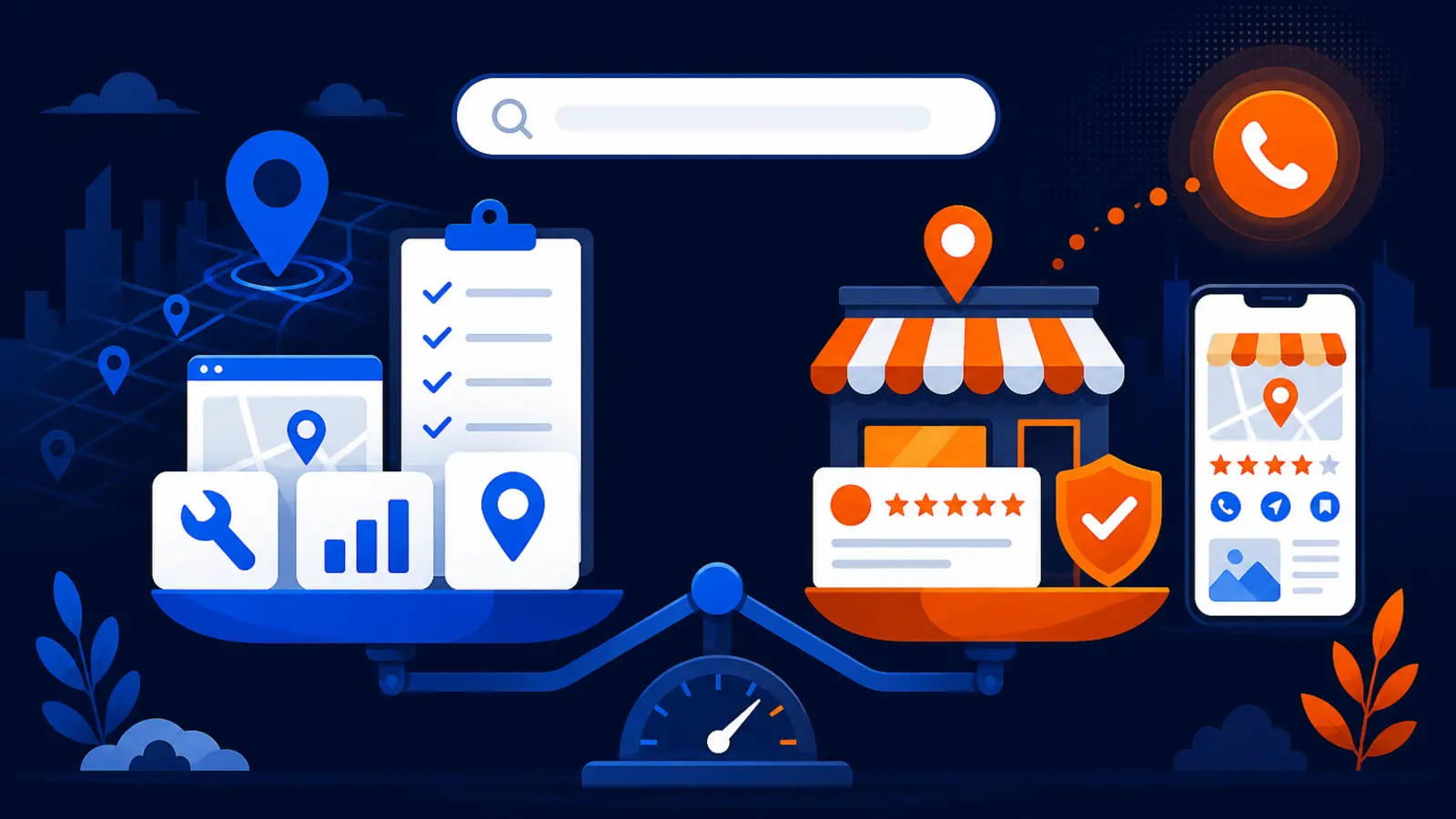
The short answer
DIY local SEO can create more calls if the business owner has time, patience and a simple market. Google Business Profile is free, Google Search Console is free, and a local rank tracker can help show where the business appears from different parts of town. For an owner-operated business that can update its own profile, improve its own website, ask customers for reviews and read the data every month, DIY is a real option.
White label local SEO is usually the better fit when an agency is responsible for results across several client accounts, multiple service areas or competitive trades. The agency still owns the client relationship, but a fulfillment partner handles the local SEO work under the agency’s brand. That can include Google Maps visibility, Google Business Profile management, reviews, organic visibility, Local Services Ads management, reporting and newer search surfaces such as AI Overview and LLM SEO.
The buying question is not whether free tools work. They do. The better question is whether the person using them has enough time, local search judgment and reporting discipline to turn visibility into calls consistently.
What the DIY path really includes
Google Business Profile Help says an eligible storefront or service-area business can manage how it appears on Google Maps and Search at no charge. That includes hours, phone number, website, location, photos, videos, customer reviews, booking links, social media links and other profile links.
Google Search Console Help says performance reports can measure impressions, clicks, click-through rate and, depending on the report type, user queries or position in search results. Google Search Central also says a small local business can probably do much of its SEO work itself, starting with Google’s SEO starter guide.
That makes DIY attractive, especially for a hands-on owner with a tight budget. The catch is that free tools do not do the work for you. They show profile activity, website search activity and some customer actions, but the owner still has to decide what to change, what to publish, how to earn reviews and how to interpret movement in local visibility.
The DIY stack usually includes:
- ▸A claimed and complete Google Business Profile
- ▸Accurate hours, categories, services, photos and contact details
- ▸Google Search Console connected to the website
- ▸A local rank tracker for map and organic visibility by area
- ▸A review request process that follows Google’s rules
- ▸Basic website updates for service pages and city pages
- ▸Monthly checks of calls, clicks, rankings and customer inquiries
What white label local SEO fulfillment includes
Cambridge Dictionary defines white label as a product or service made or developed by one company and sold to the public under another company’s name. In local SEO, that means an agency can sell local search services to its clients while a fulfillment team performs the work behind the scenes.
For an agency, this is not just outsourcing tasks. It is a way to keep the client relationship while adding a delivery team that understands Google Business Profile optimization, local ranking movement, review systems, reporting and lead channels. The client sees the agency as the provider. The white label partner helps the agency deliver.
Digital Domination provides white label local SEO fulfillment for agencies across Maps, GBP, reviews, organic, LSA management, AI Overview and LLM SEO, and reporting. The practical value is that an agency can offer a broader local SEO service without hiring and training every specialist internally.
A serious white label program should cover these operating pieces:
- ▸Google Business Profile review and ongoing optimization
- ▸Map Pack visibility tracking across the service area
- ▸Review growth support and review response guidance
- ▸Organic local SEO work on the client website
- ▸Local Services Ads management when appropriate
- ▸Clear reporting the agency can use with clients
- ▸Issue spotting when rankings, calls or profile actions change
How rankings turn into calls
More visibility can create more calls, but ranking reports are not the same thing as phone revenue. Google Business Profile performance reporting defines Calls as the number of times a customer clicked the call button on a Business Profile, and Google Business Profile Help says a phone number must be added to track this metric.
That matters because a local rank tracker measures visibility. It can show whether the business appears in map or organic results from different search locations. BrightLocal says local rankings change based on where someone is searching, and that Search Console does not focus on location-specific searches or give a true reflection of local rankings across multiple areas.
BrightLocal also says a local rank tracker monitors performance in local search by focusing on location-based keywords and visibility in both map and organic listings. That is useful for diagnosing visibility, but it cannot guarantee that a searcher will call. Calls depend on many other factors, including proximity, reviews, category fit, business hours, photos, services, price perception and the quality of the website.
A practical buyer should treat local SEO as a chain. Visibility gets the business considered. Reviews and profile quality help the customer trust it. The website and phone process help turn that interest into a lead.
What to look for before you choose either path
Whether you choose DIY or white label fulfillment, you should be able to verify what is being done. Local SEO should not feel like a black box. Google Search Central advises buyers to ask an SEO what results they expect, in what timeframe, how success will be measured, what experience they have in the buyer’s industry, and what experience they have in the buyer’s country or city.
Google also says there is no way to request or pay for a better local ranking, and that local results are mainly based on relevance, distance and popularity. That means any plan should focus on the factors a business can improve, not on secret access to Google.
Use these checkpoints before committing to DIY or a fulfillment partner:
- ▸The Google Business Profile is complete and accurate
- ▸The website has clear pages for core services and locations
- ▸The rank tracker is set to the real service area, not one city center point
- ▸Calls and website clicks are reviewed separately from rankings
- ▸Review requests follow Google’s rules and avoid incentives
- ▸Reports explain what changed, not just where rankings moved
- ▸Someone is accountable for next steps every month
Seven questions to ask before you sign
This is the section to slow down and protect yourself. Google Search Central says no one can guarantee a number one ranking on Google, and if an SEO audit guarantees first place in search results, the buyer should find someone else. Google also says it does not evaluate or endorse third-party SEO tools and that third-party SEO tools do not have access to Google’s internal ranking data.
That does not mean all guarantees or tools are bad. It means you need to understand what is being promised, what data is being used and how success will be measured. A Map Pack outcome, a lead goal, a visibility report and a revenue promise are not the same thing.
Ask these questions before you choose an SEO path:
- ▸What exact work will be done each month
- ▸Which tool shows local rankings across the service area
- ▸How are calls, clicks and leads reported
- ▸Who will update the Google Business Profile
- ▸Who will improve the website content and structure
- ▸How will reviews be requested without breaking Google’s rules
- ▸What happens if rankings improve but calls do not
Who should choose DIY local SEO
The cheaper DIY path genuinely suits an owner-operated local business with time to learn Google’s documentation, update its own profile and site, ask for reviews, monitor call-click data and accept that rank trackers measure visibility rather than guaranteed calls.
DIY is especially reasonable when the owner knows the customers personally and can make fast business decisions. A two-truck plumbing company, a solo photographer or a neighborhood repair shop may not need a full outside team at the beginning if the owner can keep the basics moving every week.
DIY is a good fit when these statements are true:
- ▸You can spend time learning Google’s SEO guidance
- ▸You can update your profile without waiting on a vendor
- ▸You can publish helpful service information on your site
- ▸You can ask real customers for reviews consistently
- ▸You can read Search Console and profile performance reports
- ▸You can be patient while local visibility builds
- ▸You are comfortable making judgment calls from imperfect data
Who should choose white label fulfillment
White label fulfillment is usually the better fit for an agency that has sold local SEO or wants to add it, but does not want to build the whole delivery department internally. It is also useful when a client expects regular reporting, service-area tracking, review support and help across several lead channels.
Agencies often run into a capacity problem before they run into a sales problem. One client needs Google Business Profile help. Another needs local pages. Another wants Local Services Ads checked. Another needs review support. If the agency owner is doing all of that manually, delivery can become the bottleneck.
White label fulfillment is a stronger fit when these are true:
- ▸You manage more than one local business account
- ▸Your clients ask for proof of local visibility
- ▸You need reports that make sense to non-technical owners
- ▸You want fulfillment under your own brand
- ▸You need support across Maps, GBP, reviews and organic visibility
- ▸You do not want to hire a full local SEO team yet
- ▸You want delivery standards that can scale as you add clients
Reviews are not optional in either model
BrightLocal’s 2026 Local Consumer Review Survey found that 97% of consumers read reviews for local businesses, and that the average consumer uses six different review sites when choosing businesses. The same BrightLocal survey found that 47% of consumers will not use a business with fewer than 20 reviews, 74% only care about reviews written in the last three months, and 31% will only use a business that has at least 4.5 stars.
That does not mean a business should chase fake reviews or offer incentives. Google Business Profile Help says businesses can create and share a review request link or QR code, but offering free or discounted goods or services in exchange for reviews is strictly prohibited.
Whether you choose DIY or white label fulfillment, the review process should be simple, compliant and steady. It should ask real customers at the right time and make it easy for the owner or staff to respond professionally.
A healthy review process includes:
- ▸A direct Google review request link or QR code
- ▸A staff habit for asking after completed work
- ▸No discounts, gifts or free services for reviews
- ▸Responses to positive and negative reviews
- ▸A monthly check of review recency and star rating
- ▸Attention to other review sites customers may use
How paid local leads fit into the decision
Local SEO and paid lead channels can support each other, but they should be measured separately. Google Local Services Help says Local Services Ads charge for valid leads, and the reporting dashboard shows total spending and the number of leads generated through message, call and book channels.
For a DIY owner, Local Services Ads may be manageable if the category is eligible and the owner can review leads, disputes and spending. For an agency, LSA management becomes another service layer that needs process, monitoring and client communication.
This is one reason white label fulfillment can be useful. The agency can keep the strategy and client relationship while the fulfillment team helps manage organic local visibility, Maps work, GBP updates, reviews, LSA management and reporting in one operating system.
The fair verdict
If you are a single local business owner with more time than budget, start with Google’s free tools, a properly set up Google Business Profile, Search Console and a local rank tracker. That path can be enough if you keep doing the work and judge success by calls, clicks, reviews and qualified inquiries, not just ranking screenshots.
If you are an agency serving local businesses, white label local SEO fulfillment is usually the more practical choice. It gives you a delivery team for Maps, GBP, reviews, organic visibility, reporting and lead channels while your agency stays in front of the client.
To see how Digital Domination supports agencies, visit the Digital Domination white label local SEO page. It explains the fulfillment areas, how agencies can use the service under their own brand and what a white label relationship looks like in practice. If you want to understand local visibility before making a decision, request the Free GeoGrid scan page, which checks 169 real Google results across the service area.
Keep reading
Related guides
- ▸When To Choose Google Maps SEO Instead Of Doing Local SEO Yourself Diy
- ▸When To Choose Google Review Management Instead Of Doing Local SEO You
- ▸When To Choose Local SEO Services Instead Of Doing Local SEO Yourself
Put it into action
Frequently Asked Questions
Can I do local SEO myself with free Google tools?
Yes, many small local businesses can start with free Google tools. Google Search Central says a small local business can probably do much of its SEO work itself, starting with Google’s SEO starter guide. The tradeoff is that you must keep updating the profile, website, reviews and reporting yourself.
Does a local rank tracker prove I will get more calls?
No. A local rank tracker shows visibility in local map and organic results, but it does not guarantee calls. Google Business Profile performance reporting counts Calls as clicks on the call button, so you should compare ranking movement with call-click data and real inquiries.
What is white label local SEO?
White label local SEO is local SEO work delivered by one company and sold under another company’s brand. Cambridge Dictionary defines white label as a product or service made or developed by one company and sold to the public under another company’s name. For agencies, it lets you offer local SEO without building the entire fulfillment team in-house.
Is white label local SEO only for agencies?
Usually, yes. White label fulfillment is built for agencies that want to sell and manage the client relationship while a specialist team handles delivery. A single local business owner normally needs direct local SEO service, not white label fulfillment.
What should local SEO reporting include?
It should include local visibility, Google Business Profile actions, website clicks, calls and clear notes on what changed. Search Console can show impressions, clicks, click-through rate and queries or position, while Business Profile performance can show call button clicks when a phone number is added. Good reporting connects those signals instead of showing rankings alone.
Can anyone guarantee first place on Google?
Google Search Central says no one can guarantee a number one ranking on Google. It also says buyers should find someone else if an SEO audit guarantees first place in search results. Be careful to distinguish a specific Map Pack program promise from a broad claim of guaranteed number one placement everywhere.
How important are reviews for local SEO and calls?
Reviews matter because customers use them when deciding whom to call. BrightLocal’s 2026 Local Consumer Review Survey found that 97% of consumers read reviews for local businesses. Google allows review request links and QR codes, but it prohibits offering free or discounted goods or services in exchange for reviews.
When should an agency stop doing local SEO manually?
An agency should consider white label fulfillment when client work starts to outgrow internal capacity. If reporting, GBP updates, review systems, service-area tracking, organic work and Local Services Ads management are slowing delivery, a fulfillment partner can help. The agency can keep the client relationship while specialists handle the execution.
Ready to dominate your map?
Top 3 in the Google Map Pack in 12 weeks, or you don't pay.