
When to choose white label local SEO instead of doing local SEO yourself
A practical buyer guide for agencies deciding whether to fulfill local SEO with free Google tools and a rank tracker, or bring in a white label partner under the agency brand.
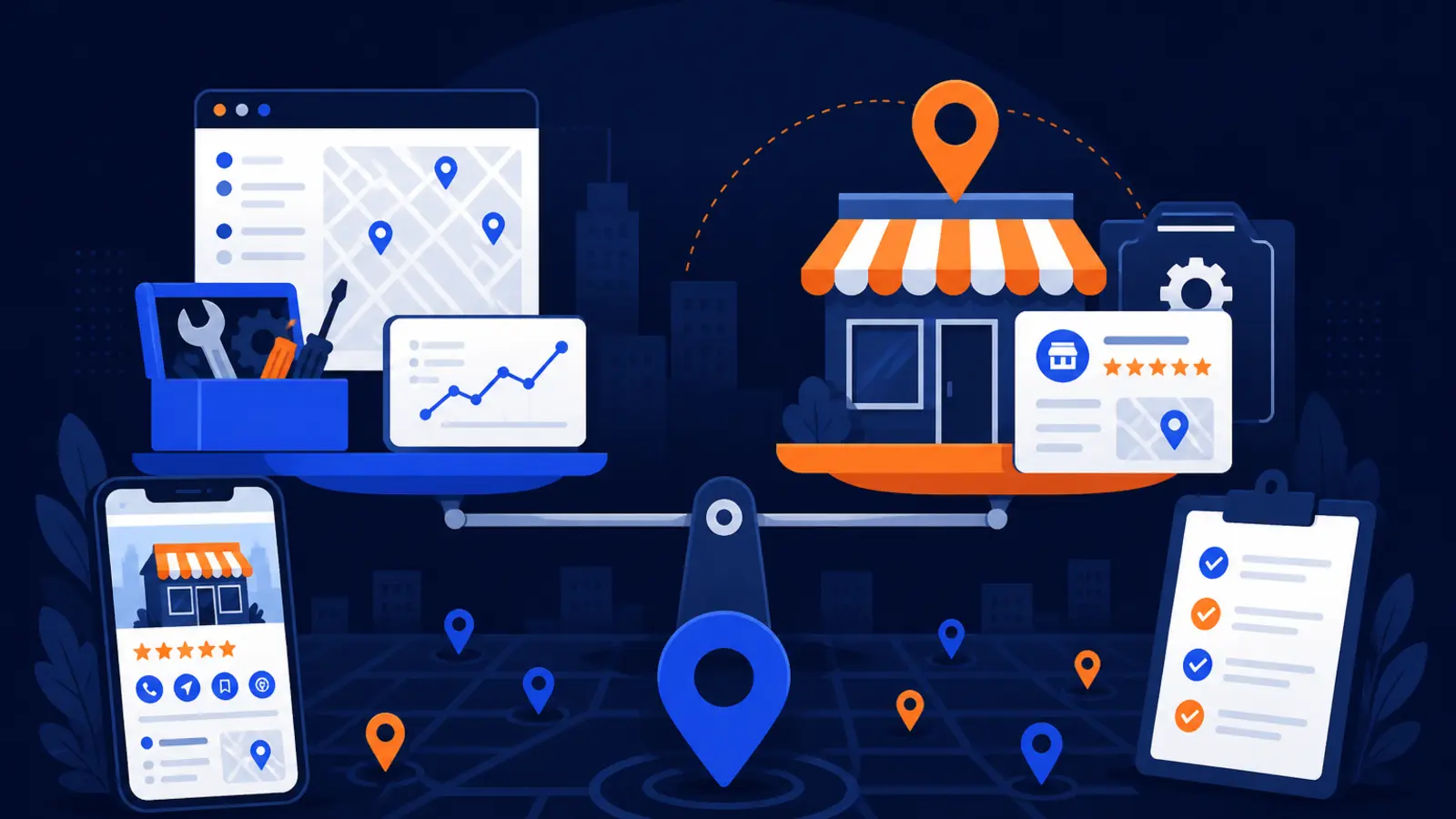
The direct answer
Choose DIY local SEO if you have a small number of locations, verified Google Business Profile access, enough staff time for steady maintenance, and no need to hide the fulfillment team from the client. Free Google tools plus a rank tracker can work when the work is simple, the client volume is low, and expectations are modest.
Choose a white label local SEO partner when your agency is selling local SEO as a client service, but does not want to build the entire operations bench in house. That usually means you need repeatable execution, review support, reporting, Google Business Profile maintenance, local ranking work, and client-ready proof under your brand.
The risk is not that DIY tools are bad. Google Business Profile is free, useful, and necessary. The risk is selling a local SEO promise, then discovering that the day-to-day work needs more attention, process, and accountability than your team can consistently provide.
What the DIY path really includes
Google Business Profile Help says an eligible business can manage how it appears on Google Maps and Search at no charge, including hours, website, phone number, location, photos, videos, and reviews. That makes DIY attractive, especially for a single-location business or a small agency helping only a few clients.
But free does not mean hands-off. Google Business Profile eligibility is limited to businesses that make face-to-face contact with customers, according to Google Business Profile Help. Online-only businesses without in-person customer contact are not eligible. That alone can create client education work before optimization even starts.
Google also says there is no way to request or pay for a better local ranking. Local results are mainly based on relevance, distance, and popularity, and relevance improves when complete and detailed business information is provided. That means DIY local SEO is not a button. It is a routine.
- ▸Confirm the business is eligible for a profile
- ▸Get verified access before promising review replies or photo updates
- ▸Keep hours, services, categories, website, phone, and location details accurate
- ▸Publish appropriate updates, offers, or events when useful
- ▸Respond to reviews in a timely and compliant way
- ▸Watch ranking movement by location, not only from one office computer
Where a rank tracker helps and where it stops
A rank tracker is helpful because local rankings vary by searcher location. A business may look strong near its storefront and weak a few miles away. If your agency reports only one search result, you can miss the real pattern across the service area.
A rank tracker does not do the work. It will not verify the profile, improve incomplete business information, answer reviews, publish posts, upload photos, fix website relevance, earn links, or explain why a client is not eligible for a certain Google feature.
Google Search Central says Search Console is the source of truth for Search performance, while Google Analytics is the source of truth for behavior on the site. A rank tracker should sit beside those tools, not replace them. It is a measurement tool, not a fulfillment system.
Use a rank tracker when you need visibility, but do not mistake it for operations. The gaps usually show up in these places:
- ▸No one owns weekly profile maintenance
- ▸No one checks whether posts are live, pending, or not approved
- ▸No one reviews Search Console and site behavior together
- ▸No one connects ranking changes to review activity, website updates, and profile completeness
- ▸No one turns ranking data into a client-ready explanation
The best fit for DIY
The DIY path suits a business owner or agency with few locations, direct profile access, and enough time to keep details current. It can also fit an agency that offers local SEO as a light add-on, not as a core profit center.
DIY is most realistic when the client understands that progress depends on ongoing work, not one setup session. It also works better when the business has a simple service area, clean branding, one website, one phone number, and no messy ownership history across profiles.
DIY is usually a reasonable starting point when these conditions are true:
- ▸One or a few locations
- ▸Verified Google Business Profile access
- ▸A clear owner or manager inside the profile
- ▸Someone available to answer reviews and update information
- ▸No need to package fulfillment under your agency brand
- ▸Low client volume and low reporting complexity
- ▸No Local Services Ads management requirement
The best fit for white label local SEO
White label local SEO fits agencies that want to sell local search services without building the entire production department. The client sees your agency brand, while the partner handles defined execution behind the scenes.
This matters when your agency is good at relationships, strategy, web design, paid ads, branding, or sales, but local SEO delivery keeps pulling your team into unfamiliar tasks. It also matters when your clients expect reporting, local ranking movement, review support, and practical explanations every month.
A partner makes more sense when the agency needs these things:
- ▸Repeatable fulfillment across multiple clients
- ▸Client-ready reporting under the agency brand
- ▸Google Business Profile work done on a schedule
- ▸Review management support that follows platform and FTC rules
- ▸Local ranking tracking by service area
- ▸Help connecting Maps, organic, reviews, and Local Services Ads work
- ▸Execution depth without hiring and training a full local SEO team
The compliance risk agencies often miss
Reviews are not just a marketing task. They are also a compliance area. BrightLocal reported in its Local Consumer Review Survey 2026 that 89% of consumers expect a response to their reviews, and 81% expect to hear back within a week. That creates an operations burden if your agency promises review management.
Google Business Profile Help says a verified Business Profile is required before a business can reply to Google reviews. Google also says review replies usually take up to 10 minutes to review, but sometimes a review can take up to 30 days. So even a simple reply process can involve access, verification, and client expectation management.
The Federal Trade Commission says businesses may not provide compensation or incentives conditioned on a consumer review expressing a positive or negative sentiment. The FTC's Consumer Reviews and Testimonials Rule went into effect on October 21, 2024 and authorizes courts to impose civil penalties for knowing violations.
For agencies, the question is not only whether you can get more reviews. It is whether you can run a clean process that does not create risk for your client or your own brand. Watch these areas closely:
- ▸Do not offer rewards only for positive reviews
- ▸Do not write reviews for customers
- ▸Do not pressure customers to change honest feedback
- ▸Do not promise instant visibility for review replies
- ▸Keep review response tone professional and specific
- ▸Make sure the client understands what is allowed
Why local SEO is broader than the profile
Google Business Profile is central, but it is not the whole job. Google Business Profile Help says prominence is based on information such as links and reviews, and that more reviews and positive ratings can help a business's local ranking. Google also groups local ranking around relevance, distance, and popularity.
Whitespark's Local Search Ranking Factors report used 47 local search experts to score 187 factors across local pack and Maps ranking impact, local organic ranking impact, conversion impact, and AI search visibility impact. Whitespark groups local search ranking factors into Google Business Profile, on-page, review, link, behavioral, citation, personalization, and social signals.
That does not mean every local business needs an enormous campaign. It does mean your agency should be careful about selling local SEO as if it is only a profile checklist. If the website is weak, reviews are stale, services are unclear, or the business lacks authority, a free profile edit may not be enough.
Seven questions to ask before you sign
Before you choose DIY or a white label partner, ask questions that expose who will do the work, who owns access, and how proof will be shown. A good decision is usually obvious once the operational details are visible.
Use these questions before you sell the service or sign a fulfillment agreement:
- ▸Who will own and manage Google Business Profile access?
- ▸Who will respond to reviews, and how fast?
- ▸Who will check whether posts, photos, and videos are visible?
- ▸Who will explain ranking changes to the client?
- ▸Who will connect Search Console, site behavior, and local ranking data?
- ▸Who will manage Local Services Ads screening requirements if needed?
- ▸Who will handle fulfillment if client count doubles?
- ▸Who will protect the agency brand if the client asks technical questions?
What to look for in a white label partner
A white label partner should make your agency look organized, not dependent. You need clear deliverables, clean communication, reporting you can show clients, and a process that does not require you to chase every small task.
You should also expect realistic language. Google says there is no way to request or pay for a better local ranking. A partner should be able to explain what it controls, what it influences, and what depends on Google, the market, the client, and customer behavior.
Concrete checkpoints are easier to verify than vague promises. Ask for these before you commit:
- ▸A clear scope of work for Maps, profile, reviews, website, citations, or Local Services Ads
- ▸A sample report that a nontechnical client can understand
- ▸A process for profile owner and manager access that does not require password sharing
- ▸A schedule for maintenance, tracking, and communication
- ▸A policy for review requests and incentives that matches FTC guidance
- ▸A method for showing local ranking movement across the service area
- ▸A plan for handling Google post, photo, review, and indexing delays
- ▸A named escalation path when a client issue is urgent
When DIY becomes more expensive than it looks
DIY looks cheaper because Google Business Profile is free and basic tools are affordable. The hidden cost is staff time. Someone has to learn the rules, monitor changes, respond to clients, check data, produce reports, and explain why results differ by neighborhood.
Delays also cost trust. Google Business Profile Help says posts can be live, pending, or not approved, and Google reviews Business Profile post content before visibility. Photos and videos can take 24 to 48 hours to show after profile verification. Google Search Central says crawling after a recrawl request can take from a few days to a few weeks, and a crawl request does not guarantee instant inclusion or inclusion at all.
These delays are normal, but they can sound like excuses if your agency is not ready to explain them. White label fulfillment is often worth considering when the cost of confusion, rework, and client support becomes larger than the cost of using a specialist.
A simple decision framework
If your agency is testing demand, DIY can be a smart way to learn the basics. Do not overpackage it. Keep the offer narrow, set realistic expectations, and avoid promising outcomes you cannot support with a real process.
If your agency is already selling local SEO or wants to make it a serious service line, a white label partner is usually safer. You can keep the client relationship while adding fulfillment capacity and more consistent execution.
Use this quick filter:
- ▸Choose DIY when the work is occasional, simple, and directly managed
- ▸Choose DIY when you have verified access and a clear internal owner
- ▸Choose white label when clients expect monthly fulfillment and reporting
- ▸Choose white label when your agency brand needs to stay front and center
- ▸Choose white label when Local Services Ads, reviews, Maps, organic, and reporting must work together
- ▸Choose white label when hiring, training, and quality control would distract your team
How Digital Domination fits this choice
Digital Domination provides white label local SEO fulfillment for agencies, including Maps, Google Business Profile, reviews, organic, Local Services Ads management, AI Overview and LLM SEO, and reporting. The White Label Local SEO page explains what agencies can outsource under their brand and how fulfillment is structured.
If you want proof before deciding, start with the free GeoGrid scan page. Digital Domination's free GeoGrid scan checks 169 real Google results across the service area, so you can see where a local business is strong, weak, or invisible before you package an offer.
Use DIY when the work is small and manageable. Use a white label partner when you need reliable fulfillment under your agency brand and do not want local SEO operations to become your bottleneck.
Keep reading
Related guides
- ▸When To Choose A Free Geogrid Scan Instead Of Doing Local SEO Yourself
- ▸When To Choose A Free Trinity Website Audit Instead Of Doing Local SEO
- ▸When To Choose AI Search Optimization Instead Of Doing Local SEO Yours
Put it into action
Frequently Asked Questions
Can I do local SEO myself with free Google tools?
Yes, if the business is eligible, the Google Business Profile is verified, and someone has time to maintain it. Google Business Profile is free and lets eligible businesses manage how they appear on Search and Maps. The challenge is keeping up with reviews, updates, reporting, and local ranking changes over time.
Is a rank tracker enough for local SEO clients?
No. A rank tracker helps show where a business appears in different parts of a service area, but it does not perform the work. You still need profile management, review response, website work, reporting, and client communication.
When should an agency use white label local SEO?
Use white label local SEO when your agency sells the service but does not want to build the fulfillment team in house. It is especially useful when clients expect regular reporting, review support, Google Business Profile work, and local ranking progress under your brand.
Is white label local SEO only for big agencies?
No. It can help a small agency that wants to offer local SEO without hiring specialists. It can also help a larger agency standardize fulfillment across many local clients.
Can a white label partner guarantee Google rankings?
Be careful with any ranking promise. Google Business Profile Help says there is no way to request or pay for a better local ranking on Google. If a partner offers a guarantee, ask exactly what is guaranteed, how it is measured, and what happens if the result is not reached.
Who should own the Google Business Profile?
The business should keep ownership of its own profile. Google Business Profile owners can invite owners or managers who can edit information, respond to reviews, and manage posts without sharing the owner's password. That is safer than handing out login credentials.
Do reviews really matter for local SEO?
Yes, reviews matter for both trust and visibility. Google Business Profile Help says prominence can be based on information such as links and reviews, and that more reviews and positive ratings can help local ranking. Review requests still need to follow FTC rules and should not offer incentives tied to positive or negative sentiment.
What should I ask a white label SEO provider before hiring them?
Ask what work is included, how reporting is handled, who manages profile access, and how review compliance is protected. Also ask how they show local ranking movement across the service area. A good provider should make fulfillment clearer, not more confusing.
Ready to dominate your map?
Top 3 in the Google Map Pack in 12 weeks, or you don't pay.