
A free GeoGrid scan vs hiring an in-house marketer or marketing coordinator
Which option helps a local business find a Google Maps visibility problem before committing to a hire?
Short answer
Yes. A free GeoGrid scan can reveal a Google Maps visibility problem before you commit to the cost, recruiting work and timeline of hiring an in-house marketer. It will not replace a full-time marketing employee, but it can quickly show whether your business is missing from the Map Pack in the neighborhoods where customers are searching.
That matters because Google Maps visibility is location-specific. A business can look strong from its own office and still be nearly invisible a few miles away. A scan helps you see the difference between “we rank somewhere” and “customers across our service area can actually find us.”
Hiring an in-house marketer or marketing coordinator is the better choice when you need one employee to run ongoing multi-channel marketing, reporting, vendor coordination, content, campaigns and day-to-day execution. A GeoGrid scan is a diagnostic tool. An employee is an operating role.
What a free GeoGrid scan shows
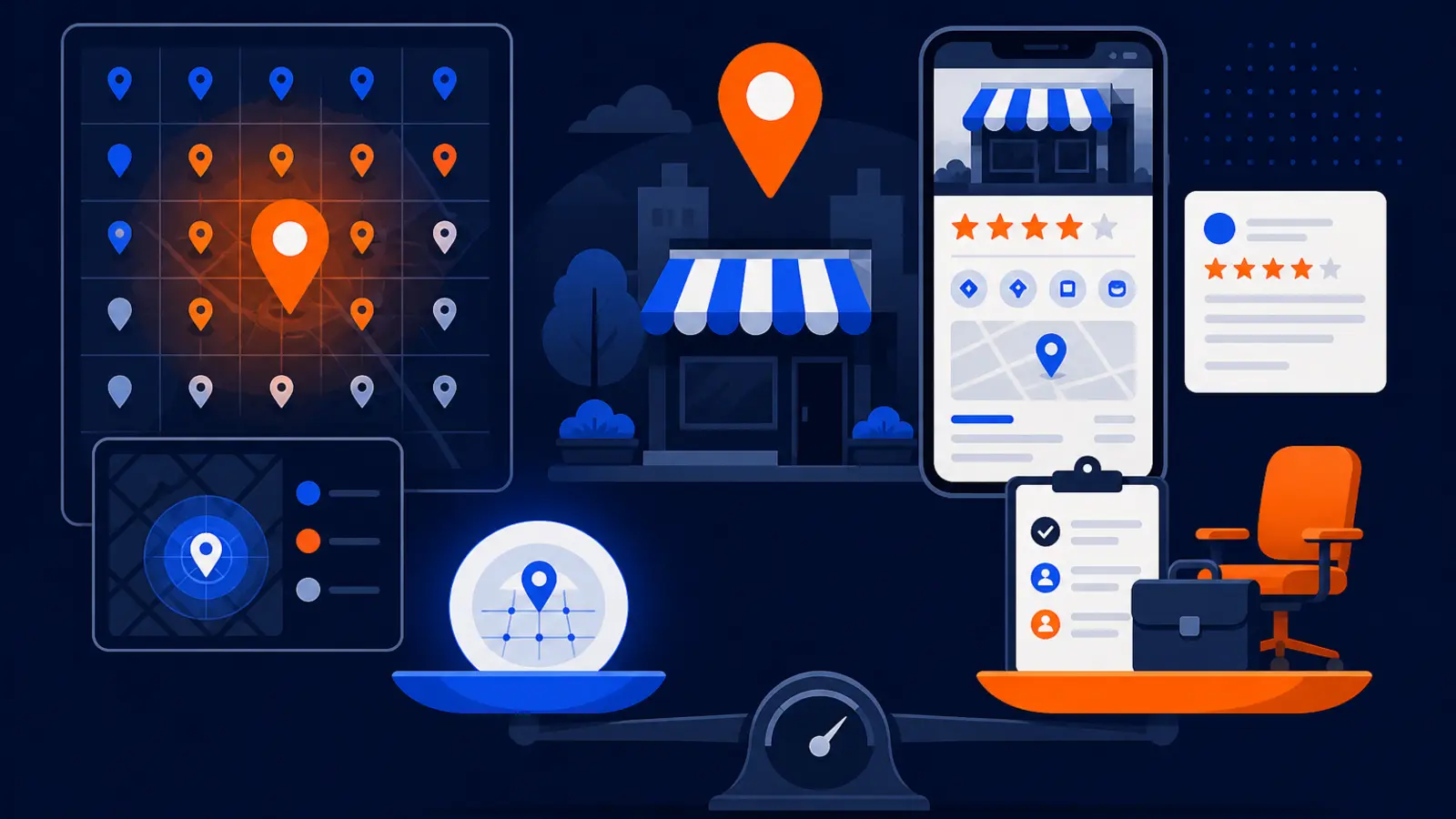
A GeoGrid scan checks rankings across points on a map instead of treating the whole city as one ranking. BrightLocal’s Help Center explains that a local search grid shows where a business ranks in local search at points on a map for a tracked keyword. BrightLocal also says each grid point runs the search as if the searcher were at that exact spot and records the business up to ranking position 100.
Digital Domination’s free 169-point GeoGrid scan checks 169 real Google results across the service area. For an owner, the useful part is simple: it turns a vague ranking conversation into a map you can inspect.
A scan can help you see these practical issues:
- ▸Where you show in the Map Pack and where you do not
- ▸Which neighborhoods are weak for an important service keyword
- ▸Whether competitors are consistently outranking you in specific areas
- ▸Whether your visibility drops off quickly away from your location
- ▸Whether your current Google Business Profile work is reaching enough of the service area
Why this matters for calls
Google Business Profile Help says local results on Google Maps and Search appear when customers search for businesses or places near their location. That means the customer’s location can affect what they see. A ranking seen at your shop, office or home is not necessarily the ranking a customer sees across town.
Google Business Profile performance reports define Calls as the number of times a customer clicked the call button on the Business Profile. Google also says a phone number must be added to track that metric. So, if Maps visibility is weak, the business may be missing call button opportunities before a customer ever reaches the website.
A scan does not promise more calls by itself. It helps answer a prior question: are enough nearby searchers seeing the business in places where they are likely to call?
What hiring an in-house marketer is really for
An in-house marketer or marketing coordinator can be a smart hire, but it solves a broader problem than diagnosing Maps visibility. O*NET OnLine lists Marketing Research Coordinator as a reported job title for Market Research Analysts and Marketing Specialists. The U.S. Bureau of Labor Statistics says market research analysts monitor and forecast marketing and sales trends and measure the effectiveness of marketing programs and strategies.
That kind of person can help coordinate many moving parts. They may work with vendors, review reports, plan campaigns, manage content, help with promotions and keep marketing tasks from falling through the cracks. For a growing local business, that can be valuable.
Hiring fits best when you need one internal owner for work like this:
- ▸Ongoing marketing calendar management
- ▸Email, social, website and print coordination
- ▸Vendor communication and accountability
- ▸Campaign planning and reporting
- ▸Content requests and approvals
- ▸Internal brand consistency
- ▸Customer research and offer testing
The cost and timing reality
A free GeoGrid scan is fast because it starts with a defined question: where does this business show up on Google Maps for a target search across its service area? It does not require writing a job description, screening applicants, interviewing candidates or onboarding a new employee.
Hiring takes longer. SHRM says the 2025 median time-to-fill from job requisition to offer acceptance was roughly a month and a half for both executive and nonexecutive positions. That does not include the time an owner may spend deciding on the role, preparing the listing, training the person or waiting for the new hire to understand the business.
There is also a payroll commitment. The U.S. Bureau of Labor Statistics says the median annual wage for market research analysts and marketing specialists was $78,760 in May 2025. That figure is not a quote for your market or your role, but it is a useful reminder that an employee is a recurring staffing decision, not a simple diagnostic step.
What to expect and what to verify
A good scan should make the next step clearer, not more confusing. The owner should be able to look at the map and understand whether the business is visible near the best customers, weak in important pockets or being beaten by specific competitors.
Google Business Profile Help says local results are mainly based on relevance, distance and popularity. Google also says complete and accurate information makes businesses more likely to show up in local search results. Google lists full address, business hours, business category and attributes as Business Profile information that helps customers know what a business does, where it is and when they can visit.
When you review a scan, check these items:
- ▸The keyword matches a real buying search, not a vanity phrase
- ▸The grid covers the real service area, not just the office location
- ▸The business name is clearly identified on the map
- ▸Competitors are visible enough to compare patterns
- ▸Weak zones are obvious without needing technical knowledge
- ▸The Google Business Profile phone number is present so call clicks can be tracked
- ▸Hours, category and key profile details are accurate
- ▸A service-area business with a residential address is handled correctly
Questions to ask before you choose
This decision is easier when you separate diagnosis from execution. If you do not yet know whether Google Maps visibility is the problem, start by asking questions that expose what each option can and cannot prove.
Ask these questions before you sign anything or open a job requisition:
- ▸Do we know where we rank across the service area, or only from one location?
- ▸Are the weak areas tied to neighborhoods that actually matter to revenue?
- ▸Can we see which competitors appear for the same searches?
- ▸Is our Google Business Profile complete, accurate and current?
- ▸Do we need a diagnosis, or do we need a full-time person managing many channels?
- ▸Will an in-house hire have the local SEO experience to fix Maps visibility?
- ▸Can we wait through a hiring process before understanding the problem?
- ▸Who will be accountable for turning the findings into action?
What you can act on after a GeoGrid scan
The best use of a scan is to decide what needs attention next. It can point to a Google Maps problem, but the fix depends on what the map and profile review show.
Google says there is no way to request or pay for a better local ranking on Google. That means the action plan should focus on the factors Google discusses, such as relevance, distance, popularity and complete, accurate profile information. Google Search Central also says some SEO changes can take effect in a few hours, others can take several months and a few weeks is usually needed to assess beneficial effects in Google Search results.
After a scan, a practical action list may include:
- ▸Correcting profile details that are incomplete or outdated
- ▸Reviewing the primary business category and service details
- ▸Checking whether service-area settings follow Google’s guidelines
- ▸Comparing competitor patterns in weak parts of the map
- ▸Deciding which neighborhoods deserve more attention
- ▸Watching whether changes affect future grid reports
- ▸Separating Maps work from broader marketing tasks
When hiring in-house is the better choice
Choose the in-house marketer when the business has moved beyond a single visibility question. If the owner needs one person inside the company every day to coordinate marketing work, answer vendor questions, gather assets, organize campaigns and keep reporting moving, an employee can be the right fit.
This is especially true when marketing has become operationally messy. A scan can show where you rank, but it will not attend staff meetings, coordinate a seasonal campaign, manage the photo library or chase approvals from managers.
An in-house marketer is likely the better option when you need:
- ▸Daily internal marketing coordination
- ▸Multiple campaigns running at the same time
- ▸A person who knows the team and operations closely
- ▸Hands-on help across social, email, website and offline promotions
- ▸Regular reporting across many channels, not only Maps
- ▸A central person to manage several outside vendors
- ▸Long-term capacity inside the company
How to compare the two fairly
A free GeoGrid scan and an in-house hire should not be judged as equal products. One is a diagnostic step. The other is a staffing decision. The fair comparison is whether you need proof of a Maps visibility issue first, or whether you already know you need an internal marketing role.
For many local service businesses, the scan is the lower-commitment first step. It can reveal whether the Google Maps problem is real, where it is happening and which competitors are showing up. If the scan shows a serious visibility gap, the owner can decide whether to assign the work internally, hire help or speak with a local SEO provider.
For other businesses, the hire comes first. If the owner is overwhelmed by marketing operations across every channel, the visibility scan may still be useful, but it will not replace the need for a dedicated person.
Next step: see the map before you commit
If your main question is “are we losing calls because customers cannot find us on Google Maps,” start with proof. Digital Domination’s Scan page explains the free 169-point GeoGrid scan, what it checks and how it shows real Google results across the service area.
The scan is built for owners who want to see the visibility problem before they commit to a bigger decision. Visit Digital Domination’s Scan page to request the free GeoGrid scan.
Keep reading
Related guides
- ▸AI Local Recommendations Volatile
- ▸How Do I Get My Local Business Into Google's AI Overviews?
- ▸AI Page Facts Gemini Chrome Android
Put it into action
Frequently Asked Questions
Is a GeoGrid scan better than hiring a marketing coordinator?
It depends on the job you need done. A GeoGrid scan is better for quickly finding whether Google Maps visibility is weak across your service area. A marketing coordinator is better when you need one employee to manage ongoing campaigns, vendors, reporting and daily execution.
Can a free GeoGrid scan show why my phone is not ringing?
It can show whether Maps visibility may be part of the problem. Google Business Profile performance reports count Calls when a customer clicks the call button, so weak Maps visibility can reduce those opportunities. The scan does not diagnose every call problem, such as pricing, reviews, sales process or seasonality.
Why not just search my business on Google myself?
A single search only shows what appears from your location at that moment. BrightLocal explains that a local search grid runs searches from points on a map, which is more useful for seeing neighborhood-by-neighborhood visibility. That is important because Google local results can change based on where the searcher is.
Does Google let me pay for a better local ranking?
No. Google Business Profile Help says there is no way to request or pay for a better local ranking on Google. Work should focus on the factors Google describes, including relevance, distance, popularity and complete, accurate business information.
How fast can Maps visibility improve after changes?
Timing varies. Google Search Central says some SEO changes can take effect in a few hours, others can take several months and a few weeks is usually needed to assess beneficial effects in Google Search results. That is why tracking over time matters.
Should a plumber or service-area business show its address?
Not if the business operates from a residential address and serves customers at their locations. Google Business Profile Help says a service-area business should hide its business address from customers, such as a plumber operating from a residential address. This is one checkpoint to verify before judging visibility.
What if I already have an in-house marketer?
A GeoGrid scan can still help because it gives the marketer a clearer Maps visibility baseline. It can show weak areas, competitor patterns and whether profile work is translating into local visibility. The marketer can then use the findings to plan next steps.
What is on Digital Domination’s Scan page?
The Scan page is where a local business can request the free 169-point GeoGrid scan. It explains that the scan checks real Google results across the service area so the owner can see Maps visibility before making a larger marketing decision.
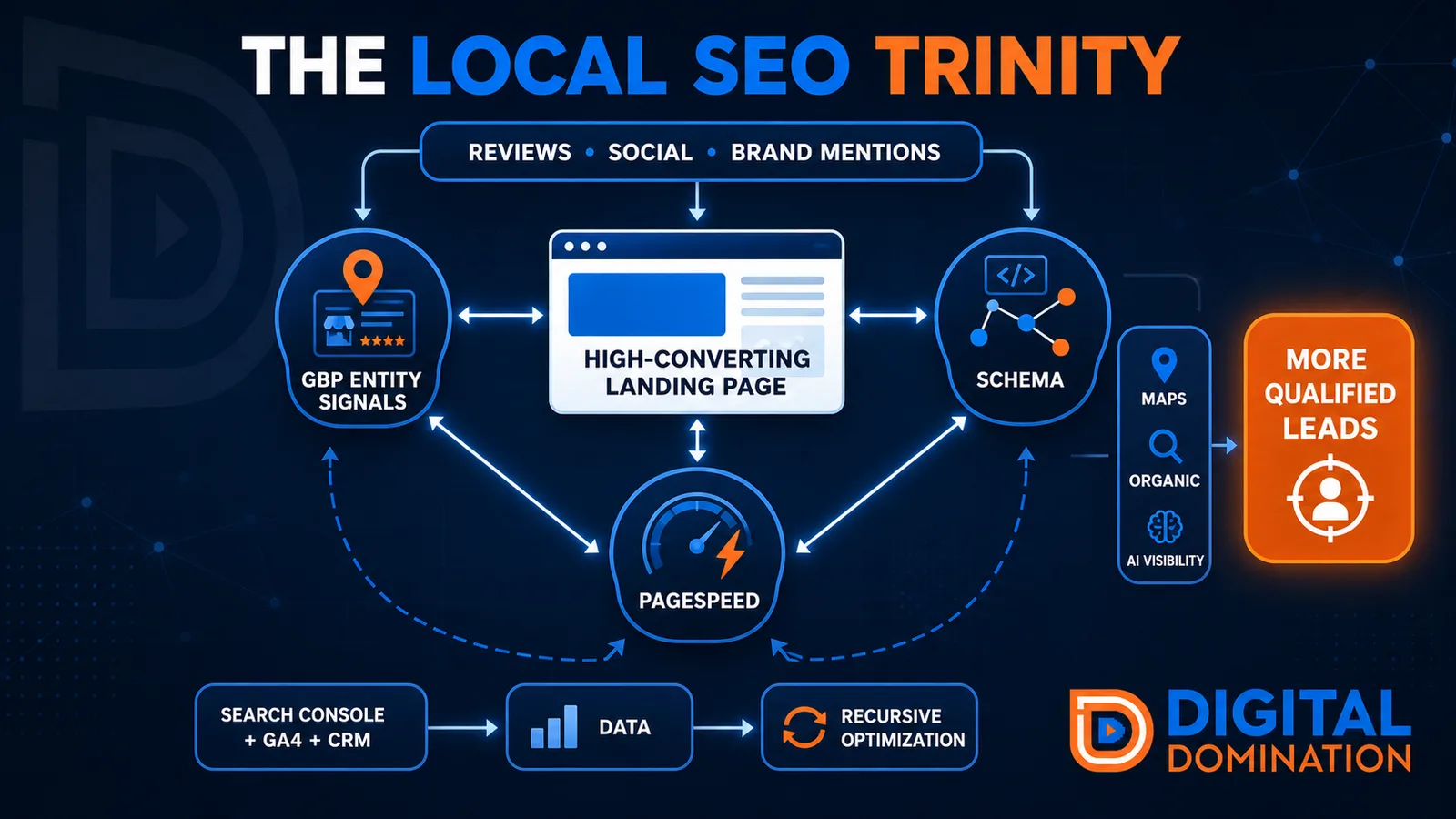
The Local SEO Trinity
Think of a three-legged stool. Your Google profile, your website, and your reviews all have to hold you up. If one leg is short, the whole thing wobbles.
GBP entity signals
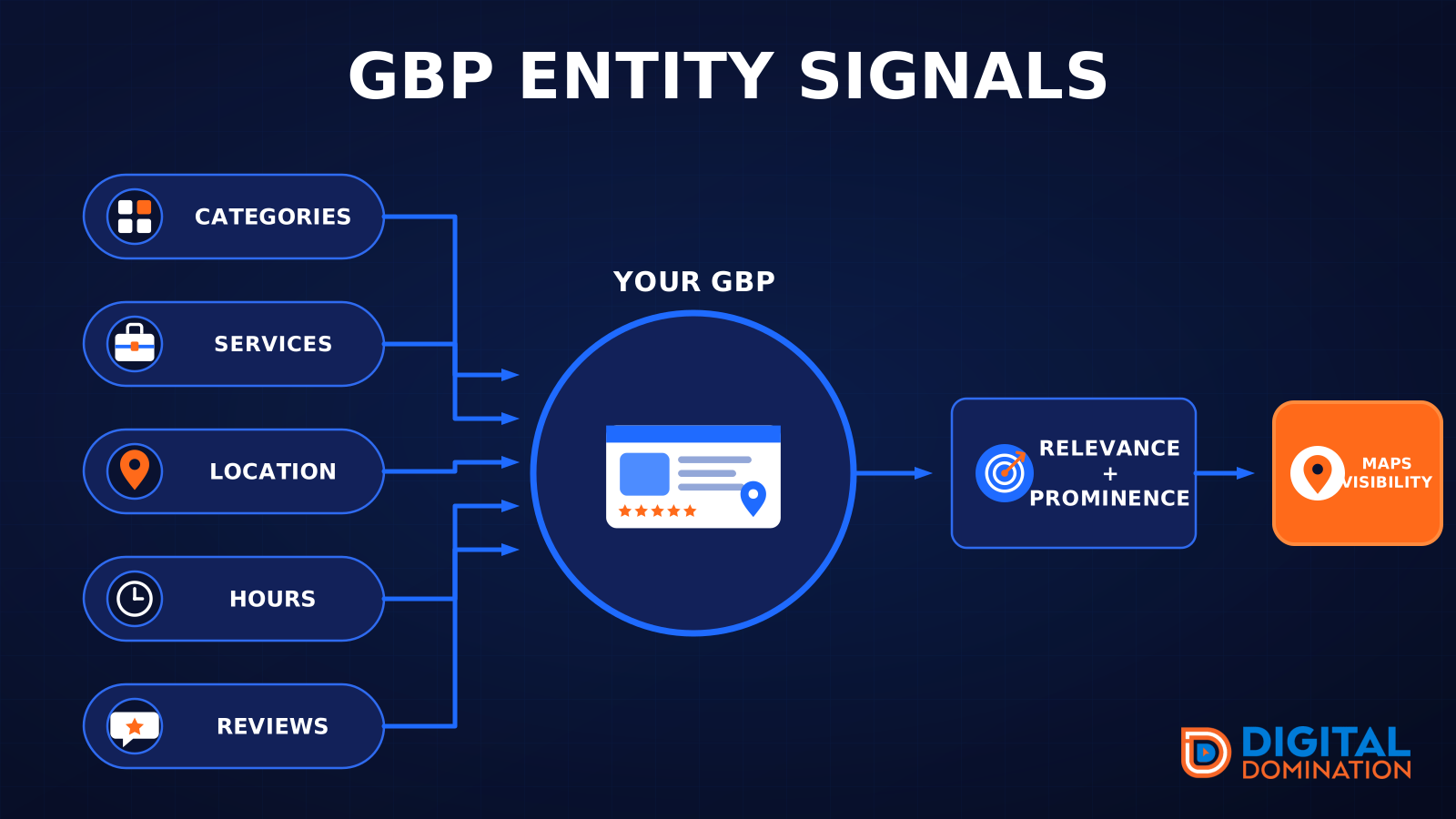
This leg is your Google Business Profile. GBP means Google Business Profile. It covers your categories, your services, your location, your hours, and your reviews. Google uses those facts to decide who to show.
Your Google profile is your storefront sign. If the sign is missing, or it names the wrong shop, people drive past.
PageSpeed to conversion
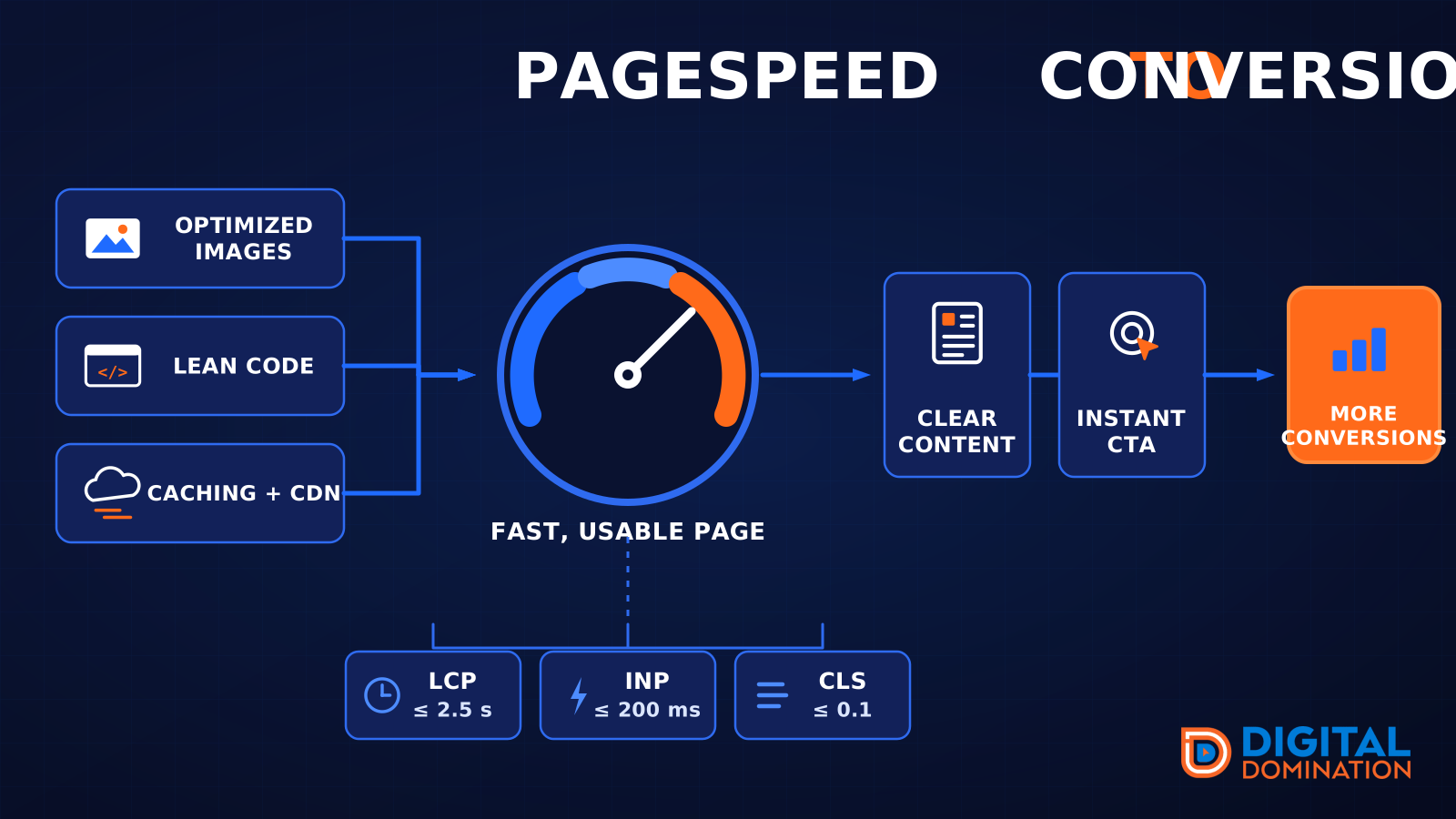
This leg is your website, above all on a phone. Small images, lean code, and caching make a page fast. A fast, clear page is what turns a visit into a call. Phone speed is one of the 12 Trinity checks because a slow page loses the call before anyone sees your offer.
Your website is the showroom. If the door sticks, people leave before they look around.
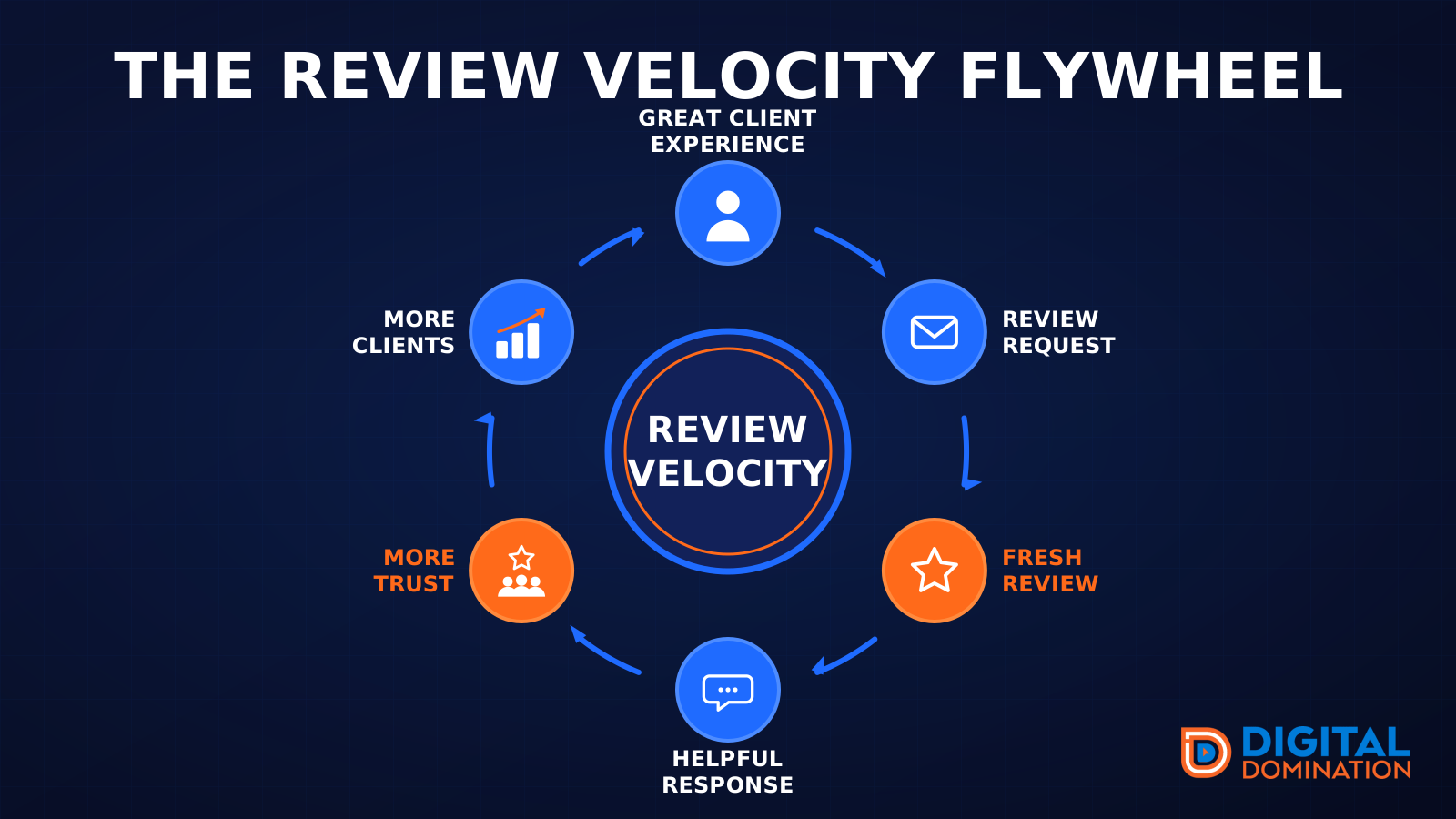
The review velocity flywheel
This leg is reviews and reputation. A good visit leads to a review request, then a fresh review, then a helpful reply, then more trust, then more customers. When the scan can find your Google listing, it shows your rating, your recent reviews, and how many you answered.
Reviews are word of mouth. One kind word helps. A steady stream of real reviews, and a reply from you, helps more.
How this turns into revenue
Being found in more searches leads to more calls. More calls lead to more booked jobs. More booked jobs lead to more revenue.
Example numbers, not a real business: 40 calls from search in a month, a 25 percent close rate, and a $400 average job. That is 10 booked jobs. That is $4,000. The math is the lesson. It is not a promise.
The full page has a box where you can type your own average job value and close rate.
One real story, from our car dealership case study: Medina Auto Group went from invisible on Google Maps to dominating every high-intent search across their market. The turnaround spanned all four of their rooftops at once. The same page says the team eliminated 89 unfair one-star reviews that had been dragging the dealership's reputation down and keeping it out of the Map Pack. It also says: “Results described here are exceptional and non-typical. Outcomes vary based on market conditions, competition, and implementation. No guarantees are made regarding earnings, rankings, or conversions.”
Free strategy call
More booked jobs start with a clear plan
Book a free strategy call. We look at your Google profile, your website, and your reviews, and we tell you what to fix first.
Free. You pick the time. A real person shows up.