
AI search optimization in Phoenix
Make your Phoenix business easier to verify, understand and recommend in Google Maps, Google AI results and ChatGPT-style answers.
Yes, if the work is built around eligibility and trust
Yes. A Phoenix AI search optimization provider can help make your business more eligible and credible in Google Maps, Google AI results and ChatGPT-style answers. The honest version is not a trick, shortcut or paid ranking button. It is a local search program that keeps your Google Business Profile accurate, makes your website crawlable, explains your services clearly, supports reviews and gives search systems enough consistent proof to understand who you serve and where you serve them.
The boundary matters. Google Business Profile Help says there is no way to request or pay for a better local ranking on Google. Google also says local results are mainly based on relevance, distance and prominence. A provider should work on the signals that support those areas, not claim it can buy placement.
For Phoenix businesses, the job is practical. Your profile, website, reviews, service pages and crawler access need to line up so Google and AI answer engines can understand your business without guessing.
Why Phoenix makes this more competitive
Phoenix is a large local market. The U.S. Census Bureau estimated Phoenix city had 1,665,481 residents on July 1, 2025. That does not mean every trade is impossible to rank in, but it does mean vague service pages and half-finished profiles are easier to overlook.
AI search also changes how buyers compare local companies. BrightLocal's 2026 Local Consumer Review Survey says consumers used an average of six review sites when choosing businesses. The same BrightLocal survey says use of ChatGPT and other generative AI tools for local recommendations rose from 6% in the prior year to 45% in 2026.
A Phoenix business now needs to look credible in more than one place. The basic checkpoints are still familiar, but the margin for sloppy information is smaller.
The places that need to agree include:
- ▸Your Google Business Profile
- ▸Your website service pages
- ▸Your reviews and owner replies
- ▸Your business name, address and phone details where they appear online
- ▸Your page indexing, snippets and crawler permissions
What Google says matters for local ranking
Google Business Profile Help says a Business Profile can be used to improve a business's local ranking on Google Maps and Search. It also says businesses with complete and accurate information are more likely to show up in local search results.
That means your provider should be obsessive about the boring items. Your address, hours, categories and service details should be correct. Google Business Profile Help says profile information should include the business address, business hours, business category and other details such as parking or Wi-Fi availability.
Reviews matter too, but not as a fake-review scheme. Google Business Profile Help says replying to customer reviews shows that a business values feedback, and positive reviews and helpful replies can help the business stand out. It also says prominence can be based on information such as how many websites link to a business and how many reviews the business has.
A provider should be able to show you how it improves these areas without violating Google's rules. Look for work in these areas:
- ▸Profile completeness and accuracy
- ▸Correct primary and secondary categories
- ▸Service and location clarity
- ▸Review requests and owner replies
- ▸Local links, mentions and business information consistency
- ▸Website pages that clearly match what customers search for
How Google AI results fit into the plan
Google Search Central says the same foundational SEO practices apply to AI Overviews and AI Mode. Google says there are no additional technical requirements beyond being indexed and eligible to show in Google Search with a snippet.
That is good news for a local owner. You do not need a separate mystery system for Google AI. You need pages that Google can crawl, index, understand and show in results. If your site hides important content, blocks snippets or has thin service pages, AI visibility can suffer because the foundation is weak.
Google Search Central also says preview controls such as nosnippet, data-nosnippet, max-snippet and noindex can limit information shown from a page in Search and AI features. A provider should check these settings before talking about advanced AI work.
The Google AI checklist should include:
- ▸Indexable pages for core services
- ▸Clear service-area language
- ▸Useful page titles and summaries
- ▸No accidental noindex instructions
- ▸Snippet settings that do not block useful information
- ▸Content that answers buyer questions plainly
How ChatGPT-style answers change the checklist
ChatGPT-style answers are not the same as the Google Map Pack, but they still need sources they can access and understand. OpenAI says OAI-SearchBot is used to surface websites in ChatGPT search results. OpenAI also says sites opted out of OAI-SearchBot will not be shown in ChatGPT search answers except as navigational links.
That does not mean every business should open every crawler without thinking. It does mean your provider should know whether important pages are reachable by the systems that may surface local answers. If your robots settings block useful access, your business may be absent from some answer experiences even when your services are relevant.
For a Phoenix business, this is especially important when customers ask questions like who offers emergency repair near them, which clinic serves a neighborhood or which contractor handles a specific type of work. The answer engine needs clear proof from your own site and from the broader web.
The ChatGPT-style readiness check should cover:
- ▸Whether key pages can be crawled
- ▸Whether service descriptions are plain and specific
- ▸Whether contact and location details are easy to find
- ▸Whether review and reputation signals are consistent
- ▸Whether pages answer real customer questions
What to look for before you sign
A good AI search optimization provider in Phoenix should start with verification, not hype. The first call should feel like a local search inspection. They should ask what services matter most, where you actually work, whether your profile is verified, what changed recently and how you currently get calls.
They should also be clear about limits. Google says no one can request or pay for a better local ranking. If a proposal sounds like paid access to Google's local results, walk away. If it talks about making your business complete, accurate, crawlable, trusted and better supported by reviews, you are closer to the right conversation.
You should be able to verify these checkpoints yourself:
- ▸The provider reviews your Google Business Profile before quoting strategy
- ▸They explain relevance, distance and prominence in plain language
- ▸They check whether your important pages are indexed
- ▸They inspect review flow and owner replies
- ▸They look at service-area and category fit
- ▸They check AI crawler access where appropriate
- ▸They provide reporting that shows locations, not just one keyword average
Seven questions to ask before you sign
Use these questions to separate practical local search work from AI packaging. A capable provider should answer directly, without pretending that AI search replaced the rules of local SEO.
Ask these questions before you choose a Phoenix provider:
- ▸How will you improve my Google Business Profile without violating Google's local ranking rules?
- ▸What will you check on my website for Google AI eligibility?
- ▸Will you review noindex, snippet controls and crawler access?
- ▸How will you help us request and answer reviews?
- ▸What proof will I see that rankings changed across my service area?
- ▸What work is included on service pages and structured data?
- ▸What should I do myself if I choose not to hire you?
What a done-for-you program should include
A done-for-you program should connect the profile, website and reputation work. These are not separate silos to a customer or to a search engine. If your profile says one thing, your website says another and your reviews mention services you never explain online, the business is harder to understand.
Google Search Central says Local Business structured data can tell Google about business hours, business departments and reviews if the site captures reviews about other businesses. It also says it may take several days after publishing structured data for Google to find and crawl a page. Structured data is not a paid ranking switch, but it can help present business facts clearly when used correctly.
A practical program should include these pieces:
- ▸Google Business Profile cleanup and maintenance
- ▸Service page improvements
- ▸Local Business structured data where appropriate
- ▸Review request and reply process
- ▸Tracking across the service area
- ▸Reporting that a non-technical owner can read
- ▸Checks for Google AI and ChatGPT-style access issues
When the cheaper DIY path makes sense
The cheaper DIY path can be a good fit if you have time and attention to keep the basics clean. It suits a business owner who can verify and maintain the Google Business Profile, request and answer reviews, keep service pages crawlable, add structured data and monitor AI crawler access without needing a done-for-you local search program.
DIY is not wrong. Many local businesses can make meaningful progress by fixing incomplete profiles, replying to reviews and publishing clearer service pages. The risk is inconsistency. Local search work is easy to start and easy to neglect when phones, staffing and jobs get busy.
DIY is most realistic when these are true:
- ▸You control your Google Business Profile
- ▸You can update hours, services and categories quickly
- ▸You have someone who can edit the website safely
- ▸You can ask for reviews without making it awkward
- ▸You can check whether important pages are indexed
- ▸You can keep the work going each month
How Digital Domination handles Phoenix AI search optimization
Digital Domination's Phoenix work is built around local visibility, AI readiness and proof an owner can understand. We start with a 169-point GeoGrid scan that checks 169 real Google results across the service area. That matters because one ranking from one location does not show how visible you are across Phoenix.
Digital Domination works with one client per trade per service area, so territory exclusivity is part of the model. The Maps Domination Program pricing is set per market on a qualification call and tied to the ranking outcome. The guarantee is simple: top 3 in the Google Map Pack in 12 weeks or you do not pay.
Digital Domination also provides weekly GeoGrid tracking reports with visual proof of rankings and call volume. The team has spent 20 years learning how businesses earn attention, authority, trust and rankings online. Google Partner and Meta Business Partner badges are shown on the roster page.
The program is designed to connect these parts:
- ▸Google Maps visibility
- ▸Google Business Profile accuracy
- ▸Review growth and replies
- ▸Service-area tracking
- ▸Website and page clarity
- ▸AI search readiness checks
- ▸Plain reporting for owners
What this should not include
AI search optimization should not include fake locations, fake reviews, keyword stuffing, hidden pages or claims that a provider can pay Google for a better local ranking. Those tactics create risk and do not match what Google says about local results.
It should also not treat AI as a reason to ignore the customer. Search systems are trying to summarize trust signals that already exist. If your hours are wrong, your reviews are unanswered and your service pages are thin, an AI label will not fix the problem.
Be cautious when you hear claims like these:
- ▸Guaranteed placement because of a secret Google relationship
- ▸Paid access to local ranking improvements
- ▸AI content at scale with no local proof
- ▸Reviews that are not from real customers
- ▸Tracking based on one point in the city
- ▸Reports that avoid showing the actual Map Pack
See the Phoenix program and get the scan
If you want a done-for-you path, visit Digital Domination's Phoenix page. It explains the local Maps Domination Program for Phoenix business owners, how the qualification process works and what kind of visibility proof you should expect.
If you want to see where you stand first, request the free GeoGrid scan on the scan page. The scan checks 169 real Google results across your service area, so you can see whether your business is strong in the places your customers actually search from.
Use that information to decide whether you want help or whether the DIY path is enough for now.
Keep reading
Related guides
- ▸ChatGPT business profiles
- ▸ChatGPT local SEO now depends on directory proof too
- ▸Chatgpt SEO For Local Business
Put it into action
Frequently Asked Questions
What is AI search optimization for a Phoenix business?
AI search optimization helps your business information become easier for Google, Google AI results and ChatGPT-style answer tools to find and understand. For a Phoenix local business, that usually means a stronger Google Business Profile, clearer service pages, crawlable content, consistent business details and better review practices.
Can I pay Google to rank higher in the local Map Pack?
No. Google Business Profile Help says there is no way to request or pay for a better local ranking on Google. A legitimate provider works on relevance, distance and prominence signals instead of promising paid placement.
Do Google AI Overviews need special SEO work?
Google Search Central says the same foundational SEO practices apply to AI Overviews and AI Mode. The key is being indexed and eligible to show in Google Search with a snippet, then making your pages clear and useful enough to be considered.
Will ChatGPT show my local business in answers?
It depends on whether the answer system can access and understand useful information about your business. OpenAI says OAI-SearchBot is used to surface websites in ChatGPT search results, and sites opted out of it will not be shown in ChatGPT search answers except as navigational links.
Is AI search optimization different from local SEO?
It overlaps heavily with local SEO. The difference is that a good program now also checks snippet controls, crawler access and how well your pages answer buyer questions that AI tools may summarize.
Can I do Phoenix AI search optimization myself?
Yes, if you can keep your Google Business Profile accurate, request and answer reviews, maintain crawlable service pages, add structured data correctly and monitor AI crawler access. DIY is usually best for owners who have time to keep the work consistent.
How do I know if a provider is using risky tactics?
Be careful if they promise paid local ranking access, fake reviews, fake locations or secret relationships with Google. Ask them to explain how their work supports relevance, distance and prominence using profile accuracy, reviews, website clarity and local proof.
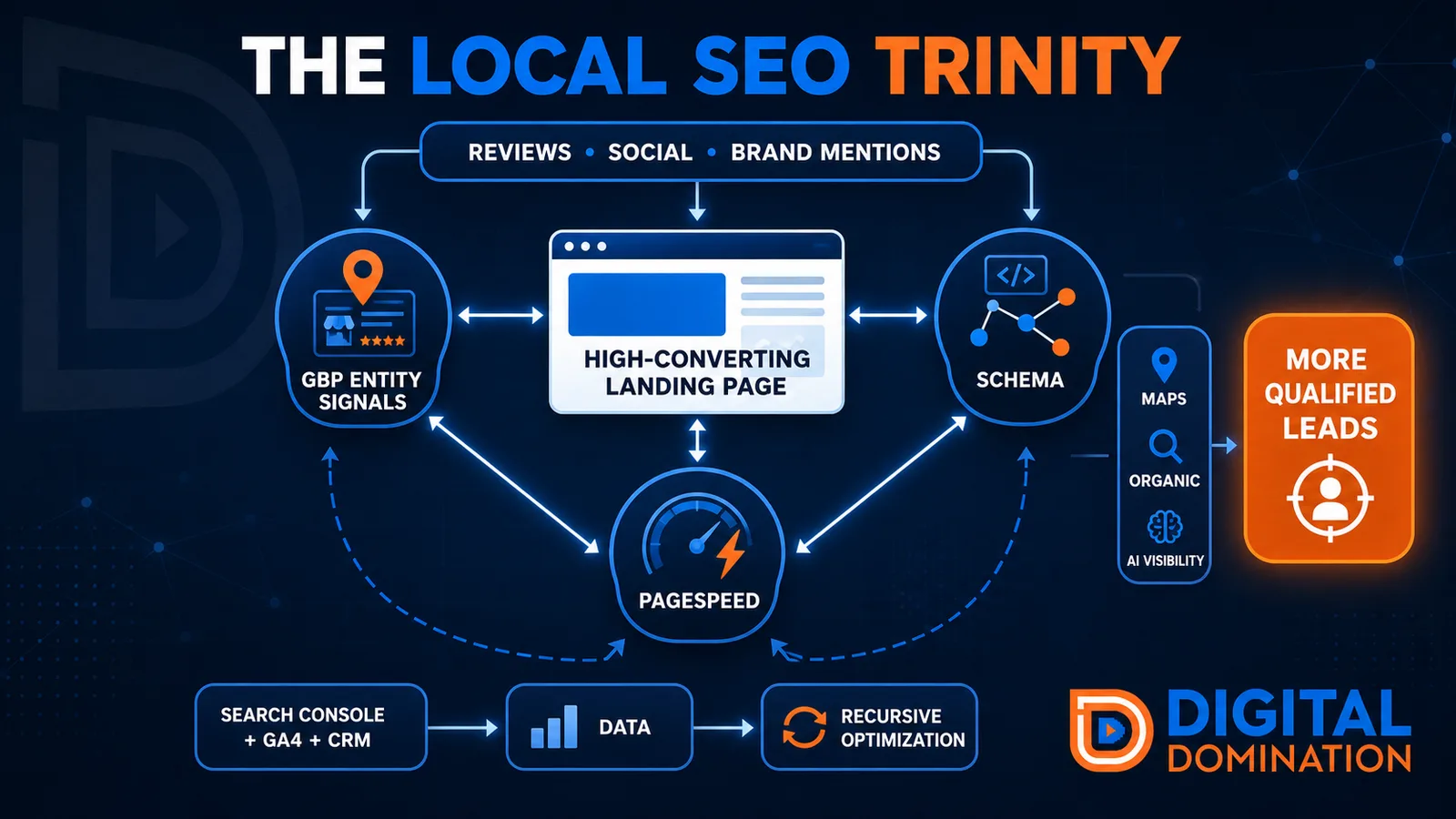
The Local SEO Trinity
Think of a three-legged stool. Your Google profile, your website, and your reviews all have to hold you up. If one leg is short, the whole thing wobbles.
GBP entity signals
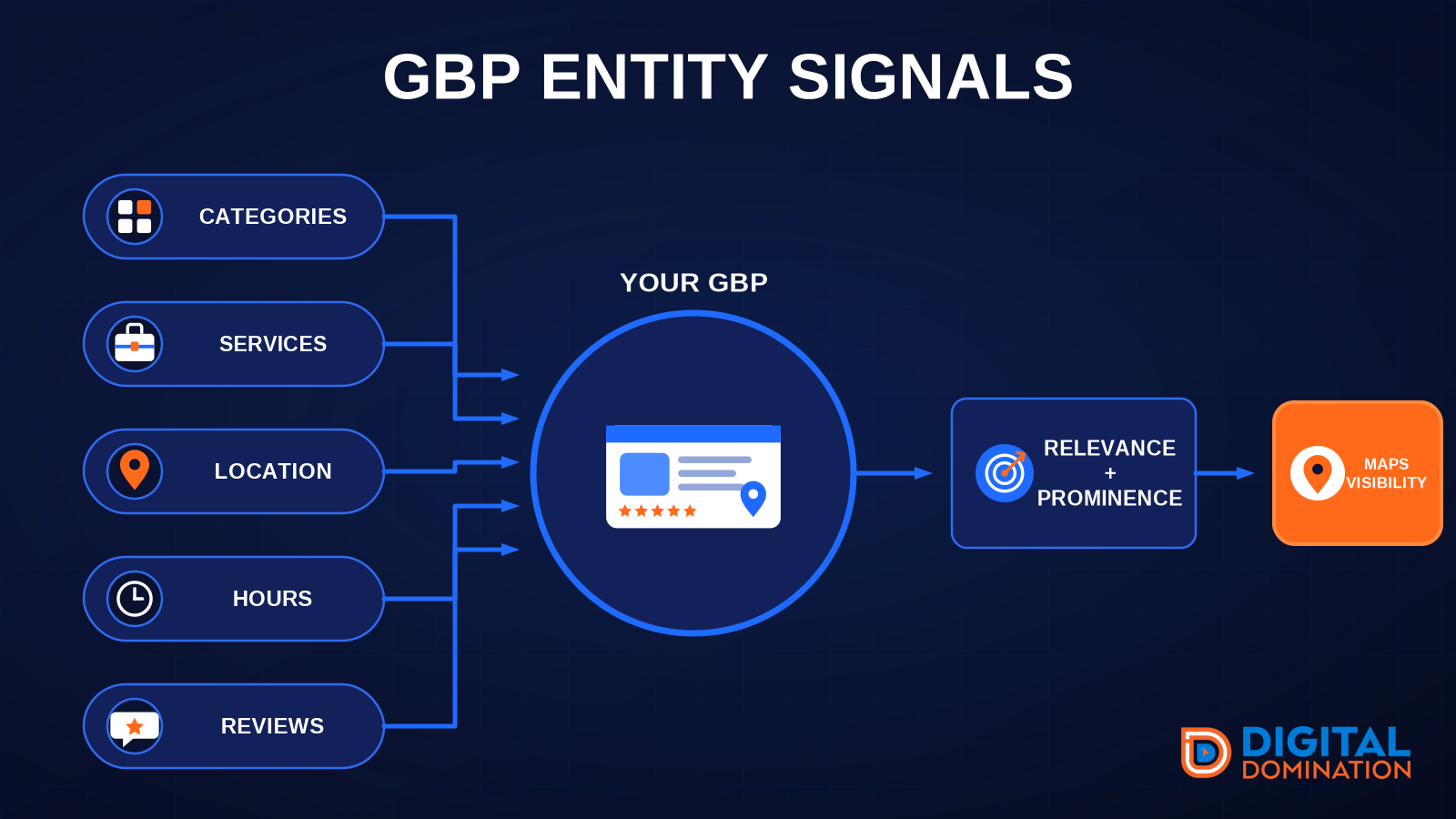
This leg is your Google Business Profile. GBP means Google Business Profile. It covers your categories, your services, your location, your hours, and your reviews. Google uses those facts to decide who to show.
Your Google profile is your storefront sign. If the sign is missing, or it names the wrong shop, people drive past.
PageSpeed to conversion
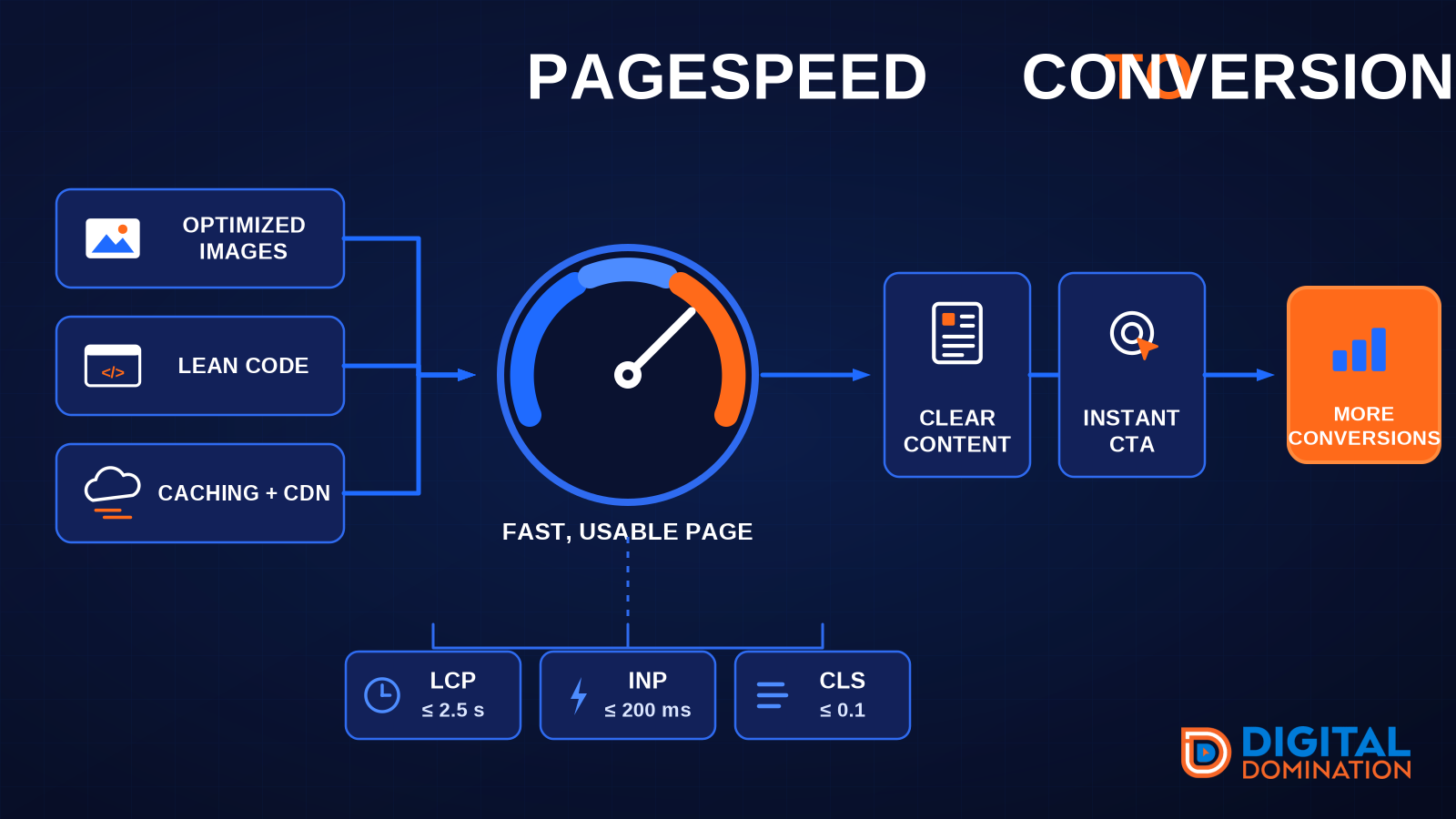
This leg is your website, above all on a phone. Small images, lean code, and caching make a page fast. A fast, clear page is what turns a visit into a call. Phone speed is one of the 12 Trinity checks because a slow page loses the call before anyone sees your offer.
Your website is the showroom. If the door sticks, people leave before they look around.
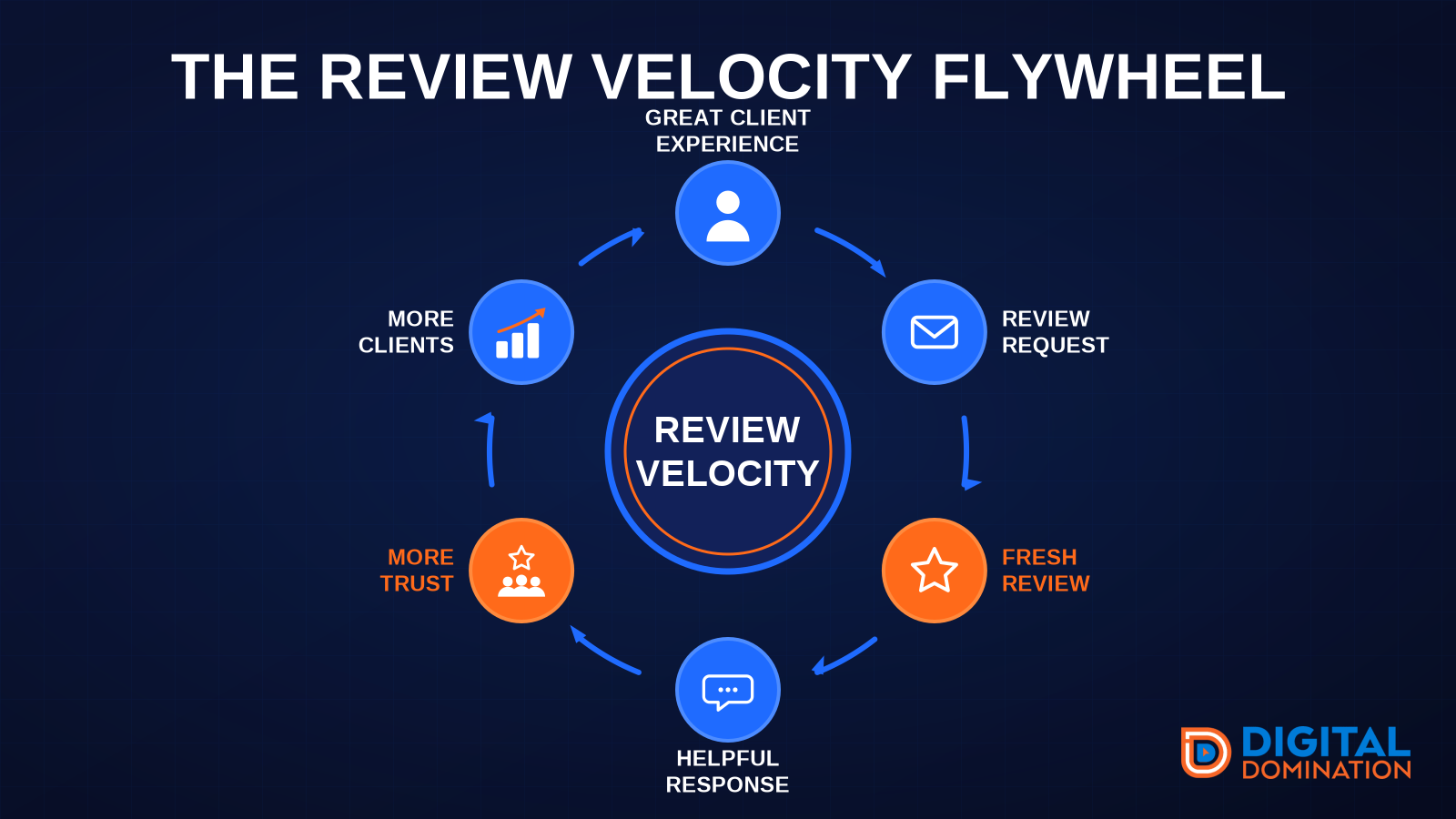
The review velocity flywheel
This leg is reviews and reputation. A good visit leads to a review request, then a fresh review, then a helpful reply, then more trust, then more customers. When the scan can find your Google listing, it shows your rating, your recent reviews, and how many you answered.
Reviews are word of mouth. One kind word helps. A steady stream of real reviews, and a reply from you, helps more.
How this turns into revenue
Being found in more searches leads to more calls. More calls lead to more booked jobs. More booked jobs lead to more revenue.
Example numbers, not a real business: 40 calls from search in a month, a 25 percent close rate, and a $400 average job. That is 10 booked jobs. That is $4,000. The math is the lesson. It is not a promise.
The full page has a box where you can type your own average job value and close rate.
One real story, from our car dealership case study: Medina Auto Group went from invisible on Google Maps to dominating every high-intent search across their market. The turnaround spanned all four of their rooftops at once. The same page says the team eliminated 89 unfair one-star reviews that had been dragging the dealership's reputation down and keeping it out of the Map Pack. It also says: “Results described here are exceptional and non-typical. Outcomes vary based on market conditions, competition, and implementation. No guarantees are made regarding earnings, rankings, or conversions.”
Free strategy call
More booked jobs start with a clear plan
Book a free strategy call. We look at your Google profile, your website, and your reviews, and we tell you what to fix first.
Free. You pick the time. A real person shows up.