
How Do I Get My Business to Show Up When Someone Asks ChatGPT for a Plumber Near Me?
ChatGPT recommends local businesses it can find, confirm and trust. Let it read your site, keep your listings accurate, build reviews, and publish a clear page for each service.
By Digital Domination Team
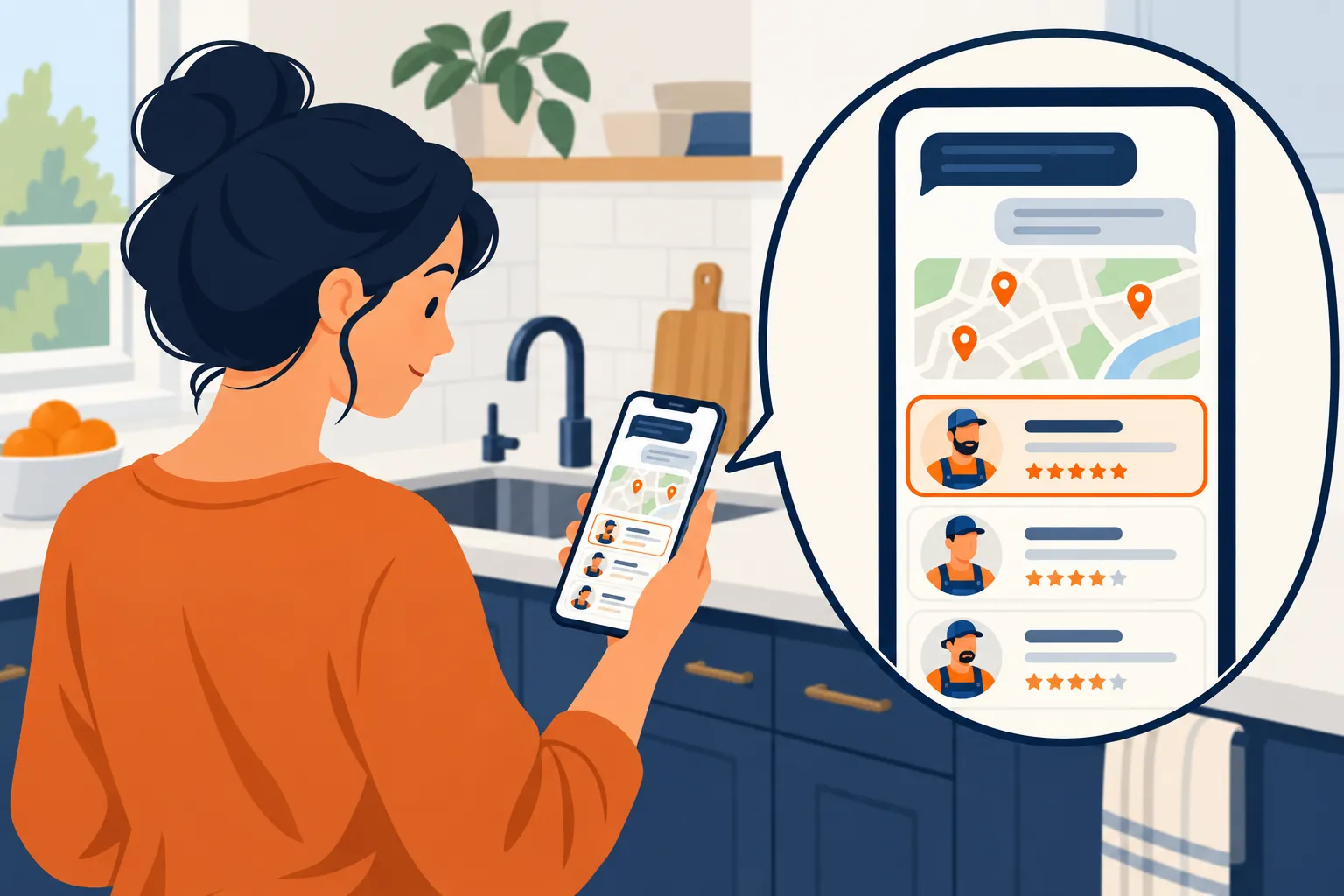
Make sure ChatGPT can read your website, keep your Google Business Profile and other listings accurate, build steady reviews, and publish clear pages for each service and area you cover. Then test the questions your customers actually ask and track whether you're named. There's no form to submit and no way to buy a spot in the answer. ChatGPT searches the web when someone asks for a local business, so you get recommended by being easy to find, easy to confirm and easy to trust. The same plan works whether you're a plumber, dentist, roofer or any other local service business.
Want to see where you stand before you start? Our free AI Overview and LLM SEO scan asks a real AI assistant who is best in your area, shows you who it named, and checks whether AI crawlers can read your site.
This is our hub guide for ChatGPT and local businesses. Each step below links to a deeper guide. If ChatGPT never mentions you at all, start with Why Isn't My Business Showing Up in ChatGPT Answers?, which walks through the six common causes in order. This page is the plan for what to build once you know.
How does ChatGPT decide which local businesses to recommend?
When someone asks for a local business, ChatGPT usually searches the web, works out the person's general area, and builds its answer from business listings, websites and reviews it can find and confirm. OpenAI's help page on searching the web with ChatGPT explains a few parts of this in plain terms:
- ▸It rewrites the question into searches. OpenAI's example: if someone asks for "good restaurants near me" from the San Francisco area, ChatGPT may search for "top restaurants San Francisco."
- ▸It uses approximate location. ChatGPT can estimate a general location from the person's IP address, and people can choose to share a more precise device location.
- ▸It uses outside search and listing providers. OpenAI says ChatGPT sometimes works with other search providers (it lists Microsoft among them) and may share general location with trusted providers of "nearby business listings."
- ▸Placement is not guaranteed. OpenAI says ChatGPT ranks results on multiple factors meant to surface relevant, reliable information.
Independent testing this month fills in more of the picture. Local questions usually trigger a map. In an October 9, 2026 study of 50 ChatGPT conversations, scaile found that all 12 of its city-specific recommendation prompts produced a map, and the ratings and review counts on the businesses it checked matched Google Maps. The highest-rated business usually was not listed first. It was a small test, mostly in German about Munich, so treat it as a snapshot.
Google's top three is only part of it. In an October 7, 2026 field test of 250 local recommendations, 31.0% of ChatGPT's picks were in Google's top three map results for the matching search.
Your website still matters. In BrightLocal's study of 200,000 local AI searches (September 2026), 93% of the unique domains used as sources were business websites, and they made up 42% of all citations.
Put together: ChatGPT leans on the same public facts customers see (your listings, your reviews and your website), and it rewards businesses whose facts are easy to find and agree with each other.
What's the step-by-step plan to get recommended by ChatGPT?
Work through these seven steps in order. The first two remove the blockers, the middle three build the evidence, and the last two make sure it's working.
Step 1: Make sure ChatGPT can read your website
OpenAI says that to make a site eligible for ChatGPT search, you need to allow its search crawler, OAI-SearchBot, and make sure your host or CDN isn't blocking OpenAI's traffic. A single line in robots.txt or a security setting can quietly take you out of the running. Our guide How Do I Know If My Website Is Blocking ChatGPT From Seeing My Business? shows the five-minute check.
Step 2: Fix your Google Business Profile, then claim Bing Places
Because the business details ChatGPT shows can match Google Maps closely, your Google Business Profile is the first listing to get right:
- ▸Exact business name, with no extra keywords
- ▸One correct primary category
- ▸Accurate hours, phone number and website
- ▸Each service listed on its own, plus your real service areas
Then claim or update your free Bing Places listing, since Microsoft is one of the search providers OpenAI names. If old or duplicate listings exist from a previous address or owner, clean them up. Two versions of your business give an assistant two conflicting stories. If ChatGPT already shows wrong details, follow ChatGPT Has the Wrong Information About My Business, How Do I Fix It?.
Step 3: Make your facts easy to read on your own site
Your address, phone, hours, services and service area should be written as text on your website, not only shown in images. Add LocalBusiness schema (or a more specific type like Plumber) that matches what's on the page. Our guide What Is Schema Markup, and Does My Local Business Website Actually Need It? explains what to include.
Step 4: Build steady, specific reviews
Ratings and review counts are among the facts that show up next to local recommendations. Ask every happy customer, reply to every review, and make it easy for customers to mention the job and the neighborhood. Our guide Does ChatGPT Look at My Google Reviews When It Recommends a Local Business? covers how many you need and how to handle unfair ones.
Step 5: Get confirmed by other sources
Assistants trust what they can confirm in more than one place. Keep your details identical on the directories that matter in your industry (for a plumber, think trade associations, local chambers and home service directories). See ChatGPT local SEO now depends on directory proof too.
Step 6: Publish pages that answer the questions customers ask
Customers don't just ask for "a plumber." They ask for "a plumber near me who can fix a tankless water heater today." Give each core service its own page that explains:
- ▸What the job involves and when to call
- ▸The areas you serve
- ▸What happens on the first visit
- ▸Why customers should trust you (licenses, years in business, warranties, when true)
Clear, specific pages give ChatGPT something worth quoting and give Google the same evidence for its AI Overviews.
Step 7: Test, track and repeat
Check what ChatGPT says every month with the same set of questions (next section), and watch whether visits and calls from ChatGPT are growing.
Can I pay or submit my business to ChatGPT?
No. There's no submission form or paid placement inside ChatGPT's answers. OpenAI started testing ads in ChatGPT in the United States on February 9, 2026, but its ads help page says ads appear below the response, are clearly labeled, and "do not influence ChatGPT's answers." Advertisers "have no ability to shape, rank, or alter" the response. So an ad is a separate channel. It won't get you recommended in the answer itself, which is earned through the steps above.
How do I test what ChatGPT says about my business?
Ask the same five to ten customer-style questions every month, in fresh chats, and write down who gets named and which sources are linked. One answer is a sample, not a ranking. BrightLocal found that ChatGPT's lists for the same question overlapped by only 23% on average from one try to the next, though a business that appeared once came back about half the time. A simple routine:
- Write your questions like a customer. "Who's the best plumber near me?" "Who can fix a water heater today in [your city]?" "Best emergency plumber in [neighborhood]?"
- Include your city in some and leave it out of others. ChatGPT may use the asker's location when no city is named.
- Use a fresh chat each time so earlier conversations don't color the answer.
- Record three things: whether you're named, who else is named, and which sources ChatGPT links.
- Repeat each question a few times and count how often you appear, not just whether you appeared once.
- Compare the sources with your own listings. If ChatGPT cites a directory you're missing from, that's your next fix.
If you'd rather skip the spreadsheet, the free AI Overview and LLM SEO scan samples real AI answers for your main search, reports how many named you (with the margin, not a made-up "position"), and lists the sources the answers pulled from. To understand why answers move around, read AI local recommendations are volatile.
How can I tell if ChatGPT is actually sending me customers?
Look for chatgpt.com in your website analytics, and ask new callers how they found you.
- ▸Website visits: in Google Analytics, check your traffic sources for chatgpt.com. These are people who clicked a link in a ChatGPT answer.
- ▸Calls and forms: many people read a recommendation and call without ever visiting your site. Add "ChatGPT or another AI assistant" as an option wherever you ask "How did you hear about us?"
- ▸Your Google Business Profile: watch calls and direction requests. An AI recommendation often sends people to your profile before your website.
- ▸Your monthly test: if you're named more often over time, and calls rise with it, the work is paying off.
For what to ask an outside provider to prove, see Gemini starts tagging outbound links.
Why does ChatGPT recommend my competitors instead of me?
Usually because it can confirm them from more sources than it can confirm you. That's a comparison you're losing, not an absence. The fix is more corroboration: consistent details, more independent mentions and pages that answer questions directly. Read Why Does ChatGPT Recommend My Competitors Instead of My Business? for the side-by-side checklist.
Is getting into ChatGPT the same work as Google Maps and AI Overviews?
Largely, yes. Accurate listings, real reviews, a readable website and clear service pages feed Google Maps, Google's AI Overviews and ChatGPT at the same time. The differences are in how each one is tested and measured. BrightLocal found Google Maps mentioned a tracked business in 66% of searches, compared with 32 to 38% for AI surfaces, so ranking in Maps doesn't guarantee an AI mention. For Google's side, see our hub guide How Do I Get My Local Business Into Google's AI Overviews?, and for the difference between the two, Google Maps visibility is not the same as local AI visibility.
Explore this guide
- ▸How Do I Know If My Website Is Blocking ChatGPT From Seeing My Business?
- ▸Does ChatGPT Look at My Google Reviews When It Recommends a Local Business?
- ▸Why Isn't My Business Showing Up in ChatGPT Answers?
- ▸Why Does ChatGPT Recommend My Competitors Instead of My Business?
- ▸ChatGPT Has the Wrong Information About My Business, How Do I Fix It?
- ▸ChatGPT local SEO now depends on directory proof too
- ▸AI local recommendations are volatile
- ▸What Is Schema Markup, and Does My Local Business Website Actually Need It?
- ▸Industry examples: How Trial Attorneys Are Being Found in AI Answers Now and AI search optimization for HVAC companies
Sources
- ▸OpenAI Help Center, Searching the web with ChatGPT
- ▸OpenAI Help Center, Ads in ChatGPT
- ▸OpenAI, Overview of OpenAI Crawlers
- ▸scaile, How ChatGPT surfaces local businesses, October 9, 2026
- ▸Ryan Doser, Does ChatGPT Recommend Local Businesses? 250 AI Picks Tested, October 7, 2026
- ▸BrightLocal, What 200k local AI searches tell us about what businesses get recommended, September 16, 2026
- ▸Microsoft, Bing Places for Business
Keep reading
Related guides
- ▸GBP Reinstatement Checklist
- ▸Google GBP support misuse policy raises SEO vendor risk
- ▸GBP Suspension Recovery
Put it into action
Frequently Asked Questions
How do I get my business recommended by ChatGPT?
Make sure ChatGPT's search crawler can read your site, keep your Google Business Profile and other listings accurate, build steady reviews, publish clear pages for each service and area, and test the questions customers ask every month. There's no shortcut or submission form.
Can I pay to have ChatGPT recommend my business?
No. OpenAI is testing ads in ChatGPT, but it says ads appear below the answer, are clearly labeled, and do not influence ChatGPT's answers. Being recommended in the answer itself has to be earned.
Does ChatGPT use Google Maps for local recommendations?
OpenAI doesn't name all of its listing providers. Independent testing in October 2026 found that the ratings and review counts ChatGPT showed for local businesses matched Google Maps in the cases checked, so an accurate Google Business Profile is a sensible first priority.
Do I need to be in Google's top 3 to show up in ChatGPT?
No. In an October 2026 field test, 31.0% of ChatGPT's local picks were in Google's top three map results for the same search. Ranking well in Maps helps, but it isn't required.
How do I check what ChatGPT says about my business?
Ask five to ten customer-style questions in fresh chats each month, repeat each one a few times, and record who is named and which sources are linked. The AI Overview and LLM SEO scan at https://digitaldomination.ai/ai-llm-seo-scan/ does this sampling for you.
How long does it take to start showing up in ChatGPT?
If the cause was technical, like a blocked crawler, things can change soon after the fix. OpenAI says its systems can take about 24 hours to adjust to a robots.txt change. Building reviews, corrected listings and new pages takes longer, often months.
Does Bing Places matter for ChatGPT?
It's worth claiming. OpenAI's help page lists Microsoft among the search providers ChatGPT works with, and a free, accurate Bing Places listing is one more place your details can be confirmed.
Ready to dominate your map?
Run a free GeoGrid scan, or book a call to walk through the map.