
No AI click data yet: What local owners should demand before paying for AI SEO
Google has not committed to clean AI Mode or AI Overviews click and query reporting in Search Console. Local businesses need a different proof standard before buying AI SEO.
What changed and who it hits
A November 2 Search Engine Roundtable report said Google still has no announced click or query data coming for AI Mode and AI Overviews inside Google Search Console. The report covered a LinkedIn discussion where Gary Illyes corrected a claim that this data was expected soon. Illyes said the team is interested in giving more data that makes sense, but that Google has nothing to announce.
That matters most to local service businesses being pitched AI SEO right now. If you own a roofing company, dental office, HVAC shop, law firm, med spa or home services company, you may hear that an agency can get you visible in AI answers. The hard question is not whether AI answers matter. The hard question is what proof you can actually audit before you pay.
The same Search Engine Roundtable article pointed to Rajeev Lekhwar’s LinkedIn post with Gary Illyes’ comment, and to John Mueller’s Bluesky response. Mueller pushed back on reading Illyes’ comment as a permanent no. That is still not a reporting product local owners can open today.
The short version for a local owner
Do not buy AI SEO based on a promise that Google Search Console will soon show clean AI Mode and AI Overviews clicks and queries. Google may add more reporting later, or it may not. Right now, the buying decision needs to be based on evidence an agency can collect and explain without pretending Google has already solved the measurement problem.
A practical proof plan should show whether your business is being mentioned, cited, compared and chosen in the places customers are asking questions. It should also connect that work back to calls, form fills, Google Business Profile activity and Map Pack movement.
Before you sign, ask the provider to show you the reporting format they will use and what each item means:
- ▸Where your business appears in AI answers for local buying questions
- ▸Whether the answer cites your site, profile or trusted third-party sources
- ▸How your Google Business Profile and Map Pack rankings are moving
- ▸Which calls, forms and booked jobs came from organic, local or tracked sources
- ▸What changed on your site, profile and listings during the reporting period
Why Search Console is not enough for AI proof right now
Search Console is still useful. It can help you see regular Google search queries, pages that earn impressions and pages that earn clicks. The problem is that the current news is about a missing layer: clean AI Mode and AI Overviews click and query reporting that a local owner could use to judge an AI SEO campaign.
That gap creates room for sloppy sales claims. An agency can say, “AI is the future,” then show you a normal Search Console chart and imply it proves AI visibility. It may prove your site received search impressions or clicks. It does not automatically prove you were included in an AI Overview, cited in an answer or shown inside AI Mode for local buying questions.
The safe rule is simple: Search Console can be part of the report, but it should not be the only report for AI SEO. Ask these questions when someone shows you Search Console data:
- ▸Does this chart separate AI Mode from traditional Google Search
- ▸Does this chart separate AI Overviews from normal results
- ▸Can you show the exact queries where our business appeared in an AI answer
- ▸Can you show screenshots or dated captures of the AI answer
- ▸Can you connect this visibility to phone calls, forms or booked consultations
Five proof points to demand before you pay
If Google is not giving clean AI click and query data yet, the proof standard has to move closer to the customer journey. A good local AI SEO report should not hide behind vague visibility language. It should show where you appeared, why that appearance matters and whether it is moving business outcomes.
Use this checklist before approving a proposal:
- ▸AI answer tracking for real local questions your customers ask, such as “best emergency plumber near me,” “who offers same-day AC repair” or “top family dentist in my area”
- ▸Citation evidence that shows whether the AI answer references your website, Google Business Profile, directory listings, review profiles or local content
- ▸Answer inclusion notes that show if your business is named, compared, summarized or omitted when nearby competitors appear
- ▸Local ranking movement, especially Google Map Pack visibility across the service area, not only at your office address
- ▸Lead tracking that ties calls, forms, chats and booked appointments back to organic search, local search and campaign changes
Track AI citations, not just AI mentions
A mention is when an AI answer names your business. A citation is when the answer points to a source that supports the statement, such as your website, a business profile or a trusted listing. For local owners, citations are often more useful than a screenshot that simply shows your name in one answer.
Why? Because AI answers can change. The same question may produce a different response based on wording, location, timing and user context. A citation trail helps you see whether your online footprint is strong enough to be used as supporting evidence.
Ask your provider to separate these items in the report:
- ▸Business name mentioned in the AI answer
- ▸Website cited as a source
- ▸Google Business Profile or local listing used as supporting information
- ▸Third-party profile cited, such as a directory or review platform
- ▸Competitors cited when your business is not included
Measure Map Pack movement because local intent still matters
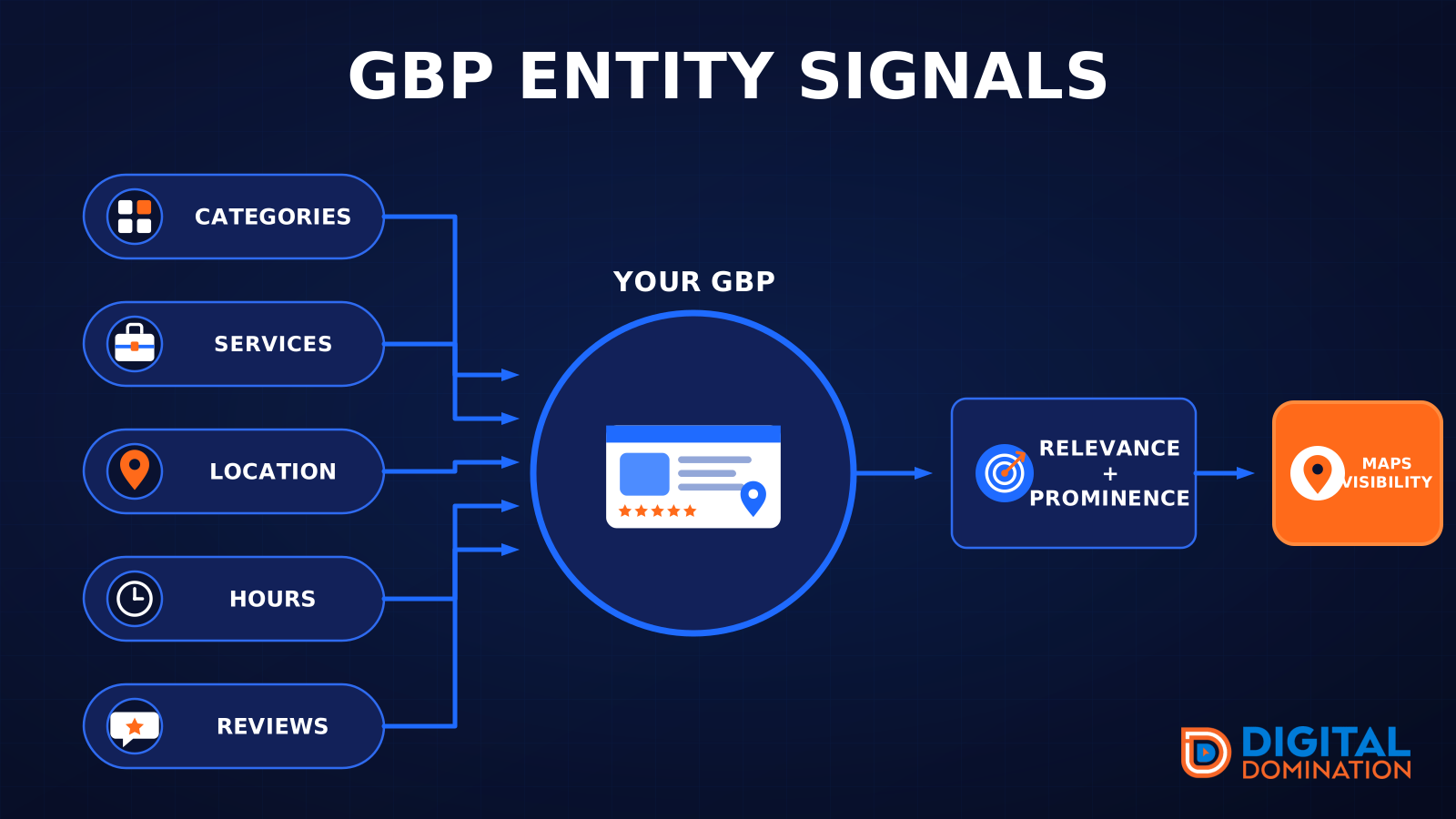
For local businesses, AI visibility should not be treated as separate from local SEO. When someone asks an AI system for a nearby provider, the answer still depends on local signals, business information, reputation and proximity. Google has said its local ranking factors are relevance, distance and prominence. Those basics still matter when a customer is choosing who to call.
That means your Google Business Profile is not old news. It is one of the most important business records on the web. If your name, categories, services, hours, photos and reviews are weak or inconsistent, an AI answer has less reliable information to work with.
Your reporting should show local movement in plain English, including these items:
- ▸Map Pack rankings for core services across the area you actually serve
- ▸Google Business Profile actions, such as calls, direction requests and website visits where available
- ▸Category, service and description updates made during the month
- ▸New reviews, review responses and recurring themes customers mention
- ▸Competitors that consistently show above you in the same neighborhoods
Use call tracking without breaking trust
A local business does not need perfect AI click data to know whether marketing is producing opportunities. You need clean lead tracking. That means calls, forms, chats, booked estimates and consultations should be tracked consistently enough that you can see what is working.
Call tracking should be set up carefully. The goal is to understand lead sources without creating confusing business information across the web. If an agency wants to change your public phone number everywhere without explaining the local SEO risk, slow down and ask questions.
At minimum, ask for a lead report that separates these categories:
- ▸Calls from your website
- ▸Calls from your Google Business Profile
- ▸Form submissions from organic landing pages
- ▸Chat leads from service pages
- ▸Booked jobs or appointments that sales staff marked as qualified
What to do about it this week
You do not need to wait for Google to add a new Search Console report before improving your AI and local visibility. Start with assets you control and sources that AI systems can understand. The goal this week is to make your business easier to verify, easier to compare and easier to choose.
Pick one service you care about most, then check whether your online presence clearly supports that service. A vague homepage is not enough. A searcher asking for a specific local service needs evidence that you offer it, serve their area and have real experience solving that problem.
Here are practical actions you can take this week:
- ▸Search your top service plus your city and save screenshots of AI Overviews, Map Pack results and organic results
- ▸Ask your agency or internal marketer for a sample AI visibility report before buying anything new
- ▸Update your Google Business Profile services so they match the exact work customers ask about
- ▸Review your top service page and add clear service details, service areas, common questions and proof of real local experience
- ▸Check your major listings for consistent name, address, phone, hours and website information
- ▸Start tagging calls and form fills by source so future reporting is not based on guesses
Red flags in AI SEO sales pitches
The lack of announced AI click and query data makes the sales conversation more important. Some providers will be careful and transparent. Others may use AI uncertainty to sell a package that cannot be checked. Your job is not to become a technical expert. Your job is to ask for proof you can understand.
Be cautious when an agency treats AI SEO as a mystery box. Local marketing should have visible work, clear reports and a connection to leads. If you cannot see what changed or how success is judged, you are being asked to trust a label instead of a process.
Watch for these warning signs:
- ▸They promise AI clicks from Google Search Console without explaining the current reporting gap
- ▸They only show broad impressions and claim that proves AI visibility
- ▸They refuse to share example report formats before you sign
- ▸They talk about AI visibility but ignore your Google Business Profile
- ▸They cannot explain how citations, local rankings, calls and leads will be measured
- ▸They guarantee inclusion in every AI answer for your service
What a fair monthly report should include
A fair AI SEO report for a local business should be understandable in a short owner meeting. It should not be a dump of charts with no decisions attached. Every section should answer one of three questions: what changed, what proof do we have and what happens next.
Because Google has not announced clean AI Mode and AI Overviews click and query reporting in Search Console, your report should use multiple signals. None of them is perfect alone. Together, they give you a more honest view of whether the campaign is improving your chances of being found and chosen.
A useful monthly report should include these sections:
- ▸Target questions tested in AI answers, with dates and locations noted
- ▸Screenshots or exports showing answer inclusion, citations and competitor appearances
- ▸Map Pack ranking movement across the service area
- ▸Google Business Profile changes and performance notes
- ▸Website pages created or improved, with the reason for each change
- ▸Lead totals by tracked source, with notes on lead quality when your team can provide it
- ▸Next actions for the coming month, written in plain language
How to make a buying decision now
The November 2 Search Engine Roundtable report, Rajeev Lekhwar’s LinkedIn post and John Mueller’s Bluesky response all point to the same practical takeaway for owners: do not make a buying decision based on AI click data that Google has not committed to providing. Treat AI SEO like any other local marketing investment. Demand a measurement plan before you approve the work.
A strong provider will be comfortable saying what cannot be measured cleanly yet. That honesty is a good sign. It means they are more likely to build a report around real evidence: citations, answer inclusion, Google Business Profile work, Map Pack movement, call tracking and leads.
At Digital Domination, we work with local service businesses from our Las Vegas base, and we look at AI SEO as part of the same local trust system that affects search, maps and customer choice. Our AI SEO page at digitaldomination.ai/ai-seo/ explains how we approach answer inclusion, citations, local prominence, GBP signals and reporting without pretending Search Console has an AI click report. If you want a baseline first, start with the free GeoGrid scan at digitaldomination.ai/scan/.
Keep reading
Related guides
- ▸Digital Domination vs Thrive Internet Marketing Agency
- ▸Digital Marketing Company for Local Service Businesses
- ▸Divorce lawyer local SEO
Put it into action
Frequently Asked Questions
Does Google Search Console show AI Mode clicks and queries?
Based on the November 2 Search Engine Roundtable report, Google has no announced Search Console click or query reporting for AI Mode and AI Overviews. Gary Illyes said Google is interested in giving more data that makes sense, but had nothing to announce.
Can an agency prove AI SEO results without AI click data?
Yes, but the proof has to come from multiple signals instead of one clean Google report. Ask for AI answer tracking, citation evidence, Map Pack movement, Google Business Profile reporting, call tracking and lead reporting.
Should I wait to invest in AI SEO until Google adds reporting?
Not necessarily. You can improve the sources AI systems may use, including your website, Google Business Profile, service pages, reviews and trusted listings. Just do not buy a package that depends on a Search Console AI click report that is not available yet.
What is the best AI SEO metric for a local business?
There is no single best metric right now. A practical local business should look at answer inclusion, citations, local rankings, calls, forms and booked opportunities together.
What should I ask an AI SEO agency before signing?
Ask to see a sample report, the exact questions they will track, how they document AI answer inclusion and how they connect work to leads. Also ask how they will report Google Business Profile and Map Pack movement.
Are AI Overviews the same as local Map Pack rankings?
No. AI Overviews and Map Pack results are different experiences, but local businesses should measure both because customers use both when deciding who to call. Your Google Business Profile still matters because local ranking is tied to relevance, distance and prominence.
Can Search Console still help my local SEO reporting?
Yes. Search Console can still show regular search queries, pages, impressions and clicks. It should be part of your reporting, but not treated as proof of AI Mode or AI Overviews performance unless Google adds that specific reporting.
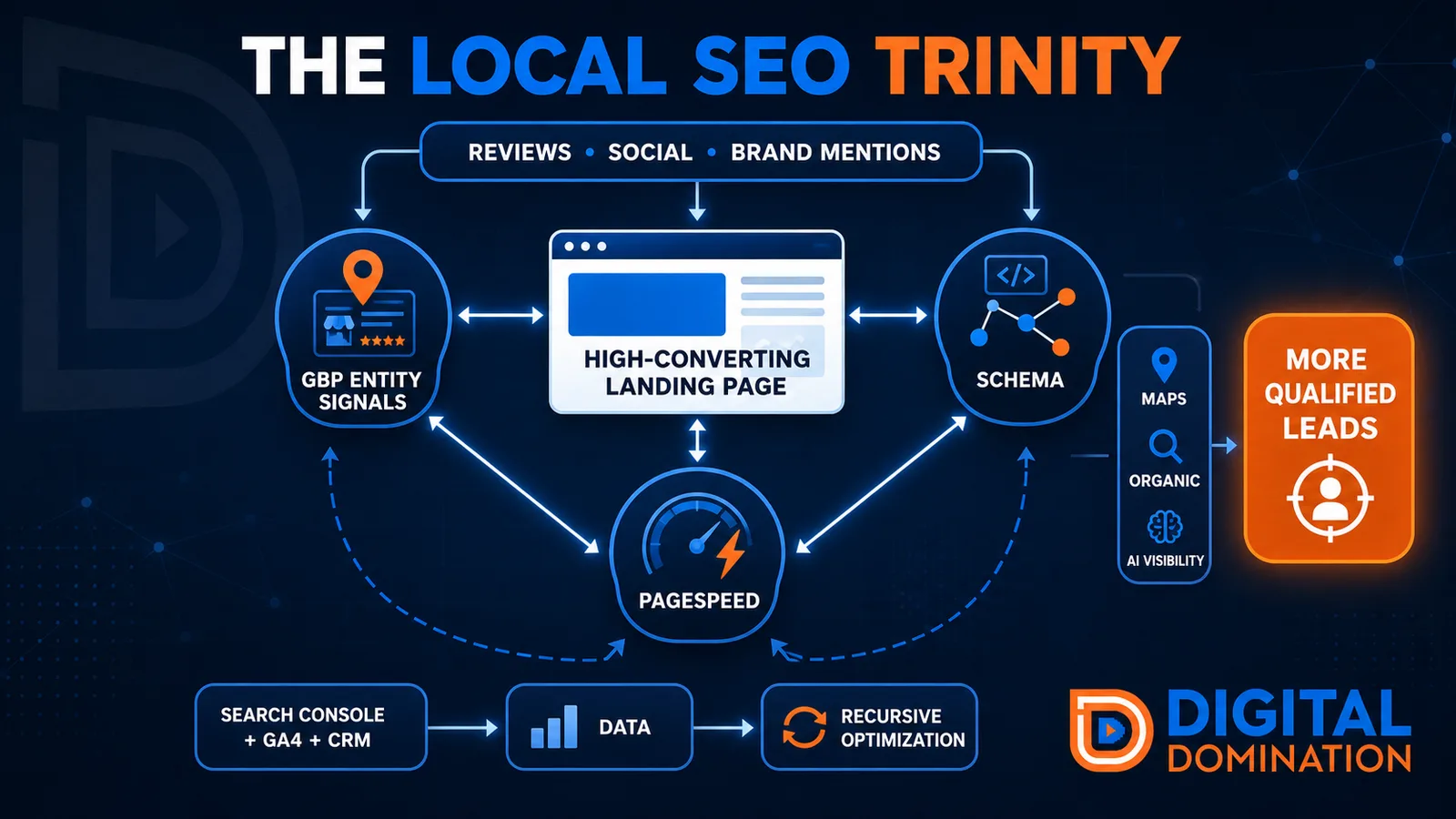
The Local SEO Trinity
Think of a three-legged stool. Your Google profile, your website, and your reviews all have to hold you up. If one leg is short, the whole thing wobbles.
GBP entity signals
This leg is your Google Business Profile. GBP means Google Business Profile. It covers your categories, your services, your location, your hours, and your reviews. Google uses those facts to decide who to show.
Your Google profile is your storefront sign. If the sign is missing, or it names the wrong shop, people drive past.
PageSpeed to conversion
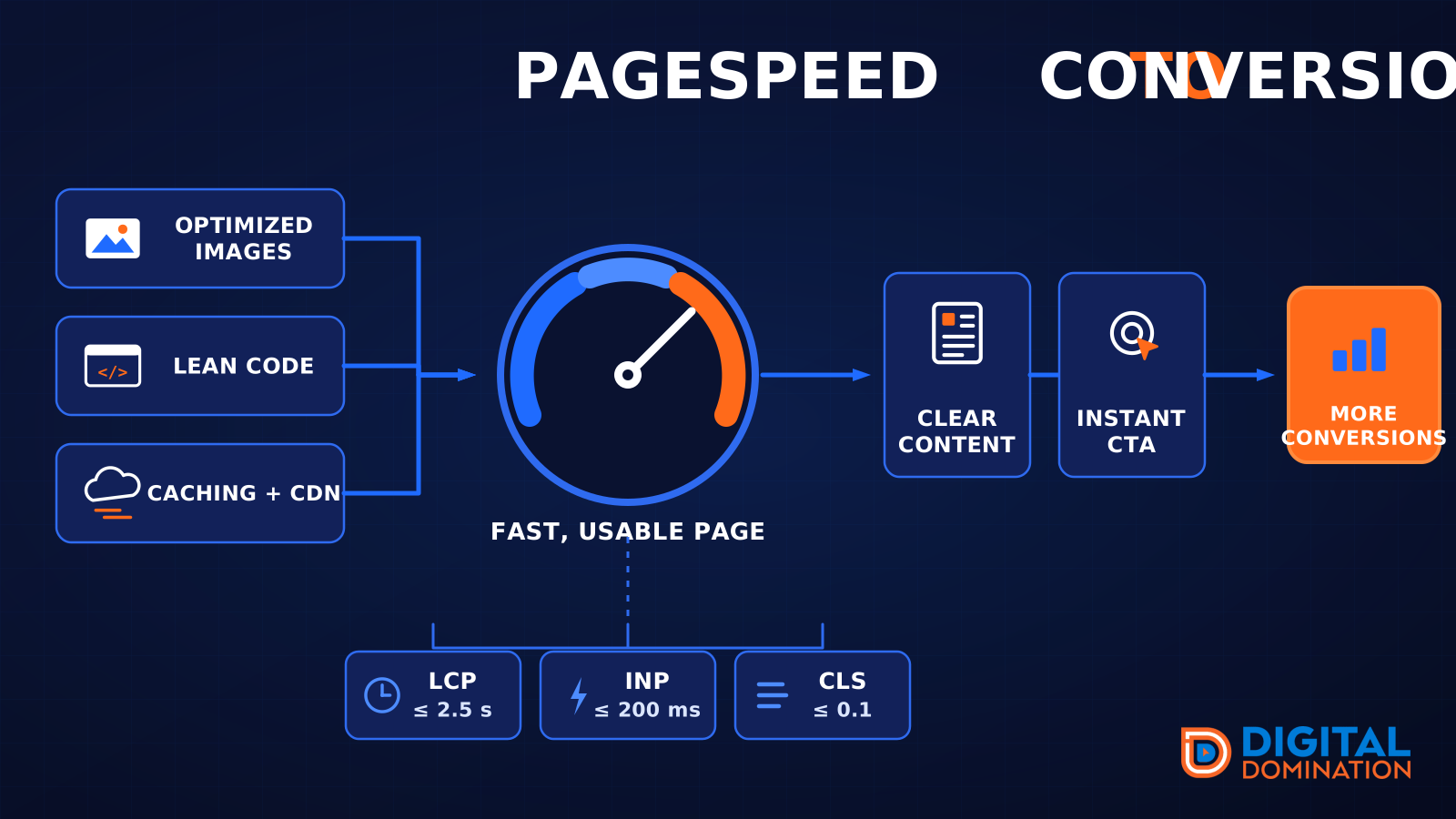
This leg is your website, above all on a phone. Small images, lean code, and caching make a page fast. A fast, clear page is what turns a visit into a call. Phone speed is one of the 12 Trinity checks because a slow page loses the call before anyone sees your offer.
Your website is the showroom. If the door sticks, people leave before they look around.
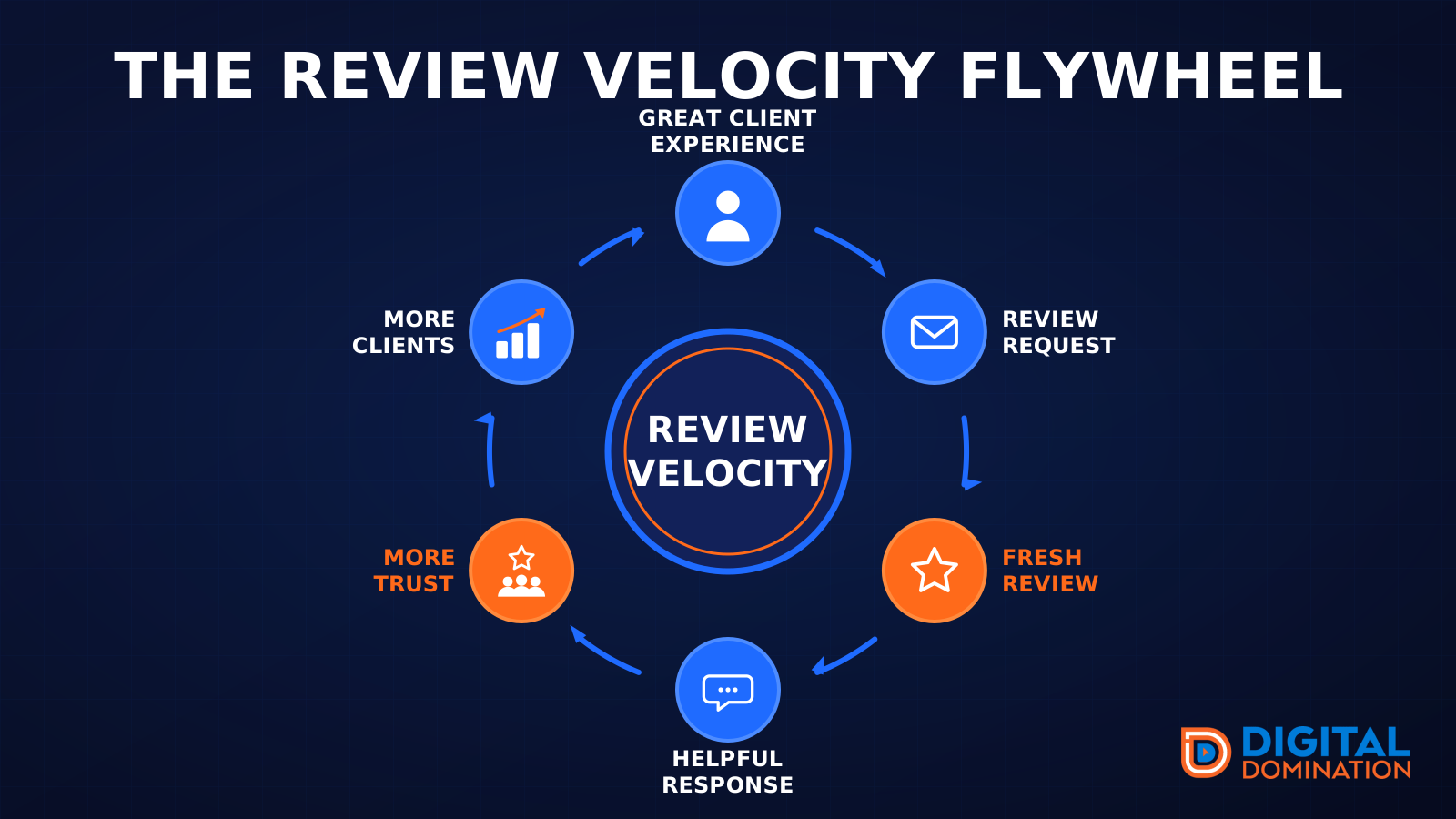
The review velocity flywheel
This leg is reviews and reputation. A good visit leads to a review request, then a fresh review, then a helpful reply, then more trust, then more customers. When the scan can find your Google listing, it shows your rating, your recent reviews, and how many you answered.
Reviews are word of mouth. One kind word helps. A steady stream of real reviews, and a reply from you, helps more.
How this turns into revenue
Being found in more searches leads to more calls. More calls lead to more booked jobs. More booked jobs lead to more revenue.
Example numbers, not a real business: 40 calls from search in a month, a 25 percent close rate, and a $400 average job. That is 10 booked jobs. That is $4,000. The math is the lesson. It is not a promise.
The full page has a box where you can type your own average job value and close rate.
One real story, from our car dealership case study: Medina Auto Group went from invisible on Google Maps to dominating every high-intent search across their market. The turnaround spanned all four of their rooftops at once. The same page says the team eliminated 89 unfair one-star reviews that had been dragging the dealership's reputation down and keeping it out of the Map Pack. It also says: “Results described here are exceptional and non-typical. Outcomes vary based on market conditions, competition, and implementation. No guarantees are made regarding earnings, rankings, or conversions.”
Free strategy call
More booked jobs start with a clear plan
Book a free strategy call. We look at your Google profile, your website, and your reviews, and we tell you what to fix first.
Free. You pick the time. A real person shows up.