
Google AI Mode now sends U.S. home-service searches to booking and quote links
For plumbers, HVAC contractors, cleaners, landscapers and other home-service companies, AI search is becoming a place where customers can request help, not just read answers.
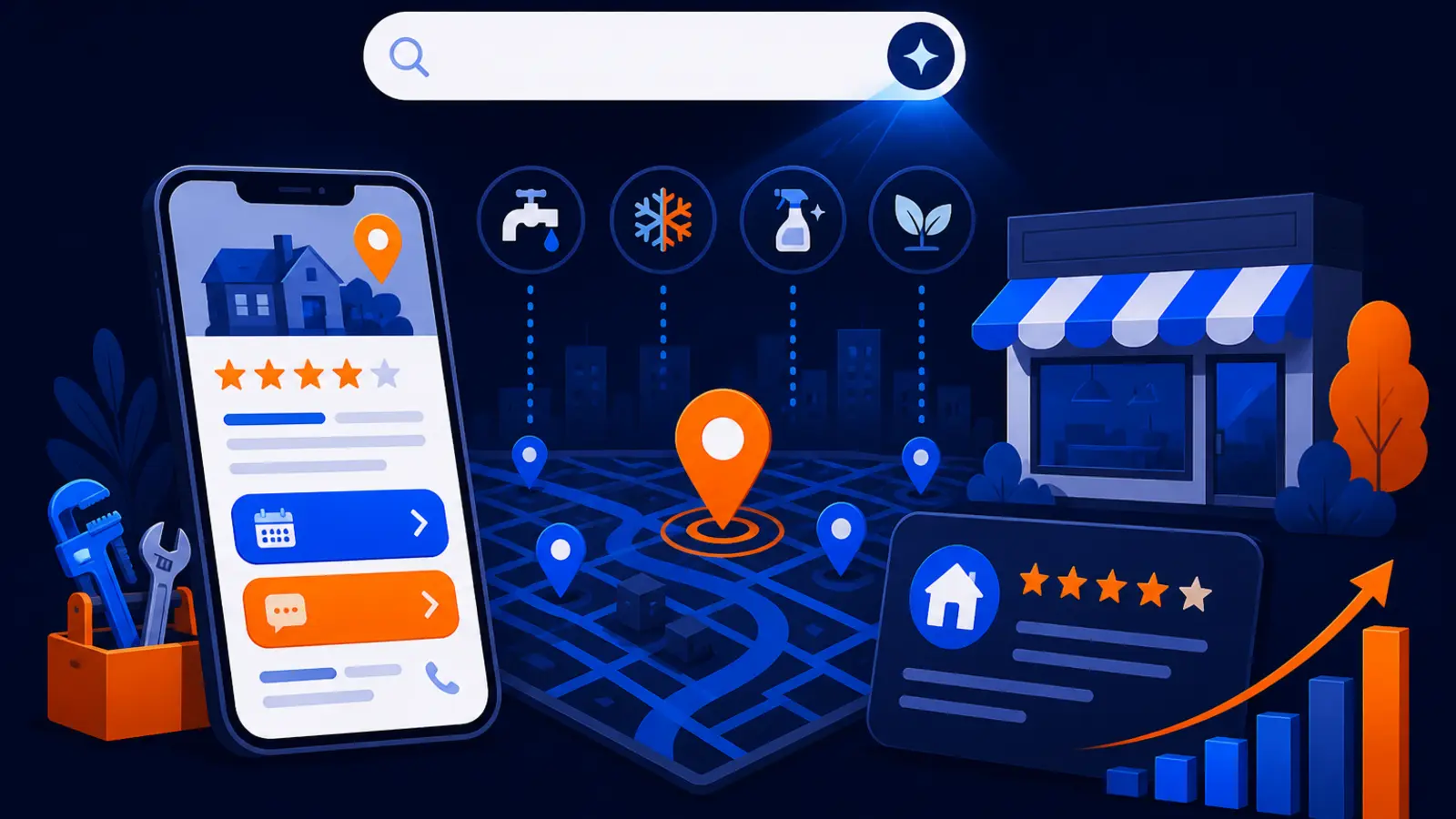
What changed on November 4
On November 4, Google AI Mode began showing direct booking and quote paths for U.S. home-service searches. Search Engine Land reported that the feature connects certain searches to partners including Angi, Thumbtack, Housecall Pro and Jobber, with ServiceTitan expected later. Search Engine Journal also covered the rollout, describing it as Google adding home-service booking and quote links inside AI Mode.
This matters most for local service businesses that depend on fast-intent searches: plumbers, HVAC companies, electricians, cleaners, landscapers, pest control companies, roofers and similar trades. A homeowner asking AI Mode for help with a clogged drain, a broken AC unit or house cleaning may now be moved closer to a quote request or booking path without making the traditional trip through a list of blue links.
The practical point is simple: Google AI Mode is not only an information surface anymore. For some home-service searches, it is becoming a lead surface. If your profile, reviews, booking tools and service details are not connected cleanly, a competitor that is easier to recommend and easier to book may get the opportunity first.
What AI Mode appears to be doing now
The public reports describe Google AI Mode presenting a path from a home-service question to a partner-powered quote or booking experience. That does not mean every search, category or market will show the same thing today. It does mean Google is testing and expanding a more direct bridge between AI answers and local service providers.
Jobber's own Help Center says eligible U.S. businesses can receive AI Mode requests through Jobber when their Google Business Profile and business details are properly connected. Jobber also says reviews and booking-form setup can influence how often a business is recommended. That is a very practical clue for owners: this is not just about buying software. It is about whether your business data, reputation and intake process are ready to be trusted by the system.
Here are the moving parts owners should understand at a basic level:
- ▸AI Mode can answer a home-service question and offer a booking or quote path.
- ▸Partners named in reports include Angi, Thumbtack, Housecall Pro and Jobber.
- ▸ServiceTitan is expected later, according to the November 4 coverage.
- ▸Jobber says eligibility depends on connected business details and profile setup.
- ▸Reviews and booking-form setup may affect how often a business is recommended.
Why this matters for local service owners
For years, local SEO has focused on showing up in the Google Map Pack, organic results and paid ads. Those still matter. Google's local ranking factors are relevance, distance and prominence, and those fundamentals have not disappeared because AI Mode added booking paths.
What has changed is the distance between the search and the lead. If a homeowner can move from an AI answer to a quote request in the same experience, the winner may not be the company with the prettiest website. It may be the company that has the clearest service category, strongest trust signals and least friction in the booking flow.
That makes this a buying decision, not just a marketing headline. Before you pay for a new field-service platform or sign up for another marketplace, you need to know what problem you are solving. Are you trying to be visible in AI Mode, receive requests cleanly, respond faster, track lead quality or reduce missed calls? Those are related, but they are not the same problem.
Five things to check on your profile this week
You do not need to wait for a platform sales call to clean up the basics. If AI Mode is using partner data, Google Business Profile details, reviews and booking forms as part of the recommendation and request process, then your first job is to make your business easy to understand and easy to contact.
Check these items this week:
- ▸Your Google Business Profile primary category matches your main money service, not a vague category.
- ▸Your service areas, hours, phone number and website are current and consistent with your booking platform.
- ▸Your services list uses plain customer language, such as drain cleaning, AC repair, lawn mowing or move-out cleaning.
- ▸Your review profile shows recent, specific customer feedback about the jobs you want more of.
- ▸Your booking or quote form asks for enough detail to qualify the request, but not so much that a homeowner gives up.
Do not confuse software eligibility with AI SEO
A platform connection can help you receive requests, but it does not automatically make your business the best answer. AI SEO for a local service business is the work of making your business understandable, trustworthy and easy to choose across Google, your website, your reviews and the tools customers use to contact you.
Think of it this way: your field-service software is the pipe, not the water pressure. It may carry the request, but your local authority, service relevance, review strength and booking clarity help determine whether the request comes your way in the first place. Jobber's Help Center language about connected profiles, business details, reviews and booking forms points in that direction.
Separate these two decisions before you spend money:
- ▸Visibility decision: Can Google understand where you work, what you do and why customers trust you?
- ▸Conversion decision: Can a homeowner request a quote or appointment without friction?
- ▸Operations decision: Can your team respond, schedule, dispatch and follow up quickly?
- ▸Attribution decision: Can you tell which leads came from AI Mode, marketplace listings, organic search or ads?
What to ask before paying for or switching platforms
The November 4 news will cause some owners to ask whether they should move to Jobber, Housecall Pro, Angi, Thumbtack or ServiceTitan. The answer is not the same for every business. A one-owner cleaning company, a two-truck plumbing company and a larger HVAC company may need very different workflows.
Before switching anything, ask vendors specific questions and ask them to show you the answers inside the product. Do not settle for a broad claim that they are connected to Google or AI search. You need to know what is supported for your category, your location and your existing Google Business Profile.
Use these questions on your next demo or renewal call:
- ▸Is my exact service category eligible for AI Mode requests today?
- ▸How does the platform connect to my Google Business Profile?
- ▸Which business details are passed to Google or used in the request flow?
- ▸Can I control the services, service areas, hours and booking questions shown to customers?
- ▸How are reviews displayed, requested or connected to the recommendation process?
- ▸Can I see whether a request came from AI Mode, a marketplace listing or another source?
- ▸What happens if my calendar is full, my office is closed or a request is outside my service area?
How marketplaces and field-service software differ
Angi and Thumbtack are commonly thought of as marketplaces, while Housecall Pro, Jobber and ServiceTitan are commonly thought of as field-service software platforms. The lines can blur because platforms can add lead channels and marketplaces can add booking tools. For an owner, the key question is what you are really buying: exposure, workflow or both.
A marketplace may help put you in front of homeowners who are actively comparing providers. A field-service platform may help you schedule, dispatch, invoice and manage customer communication. AI Mode booking paths could make both types of companies more important, but they do not replace the need for a strong Google Business Profile and a clean website.
Compare options by the business function you need most:
- ▸If you need more demand, ask about lead quality, competition and cost controls.
- ▸If you need fewer missed calls, ask about booking forms, reminders and after-hours intake.
- ▸If you need cleaner operations, ask about dispatching, estimates, invoices and customer history.
- ▸If you need AI-search readiness, ask how your profile, services, reviews and booking data are connected.
What to do about it now
The right move is not panic-buying software. The right move is getting your local search foundation and booking process in order, then deciding whether a platform change fills a real gap. Owners who already have a strong Google Business Profile, clear services, steady reviews and a simple quote path are in a better position to benefit from this rollout than owners who only buy a tool and leave their public information messy.
Start with changes your team can make this week. You should be able to complete most of these without a developer, and the work will help your Map Pack visibility even if AI Mode request volume varies by category and city.
Take these actions first:
- ▸Audit your Google Business Profile categories, services, hours, service area and appointment link.
- ▸Search your main services in your city and note whether AI Mode, Map Pack results, ads or marketplaces appear.
- ▸Shorten your quote form and remove fields that are not needed for the first conversation.
- ▸Add service pages on your website for the jobs you most want, written in customer language.
- ▸Ask recent happy customers for specific reviews that mention the service performed and city or neighborhood.
- ▸Make sure someone responds quickly to form requests, text requests and missed calls.
- ▸Track every new lead source in your CRM or even a simple spreadsheet until your platform reporting is clear.
Website readiness still matters
Even when a request starts in AI Mode, homeowners may still check your website before choosing you. Google and partner systems also need clean information about your services, service areas and trust signals. A thin site with vague service pages makes your business harder to understand.
Your website does not need to be fancy. It needs to be fast, clear and specific. For page experience, the Core Web Vitals good thresholds are LCP 2.5 seconds, INP 200 milliseconds and CLS 0.1 at the 75th percentile of field data. You do not need to memorize those terms, but you should ask your web person whether your site meets them on mobile.
Look for these practical website issues:
- ▸Your main service pages clearly say what you do and where you do it.
- ▸Your phone number and quote button are easy to find on mobile.
- ▸Your pages answer common customer questions before the form.
- ▸Your website matches your Google Business Profile name, address, phone and service area.
- ▸Your booking or estimate page works on a phone without pinching, zooming or confusion.
How to think about investment
Yes, home-service businesses should invest in AI SEO and booking-readiness now, but that does not mean every owner should switch platforms this month. The smart investment is the work that makes you easier to recommend, easier to verify and easier to book. That includes your Google Business Profile, reviews, service pages, citations, booking flow and lead tracking.
If your current platform already handles scheduling well, first ask whether it can connect to the new request paths or whether your category is supported through a partner. If it cannot, weigh the value of a switch against training time, data migration, staff adoption and the risk of disrupting a system that already works. If your current setup is already causing missed calls, lost estimate requests or messy follow-up, the AI Mode rollout may be the push to fix it.
A practical budget conversation should start with priorities:
- ▸Fix incorrect or incomplete Google Business Profile information first.
- ▸Improve reviews and response habits before buying more lead flow.
- ▸Clean up service pages before chasing advanced AI visibility tactics.
- ▸Test booking forms before sending more traffic to them.
- ▸Choose platforms based on eligibility, workflow, reporting and customer experience, not hype.
The decision for your business
Search Engine Land, Search Engine Journal and the Jobber Help Center all point to the same practical shift: AI search is moving closer to transactions for U.S. home services. For owners, the decision is not whether AI Mode is interesting. The decision is whether your business is ready when a customer asks Google for help and is offered a quote or booking path.
At Digital Domination, we look at this from the local SEO side for service businesses across the country. Our AI SEO page at digitaldomination.ai/ai-seo/ explains how we help businesses get clearer to AI search systems with stronger local signals, better service content, cleaner entity information and booking-focused visibility work.
If you want to know where you already show up across your market before you spend money on software or AI SEO, start with the free GeoGrid scan. Digital Domination's GeoGrid scan checks 169 points across a market so you can see where you are strong, weak or invisible in local results. Get the free GeoGrid scan at digitaldomination.ai/scan/.
Keep reading
Related guides
- ▸How Trial Attorneys Are Being Found in AI Answers Now
- ▸Hub-and-Spoke Silo Structure for Local SEO
- ▸HVAC local SEO
Put it into action
Frequently Asked Questions
What is Google AI Mode for home-service searches?
Google AI Mode is Google's AI-powered search experience. As reported by Search Engine Land and Search Engine Journal on November 4, it can now show booking and quote paths for some U.S. home-service searches through partners such as Angi, Thumbtack, Housecall Pro and Jobber.
Can my plumbing or HVAC company get leads from Google AI Mode?
Possibly, depending on your category, location, profile setup and platform connection. Jobber's Help Center says eligible U.S. businesses can receive AI Mode requests through Jobber when their Google Business Profile and business details are properly connected.
Do I need Jobber to appear in Google AI Mode booking results?
Not necessarily. Jobber is one named partner, but reports also named Angi, Thumbtack and Housecall Pro, with ServiceTitan expected later. The better question is whether your current tools can support the request path and whether your Google Business Profile, reviews and booking flow are ready.
Should I switch from Housecall Pro to Jobber because of AI Mode?
Do not switch only because of one announcement. First ask both platforms what is supported for your exact category, market and Google Business Profile connection. Also compare scheduling, dispatching, reporting, staff training and customer experience before making a move.
Do reviews affect whether AI Mode recommends my business?
Jobber's Help Center says reviews can influence how often eligible businesses are recommended through its AI Mode integration. That makes recent, specific and trustworthy reviews more important. Ask customers to mention the service performed and the city or neighborhood when it feels natural.
Is AI SEO different from regular local SEO?
They overlap heavily for a local service business. Regular local SEO helps Google understand relevance, distance and prominence, while AI SEO also focuses on making your business easy for AI systems to identify, summarize and route customers toward. Your profile, reviews, service pages and booking flow all matter.
What should I fix first for AI Mode readiness?
Start with your Google Business Profile, service categories, service areas, reviews and booking link. Then test your quote form on a phone and make sure your team responds quickly. Those basics help with both traditional local SEO and AI-driven booking paths.
Will Google AI Mode replace the Google Map Pack?
There is no reason for owners to treat AI Mode as a replacement for the Map Pack. The Map Pack still matters because local ranking is built around relevance, distance and prominence. Treat AI Mode as another customer path that makes your local SEO and booking setup even more important.
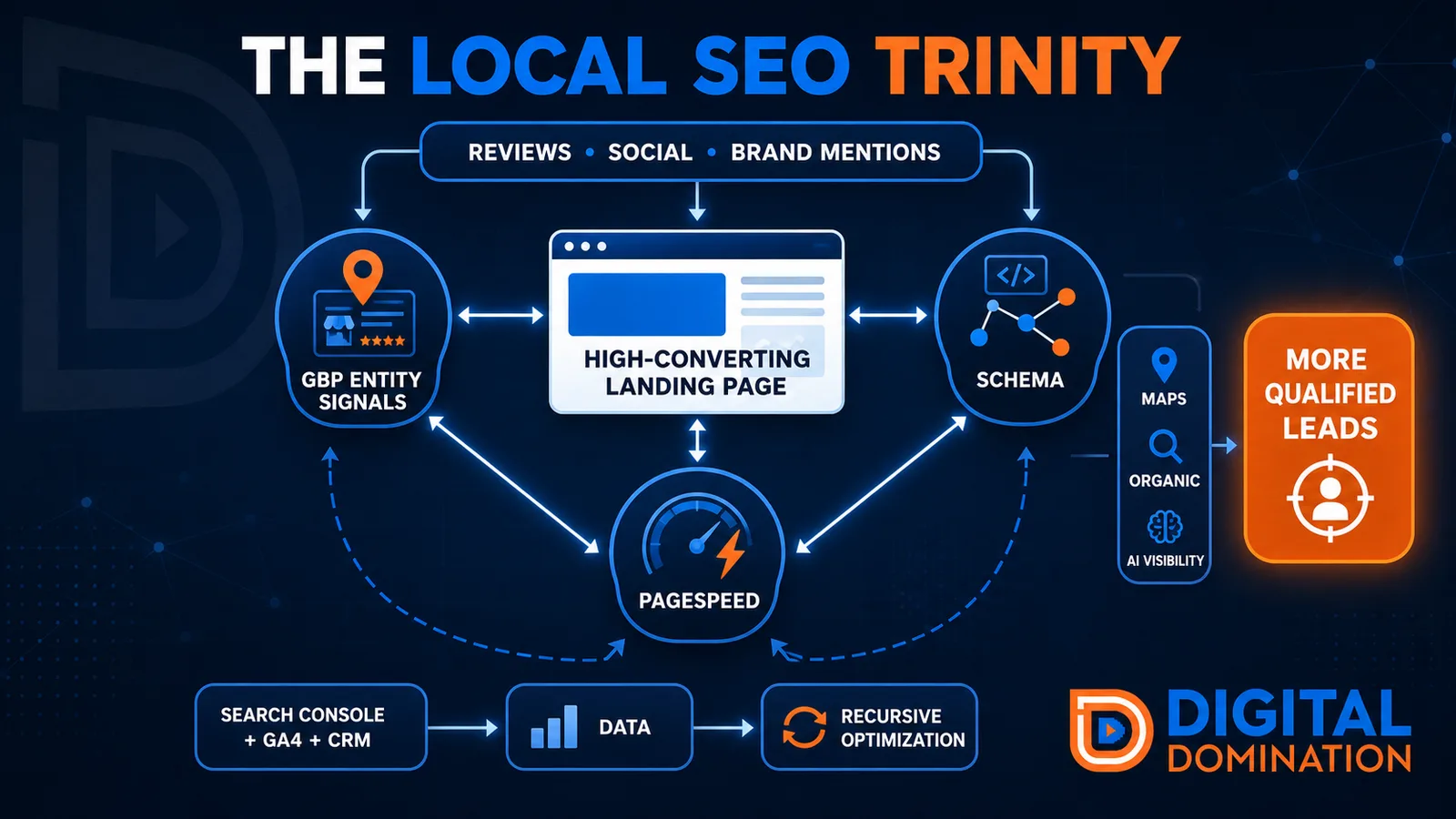
The Local SEO Trinity
Think of a three-legged stool. Your Google profile, your website, and your reviews all have to hold you up. If one leg is short, the whole thing wobbles.
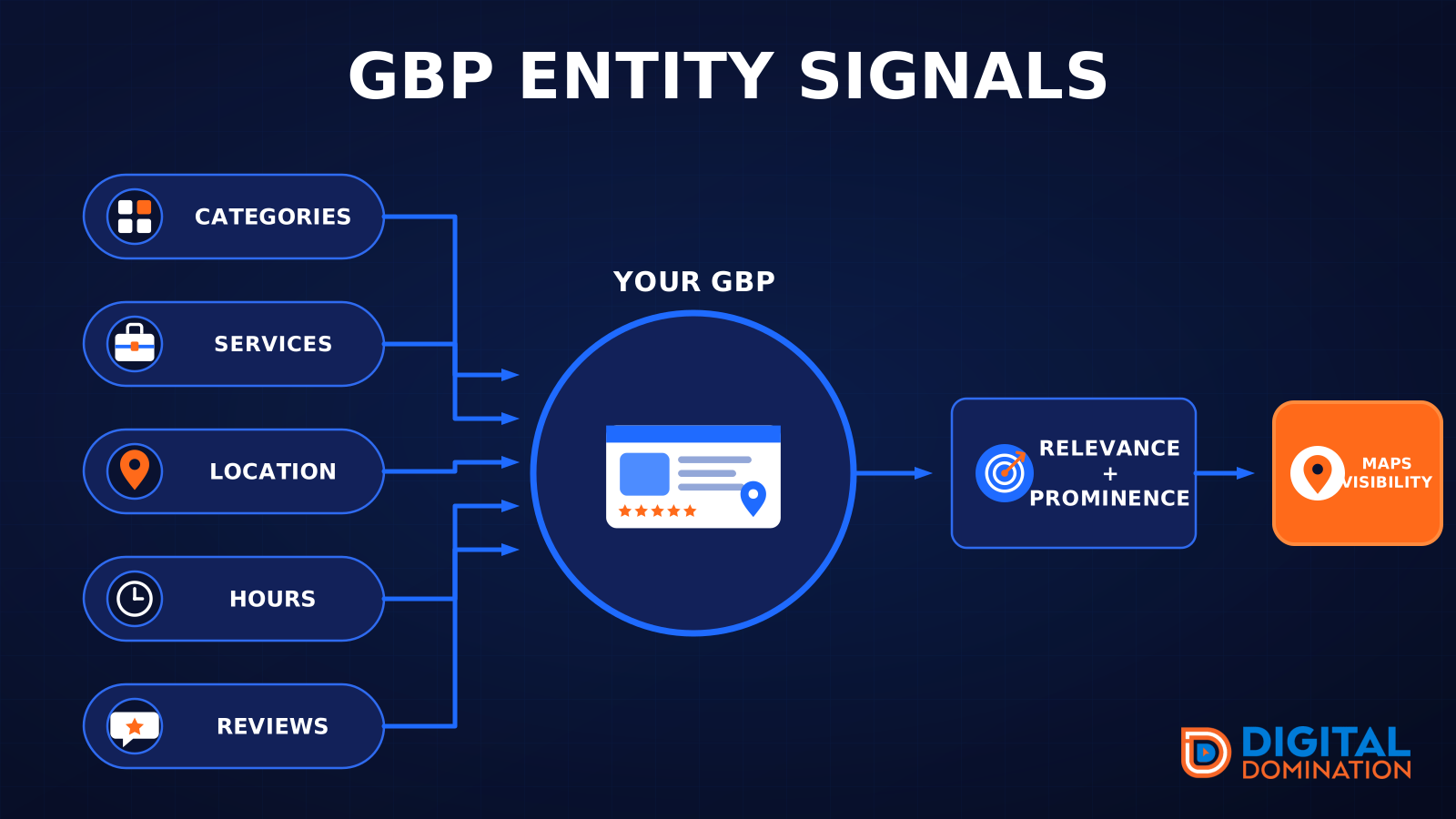
GBP entity signals
This leg is your Google Business Profile. GBP means Google Business Profile. It covers your categories, your services, your location, your hours, and your reviews. Google uses those facts to decide who to show.
Your Google profile is your storefront sign. If the sign is missing, or it names the wrong shop, people drive past.
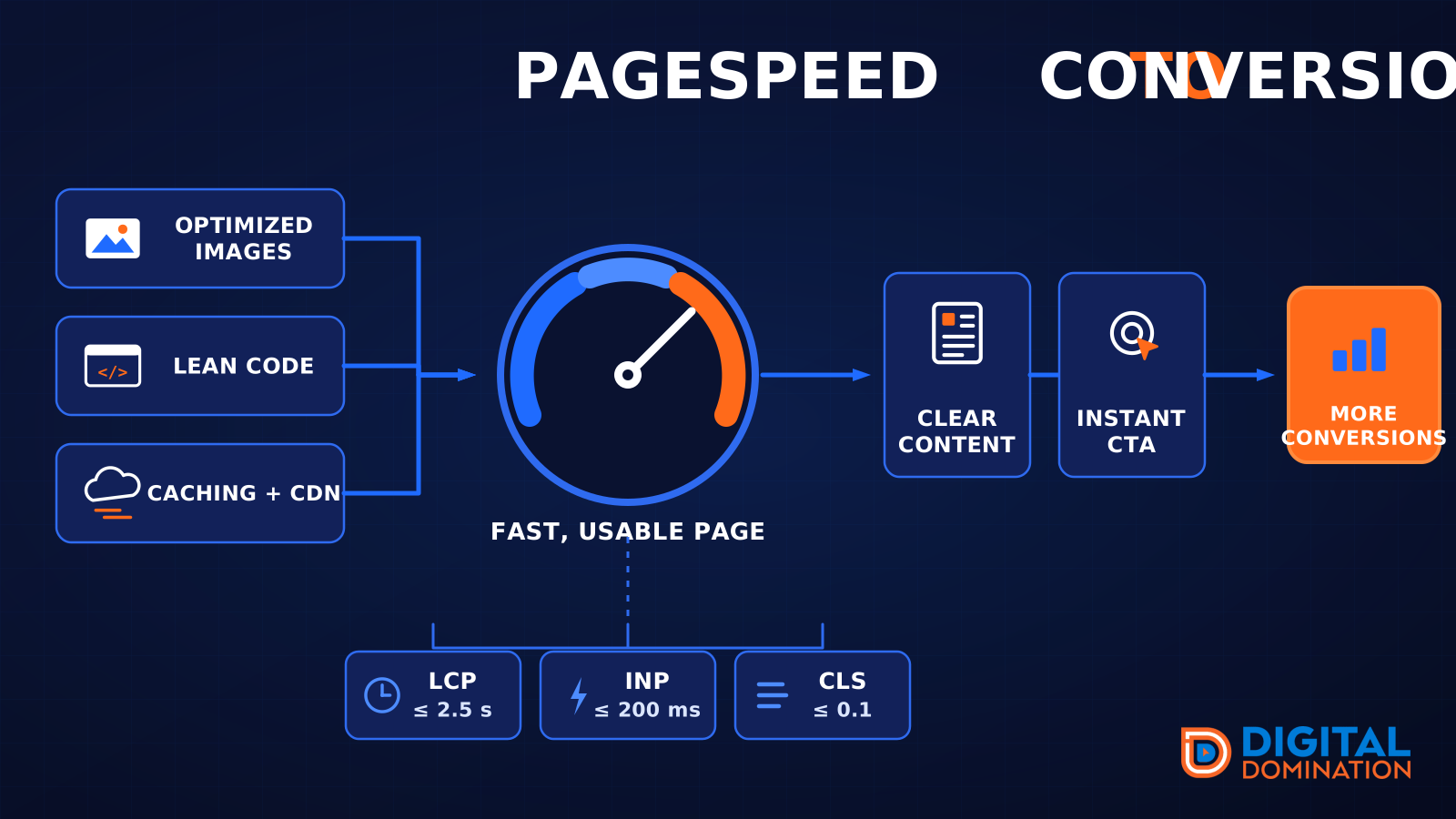
PageSpeed to conversion
This leg is your website, above all on a phone. Small images, lean code, and caching make a page fast. A fast, clear page is what turns a visit into a call. Phone speed is one of the 12 Trinity checks because a slow page loses the call before anyone sees your offer.
Your website is the showroom. If the door sticks, people leave before they look around.
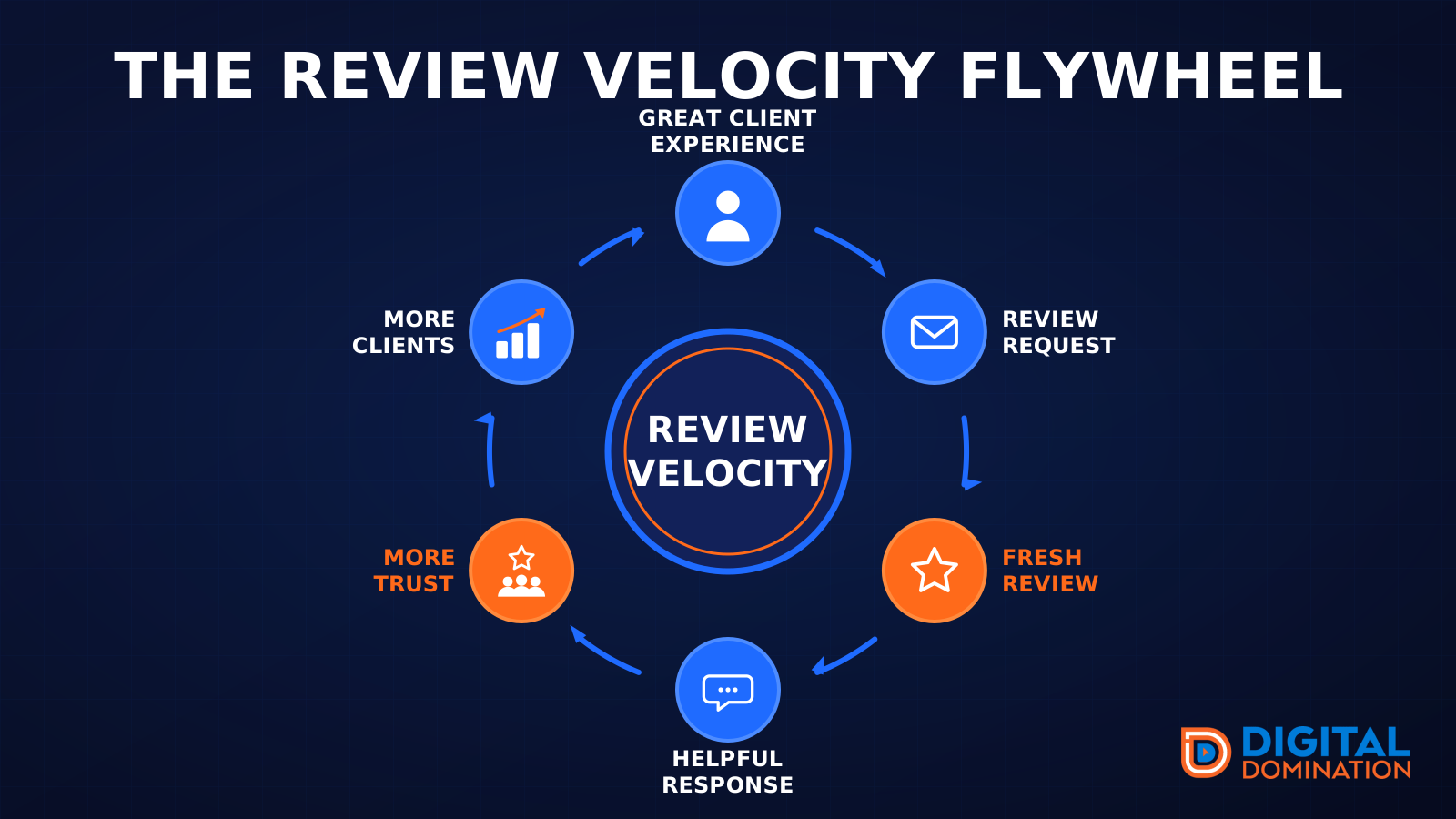
The review velocity flywheel
This leg is reviews and reputation. A good visit leads to a review request, then a fresh review, then a helpful reply, then more trust, then more customers. When the scan can find your Google listing, it shows your rating, your recent reviews, and how many you answered.
Reviews are word of mouth. One kind word helps. A steady stream of real reviews, and a reply from you, helps more.
How this turns into revenue
Being found in more searches leads to more calls. More calls lead to more booked jobs. More booked jobs lead to more revenue.
Example numbers, not a real business: 40 calls from search in a month, a 25 percent close rate, and a $400 average job. That is 10 booked jobs. That is $4,000. The math is the lesson. It is not a promise.
The full page has a box where you can type your own average job value and close rate.
One real story, from our car dealership case study: Medina Auto Group went from invisible on Google Maps to dominating every high-intent search across their market. The turnaround spanned all four of their rooftops at once. The same page says the team eliminated 89 unfair one-star reviews that had been dragging the dealership's reputation down and keeping it out of the Map Pack. It also says: “Results described here are exceptional and non-typical. Outcomes vary based on market conditions, competition, and implementation. No guarantees are made regarding earnings, rankings, or conversions.”
Free strategy call
More booked jobs start with a clear plan
Book a free strategy call. We look at your Google profile, your website, and your reviews, and we tell you what to fix first.
Free. You pick the time. A real person shows up.