
Why does my Google Business Profile get views but no calls?
If people are seeing you and not calling, they are comparing you against two other businesses in the pack and picking one of them.
Is this a visibility problem or a conversion problem?
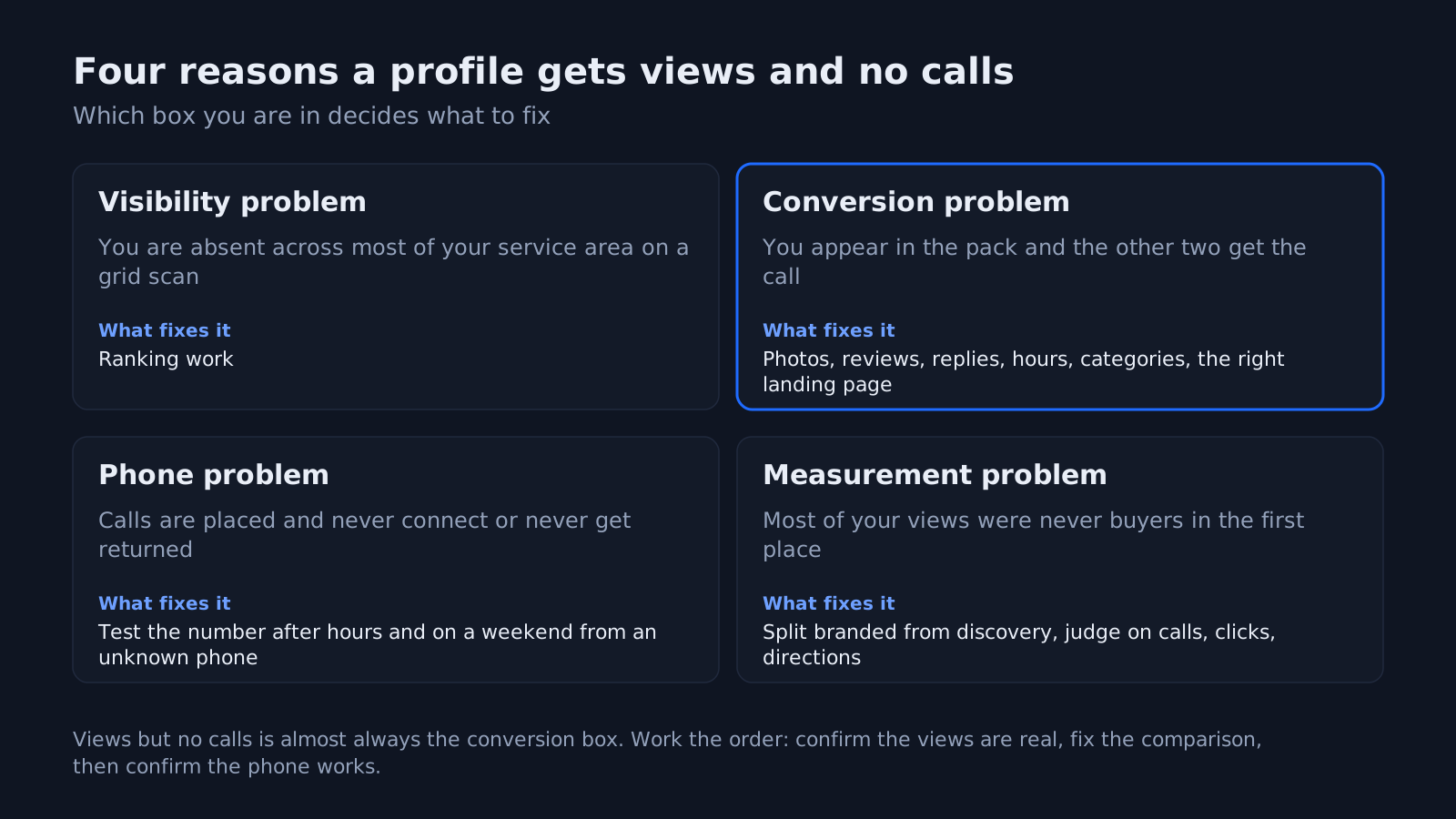
A profile that gets views but no calls almost always has a conversion problem rather than a visibility problem: homeowners are finding you, comparing you side by side against the other businesses in the map pack, and choosing one of them. The usual causes are a thin profile (few or stale photos, no review responses, missing services), a review profile that loses the comparison, hours or a service area that make you look unavailable, and calls that quietly reach voicemail. Views are also inflated by low-intent impressions, so the first job is separating people who wanted a contractor from people who merely scrolled past you.
The distinction matters because the two fixes are opposites. A visibility problem is solved with ranking work: categories, service-area pages, reviews, coverage across the map. A conversion problem is often solved in an afternoon with better photos, answered reviews, correct hours, and a phone a human picks up.
Work it in that order. Confirm the views were real, then look at the comparison from the homeowner's side, then confirm the calls are actually reaching you. Skipping to step three is why so many owners spend another month blaming Google.
- ▸Visibility problem: you are absent across most of your service area on a grid scan
- ▸Conversion problem: you appear in the pack and the other two get the call
- ▸Phone problem: calls are placed and never connect or never get returned
- ▸Measurement problem: most of your views were never buyers in the first place
Are those views actually buyers?
Google's performance data counts an impression every time your profile appears, including inside a list someone scrolled past without reading. A large view count is not the same as a large number of people who wanted your trade in your city today.
Split the number two ways before you panic. First by search type: branded searches (people typing your business name) behave completely differently from discovery searches (people typing the trade and the city). If most views are branded, you have a reputation asset and a discovery problem. If most are discovery and nobody calls, that is the conversion problem in plain sight.
Second, judge on actions rather than views: calls, website clicks, and direction requests. Direction requests are a strong signal for a storefront and a weak one for a service-area business that goes to the customer. Website clicks that land on a slow homepage are a leak you can plug the same day. Google retired Business Profile chat, so the call, the click, and the direction request are the actions left to measure.
One honest note about how search works now: more queries finish inside the results page or an AI summary without a click to anybody. Some of your missing calls did not go to a competitor, they simply never became a call. That is an argument for showing up in more places, not a reason to distrust the report.
- ▸Impressions count every appearance, including ones nobody read
- ▸Split views into branded versus discovery before drawing conclusions
- ▸Judge the profile on actions: calls, website clicks, direction requests
- ▸Some searches now end without a click to any business at all
What makes a homeowner call one profile instead of another?
Assume every call is a three-way comparison, because that is exactly what the map pack is. The homeowner sees three businesses, spends a few seconds on each, and dials the one that looks most obviously safe. Rating and review count are the first filter, but recency carries more weight than most owners expect: a dozen reviews from this year usually beat sixty reviews that stop three years ago.
After reviews, the decision moves on photos that show real crews, real trucks, and real finished work instead of stock images or a logo tile; an owner who replies to reviews, especially the negative ones, calmly; hours that say open now; a description and service list that names the exact job they searched for; and a Q&A section that answers the obvious question about pricing or scheduling.
Then there are the silent disqualifiers. A primary category that does not match the search. A service area that leaves them unsure whether you come to their town. A business name stuffed with keywords that reads as spam. A website link that dumps them on a slow homepage rather than a page about the thing they need right now.
Pull your profile up on a phone next to the two competitors above you and ask honestly which one you would call. That five-minute exercise finds more problems than most paid audits.
- ▸Recent reviews beat old volume in a side-by-side comparison
- ▸Real job photos outperform stock imagery and logo tiles
- ▸Replies to reviews, especially negative ones, visibly change trust
- ▸Hours, categories, and service area quietly disqualify you
- ▸The website link should land on the service page, not the homepage
Why does my competitor rank higher on Google Maps even with fewer reviews?
Reviews are one signal among many, and they are not the heaviest one. The business above you is usually winning on some combination of a better matched primary category, closer proximity to where the searcher is standing, stronger relevance on their website for that service in that area, and a longer history of engagement on the profile.
The other explanation is that they are not actually above you. The pack you see on your own phone is shaped by your location, your search history, and your account. What ranks at your desk is not what ranks in the neighborhood across town where the jobs you want are.
The reliable way to check is a grid scan that samples map rankings from many points across your service area. It usually tells the same story: strong in a tight circle around your address, invisible three miles out, and that outer ring is where most of the missing calls live.
If a competitor genuinely outranks you with fewer reviews, the leverage is rarely to chase their review count. It is to fix the primary category, build real pages for the areas you want to serve, and earn reviews steadily instead of in bursts.
- ▸Primary category match usually outweighs raw review count
- ▸Proximity to the searcher, not to you, shapes what each person sees
- ▸Your own phone is a biased place to check a local ranking
- ▸A grid scan across the service area shows your real coverage
How do I prove the calls are actually reaching me?
Before you rebuild anything, check the phone. A surprising share of views-but-no-calls cases turn out to be calls that were placed and never connected: rings after hours with no forwarding, a full voicemail box, a number that changed and was never updated on the profile, or an office line that goes to someone who cannot pick up while they are on a job.
Run the test yourself. Call the number on your profile from a phone Google does not associate with your business, at three different times, including a Saturday morning and 7pm on a weekday. Then compare the calls shown in the profile's performance data against the calls your team actually logged. The gap is your answer.
Add call tracking if you want the full picture, putting the tracking number in the profile and keeping your main line listed as an additional number so your business information stays consistent everywhere else. Then count three separate things: calls received, calls answered, and calls that became appointments. Most contractors are shocked by the middle number.
Expect junk in the totals. Public listings attract sales calls from people selling exactly the services you are researching right now. Log those separately so they do not convince you the profile is producing more than it is.
- ▸Test the number after hours and on a weekend from an unknown phone
- ▸Compare Google's call data against calls your team actually logged
- ▸Count calls received, calls answered, and calls booked as three numbers
- ▸Strip out spam and sales calls before you judge the channel
Want to know which of these is costing you calls?
Work the order: confirm the views are real, fix the comparison, then confirm the phone works. Plenty of profiles gain calls from the second step alone, and it costs nothing beyond an hour and some honest photos.
If you would rather see it measured than guess, book a free 15-minute call. We will map your coverage across the whole service area instead of a single point, show you where you appear and where you vanish, and tell you plainly whether your problem is ranking or conversion. Digital Domination gets you into the top 3 of the Google Map Pack within 12 weeks or you do not pay, and we take one client per trade per service area.
Fifteen minutes, no pitch deck, and you leave knowing which of the two problems you actually have.
Reviews and follow-up, handled
Get the 5-Star Reputation System for $297 a Month
Every customer asked for a review at the right moment, every review answered, every lead and missed call followed up automatically, with a free custom website included. Watch the short video and see how it works for a business your size.
Watch the Video »Keep reading
Related guides
- ▸Online reputation management near me
- ▸Online Reputation Management Vs Doing Local SEO Yourself Diy With Free
- ▸Optometrist local SEO
Put it into action
Frequently Asked Questions
How many Google Business Profile views should turn into calls?
There is no reliable benchmark, because impressions include people who never intended to call anyone. Track your own ratio month over month and treat a falling trend, rather than an absolute number, as the signal worth acting on.
Why did my Google Business Profile calls suddenly drop?
Check hours and special hours first, then any recent category, name, or service-area edit, then whether the profile was suspended or a duplicate listing appeared. Seasonality and a competitor's new content explain most of what is left.
Do photos actually get more calls?
Yes, in the comparison sense: real photos of your crews, trucks, and finished work make a profile look active and safe beside a competitor using stock images. Add them regularly rather than dumping them all in at once.
Do Google Posts help get calls?
They rarely move rankings much, but they add recency and give a homeowner one more reason to trust the listing. Treat them as conversion support, not as a ranking tactic.
Should I put a call tracking number on my Google Business Profile?
Yes, as long as you keep your main business line listed as an additional number so your information stays consistent across the web. That setup gives you real call data without breaking your consistency signals.
How many Google reviews do I need to rank in the map pack?
There is no threshold number. You need enough to look credible next to the businesses currently in your pack, earned steadily over time, because a consistent trickle of recent reviews outperforms a one-time burst.
Why do I get spam and sales calls through my profile?
Public listings get harvested constantly, and contractors are a favorite target for marketing and lead-selling calls. Log them separately so they do not inflate the call numbers you use to judge the channel.
Can I see who viewed my Google Business Profile?
No. Google reports aggregate views, searches, and actions, never individual identities. Call tracking and form data are the only ways to know who actually reached out to you.
Ready to dominate your map?
Top 3 in the Google Map Pack in 12 weeks, or you don't pay.