
Google Maps SEO vs hiring an in-house marketer or marketing coordinator
A practical comparison for local business owners who want more phone calls from nearby customers, not just more marketing activity.
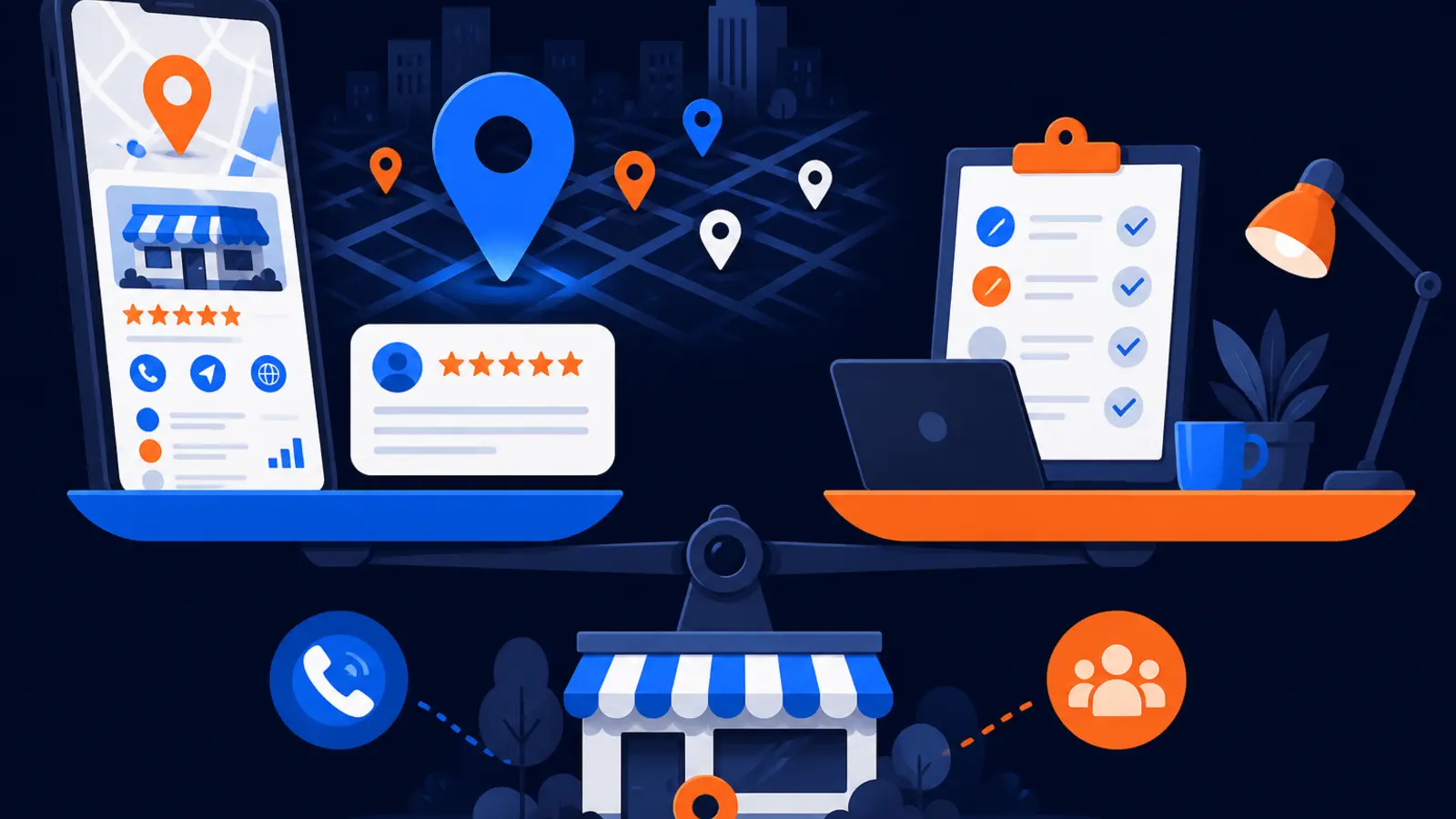
The short answer for call-driven local businesses
If your main goal is more trackable calls from people nearby, a focused Google Maps SEO program is usually the more direct choice. It works on the channel where many local customers are already searching, and it is tied to Business Profile actions like calls, website clicks, messages, bookings and directions.
That does not mean an in-house marketer is a bad hire. It means the job is different. A marketing coordinator is built for broad daily execution across search, social, email, events, reporting and internal coordination. Google Maps SEO is built to improve your visibility in local Google results and measure whether that visibility turns into calls.
For a plumber, HVAC company, electrician, auto repair shop, med spa, dental office, attorney, landscaper or other location-driven business, the buying question is not, “Who can do more tasks?” The better question is, “Which option is accountable to the local search result that produces calls?”
The practical answer is simple:
- ▸Choose Google Maps SEO if calls from nearby searchers are the priority.
- ▸Choose an in-house marketer if your business needs daily execution across many channels.
- ▸Choose both only when your budget and management time can support both roles clearly.
Why Google Maps is central to local call demand
Google Business Profile Help says local results are based mainly on relevance, distance and prominence. In plain English, Google is trying to decide whether your business matches the search, whether you are close enough to the searcher and whether the business appears trusted and known enough to show prominently.
Google Business Profile Help defines relevance as how well a Business Profile matches what someone is searching for. Google also says complete and detailed business information helps it match a profile to relevant searches. That matters because a local business can lose calls not because it is bad, but because Google cannot clearly connect the profile to the service someone wants.
The market behavior supports paying attention to Google. BrightLocal reported that 52% of consumers started their most recent local business search on Google Search and 9% started on Google Maps in its survey of 1,227 U.S. consumers. That does not mean every customer starts on Google, but it does mean Google is too important for a local business to treat as a side task.
The core local ranking inputs are concrete:
- ▸Relevance: does your profile match the service search?
- ▸Distance: is your business close enough to the searcher or service area?
- ▸Prominence: do reviews, links, reputation and other signals support trust?
- ▸Completeness: does Google have enough detail to understand the business?
How a Google Maps SEO program turns visibility into calls
A focused Google Maps SEO program works backward from the call. First, it checks where your business appears across the actual service area, not only at your office address. Then it fixes profile data, categories, services, content, review flow, local authority and tracking gaps that can affect whether searchers see you and call you.
Google Business Profile Help says performance data includes calls, website clicks, messages, bookings, directions, products, menus and offers. It also defines the calls metric as the number of times a customer clicked the call button on a Business Profile, and says a phone number must be added to track it.
This is why Maps SEO can be easier to judge than a general marketing role. The owner can see where the business ranks, which searches are moving, whether call clicks are being recorded and whether the profile is becoming more complete and useful to customers.
A solid Maps program should connect work to measurable local actions:
- ▸Ranking movement by keyword and area.
- ▸Business Profile call clicks.
- ▸Website visits from the profile.
- ▸Direction requests for storefront businesses.
- ▸Messages or bookings, if those features are used.
- ▸Review growth and response quality.
What an in-house marketer can do that Maps SEO cannot
An in-house marketer or marketing coordinator can be the right move when the owner needs broad operational support every day. This person can help coordinate campaigns, vendors, events, social posts, email newsletters, simple website updates, printed materials, photos, offers, referral programs and reporting across departments.
That range is useful, especially in a larger local business where marketing touches recruiting, customer service, sales, community sponsorships and seasonal promotions. The tradeoff is focus. A single employee who owns everything may not have deep local SEO skill, review operations experience, Google Business Profile troubleshooting skill and call tracking discipline.
The in-house path fits best when the business needs a general marketing operator, not only higher Google Maps visibility. If the owner expects one employee to fix rankings, produce creative, run paid ads, handle events and manage vendors, the results can become scattered.
The in-house marketer is usually better for needs like these:
- ▸Daily social media publishing and inbox monitoring.
- ▸Email campaigns and customer newsletters.
- ▸Event planning, sponsorships and community outreach.
- ▸Internal coordination between sales, operations and leadership.
- ▸Brand consistency across many materials.
- ▸Managing several outside vendors.
Cost and management reality
Hiring in-house is not only a salary decision. The owner also has to recruit, train, supervise and retain the person. The U.S. Bureau of Labor Statistics reported a May 2025 median annual wage of $78,760 for market research analysts and marketing specialists, and $166,790 for marketing managers. Those figures do not include payroll taxes, benefits, software, training or management time.
A Google Maps SEO program has a different cost structure. It should be tied to a specific outcome, specific service area and specific measurement process. For Digital Domination, pricing for the Maps Domination Program is set per market on a qualification call and tied to the ranking outcome. The company does not publish one flat retainer price because competition varies by market and trade.
The more important comparison is not simply employee cost versus agency cost. It is whether the spend is aimed at the bottleneck that is costing you calls. If the bottleneck is lack of broad coordination, hire in-house. If the bottleneck is weak Map Pack visibility, incomplete profile signals, thin reviews or poor local tracking, a Maps SEO program is usually more focused.
What to look for before you pick a Maps program
Before you sign with any Google Maps SEO provider, ask for proof that they can diagnose your market at the neighborhood level. Ranking at your office address is not enough. Service businesses need visibility across the territory where jobs actually happen.
Google Business Profile Help says each Business Profile location has one primary category and may select up to nine additional categories. It also says service businesses may showcase offerings on a Business Profile, and a service may be highlighted when local customers search Google for that offering. Those details are not cosmetic. They affect how clearly Google understands what you do.
You should expect a practical, checkable process, not vague talk. At minimum, ask to see these checkpoints:
- ▸A map-based ranking scan across your real service area.
- ▸A review of your primary and additional categories.
- ▸A service list that matches what customers actually search.
- ▸A plan for reviews that follows Google policy.
- ▸Call tracking or call click reporting tied to the profile.
- ▸Before and after reporting you can understand without technical training.
Seven questions to ask before you sign
This is the list to use when comparing a focused Maps SEO program with an in-house marketing hire. The goal is to make each option explain how it will produce calls, not just activity.
Ask these questions before you commit:
- ▸Which services and neighborhoods will you be accountable for?
- ▸How will we know whether calls came from the Business Profile?
- ▸Will you show ranking visibility across the whole service area?
- ▸Who handles reviews, responses, posts, photos and profile updates?
- ▸How will you avoid review incentives that violate Google policy?
- ▸What work happens weekly, and what work happens only once?
- ▸If results are weak, what changes first?
When the in-house marketer is the better choice
The other option deserves a fair answer. An in-house marketer or coordinator is the better choice when your marketing problem is operational, not primarily local search visibility. If your team needs someone inside the business every day, an outside Maps program will not replace that role.
For example, a growing home services company may need someone to coordinate uniforms, truck wrap updates, job photos, recruiting posts, email reminders, vendor calls, sponsorship deadlines and office communication. A medical office may need daily support for patient communication, events, internal approvals and reputation follow-up. A restaurant or retail store may need frequent promotions, menu updates, community events and social content.
Choose the in-house path when these statements are true:
- ▸You need a person available during business hours for daily coordination.
- ▸You have multiple marketing channels that need constant attention.
- ▸You already rank well in Maps, but your brand execution is inconsistent.
- ▸You have managers who can train and supervise the role.
- ▸You need internal approvals, photos, events and promotions handled fast.
- ▸You are not ready to hold a provider accountable to ranking and call metrics.
Compliance and profile basics owners should understand
Some Google Maps work is simple to see, but easy to do wrong. Google Business Profile Help says a profile can be edited directly on Search or Maps, and the editor must be signed in to the Google Account linked to the profile. That sounds basic, but ownership and access problems can delay fixes.
Google Business Profile Help also says photos and videos show on Google only after the profile is verified, and that verification reviews take up to five business days after verification steps are completed, with rare reviews taking longer. If a provider promises instant changes on an unverified or locked profile, be careful.
Reviews need special care. Google provides a review-request link or QR code that businesses can share on receipts, in thank-you emails, at the end of chat interactions or in-store. Google Maps User Generated Content Policy Help prohibits offering payment, discounts, free goods or services in exchange for posting a review or revising or removing a negative review.
The owner should be able to verify these basics:
- ▸Who owns the Google account connected to the profile.
- ▸Whether the profile is verified.
- ▸Whether the phone number is present for call tracking.
- ▸Whether review requests avoid incentives.
- ▸Whether photos, posts and services are being updated correctly.
How Digital Domination fits this decision
Digital Domination is a fit for local businesses that want a focused Google Maps ranking and call tracking program, not a general marketing employee. The company offers a free 169-point GeoGrid scan that checks 169 real Google results across the service area, so the owner can see where the business is visible and where it is not.
The Maps Domination Program includes weekly GeoGrid tracking reports with visual proof of rankings and call volume. Digital Domination also offers territory exclusivity, one client per trade per service area. Its guarantee is: top 3 in the Google Map Pack in 12 weeks or you do not pay.
For businesses that mainly need review growth and reputation support, Digital Domination also offers the 5-Star Review System at $297/month, no setup fee, cancel anytime, billed monthly through Stripe. That is separate from hiring a full-time coordinator, and separate from a broader Maps ranking program.
This is the practical fit:
- ▸Use Digital Domination when Map Pack visibility is the main call bottleneck.
- ▸Use an in-house marketer when daily multi-channel execution is the main bottleneck.
- ▸Use the free GeoGrid scan when you need proof before deciding.
The bottom line and next step
For most local businesses that depend on nearby customers and want more trackable phone calls, focused Google Maps SEO is the more direct path than hiring a general in-house marketer. It targets the local result where customers search, improves the profile signals Google says matter and ties reporting to rankings and Business Profile actions.
An in-house marketer is the better choice when the business needs daily coordination across social, email, events, creative, reporting and internal projects. That role can be valuable, but it is not the same as a specialist program built around Google Maps visibility and call tracking.
If you want to compare the options using your own market, visit Digital Domination’s Get Ranked page. It explains the Maps Domination Program, the qualification process, the ranking guarantee and what owners can expect from the program. You can also request the free GeoGrid scan on the free GeoGrid scan page to see 169 real Google results across your service area before you decide.
Keep reading
Related guides
- ▸When To Choose A Free Trinity Website Audit Instead Of Doing Local SEO
- ▸When To Choose AI Search Optimization Instead Of Doing Local SEO Yours
- ▸When To Choose Case Studies Instead Of Doing Local SEO Yourself Diy Wi
Put it into action
Frequently Asked Questions
Is Google Maps SEO better than hiring a marketing coordinator?
It is usually better if your main goal is more trackable calls from nearby customers. A marketing coordinator is better when you need daily help across social, email, events, vendor coordination and internal marketing tasks.
Can an in-house marketer handle Google Business Profile SEO?
Sometimes, but it depends on their experience and workload. Google Maps SEO requires category work, service optimization, review systems, local ranking tracking and profile troubleshooting, which can be hard to manage alongside every other marketing task.
How do I track calls from my Google Business Profile?
Google Business Profile Help says the calls metric counts how many times a customer clicked the call button on your profile. Google also says a phone number must be added to track that metric.
What should I ask a Google Maps SEO company before hiring them?
Ask whether they will show rankings across your real service area, how they track calls and what profile work they perform each month. Also ask how they handle reviews, because Google prohibits paying or rewarding customers for reviews.
When should I hire an in-house marketer instead?
Hire in-house when your business needs daily multi-channel execution. That includes social media, email, events, internal coordination, creative updates, vendor management and routine reporting across the company.
Does Google Maps SEO replace all other marketing?
No. It is focused on improving visibility and calls from local Google searches. Many businesses still need email, social, paid ads, referral programs, events or internal marketing support.
How fast can a Google Business Profile be changed?
Some edits can be made directly on Search or Maps when you are signed in to the linked Google account. Google Business Profile Help says verification reviews take up to five business days after verification steps are completed, and rare reviews can take longer.
What is the first step if I do not know which option to choose?
Start with a local visibility scan. Digital Domination’s free GeoGrid scan checks 169 real Google results across your service area, which helps show whether your biggest problem is Maps visibility or broader marketing execution.
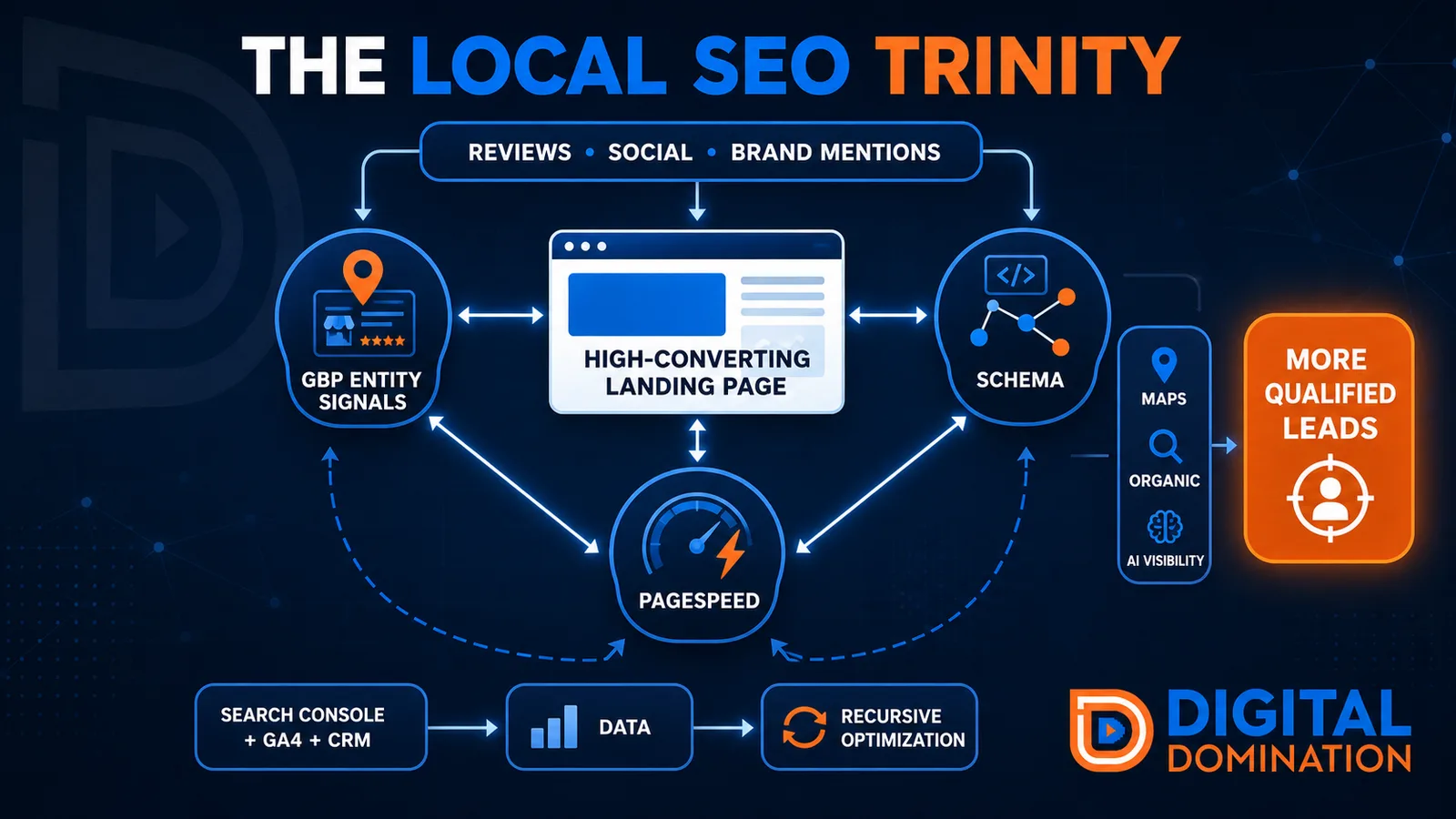
The Local SEO Trinity
Think of a three-legged stool. Your Google profile, your website, and your reviews all have to hold you up. If one leg is short, the whole thing wobbles.
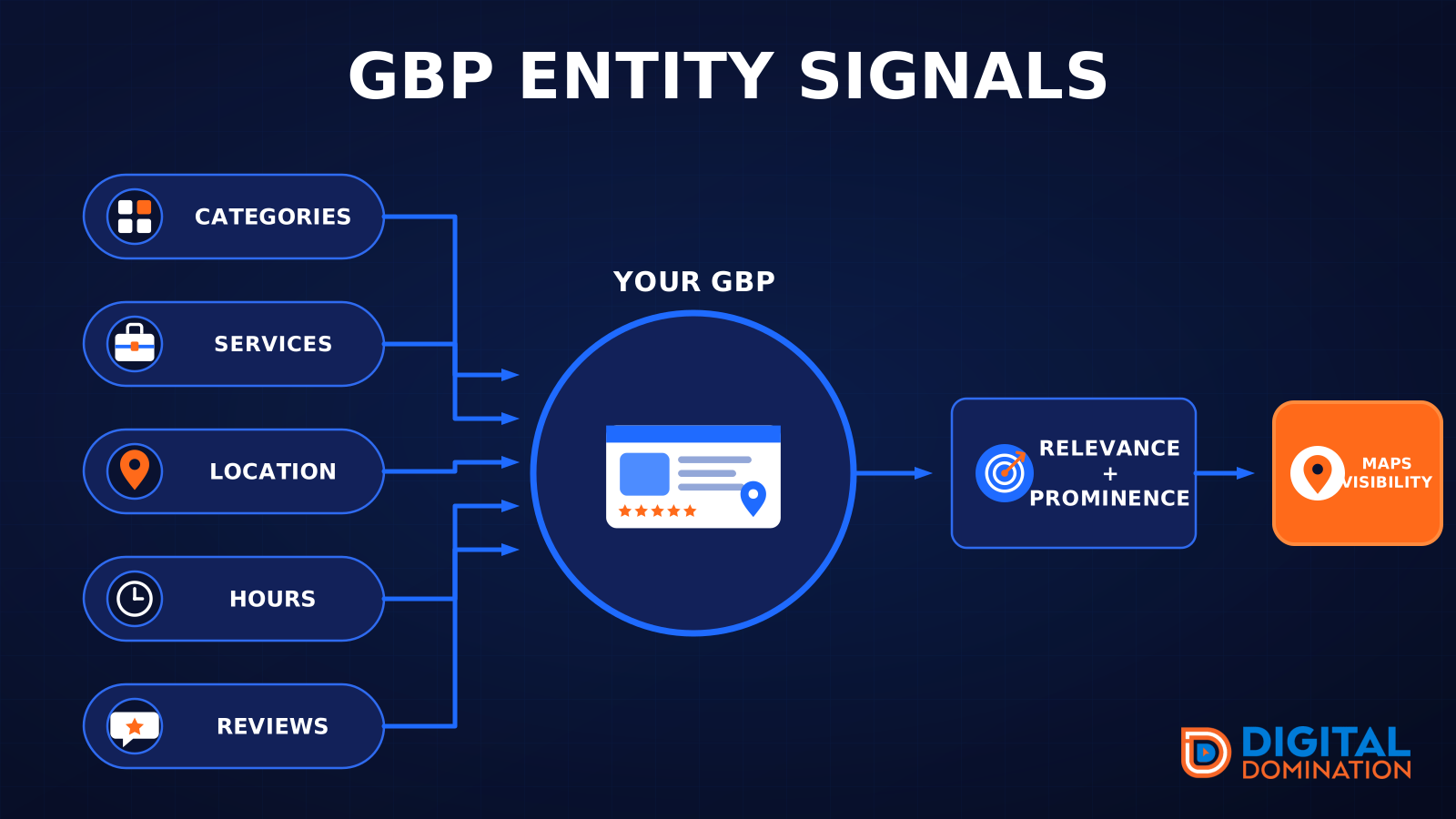
GBP entity signals
This leg is your Google Business Profile. GBP means Google Business Profile. It covers your categories, your services, your location, your hours, and your reviews. Google uses those facts to decide who to show.
Your Google profile is your storefront sign. If the sign is missing, or it names the wrong shop, people drive past.
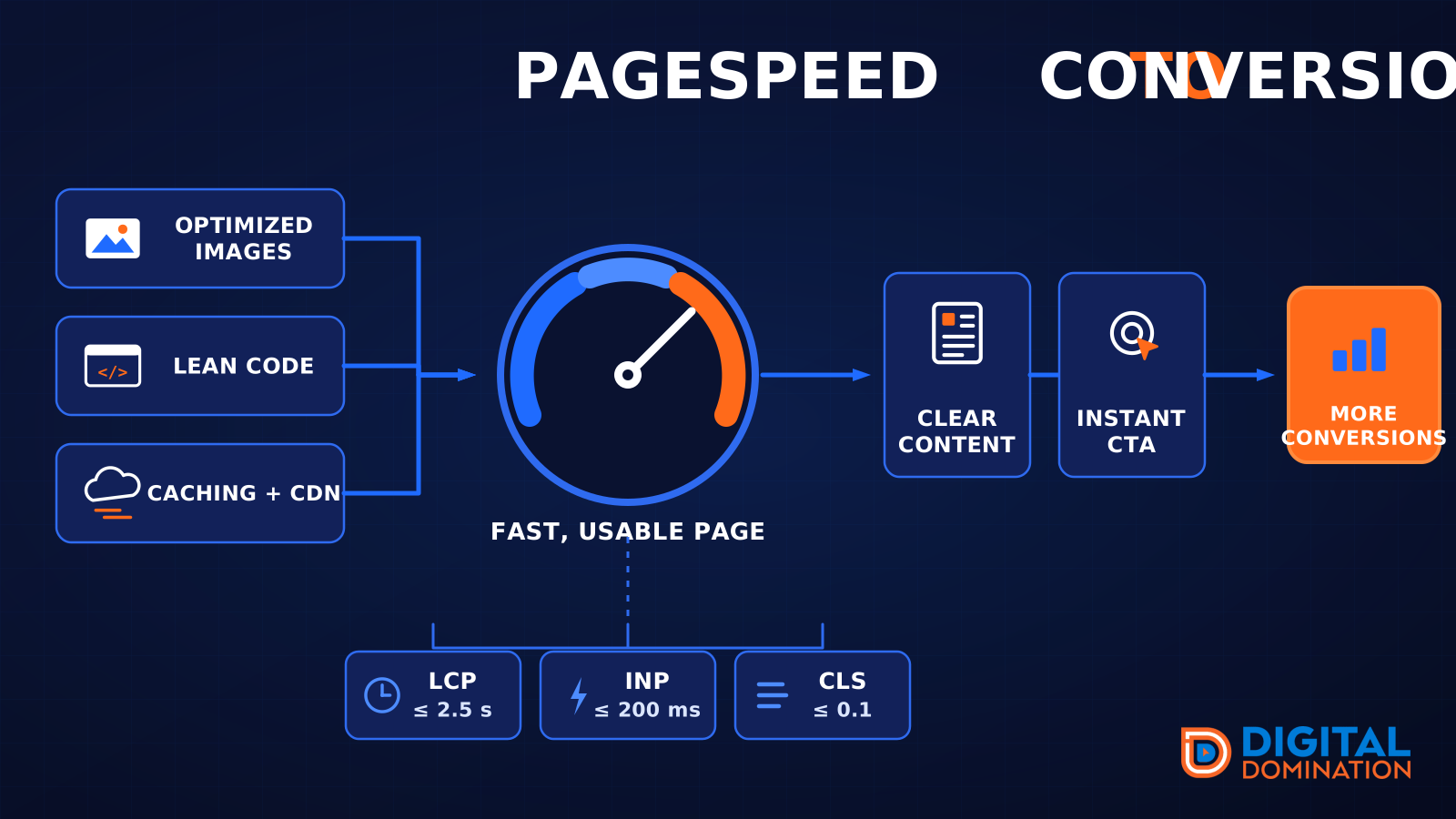
PageSpeed to conversion
This leg is your website, above all on a phone. Small images, lean code, and caching make a page fast. A fast, clear page is what turns a visit into a call. Phone speed is one of the 12 Trinity checks because a slow page loses the call before anyone sees your offer.
Your website is the showroom. If the door sticks, people leave before they look around.
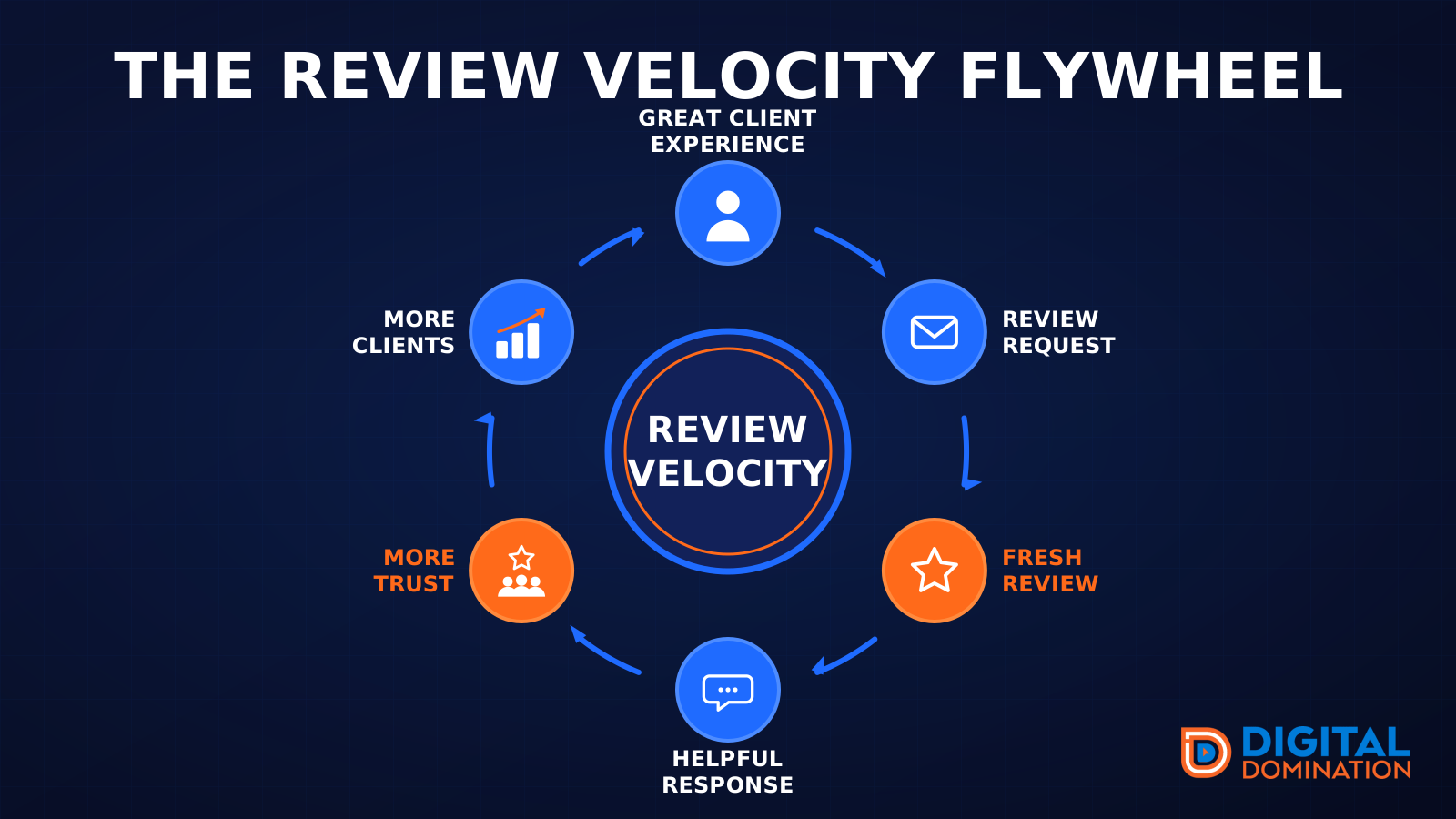
The review velocity flywheel
This leg is reviews and reputation. A good visit leads to a review request, then a fresh review, then a helpful reply, then more trust, then more customers. When the scan can find your Google listing, it shows your rating, your recent reviews, and how many you answered.
Reviews are word of mouth. One kind word helps. A steady stream of real reviews, and a reply from you, helps more.
How this turns into revenue
Being found in more searches leads to more calls. More calls lead to more booked jobs. More booked jobs lead to more revenue.
Example numbers, not a real business: 40 calls from search in a month, a 25 percent close rate, and a $400 average job. That is 10 booked jobs. That is $4,000. The math is the lesson. It is not a promise.
The full page has a box where you can type your own average job value and close rate.
One real story, from our car dealership case study: Medina Auto Group went from invisible on Google Maps to dominating every high-intent search across their market. The turnaround spanned all four of their rooftops at once. The same page says the team eliminated 89 unfair one-star reviews that had been dragging the dealership's reputation down and keeping it out of the Map Pack. It also says: “Results described here are exceptional and non-typical. Outcomes vary based on market conditions, competition, and implementation. No guarantees are made regarding earnings, rankings, or conversions.”
Free strategy call
More booked jobs start with a clear plan
Book a free strategy call. We look at your Google profile, your website, and your reviews, and we tell you what to fix first.
Free. You pick the time. A real person shows up.