
Insurance agent local SEO: how GBP entity signals, schema and PageSpeed turn a non-renewal letter into a bound policy
The agent who wins the household is rarely the one with the best carrier lineup. It is the one Google understands, the buyer trusts in eight seconds, and whose quote page loads before the call goes to a 1-800 number.

A non-renewal notice, 30 days on the clock, and a search that starts with the word 'agent'
A homeowner opens the mail on a Thursday and finds a non-renewal notice. The carrier is pulling out of the state, the policy ends in 30 days, and the mortgage servicer will force-place expensive coverage if there is a gap. She does not want another 1-800 number. She wants a person, so she types 'home insurance agent near me' and looks at three pins in the Map Pack.
The independent agency two miles away has six carriers that would write that house. It never gets the call. Its profile lists the old suite, its category is a bare 'Insurance agency', its reviews stopped two years ago, and its carrier microsite takes seven seconds to show a 38-field quote form. The captive agent across the street has forty recent reviews naming home policies and a page that loads before she finishes the headline. He binds the policy Friday, then adds the two cars.
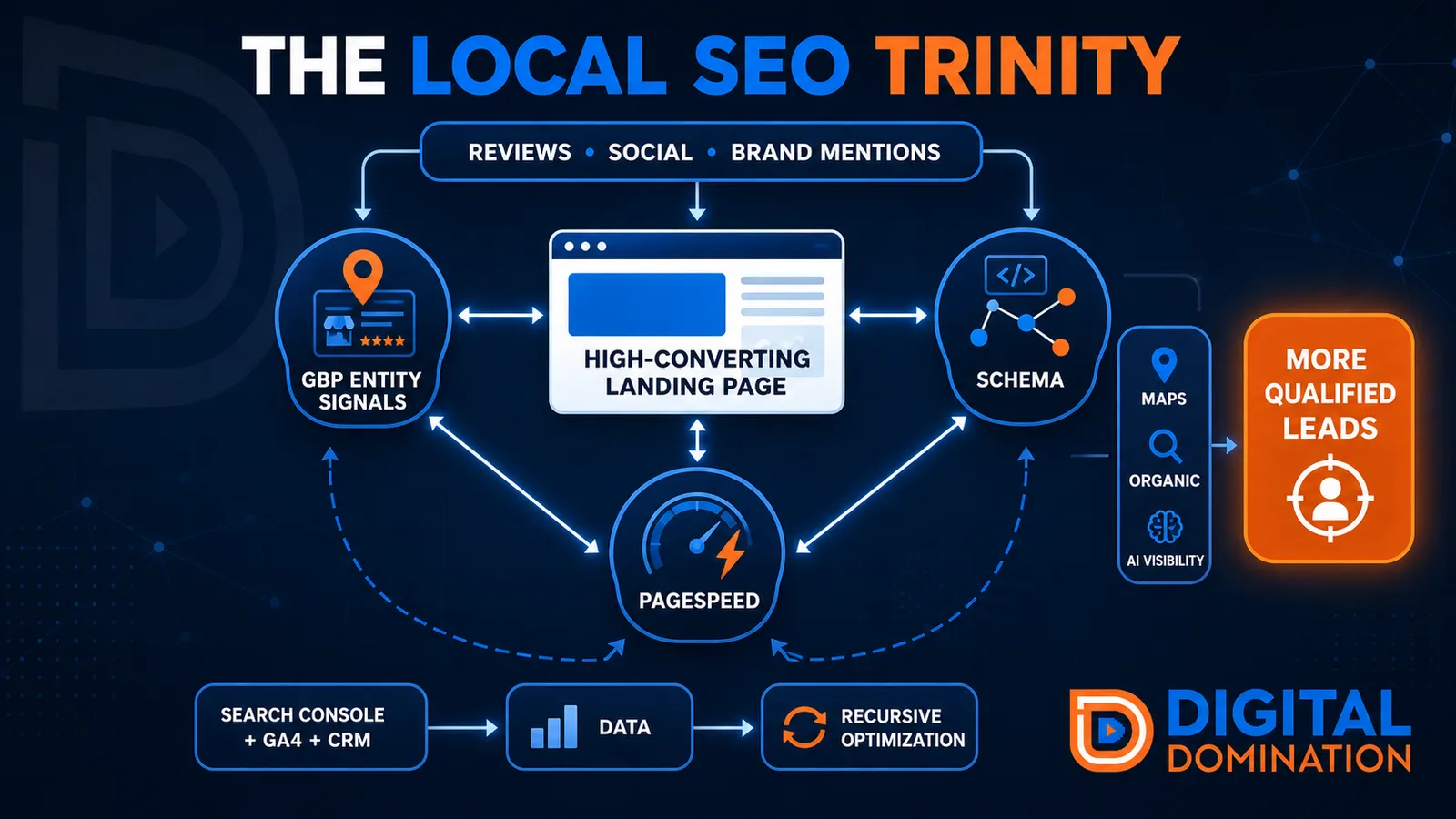
Insurance is bought under pressure: a non-renewal, a premium jump, a car waiting on proof of coverage, a contractor who needs a certificate by 7 am. In each moment Google decides which agency is relevant to the line, close enough, and prominent enough to trust. At Digital Domination we treat that decision as three connected systems, GBP entity signals, schema and PageSpeed, held together by the landing page, reviews, social proof and a Search Console, GA4 and agency management system loop.
The short version for an agency principal
Google ranks local results on relevance, distance and prominence. Distance is fixed by the searcher. Relevance is where agencies lose: Google cannot tell you write commercial auto, workers' comp and Medicare supplements if your profile, pages and reviews never say so. Prominence comes from review velocity, mentions and consistent facts across carrier locators and the state producer lookup. Each layer has one job:
- ▸Google Business Profile: which lines you write and where you are licensed. Outcome: Map Pack visibility and quote calls.
- ▸Landing page: can the buyer get this coverage from a human who picks up. Outcome: quote starts and bound policies.
- ▸Schema: agency, producers, lines, carriers and service area as one machine-readable entity. Outcome: clearer understanding by Google and AI answer engines.
- ▸PageSpeed: phone number, quote button and proof on screen before the buyer gives up. Outcome: fewer leads lost to national carriers.
- ▸Reviews and authority: proof that real policyholders were helped with real claims. Outcome: prominence and trust.
- ▸Search Console, GA4 and the management system: which queries produce quotes and which quotes bind. Outcome: a loop that tightens monthly.
GBP entity signals for an independent agency or a captive office
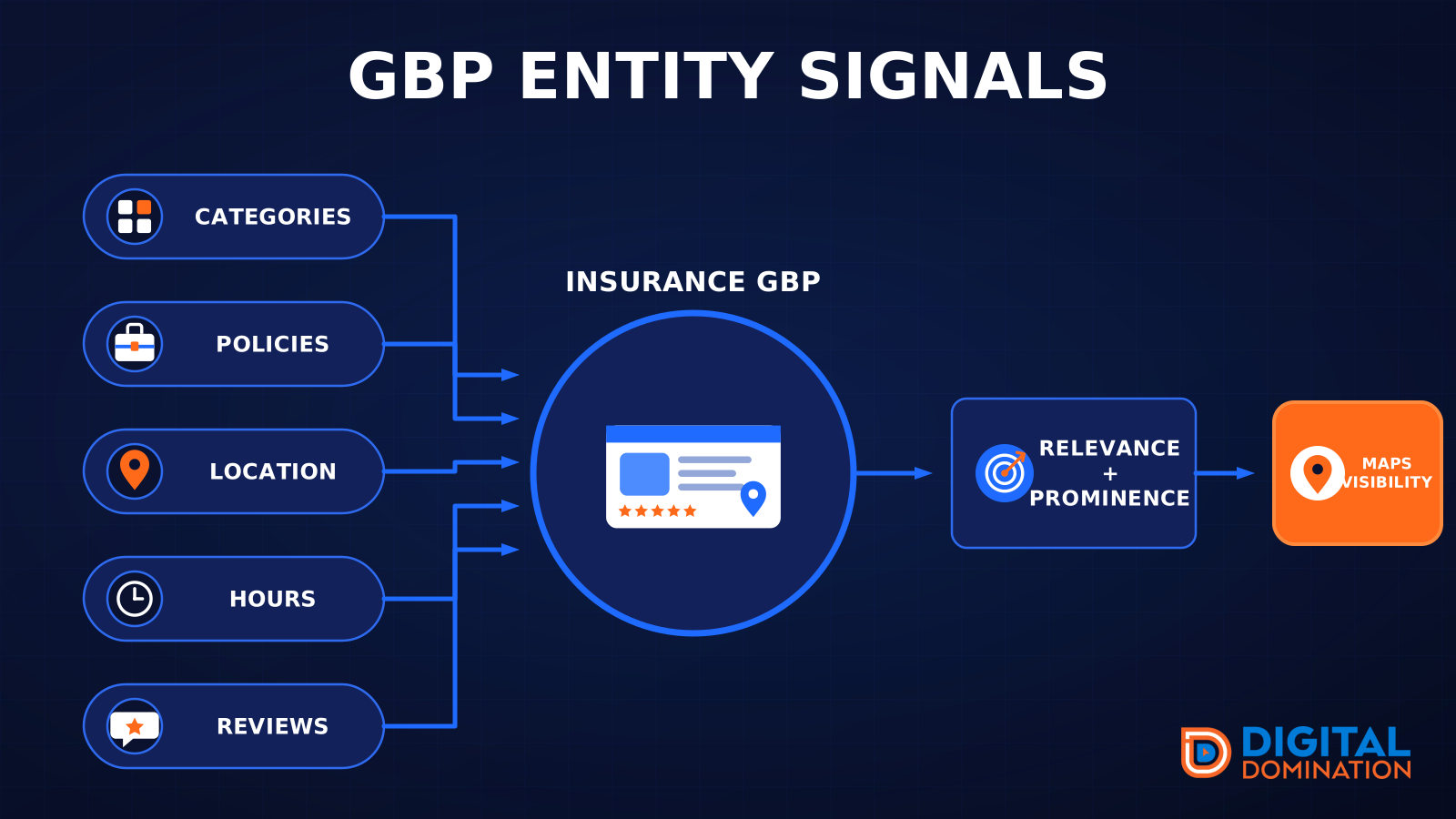
Insurance has a profile problem most trades do not: the agency, the principal agent and sometimes the carrier all claim the same address. A captive office often has a carrier-generated listing named after the agent, a second named after the office, and a stale duplicate from a prior tenant. Pick one primary profile and merge or remove the rest, or Google splits your reviews and relevance.
Then build the profile around the lines you write. The primary category should be the line driving most new business: Insurance agency for a multi-line independent, Auto insurance agency for an auto-heavy shop, Health or Life insurance agency for benefits and Medicare specialists. Add secondaries for every real line, including Home insurance agency and Insurance broker if you place with multiple carriers. Then complete:
- ▸Services named the way policyholders search: homeowners, auto, renters, umbrella, general liability, commercial auto, workers' compensation, business owner's policy, certificates of insurance, Medicare Advantage and Supplement, term life.
- ▸A description per service naming the carriers you can quote it with. 'We shop it across seven carriers' is the independent agency's whole reason to exist.
- ▸Hours that match when you answer, plus who a policyholder calls to report a claim at 11 pm.
- ▸Photos of the real storefront, real agents and the carrier logos you are appointed with, within each carrier's co-branding rules. No stock handshakes.
- ▸A service area matching your licensed footprint, and one landing page per office with UTM parameters on the website link so each office's quote starts trace separately.
Authority a buyer can verify on the state producer lookup
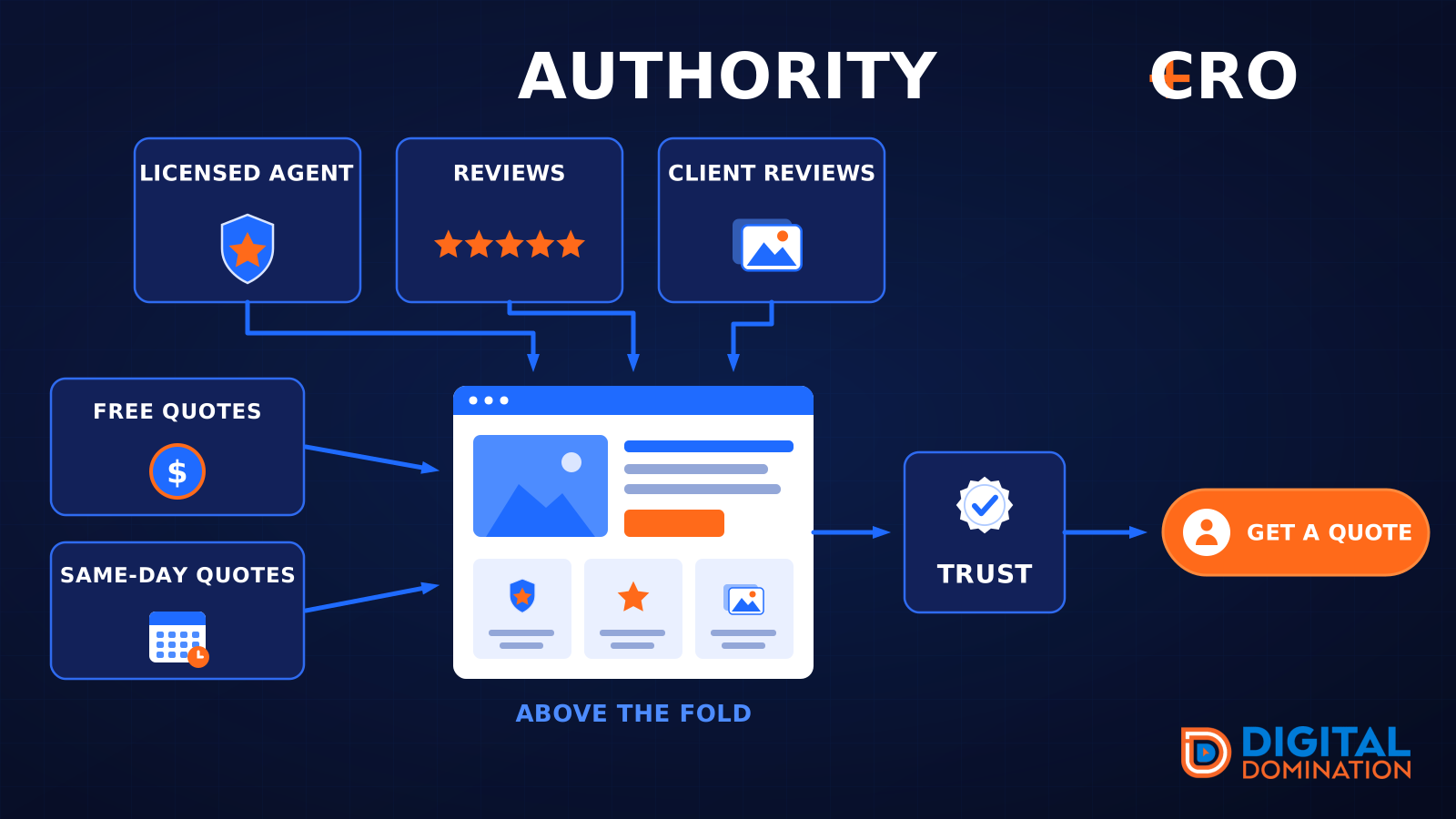
Every state insurance department runs a public producer license lookup, and the National Insurance Producer Registry ties each producer to a National Producer Number. That is the insurance equivalent of a bar number: public, checkable, specific. Most agency websites never mention it. The ones that do, with lines of authority and carriers represented, read as licensed professionals rather than lead-gen pages.
The first screen should put the line and the city in the headline, name the principal agent with a real photo, and carry an authority strip. As an example only, with placeholder figures: Independent since 2009 | Licensed in Nevada and Arizona | Appointed with 8 carriers | 4.9 stars from 300+ Google reviews | Same-day certificates. Below the fold, expand into details the buyer can check:
- ▸Each producer's name, license type, lines of authority and NPN, linked to the state lookup.
- ▸Designations with the issuing body: CIC from The National Alliance, CPCU from The Institutes, CLU from The American College, AHIP certification for anyone selling Medicare Advantage.
- ▸Carrier appointments by name, because a buyer non-renewed by one carrier wants to know you can place them with another.
- ▸Big I or state association membership, a Trusted Choice listing, and the errors and omissions coverage the agency carries.
- ▸The claims support you actually provide: first notice of loss, adjuster follow-up, annual renewal reviews.
Review velocity, and what a useful insurance review actually says
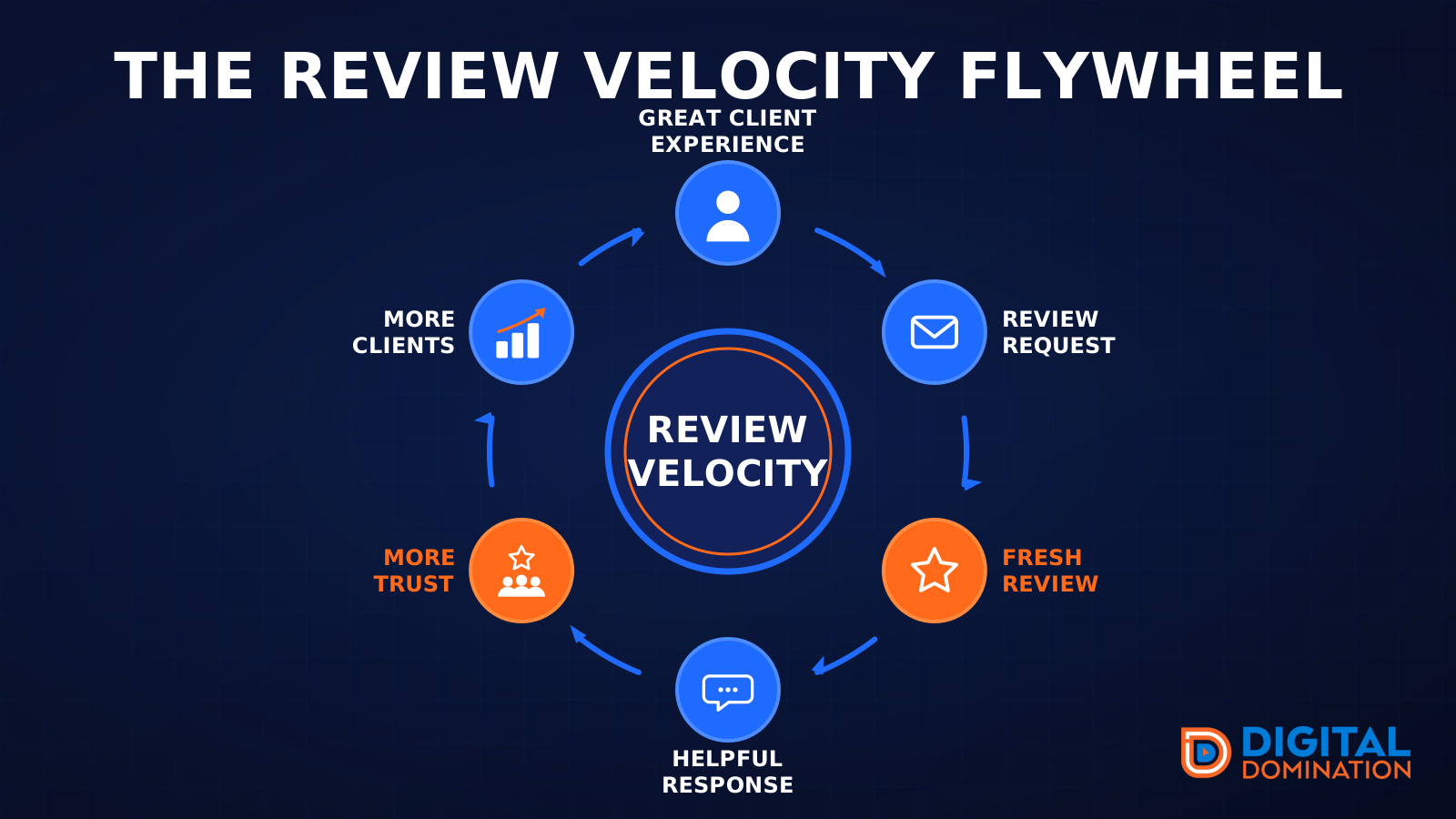
Insurance reviews cluster around three moments: the quote, the claim and the renewal. Asking only at the quote produces a wall of 'fast and friendly' that says nothing about coverage. Asking after a claim is paid, or after a renewal review heads off a premium jump, produces reviews that name the line, the agent and the problem solved, which is the language Google and AI systems use to connect your entity to those searches.
Velocity beats the total. Two hundred reviews with nothing new since last year reads as a dormant office. Trigger the ask from the management system at bind, claim close and annual review, then check monthly for:
- ▸New reviews every week, not bursts after a contest.
- ▸The line in the policyholder's words: 'my homeowners policy', 'the commercial auto for my trucks', 'my mom's Medicare supplement'.
- ▸The producer's name, so the Person entity gets corroborated too.
- ▸Claims language such as 'called the adjuster for me', the strongest trust signal in this niche, and owner responses that add context without disclosing policy details.
Schema anchored on InsuranceAgency, with the NPN as the identifier
Schema.org has a type built for this business. InsuranceAgency is a subtype of FinancialService, itself a subtype of LocalBusiness, so it inherits address, hours, telephone, areaServed and review properties while saying precisely what kind of financial service the office is. Most agency sites we audit ship no structured data or a generic LocalBusiness block from a plugin or carrier template, leaving producers, lines and carriers unconnected. The graph that describes an agency completely:
- ▸The agency: InsuranceAgency with a permanent @id such as yourdomain.com/#agency, plus address, telephone, openingHours, areaServed, sameAs and brand.
- ▸Each office: a second InsuranceAgency node with its own @id and parentOrganization pointing at the agency.
- ▸Each producer: Person with worksFor pointing at the agency @id, and an identifier PropertyValue whose propertyID is NPN and whose value is the National Producer Number.
- ▸Licenses and designations: hasCredential with EducationalOccupationalCredential nodes for the state license and for CIC, CPCU, CLU or AHIP.
- ▸Each line: Service with serviceType (Homeowners Insurance, Commercial Auto Insurance), provider pointing at the agency @id, and areaServed listing the states you are licensed in.
- ▸Carriers represented: brand on the agency node naming each carrier as an Organization, the machine-readable version of 'we shop your policy'.
- ▸Quotes and fees: Offer on each Service with price 0, or a PriceSpecification for any broker fee your state allows.
- ▸Corroboration and pages: sameAs to the state lookup, NIPR, Trusted Choice, the carrier agent-locator page and LinkedIn; WebPage per location and line, BreadcrumbList, FAQPage.
PageSpeed when the quote widget is an iframe and the site belongs to the carrier
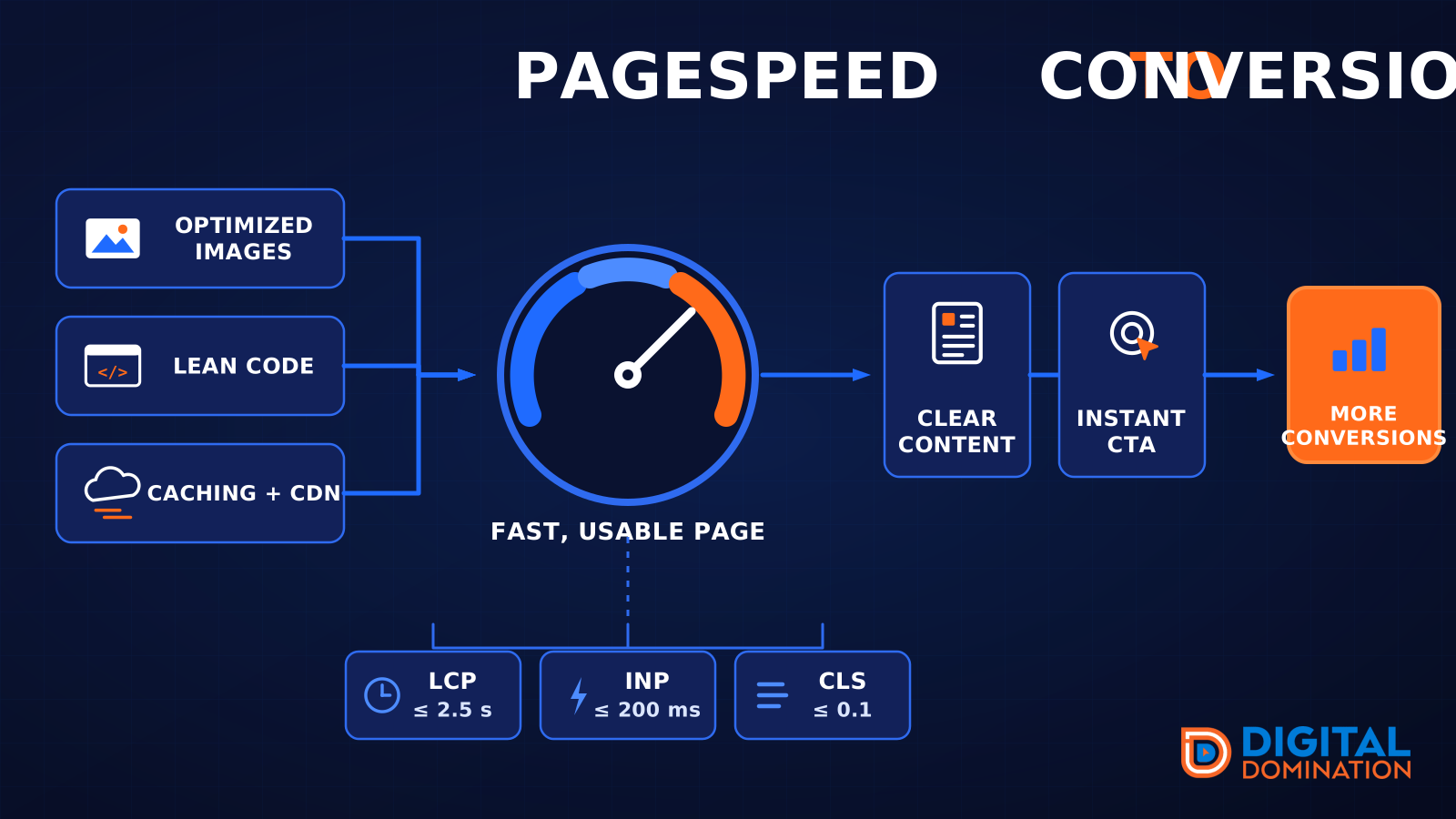
Insurance sites carry weight other local sites do not. Captive agents are often stuck on a carrier microsite they cannot fully edit. Independents bolt on a comparative rater form (EZLynx, Applied or similar) that loads as an iframe, plus chat, call tracking, a pixel and a review carousel. The homeowner from the opening is on a phone in her kitchen. If the number and quote button are not usable in about two seconds, the 1-800 number on the letter wins.
Google's good thresholds are LCP of 2.5 seconds or less, INP of 200 milliseconds or less and CLS of 0.1 or less, measured at the 75th percentile of field data. At Digital Domination we target a PageSpeed Insights performance score of 90 or higher and a 2/2 agentic browsing check, because the AI agents now shopping coverage for buyers need to read the page too. The fixes that matter on a typical agency site:
- ▸Replace the auto-loading rater iframe with a short first step (ZIP, line, phone) that hands off to the rater after the click. The iframe is almost always the LCP and INP problem.
- ▸Reserve the quote form's dimensions so it does not shove the phone number down the screen. That shove is your CLS.
- ▸Serve the hero as WebP at display size and preload it; lazy-load the carrier logo row and review carousel; defer chat, call tracking and pixels until first interaction.
- ▸If the carrier microsite cannot be sped up, build an agency-owned landing page on your own domain, point the GBP there, and make the carrier page a sameAs reference instead of the front door.
Quote and fee language that AI Overviews can repeat without misquoting a premium
Nobody can publish a homeowners premium, and an AI Overview should never guess one on your behalf. What AI systems and buyers can use is your fee structure and process: is the quote free, is there a broker fee, who pays the agent, how fast can I get a binder or a certificate. Language worth putting on line pages, the quote page and GBP service descriptions:
- ▸Quotes are free with no obligation to buy.
- ▸The carrier pays our agency when a policy is bound; we charge no broker fee (or: a stated broker fee applies to certain commercial placements and is disclosed before you buy, where your state permits).
- ▸We compare a stated number of carriers for auto and home and show the options side by side.
- ▸Certificates of insurance are issued the same business day for active commercial clients; binders the same day for most personal lines once application and payment are complete.
Content that follows the buyer from the mailbox to the renewal review
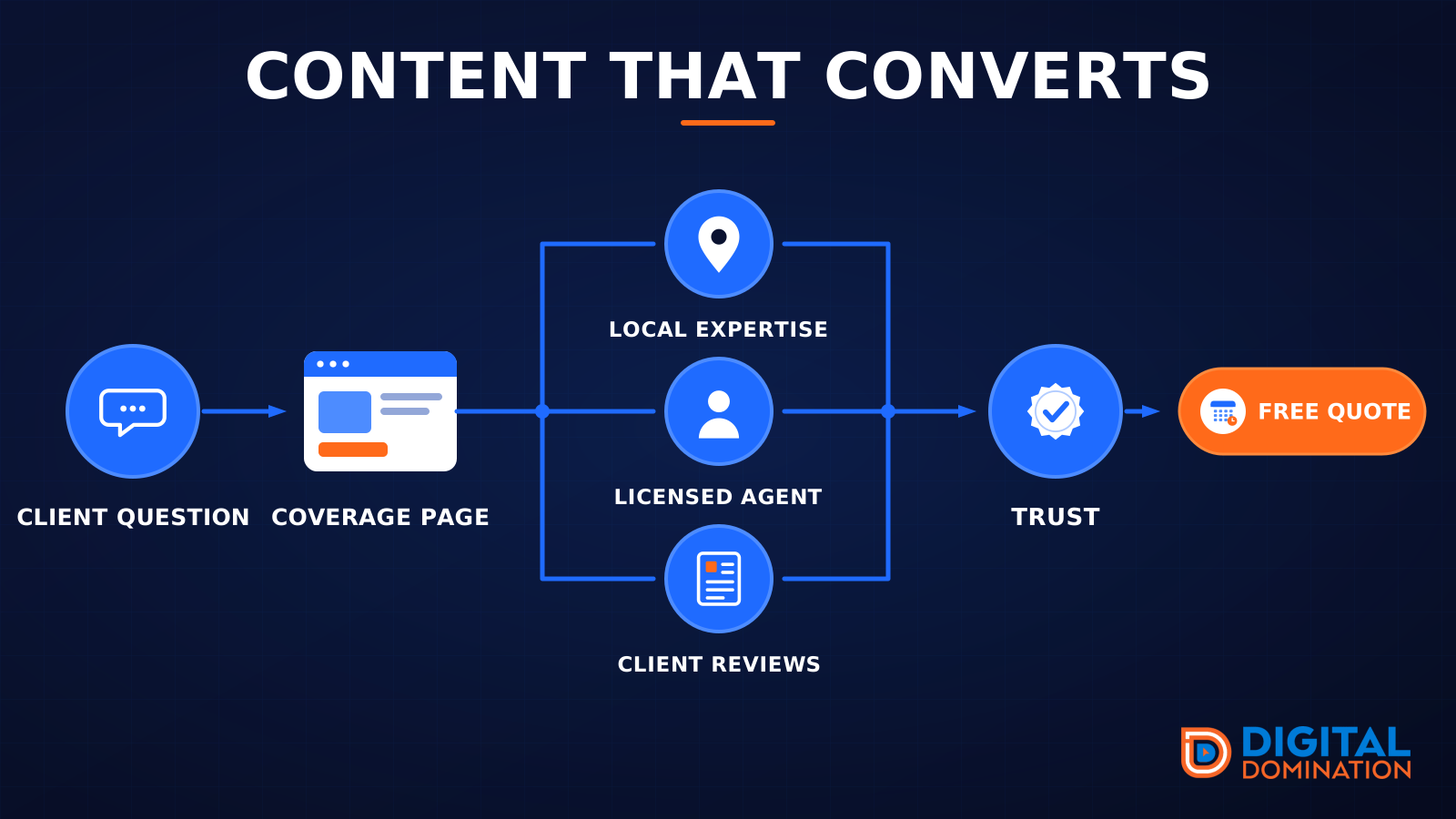
Every line has a journey with predictable questions, and the agency that answers them on its own pages gets cited for them. A homeowner asks whether an older roof is insurable. A new business owner asks the difference between general liability and a business owner's policy. A 64-year-old asks how Advantage differs from a Supplement. State-specific pages win, because minimum liability limits and workers' comp thresholds differ by state, and a national article with the city swapped in gets exposed fast. Each line page should carry:
- ▸Direct answers to the top five questions for that line under plain headings, so the agent's words become the quotable snippet.
- ▸The state minimums and why you recommend more, citing the statute or the division of insurance page.
- ▸A named producer author with license type and NPN, published and updated dates, a short claims walkthrough, and internal links to the producers who write that line and the office page.
Search Console, GA4 and the agency management system: did the quote bind
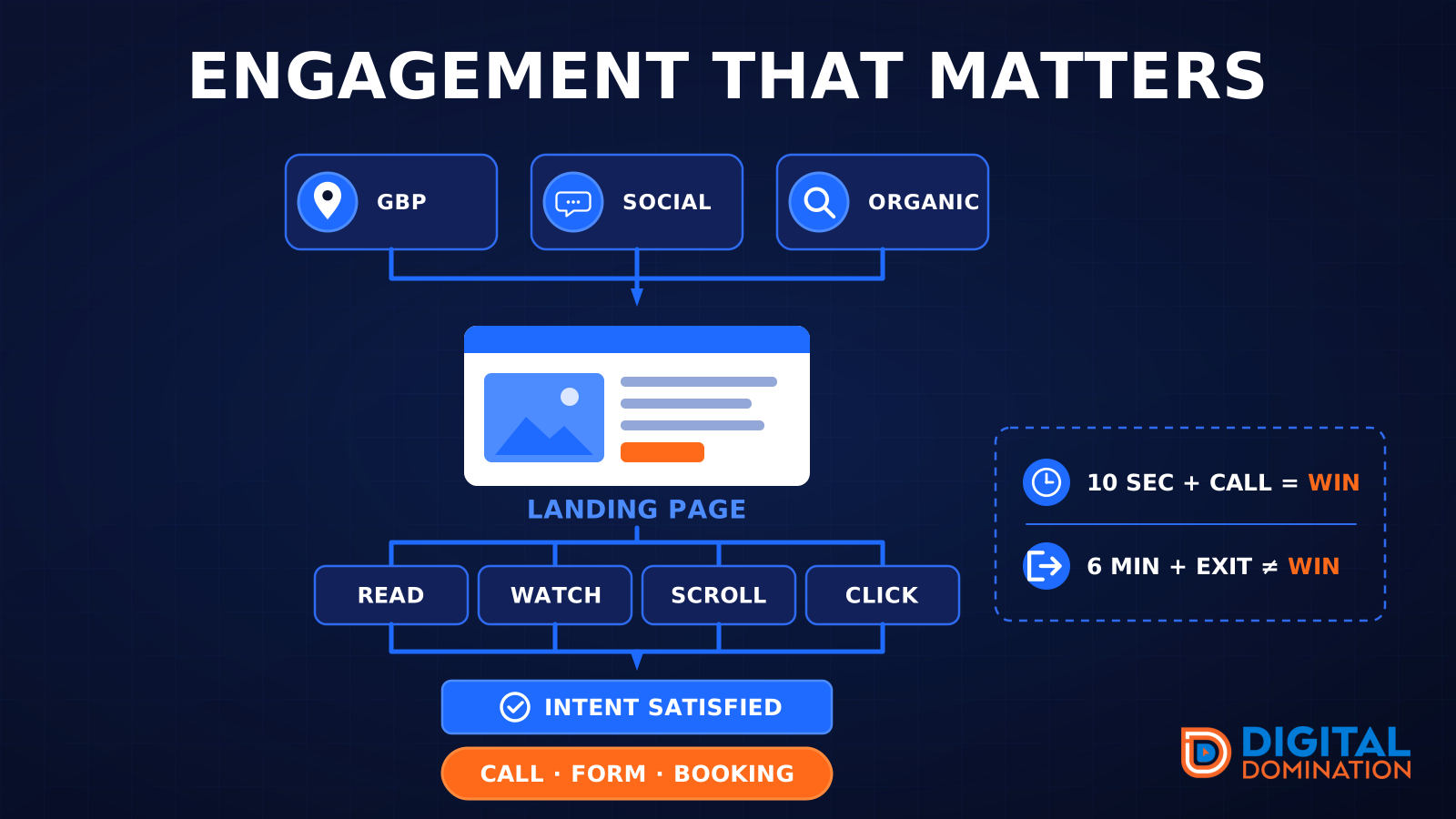
Search Console shows which coverage queries produce impressions and clicks per page and where structured data or Core Web Vitals fail. GA4 shows what happened after the click: quote starts, completions, click-to-call. The management system closes the loop: which quotes bound, at what premium, which cancelled at first payment. Pass the GA4 client ID and UTM source into the quote form so a bound policy traces back to the query, then run the cycle monthly:
- ▸High impressions, low clicks for 'commercial auto insurance' plus your city: fix the title, opening line and above-the-fold proof for that line.
- ▸Clicks but few quote starts: usually speed, a buried phone number, or a form that asks for the VIN before the name.
- ▸Quote starts that never bind: pricing fit, carrier appetite or slow follow-up, not SEO. Fix intake before buying more visibility, and date every change so four weeks of data can judge it.
Renewal-season videos, community groups and the mentions that name your agency
Social publishing here is corroboration, not virality: the same agency, producers, lines and city showing up on Facebook, LinkedIn, YouTube, Nextdoor and in local groups where policyholders already complain about premiums. Google now reports supported social and video platform properties in Search Console, so those posts are part of the same footprint. The strongest mention is unlinked and specific: a neighbor in a community group saying your office placed her home policy in two days after a non-renewal, naming the agent. Reddit is one source among several. Axios reported in August 2026 that Reddit's share of visible ChatGPT Search citations fell roughly 86 percent even though OpenAI keeps a Reddit data partnership, which is why a diversified footprint matters. Practical moves:
- ▸A short video before each renewal cycle explaining why premiums moved in your state and what a policyholder can do, with the producer on camera, posted to GBP, YouTube and Facebook.
- ▸Answers in local homeowner and small-business groups that explain coverage rather than pitch, and chamber memberships that produce a real page naming the agency.
- ▸Identical name, address, phone and license details across the state lookup, NIPR, Trusted Choice, carrier locators and every social profile.
A 90-day roadmap timed to renewal season and the enrollment windows
Insurance demand is seasonal in ways a plumber's is not. Homeowners renewals cluster on carrier dates, auto shoppers spike when rate increases hit the mail, commercial buyers renew at fiscal year end, and Medicare's annual enrollment period runs October 15 to December 7. Start the 90 days so the foundation is done before your heaviest window opens:
- ▸Days 1-14, baseline: GeoGrid scan for each primary line plus city; resolve duplicate or carrier-generated profiles; pull producer records from the state lookup and NIPR; audit schema, Core Web Vitals and the quote iframe; wire GA4 events for quote start and click-to-call.
- ▸Days 15-30, repair: one agency-owned landing page per office with the authority strip and producer bios; the InsuranceAgency graph with Person, NPN, Service and carrier brand nodes; a two-step quote start in place of the auto-loading rater; fee language on every line page.
- ▸Days 31-60, expand: state-specific line pages and claims walkthroughs; the bind, claim and renewal review request workflow; renewal-season videos; clean directory and carrier locator listings.
- ▸Days 61-90, optimize: high-impression low-click lines in Search Console, high-click low-quote pages in GA4, quotes that never bound in the management system; fix the weakest step; recheck Core Web Vitals; re-run the GeoGrid scan before the enrollment window opens.
One licensed agency, described the same way on every record that matters
The homeowner with the non-renewal letter is not comparing SEO. She is comparing which agency looks able to solve her problem by Friday. Google and the AI systems she may ask first are comparing the same thing at scale: does this agency's profile, website, schema, reviews, producer records and community mentions all describe one licensed entity that writes this line in this place.
Build that entity once. Keep the name, address, phone, license numbers, lines and carriers identical everywhere. Let the reviews and the schema name the same producers. Let the page load fast enough that the proof is seen. Then use Search Console, GA4 and your management system to make it more relevant and prominent every month. At Digital Domination that is the standard behind our promise: top 3 in the Google Map Pack in 12 weeks or you do not pay.
If your agency's map is red everywhere except your own parking lot, start by seeing where you rank. Run the free GeoGrid scan; it checks 169 points across your market and shows which lines and neighborhoods are winnable first.
Keep reading
Related guides
- ▸ChatGPT local SEO now depends on directory proof too
- ▸Chiropractor local SEO
- ▸Concrete contractor local SEO
Put it into action
Frequently Asked Questions
Should a captive agent build a separate website from the carrier's microsite?
Usually yes, within the carrier's co-branding rules. The microsite is slow, templated and outside your control, so it cannot carry custom schema, a fast quote start or your own reviews. Make an agency-owned page the GBP website link and list the carrier page as a sameAs reference.
Which Google Business Profile category should an independent agency choose?
Pick the primary that matches the line producing most new business: Insurance agency for a balanced multi-line shop, or Auto, Home, Health or Life insurance agency for a specialist. Add a secondary for every line you genuinely write, then list individual coverages as services.
Can an agency publish pricing for AI Overviews when premiums vary by person?
You cannot publish a premium, but you can publish fee structure and process: quotes are free, whether a broker fee ever applies, that the carrier pays the agency at binding, and how fast binders and certificates are issued. That can be marked up as an Offer.
Does InsuranceAgency schema improve rankings on its own?
No. Schema helps Google and AI systems understand that the agency, its producers, its lines and its carriers are one connected entity, and it makes pages eligible for supported features. Its value depends on describing facts visible on the page and verifiable on the state producer lookup.
Where should the NPN and license details appear?
On each producer's bio page in visible text and in the Person schema as an identifier, linked to the state lookup. Many states require a license number on advertising for certain lines anyway, so this is compliance and trust in one step.
When should an agency ask for reviews?
At bind, at claim close and after the annual renewal review. Claims and renewal reviews produce the specific coverage language Google and future policyholders find convincing. Automate the request from the agency management system so velocity stays steady.
Does a Medicare page need anything special?
Yes. Pages marketing Medicare Advantage or Part D plans must carry the CMS-required third-party marketing organization disclaimer stating how many organizations and plans you represent, and producers selling them should hold current AHIP certification. A compliant page is also a stronger trust signal.
Ready to dominate your map?
Top 3 in the Google Map Pack in 12 weeks, or you don't pay.