
Online reputation management vs hiring an in-house marketer
Which option is more likely to get a local business more calls from Google Maps, local search, and AI-influenced discovery?
The short answer for a local business owner
If your main goal is more calls from Google Maps, local search, and AI-influenced discovery, online reputation management is usually the more direct first investment. Reviews, ratings, responses, profile completeness, and local trust signals sit very close to the moment when a customer is choosing who to call.
An in-house marketer can be the better choice when your business needs daily execution across many channels, not just more calls from local search. That includes content, campaigns, analytics, website changes, internal coordination, events, brand messaging, email, social media, and reporting across the whole business.
For a local service business, the deciding question is simple: are you trying to fix a local trust and visibility problem, or are you trying to staff a broad marketing department? If the problem is that people find you on Google but choose someone else, or you do not appear strongly enough across your service area, reputation management should usually come first.
How Google decides which local businesses get seen
Google Business Profile Help says local results are mainly based on relevance, distance, and prominence. That means Google is trying to understand whether your business matches the search, how close you are to the searcher or searched area, and how well known or trusted your business appears to be.
Google also says businesses with complete and accurate Business Profile information are more likely to show up in local search results. For an owner, that means the basics still matter: category, services, hours, address or service area, phone number, website, photos, and other profile details need to be accurate and consistent.
Reviews are part of this buying decision and visibility picture. Google Business Profile Help says more reviews and positive ratings can help a business's local ranking, and Google Business Profile performance defines Calls as the number of times a customer clicked the call button on a Business Profile.
For calls from Maps and local search, the key inputs an owner can influence include:
- ▸Complete and accurate Business Profile information
- ▸A steady flow of legitimate customer reviews
- ▸Review responses that show the business is active and accountable
- ▸Clear service and location signals
- ▸Accurate tracking of calls from the Business Profile
- ▸Visibility checks across the actual service area, not just one search from the office
What online reputation management is really buying
BrightLocal explains that review management focuses on collecting, monitoring, and responding to online reviews, while reputation management covers the entirety of a business's reputation. In a local search context, the practical job is to help more real customers see current proof that your business is trustworthy.
This is not only about getting more stars. It is about building a repeatable process so happy customers are asked for feedback, reviews are monitored, responses happen quickly, and your Google Business Profile reflects the business you actually run.
Google Business Profile Help says a business can share a review request link or QR code to encourage customers to leave reviews. Google also says Business Profiles may show customer reviews from trusted non-Google sources such as travel or local review sites. BrightLocal's 2026 Local Consumer Review Survey reported that the average consumer uses six different review sites when choosing businesses, so your reputation is not limited to one profile.
A practical online reputation management program should usually cover:
- ▸Review request process after real customer interactions
- ▸Google review link or QR code usage
- ▸Monitoring of new reviews
- ▸Owner-approved response guidelines
- ▸Escalation for unhappy customers
- ▸Checks for important non-Google review sources
- ▸Business Profile accuracy and local trust signals
What an in-house marketer is really buying
Hiring an in-house marketer gives you a person inside the business who can coordinate marketing every day. That can be valuable when the business has enough ongoing work to keep one person focused across many projects.
The U.S. Bureau of Labor Statistics says market research analysts and marketing specialists gather and analyze data on consumers and competitors, and the median annual wage for market research analysts was $78,760 in May 2025. That wage does not include tools, training, management time, payroll costs, or the possibility that one hire may not have deep experience in every channel.
O*NET OnLine lists search marketing strategist tasks that include managing search tracking and reporting, optimizing digital assets for SEO, analyzing web metrics, conducting online marketing initiatives, and purchasing or negotiating local search or digital mapping listings. In plain English, a strong in-house marketer may touch a lot of different work, but that also means their attention is spread out.
An in-house marketer fits best when the business needs:
- ▸Daily coordination across multiple departments
- ▸Website updates and content publishing
- ▸Campaign planning across email, social, search, and offline channels
- ▸Brand communication and internal approvals
- ▸Analytics and reporting beyond local search
- ▸Vendor management across several marketing partners
- ▸A full-time person who understands the business from the inside
Why reviews matter more than many owners think
BrightLocal's 2026 Local Consumer Review Survey reported that 97% of consumers read reviews for local businesses. It also reported that Google was used by 71% of consumers for reviews and ChatGPT or other generative AI tools were used by 45% for local recommendations.
That matters because customers are not only searching one way anymore. They may look at Google Maps, read reviews on several sites, ask an AI tool for local suggestions, then come back to Google to click a call button. A thin, old, or unmanaged reputation can weaken confidence at several points in that path.
Freshness matters too. BrightLocal reported that 74% of consumers only care about reviews written in the last three months, 47% will not use a business with fewer than 20 reviews, and 31% will only use a business with 4.5 stars or more. Those are market findings, not a guarantee for any single business, but they show why a stale review profile can cost calls.
Where online reputation management usually wins
Online reputation management usually wins when the business already serves customers well but has not turned that good work into visible proof online. This is common with contractors, home service companies, medical practices, local retailers, auto shops, and other businesses where trust affects the call.
It also tends to be the better first move when the owner wants a narrow outcome: more calls from Google Maps and local discovery. A good reputation program should be tied to real visibility and call tracking, not vague activity reports.
Choose online reputation management first when these are true:
- ▸You have happy customers but not enough recent reviews
- ▸Competitors have stronger review profiles in the Map Pack
- ▸Your Google Business Profile is incomplete or inconsistent
- ▸You do not respond to reviews reliably
- ▸You are unsure where you rank across your full service area
- ▸You need a system, not another task for the front desk
- ▸You want work tied directly to Maps visibility and call opportunities
Where hiring an in-house marketer is the better choice
An in-house marketer is the better choice when your marketing problem is broader than reputation, reviews, and local search visibility. If the business needs someone to coordinate projects every day, work with staff, manage campaigns, write content, help with events, and report to leadership, a specialist reputation program may be too narrow by itself.
This is especially true for businesses with multiple departments, frequent promotions, complex sales cycles, franchise coordination, or a heavy need for brand communication. In those cases, the in-house person can become the central point for many moving parts.
Choose the in-house marketer when you need:
- ▸Daily cross-channel execution
- ▸Frequent website and content updates
- ▸Internal coordination with sales, operations, and leadership
- ▸Brand voice control across many materials
- ▸Campaign calendars and promotions
- ▸Broad reporting across marketing, not just local search
- ▸A long-term internal marketing operator
Seven questions to ask before you sign
Before choosing either option, ask questions that connect the expense to calls, visibility, and accountability. The right answer should be plain enough that you can explain it to your manager, office admin, or service team.
Use these questions before you commit:
- ▸Will this directly improve our Google Business Profile, reviews, ratings, responses, and local trust signals?
- ▸How will we track calls from the Business Profile?
- ▸How will we know where we rank across the actual service area?
- ▸Who asks customers for reviews, and when does it happen?
- ▸How are negative reviews handled without violating Google or FTC rules?
- ▸What work happens every week, and what proof will we see?
- ▸If we hire in-house, does this person already know local SEO, reviews, analytics, content, and campaign execution?
Compliance matters when asking for reviews
Review growth has to be handled carefully. Google Business Profile Help says Google does not allow merchants or users to offer payment, discounts, free goods, or services in exchange for posting any review or revising or removing a negative review.
The Federal Trade Commission says its final rule prohibits businesses from providing compensation or other incentives conditioned on consumer reviews expressing a particular positive or negative sentiment. In plain English, do not pay for positive reviews, do not offer a gift only for a good review, and do not pressure customers to change or remove negative feedback in exchange for something.
A safe review process should include:
- ▸Requests sent to real customers
- ▸No reward tied to review sentiment
- ▸No employee or fake customer reviews
- ▸No filtering that only asks happy customers for public reviews
- ▸A clear process for responding to complaints
- ▸Owner visibility into review requests and responses
What to look for and what to expect
A good reputation management provider should make the work visible. You should not have to guess whether reviews are being requested, whether responses are happening, or whether your Google Maps visibility is improving across the places where customers actually search.
For a local business, one search from your office is not enough proof. Rankings can change by neighborhood, distance, device, and search wording. A better checkpoint is a grid-style view across the service area, paired with call tracking from the Business Profile.
Digital Domination's free GeoGrid scan checks 169 real Google results across the service area. The Maps Domination Program includes weekly GeoGrid tracking reports with visual proof of rankings and call volume, and pricing is set per market on a qualification call and tied to the ranking outcome. Digital Domination also offers the 5-Star Review System for $297/month, with no setup fee, cancel anytime, billed monthly through Stripe.
Concrete checkpoints to expect include:
- ▸A baseline scan before work starts
- ▸A clear review request process
- ▸Current Business Profile information checked for accuracy
- ▸Review response standards approved by the owner
- ▸Call tracking tied to the Business Profile
- ▸Weekly or regular reporting you can understand
- ▸Evidence by location, not just one keyword screenshot
The practical decision
If calls from Google Maps, local search, and AI-influenced discovery are the priority, start with online reputation management unless you already know you need a full-time internal marketing operator. Reviews, ratings, response behavior, profile completeness, and local prominence are directly connected to how people choose a local business.
If your company needs daily content, campaign, website, analytics, internal coordination, and brand communication work, hire the in-house marketer or coordinator. That person can still work with a reputation partner, but their job is broader than review acquisition and local trust building.
A simple way to decide:
- ▸Choose reputation management if the main goal is more local calls
- ▸Choose reputation management if reviews are old, weak, inconsistent, or unmanaged
- ▸Choose reputation management if you need Google Maps visibility proof by service area
- ▸Choose in-house if marketing work is piling up across many channels
- ▸Choose in-house if leadership needs one internal person to coordinate everything
- ▸Choose both later if you need internal coordination plus specialist local search execution
Next step if reputation is the priority
If online reputation management looks like the better fit, visit Digital Domination's Online Reputation Management page. It explains the service in plain terms, including how review growth, responses, Google Business Profile signals, and local visibility connect to more call opportunities.
You can also request the free GeoGrid scan on Digital Domination's scan page. The scan checks 169 real Google results across your service area, so you can see where you show up before deciding what to do next.
Keep reading
Related guides
Put it into action
Frequently Asked Questions
Is online reputation management better than hiring a marketer for Google Maps calls?
If the main goal is more calls from Google Maps and local search, online reputation management is usually the more direct first step. It focuses on reviews, ratings, responses, profile accuracy, and local trust signals that affect how customers choose who to call.
When should I hire an in-house marketer instead?
Hire an in-house marketer when you need daily work across many channels. That includes content, campaigns, website updates, analytics, social media, internal coordination, and brand communication beyond reviews and local search.
Do reviews really affect local rankings?
Google Business Profile Help says more reviews and positive ratings can help a business's local ranking. Google also says local results are mainly based on relevance, distance, and prominence, so reviews are one important part of a bigger local visibility picture.
Can I offer customers a discount for leaving a review?
No. Google says businesses cannot offer payment, discounts, free goods, or services in exchange for posting a review or changing or removing a negative review. The FTC also prohibits incentives that are conditioned on a review expressing a particular positive or negative sentiment.
What should I track if I want more calls from Google?
Track calls from your Google Business Profile, review growth, average rating, review response activity, profile completeness, and Maps visibility across your service area. Google defines Calls in Business Profile performance as the number of times a customer clicked the call button on a Business Profile.
Can an in-house marketer manage reputation too?
Yes, if they have the time, tools, and local search knowledge. The risk is that reputation work becomes one more task among content, campaigns, reporting, website updates, and internal requests.
How fast should a business respond to reviews?
BrightLocal's 2026 Local Consumer Review Survey reported that 89% of consumers expect businesses to respond to reviews and 81% expect a response within a week. A practical goal is to respond consistently, professionally, and quickly enough that customers see the business is paying attention.
What is the first step before paying for reputation management?
Start with a baseline view of your current Maps visibility, review profile, and Business Profile accuracy. Digital Domination's free GeoGrid scan checks 169 real Google results across the service area so you can see the problem before choosing a plan.
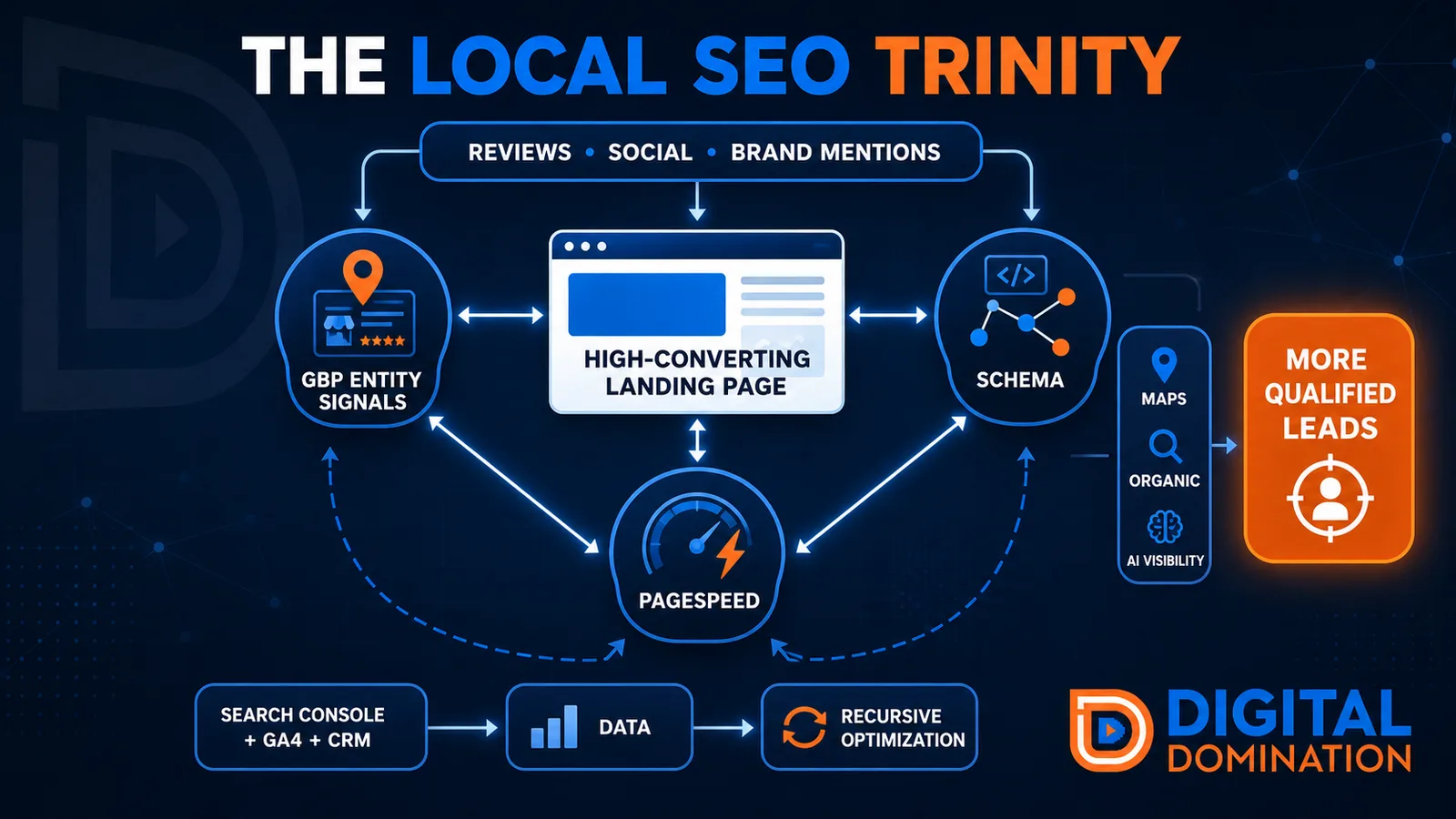
The Local SEO Trinity
Think of a three-legged stool. Your Google profile, your website, and your reviews all have to hold you up. If one leg is short, the whole thing wobbles.
GBP entity signals
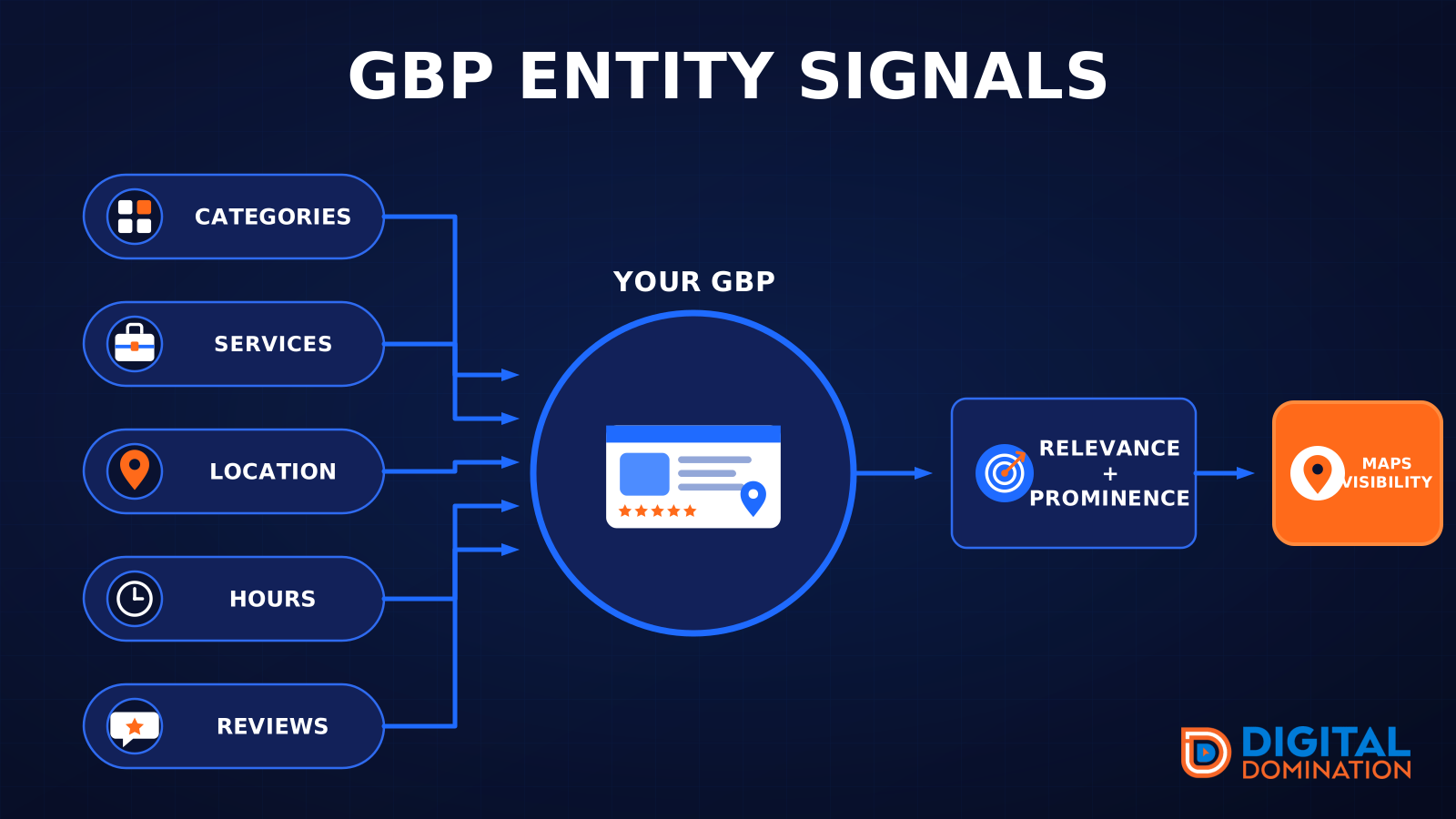
This leg is your Google Business Profile. GBP means Google Business Profile. It covers your categories, your services, your location, your hours, and your reviews. Google uses those facts to decide who to show.
Your Google profile is your storefront sign. If the sign is missing, or it names the wrong shop, people drive past.
PageSpeed to conversion
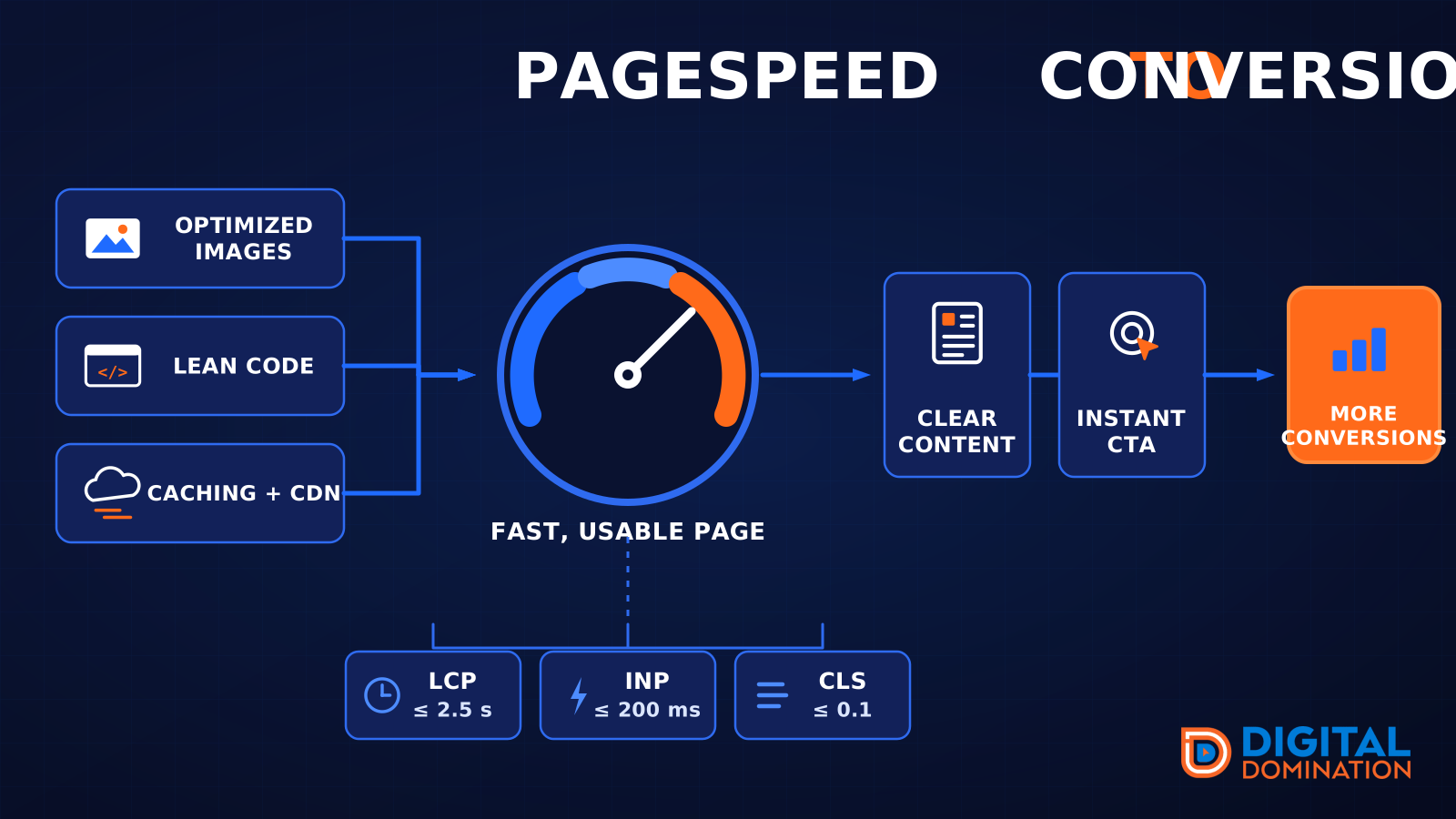
This leg is your website, above all on a phone. Small images, lean code, and caching make a page fast. A fast, clear page is what turns a visit into a call. Phone speed is one of the 12 Trinity checks because a slow page loses the call before anyone sees your offer.
Your website is the showroom. If the door sticks, people leave before they look around.
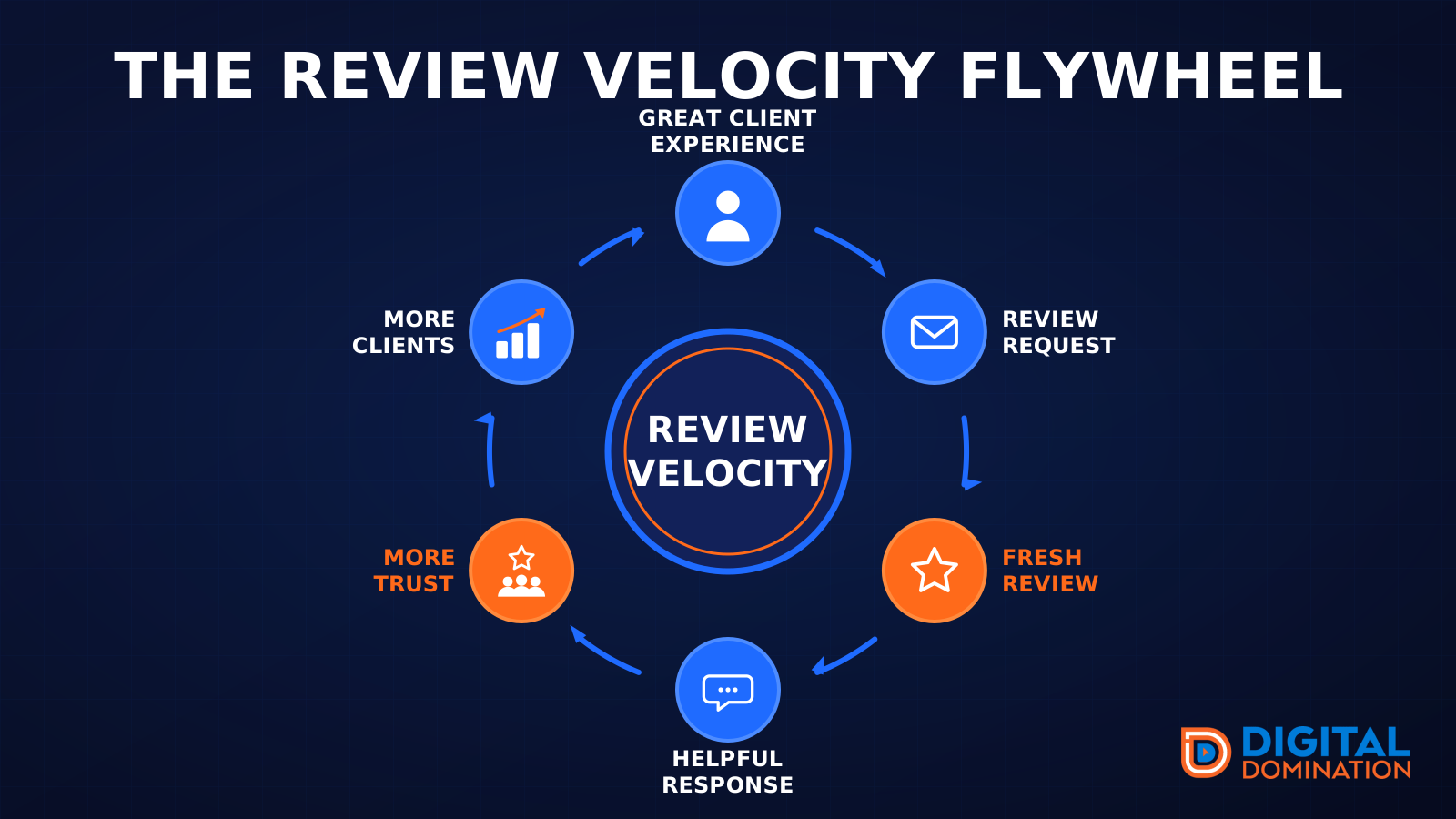
The review velocity flywheel
This leg is reviews and reputation. A good visit leads to a review request, then a fresh review, then a helpful reply, then more trust, then more customers. When the scan can find your Google listing, it shows your rating, your recent reviews, and how many you answered.
Reviews are word of mouth. One kind word helps. A steady stream of real reviews, and a reply from you, helps more.
How this turns into revenue
Being found in more searches leads to more calls. More calls lead to more booked jobs. More booked jobs lead to more revenue.
Example numbers, not a real business: 40 calls from search in a month, a 25 percent close rate, and a $400 average job. That is 10 booked jobs. That is $4,000. The math is the lesson. It is not a promise.
The full page has a box where you can type your own average job value and close rate.
One real story, from our car dealership case study: Medina Auto Group went from invisible on Google Maps to dominating every high-intent search across their market. The turnaround spanned all four of their rooftops at once. The same page says the team eliminated 89 unfair one-star reviews that had been dragging the dealership's reputation down and keeping it out of the Map Pack. It also says: “Results described here are exceptional and non-typical. Outcomes vary based on market conditions, competition, and implementation. No guarantees are made regarding earnings, rankings, or conversions.”
Free strategy call
More booked jobs start with a clear plan
Book a free strategy call. We look at your Google profile, your website, and your reviews, and we tell you what to fix first.
Free. You pick the time. A real person shows up.