
The biggest mistakes local businesses make with the Maps Domination Program
A practical buyer guide for owners who want safer Google Maps growth, cleaner proof, and fewer agency surprises.
The short answer: unsafe programs promise control they do not have
The biggest mistake is paying for a Google Maps growth program before you know whether the work is compliant, measurable, and tied to your actual service area. A safe program should not promise that it can buy rankings, stuff keywords into your business name, fake location signals, or manufacture reviews. Those tactics can make a profile unsafe, ineffective, or both.
Google Business Profile Help is clear that there is no way to request or pay for a better local ranking on Google. Google also says local results are mainly based on relevance, distance, and prominence. That means the buyer should expect a program to improve the business signals Google can evaluate, not pretend it can bypass Google.
The evidence you should expect before paying is simple: a baseline map of where you rank now, a clear cleanup plan for your Google Business Profile, a review process that follows Google and FTC rules, and ongoing reporting that shows ranking movement from many points across your market.
Mistake: buying before you see the local baseline
A single search from your office is not enough proof. Local rankings change by search location, query, and proximity. Local Falcon explains that a geo-grid scan checks a business's Google local pack rankings from multiple points across the service area rather than from one location.
Without a baseline, you cannot tell whether a program is improving visibility where your customers actually search. You also cannot tell whether the agency is reporting the best looking ZIP code while ignoring weaker neighborhoods.
Before you sign, ask for a ranking view that covers the service area, not just one screenshot:
- ▸A grid view for your main service and city terms
- ▸Your current Map Pack positions by location point
- ▸The search terms being tracked
- ▸The date the scan was run
- ▸A plain explanation of weak and strong areas
Mistake: treating Google Maps like paid placement
Some owners get into trouble because they hear a sales pitch that makes Maps rankings sound like an ad slot. Google Business Profile Help says there is no way to request or pay for a better local ranking on Google. Paying an agency should mean paying for labor, strategy, cleanup, content, tracking, and execution, not paying Google for a Maps position.
A fair agency will explain what it controls and what it does not control. It can help with profile accuracy, category choice, service settings, review acquisition systems, location pages, business data, and reporting. It cannot make Google ignore relevance, distance, and prominence.
Be careful if the sales pitch sounds like any of these claims:
- ▸We have a special Google contact for Map Pack placement
- ▸We can make you rank anywhere overnight
- ▸We can pay to push you into Maps
- ▸We can guarantee every keyword in every neighborhood
- ▸You do not need tracking because we know it works
Mistake: ignoring category, name, and profile basics
Google says businesses with complete and accurate information are more likely to show up in local search results. That sounds basic, but many Maps campaigns fail because the profile is not clean before growth work starts.
Whitespark's Local Search Ranking Factors report ranked Primary GBP Category first for Local Pack and Maps rankings, with proximity of address to the point of search second and keywords in the GBP business title third. The category point is useful because it is a legitimate profile setting. The business title point is risky if someone tries to force keywords into a name that is not the real-world name.
Google Business Profile Help says a Business Profile name should reflect the real-world name, and unnecessary information in the business name can result in suspension. If a program starts with name stuffing, that is not a strategy. It is a suspension risk.
A good profile review should cover these basics before advanced work begins:
- ▸Primary category fit
- ▸Secondary category cleanup
- ▸Real-world business name
- ▸Correct phone number
- ▸Accurate hours
- ▸Service list and business description
- ▸Photo and profile completeness
Mistake: setting a fake or sloppy service area
Service-area settings matter, especially for plumbers, electricians, roofers, mobile mechanics, locksmiths, cleaners, and other businesses that travel to customers. Google Business Profile Help says service-area businesses can set up to 20 service areas, cannot set a radius, and should keep the overall area within about 2 hours of driving time from the business base.
Google also says a service-area business without a storefront should hide its address from customers and use one profile for its central office or location with a designated service area. If an agency suggests making extra profiles for fake locations, renting addresses only for ranking purposes, or showing a home address when customers do not visit, stop and ask for the rule they are relying on.
For a service-area business, the safer path is usually a clean central profile, accurate service areas, and ranking proof across the real territory you can serve.
Mistake: using review tactics that create legal or profile risk
Reviews are important, but unsafe review tactics can hurt the business and the agency. Google Business Profile Help says merchants may solicit reviews that represent a genuine experience, but may not offer incentives for reviews or selectively solicit positive reviews from customers. Google also says businesses can ask customers to leave reviews by visiting a Google link or scanning a QR code, and customers must be signed in to a Google Account to leave a review.
The Federal Trade Commission says advertising agencies, public relations firms, review brokers, and reputation management companies can be liable under the Consumer Reviews and Testimonials Rule if they write, create, sell, suppress, or incentivize reviews in prohibited ways. In plain English, review shortcuts can create risk for more than one party.
A compliant review process should be simple, consistent, and tied to real customers. Watch for these red flags:
- ▸Paying customers for reviews
- ▸Offering discounts for positive reviews
- ▸Only asking happy customers
- ▸Writing reviews for customers
- ▸Buying reviews from a vendor
- ▸Blocking negative feedback from review requests
Mistake: skipping verification realities
Verification is not always instant, and an agency should not pretend it can choose every verification method. Google Business Profile Help says verification methods are automatically determined. Google also says verification reviews take up to 5 business days after the business completes the required steps.
Google says most postcard verification codes arrive within 14 days and verification codes expire after 30 days. If a profile is new, moved, merged, suspended, or unverified, that timing can affect the start of a Maps campaign.
Ask what happens if verification slows the project. You want a process, not panic:
- ▸Who completes verification steps
- ▸What documents may be needed
- ▸How postcard timing is handled
- ▸What changes are avoided during verification
- ▸When tracking begins
Mistake: expecting DIY results without DIY discipline
The cheaper or DIY path can be the right fit for a single-location owner who has time to manage the details. If you can handle verification, category cleanup, review requests, service-area settings, and grid-rank tracking without needing an agency workflow, you may not need a full Maps growth program yet.
DIY becomes harder when the owner is busy, the market is competitive, the service area is wide, or the business needs regular proof that work is moving rankings and calls. The risk is not that DIY is bad. The risk is that half-done DIY creates messy profile changes, inconsistent review requests, and no clear baseline.
DIY is more realistic when these conditions are true:
- ▸One location
- ▸One main service area
- ▸Clean business name and address history
- ▸Time to request reviews consistently
- ▸Comfort with Google verification steps
- ▸A way to run grid-rank scans
- ▸Patience to track changes over time
What to look for before you pay
A good Maps growth program should make the buying decision less mysterious. You should know what will be checked, what will be changed, how success will be measured, and what could delay results. You should also be able to verify the claims yourself.
At Digital Domination, the Free GeoGrid scan checks 169 real Google results across the service area. The Maps Domination Program uses weekly GeoGrid tracking reports with visual proof of rankings and call volume. Digital Domination also works with one client per trade per service area, so territory exclusivity is part of the buying conversation.
Use these checkpoints before you pay any provider:
- ▸A baseline geo-grid scan
- ▸A written profile cleanup plan
- ▸Clear service-area review
- ▸Review request process that follows Google rules
- ▸No keyword stuffing in the business name
- ▸Weekly ranking proof from multiple points
- ▸Call volume reporting
- ▸Clear explanation of what happens if verification is delayed
Questions to ask before you sign
You do not need to be technical to interview a Maps provider. You need clear answers, plain proof, and a provider that does not get defensive when you ask about risk. These questions will expose most weak offers quickly.
- ▸What does the baseline GeoGrid show right now?
- ▸Which keywords and service areas will be tracked?
- ▸What profile changes will you make first?
- ▸Will you change my business name in Google?
- ▸How do you request reviews without incentives or filtering?
- ▸How do you handle service-area settings for my business type?
- ▸What happens if Google asks for verification again?
- ▸How often will I receive ranking and call reporting?
- ▸Do you work with another business in my trade and service area?
- ▸What proof should I expect before the first invoice continues?
Mistake: ignoring the website signals that support Maps
Maps growth is not only a profile task. Your website can help confirm what your business does, where it operates, and what customers can expect. Google Search Central says LocalBusiness structured data can tell Google about business hours, departments, and reviews if the site captures reviews about other businesses.
Structured data is not magic, and it does not replace a clean Google Business Profile. It is one more way to make business information clearer. For many local businesses, the bigger website issue is still basic: thin service pages, unclear locations served, missing hours, and mismatched contact information.
A buyer should expect the agency to review the website for consistency with the profile. At minimum, the website should support these items:
- ▸Business name consistency
- ▸Phone number consistency
- ▸Clear service pages
- ▸Real service-area language
- ▸Hours and contact details
- ▸Location or service-area pages where appropriate
- ▸Basic technical crawlability
Mistake: buying without understanding demand and trust
Google matters because customers use it early and often. BrightLocal's 2026 Small Business Marketing Report says 61% of customers start an online local-business search with Google and 71% use Google at some point during the search. That is why Maps visibility can affect lead flow for many local trades and service businesses.
BrightLocal also reported that 47% of consumers will not use a business with fewer than 20 reviews, while 47% of small and midsize businesses have fewer than 20 reviews. Do not read that as a license to chase reviews recklessly. Read it as a reason to build a steady, compliant review habit tied to real customer experiences.
The practical lesson is that rankings, reviews, and trust signals work together. A Maps program that only chases position without improving profile quality and review consistency is incomplete.
Where to go next
If you are comparing a Maps growth program, start with proof before you buy. Ask for a baseline scan, confirm the cleanup plan, and make sure the provider follows Google's rules on names, reviews, service areas, and verification.
The Maps Domination Program page explains how Digital Domination approaches Google Maps growth, weekly GeoGrid tracking, territory exclusivity, qualification, and the guarantee: top 3 in the Google Map Pack in 12 weeks or you do not pay. Pricing for the Maps Domination Program is set per market on a qualification call and tied to the ranking outcome.
If you want to see your current visibility first, start with the Free GeoGrid scan page. It checks 169 real Google results across your service area so you can see where you stand before making a buying decision.
Keep reading
Related guides
- ▸How to spot a bad Google Maps SEO provider before you sign
- ▸How do you know if your SEO company is actually working?
- ▸How Trial Attorneys Are Being Found in AI Answers Now
Put it into action
Frequently Asked Questions
Can an agency pay Google to rank my business higher in Maps?
No. Google Business Profile Help says there is no way to request or pay for a better local ranking on Google. You can pay an agency for work that improves your profile, reviews, website signals, and tracking, but not for a paid Map Pack position.
What proof should I ask for before buying Google Maps SEO?
Ask for a baseline geo-grid scan, the keywords being tracked, the service area being measured, and a written profile cleanup plan. You should also ask how reviews, verification, and service-area settings will be handled.
Is a GeoGrid scan better than searching from my phone?
Yes, for buying decisions. A phone search only shows what appears from one location, while a geo-grid scan checks rankings from multiple points across the service area. That makes it easier to see where you are strong and where you are invisible.
Can I do Google Maps optimization myself?
Yes, if you have one location and can handle verification, category cleanup, review requests, service-area settings, and grid tracking. DIY is less practical when you are busy, have a wider service area, or need regular proof of ranking movement.
Is it safe to add keywords to my Google Business Profile name?
Only if those words are part of your real-world business name. Google Business Profile Help says the name should reflect the real-world name, and unnecessary information in the business name can result in suspension.
What review requests are allowed for a local business?
Google allows businesses to ask customers for reviews when the reviews represent genuine experiences. Google does not allow incentives for reviews or selectively asking only for positive reviews, and the FTC can hold review and reputation companies liable for prohibited review practices.
How long does Google Business Profile verification take?
Google says verification methods are automatically determined, and verification reviews take up to 5 business days after the required steps are completed. Google also says most postcard codes arrive within 14 days and expire after 30 days.
What is on the Maps Domination Program page?
The page explains Digital Domination's Maps growth program, weekly GeoGrid tracking, territory exclusivity, qualification, and the guarantee. It is the next page to read after you understand the common buying mistakes and want to see whether your market qualifies.
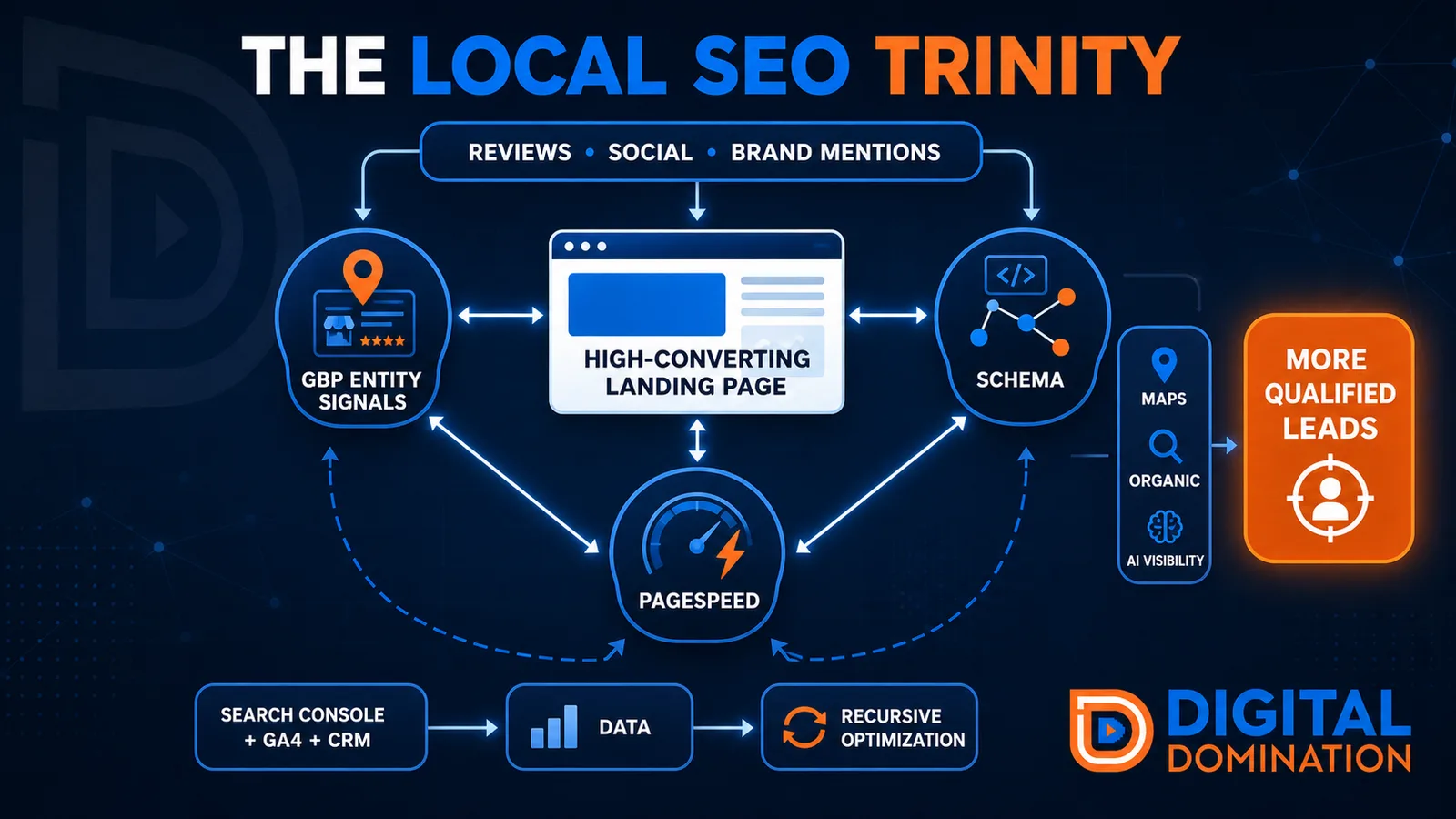
The Local SEO Trinity
Think of a three-legged stool. Your Google profile, your website, and your reviews all have to hold you up. If one leg is short, the whole thing wobbles.
GBP entity signals
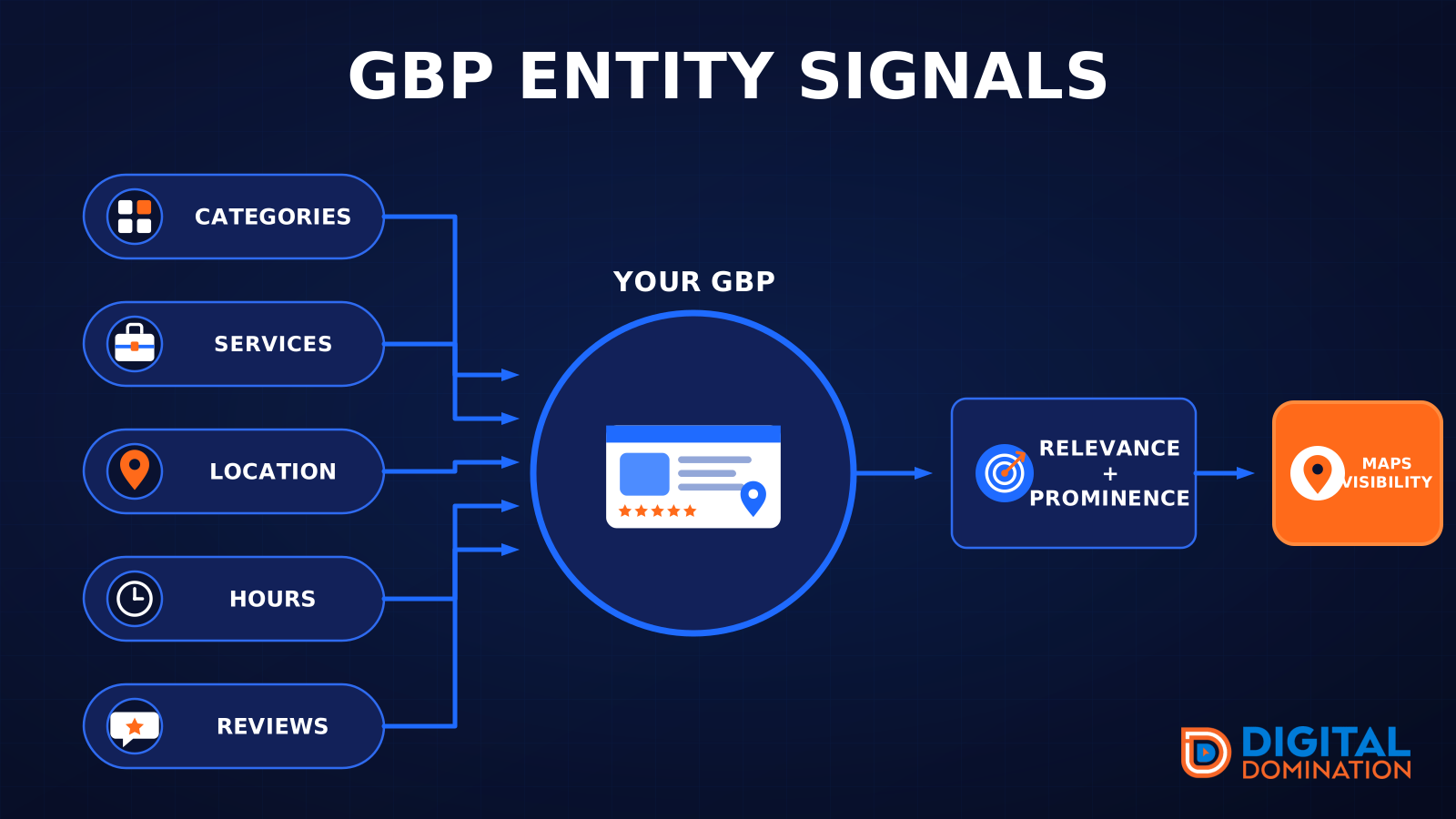
This leg is your Google Business Profile. GBP means Google Business Profile. It covers your categories, your services, your location, your hours, and your reviews. Google uses those facts to decide who to show.
Your Google profile is your storefront sign. If the sign is missing, or it names the wrong shop, people drive past.
PageSpeed to conversion
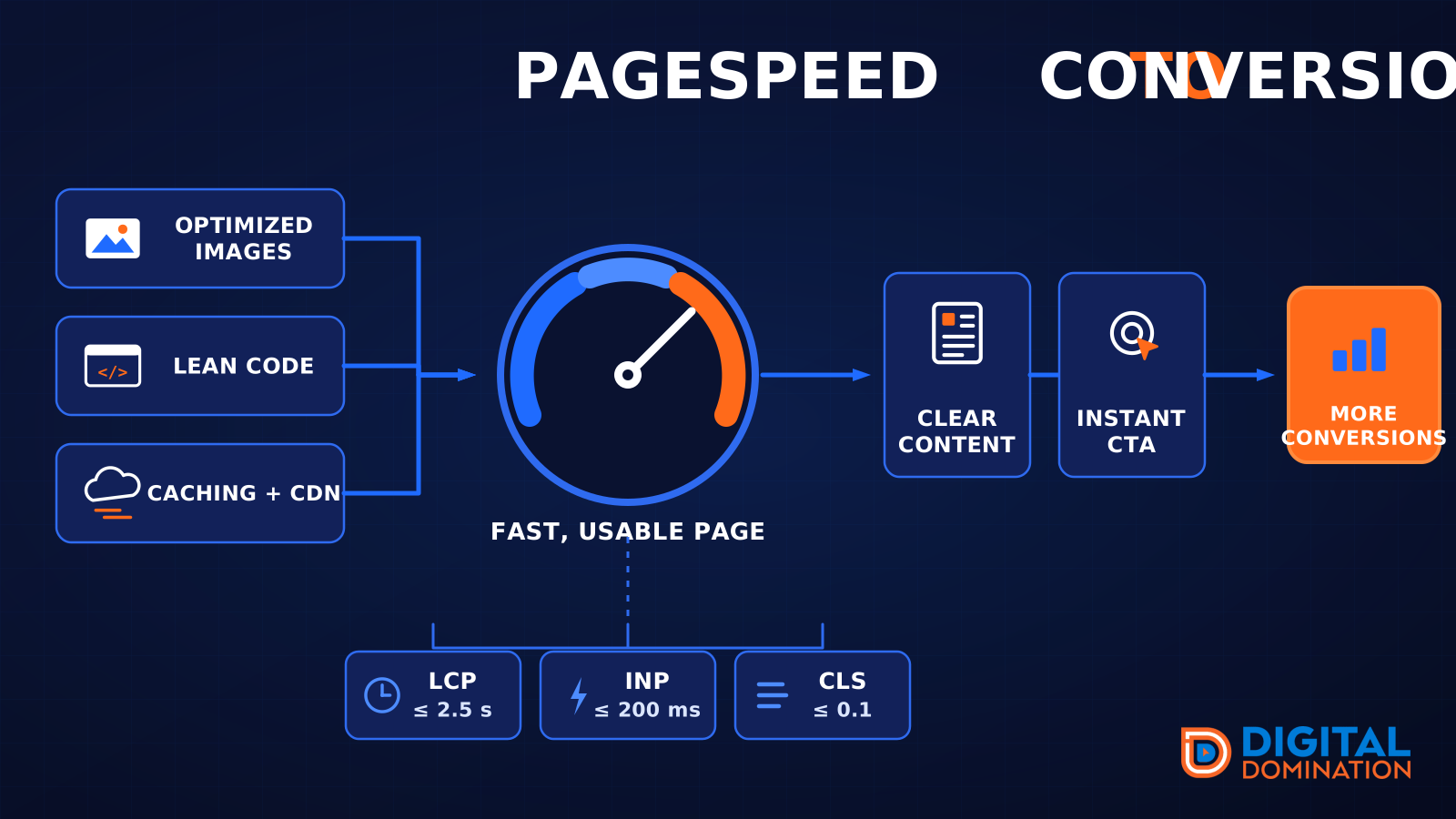
This leg is your website, above all on a phone. Small images, lean code, and caching make a page fast. A fast, clear page is what turns a visit into a call. Phone speed is one of the 12 Trinity checks because a slow page loses the call before anyone sees your offer.
Your website is the showroom. If the door sticks, people leave before they look around.
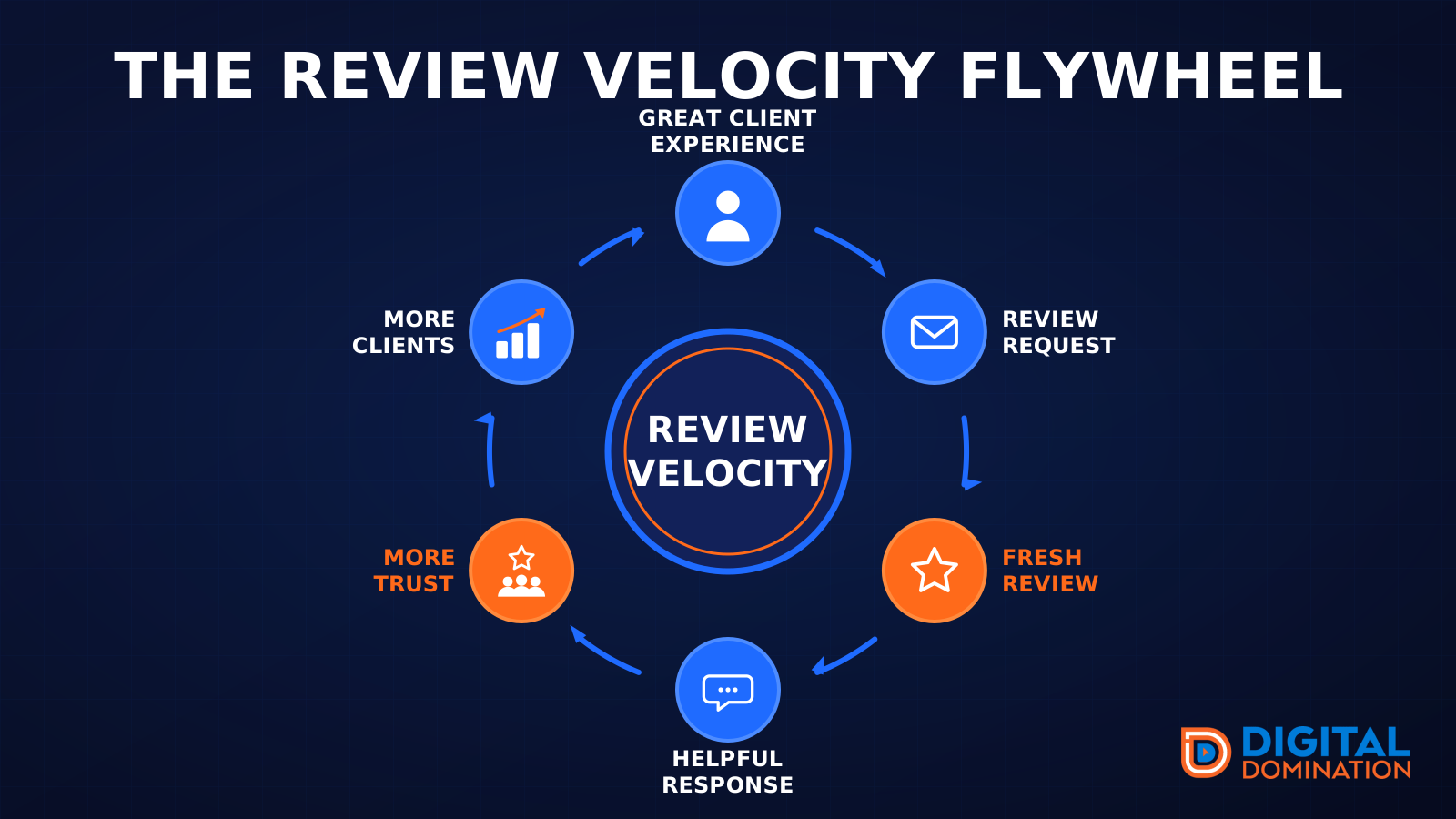
The review velocity flywheel
This leg is reviews and reputation. A good visit leads to a review request, then a fresh review, then a helpful reply, then more trust, then more customers. When the scan can find your Google listing, it shows your rating, your recent reviews, and how many you answered.
Reviews are word of mouth. One kind word helps. A steady stream of real reviews, and a reply from you, helps more.
How this turns into revenue
Being found in more searches leads to more calls. More calls lead to more booked jobs. More booked jobs lead to more revenue.
Example numbers, not a real business: 40 calls from search in a month, a 25 percent close rate, and a $400 average job. That is 10 booked jobs. That is $4,000. The math is the lesson. It is not a promise.
The full page has a box where you can type your own average job value and close rate.
One real story, from our car dealership case study: Medina Auto Group went from invisible on Google Maps to dominating every high-intent search across their market. The turnaround spanned all four of their rooftops at once. The same page says the team eliminated 89 unfair one-star reviews that had been dragging the dealership's reputation down and keeping it out of the Map Pack. It also says: “Results described here are exceptional and non-typical. Outcomes vary based on market conditions, competition, and implementation. No guarantees are made regarding earnings, rankings, or conversions.”
Free strategy call
More booked jobs start with a clear plan
Book a free strategy call. We look at your Google profile, your website, and your reviews, and we tell you what to fix first.
Free. You pick the time. A real person shows up.