
The Maps Domination Program vs doing local SEO yourself
A fair comparison for local owners deciding whether to hire a structured Google Maps SEO program or manage Google tools, reviews, and rank tracking in-house.
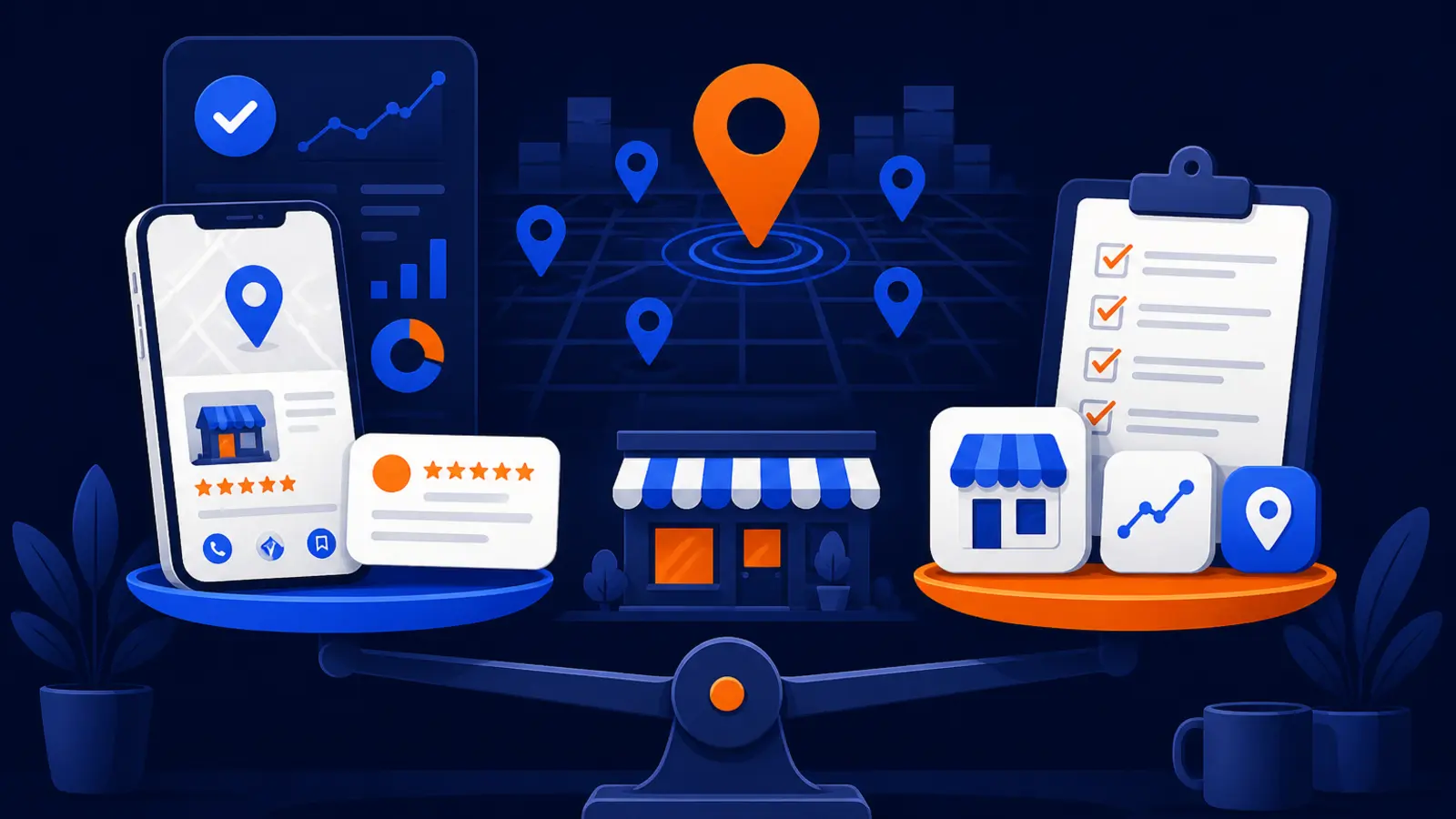
Short answer: choose based on execution, not tools
If you have time, discipline, and someone accountable for your Google Business Profile, reviews, website basics, and rank reports, the DIY route can be enough to improve visibility and calls. Google Business Profile is free, Search Console is free, and a rank tracker can help you see where you show up from different points around town.
If you want a structured system focused on more calls from Google Maps, with weekly GeoGrid tracking, ranking proof, call volume reporting, and an outcome tied to ranking, the Maps Domination Program is the stronger fit. The important difference is not free tools versus paid tools. It is whether someone is consistently doing the work that improves relevance, prominence, trust, and local visibility.
A rank tracker does not improve rankings by itself. It measures where you appear. The call growth usually comes from better profile management, stronger review activity, accurate business information, website support, local authority, and a clear plan to compete across the service area.
What the DIY path includes
The DIY path starts with the basics Google gives every eligible local business. Google Business Profile Help says eligible businesses can manage how they appear on Google Maps and Search at no charge. It also says only businesses that make face-to-face contact with customers are eligible for a Business Profile, while online-only businesses without in-person service are not eligible.
You also need verification. Google Business Profile Help says performance data is available only for verified Business Profiles, and Google may automatically determine verification methods that require more than one step. That matters because you cannot manage what you cannot verify, and you cannot judge call activity inside the profile until the profile is properly set up.
A practical DIY setup usually includes these pieces:
- ▸A verified Google Business Profile with the right business name, category, address or service area, hours, phone number, and website
- ▸A phone number on the profile so Business Profile call clicks can be tracked
- ▸Search Console connected to monitor and troubleshoot how the website appears in Google Search
- ▸A review request process that follows Google’s rules
- ▸A local rank tracker or grid tracker to see visibility from more than one search point
- ▸A calendar for checking profile edits, photos, services, reviews, website issues, and ranking reports
Where DIY can work well
DIY local SEO can work when the business owner or an in-house marketer treats it like an operating system, not a one-time setup. If your market is not brutally competitive, your profile is eligible and verified, your information is clean, and your team asks every real customer for a review without incentives, you may not need a managed program right away.
Google Business Profile Help says local results are based primarily on relevance, distance, and prominence. It also says businesses with complete and accurate information are more likely to show up in local search results, and that more reviews and positive ratings can help local ranking. That gives a DIY owner a clear starting point.
DIY is a reasonable option when these conditions are true:
- ▸You can log in weekly and keep the profile current
- ▸You understand that distance is partly outside your control
- ▸You can respond to reviews without arguing with customers
- ▸You can request reviews without offering rewards or filtering unhappy customers
- ▸You can read reports without assuming every ranking dip is an emergency
- ▸You are willing to wait a few weeks before judging whether an SEO change helped
Where DIY usually breaks down
Most DIY failures do not happen because Google’s free tools are bad. They happen because no one owns the work after the profile is created. The owner gets busy, the front desk forgets to ask for reviews, service pages stay thin, categories are not checked, duplicate profiles appear, and rank reports get ignored until calls slow down.
Google Business Profile Help warns that there should be only one profile per business because duplicate profiles can cause display problems on Maps and Search. That is the type of issue a busy owner may not notice until the phone gets quiet. Google also prohibits merchants from offering incentives for reviews, discouraging negative reviews, or selectively asking only happy customers for reviews, so review growth has to be handled carefully.
DIY becomes risky when the business needs call growth but lacks these habits:
- ▸A single person responsible for the Business Profile
- ▸A compliant review request process used every day
- ▸A way to compare rankings across the service area, not just from the office
- ▸Time to separate tracking noise from real visibility problems
- ▸Knowledge of what to fix first when rankings drop
- ▸A plan for website content, local trust signals, and profile maintenance
What a rank tracker can and cannot do
A rank tracker is useful because local rankings are not the same everywhere in town. BrightLocal says local rankings change from one street to the next and that grid tracking shows rankings from multiple map points instead of one search location. That is why a single search from your office can give a false sense of success or failure.
But a tracker is still a measuring tool. Google Search Central says third-party SEO tools do not have access to Google’s internal ranking data, and Google does not evaluate or endorse third-party SEO tools. In plain English, the report can show a pattern, but it cannot tell Google to rank you higher.
Use a rank tracker for these jobs:
- ▸Seeing where you rank near your office, shop, or service area
- ▸Spotting weak neighborhoods or suburbs
- ▸Comparing visibility over time
- ▸Checking whether a change appears to help after enough time has passed
- ▸Showing whether competitors dominate certain parts of the map
What the Maps Domination Program adds
The Maps Domination Program is for local businesses that want a managed, structured approach to Google Maps visibility instead of trying to connect every piece themselves. Digital Domination focuses on ranking in the Google Map Pack, improving local visibility, and proving progress with GeoGrid reporting and call volume tracking.
Digital Domination offers a free GeoGrid scan that checks 169 real Google results across the service area. The program also includes weekly GeoGrid tracking reports with visual proof of rankings and call volume. Pricing for the Maps Domination Program is set per market on a qualification call and tied to the ranking outcome, not published as a flat retainer.
The guarantee is specific: top 3 in the Google Map Pack in 12 weeks or you do not pay. Digital Domination also works with one client per trade per service area, so territory exclusivity matters if you are comparing providers.
The program adds structure in these areas:
- ▸A 169-point GeoGrid scan before decisions are made
- ▸A market-specific plan instead of a generic checklist
- ▸Weekly visual ranking reports
- ▸Call volume reporting tied to the campaign
- ▸A ranking outcome attached to the offer
- ▸One client per trade per service area
What to look for before you choose either path
Whether you hire a program or stay DIY, you should expect proof you can understand without being technical. Good local SEO should connect visibility, profile health, customer trust, and calls. It should not ask you to believe vague activity reports that do not show where you rank or whether prospects are taking action.
Google Business Profile Help says profile calls count the number of times a customer clicked the call button, and a phone number must be added to track this metric. Google Search Central also says SEO changes can take from a few hours to several months to be reflected, and recommends waiting a few weeks to assess beneficial effects in Search results.
Use these checkpoints to judge either option:
- ▸Is the Business Profile verified and eligible under Google’s rules
- ▸Is the primary category correct for the main service you want more calls for
- ▸Is the business information complete, accurate, and consistent
- ▸Are reviews being requested without incentives or filtering
- ▸Is ranking tracked from multiple map points, not one location
- ▸Are calls being measured from the Business Profile
- ▸Are website issues monitored in Search Console
- ▸Is there a weekly or monthly review of what changed and what happened next
Questions to ask before you choose
Before signing with any local SEO provider, buying a rank tracker, or assigning the work to your office manager, ask practical questions. The answers will show whether you are buying a system, a report, or just wishful thinking.
Ask these questions before you choose:
- ▸Who is responsible for keeping the Business Profile accurate every week
- ▸How will we know whether calls from Google Maps are increasing
- ▸Will rankings be tracked across the actual service area
- ▸What happens if rankings improve near the office but not where we need jobs
- ▸How will reviews be requested without violating Google’s policies
- ▸Who will monitor Search Console and website issues
- ▸What work is included beyond reporting
- ▸How long should we wait before judging a change
- ▸Is there any exclusivity by trade or service area
- ▸What outcome is the provider willing to stand behind
Cost and control: the real tradeoff
DIY costs less in direct fees because Google Business Profile and Search Console are free. The hidden cost is owner time. Someone still has to verify the profile, fix bad information, request reviews, check performance, read rank reports, and decide what action to take next.
A structured program costs more than DIY, but it reduces the burden on the owner and puts the work into a repeatable process. For Digital Domination, Maps Domination Program pricing is set per market on a qualification call and tied to the ranking outcome. That makes the decision less about buying hours and more about whether the opportunity in your market justifies a managed campaign.
Think about the tradeoff this way:
- ▸DIY gives you maximum control and lower direct cost
- ▸DIY requires consistent time and judgment
- ▸A program gives you a process and outside expertise
- ▸A program should provide proof, not just tasks
- ▸The right choice depends on urgency, competition, and internal capacity
Who should choose DIY instead
You should choose the DIY path if you have a capable owner, manager, or marketer who can keep the work moving without being chased. This is especially true if you are early in the business, have a modest service area, are still proving the value of Maps traffic, or want to learn the basics before hiring help.
Google Search Console Help says Search Console is a free service that helps site owners monitor, maintain, and troubleshoot a site’s presence in Google Search results. Combined with a verified Business Profile and a rank tracker, it can give a disciplined owner enough information to make smart improvements.
DIY is the better first choice if these statements fit:
- ▸You are willing to manage the profile every week
- ▸You can wait for changes to be reflected before reacting
- ▸You have a fair review request process already in place
- ▸You are comfortable learning from Google’s own documentation
- ▸You do not need aggressive service-area expansion right now
- ▸You can interpret rank tracking as a signal, not a magic answer
Who should choose the Maps Domination Program
Choose the Maps Domination Program if calls from Google Maps are a serious growth channel and you do not want local SEO to depend on spare time. It is also a better fit when your market is competitive, your rankings vary across town, you need visual proof of progress, or you want one accountable team focused on the Map Pack.
Google Search Central says SEO agencies and consultants may provide site content review, technical advice, content development, online business development campaign management, keyword research, SEO training, and expertise in specific markets and geographies. That is the role a structured program should play for a local business owner: reduce guesswork and turn the work into a plan.
The Maps Domination Program is the better fit when these are true:
- ▸You want to compete for Map Pack visibility, not just monitor it
- ▸You need ranking proof across the service area
- ▸You want call volume included in reporting
- ▸You value one client per trade per service area
- ▸You want pricing discussed after a market scan and qualification call
- ▸You want the guarantee: top 3 in the Google Map Pack in 12 weeks or you do not pay
Next step if you want more calls from Maps
If you are leaning DIY, start with Google Business Profile, Search Console, a compliant review process, and a grid-style rank tracker. Treat the tracker as a map of the problem, not the solution. Give changes enough time to show before you judge them.
If you want Digital Domination to evaluate your market, go to the Free GeoGrid Scan page. It checks 169 real Google results across your service area so you can see where you show up before deciding what to do next.
If you want the managed option, go to Digital Domination’s Maps Domination Program page. It explains the program, the ranking focus, the weekly GeoGrid tracking reports, call volume proof, territory exclusivity, and the qualification process for market-based pricing.
Keep reading
Related guides
Put it into action
Frequently Asked Questions
Can I do local SEO myself with free Google tools?
Yes, if you have time and a clear process. Google Business Profile and Search Console are free, but you still need to verify the profile, keep information accurate, request reviews properly, monitor performance, and act on what the reports show.
Will a rank tracker get my business more calls?
A rank tracker can show where you rank, but it does not improve rankings by itself. It helps you find weak areas, compare visibility over time, and decide where work is needed.
Is Google Business Profile really free?
Yes. Google Business Profile Help says eligible businesses can manage how they appear on Google Maps and Search at no charge. The business still has to meet Google’s eligibility rules and complete verification.
Why do my Google Maps rankings look different in different parts of town?
Local rankings depend heavily on location. BrightLocal says local rankings change from one street to the next, which is why grid tracking is more useful than checking from one search point.
How long does local SEO take to show results?
Google Search Central says SEO changes can take from a few hours to several months to be reflected, and recommends waiting a few weeks to assess beneficial effects. For a local business, timing depends on competition, profile quality, reviews, website strength, and the service area.
What makes the Maps Domination Program different from buying a rank tracker?
A rank tracker measures visibility. The Maps Domination Program is a managed program focused on improving Google Map Pack visibility, with a 169-point GeoGrid scan, weekly GeoGrid reports, call volume tracking, territory exclusivity, and a ranking guarantee.
Should a small local business hire local SEO or start DIY?
Start DIY if you have the time and discipline to manage the basics every week. Hire a structured program when Google Maps calls are important enough that you need a plan, proof, and accountability instead of another task on your own checklist.
Can I offer customers a discount for leaving a Google review?
No. Google Business Profile Help prohibits incentives for reviews, discouraging negative reviews, and selectively asking only happy customers for reviews. Ask real customers for honest feedback without rewards or filtering.
Ready to dominate your map?
Top 3 in the Google Map Pack in 12 weeks, or you don't pay.