
What a Maps Domination Program consultation should cover
A practical checklist for local business owners who want to know what should be reviewed before signing a local SEO engagement.
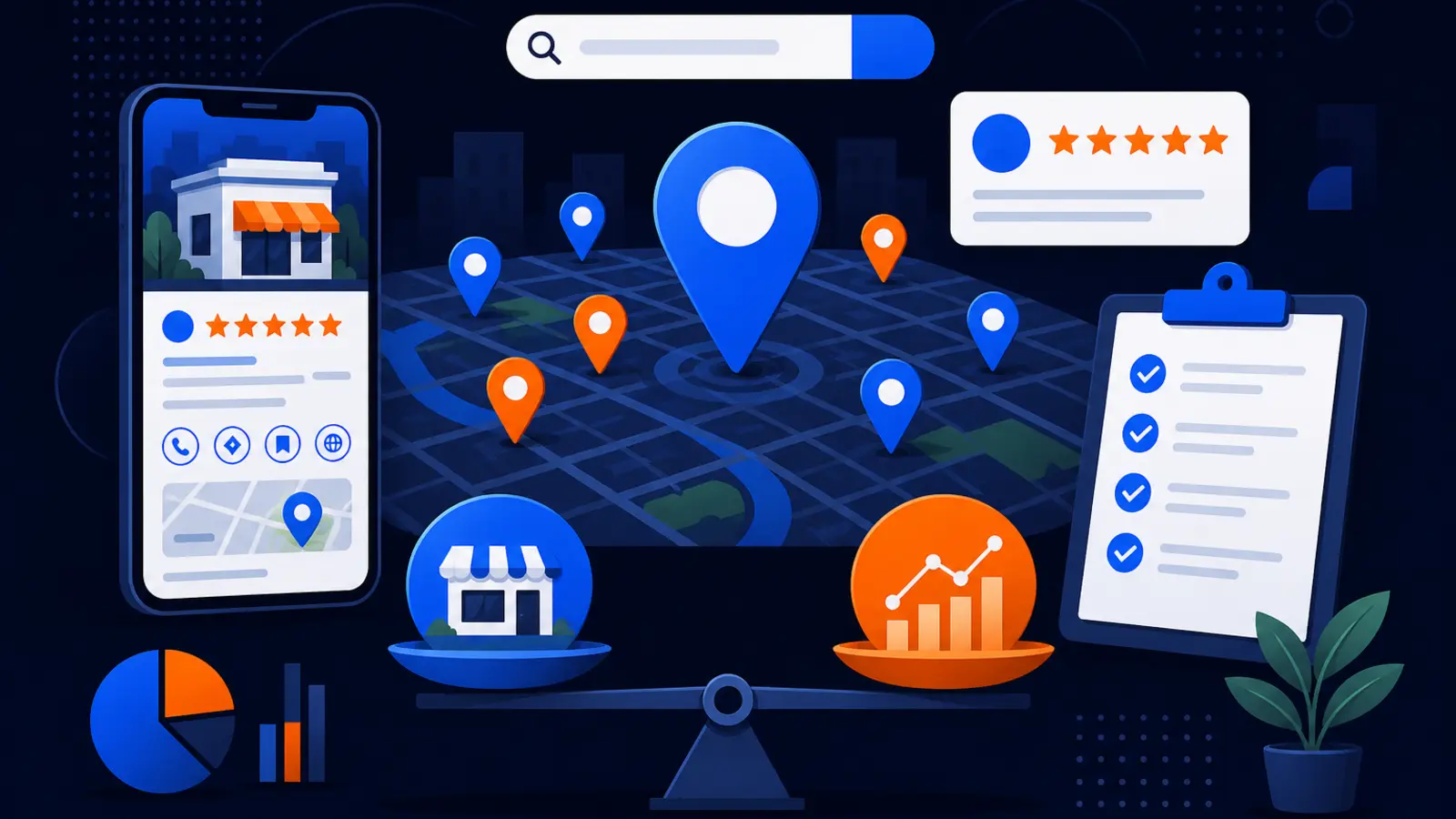
The consultation should answer four things before you commit
A proper Maps Domination Program consultation should inspect your Google Business Profile, your real search visibility by location, your website support, your review process, your competition, your risks, and your reporting plan before you sign. It should also sequence the work so you know what gets fixed first, what gets measured weekly, and what is protected from suspension, duplication, ownership problems, or wasted effort.
The goal is not to sell you a generic local SEO package. The goal is to decide whether your business, market, and Google Business Profile are a fit for a ranking outcome. Google Business Profile Help says there is no way to request or pay for a better local ranking, and that local results are mainly based on relevance, distance, and prominence. That means a useful consultation should focus on the things that can be improved and measured, not promises based on shortcuts.
For Digital Domination, the consultation starts with geographic proof. The Free GeoGrid scan checks 169 real Google results across the service area, so the conversation is about where you show up, where you do not, and what it may take to compete. Pricing for the Maps Domination Program is set per market on a qualification call and tied to the ranking outcome.
It should inspect the profile before touching tactics
Your Google Business Profile is the foundation. Google Business Profile Help says a verified Business Profile is more likely to show up in search results because verification tells Google that the business is authorized to represent the profile. Google also says complete and accurate information helps local visibility, including address, business hours, category, and attributes.
The consultation should not skip the boring fields. Small profile problems can block bigger work, especially if your name, address, service area, categories, or hours are unclear. Google’s guidelines say a business should use its real-world name, keep its address or service area accurate, choose the fewest categories needed, and maintain only one profile per business.
A good inspection should confirm these basics:
- ▸The profile is verified and owned or co-owned by the business
- ▸The business name matches the real-world name customers know
- ▸The address or service area is accurate
- ▸The primary category fits the core service
- ▸Secondary categories are limited and relevant
- ▸Hours, holiday hours, attributes, services, and contact details are complete
- ▸There are no duplicate profiles creating confusion
It should map where you rank, not just whether you rank
A citywide average is not enough. A contractor may rank near the shop but disappear across town. A dental office may rank in one neighborhood but lose visibility a few miles away. That is why the consultation should use a grid, not a single search from someone’s laptop.
Digital Domination uses a 169-point GeoGrid scan to check real Google results across the service area. That makes the problem visible. You can see which neighborhoods already have traction, which ones are weak, and where competitors are winning the Map Pack.
The scan should help answer these owner-level questions:
- ▸Where do we appear in the Map Pack today
- ▸Where are we invisible even though we serve that area
- ▸Which competitors show up repeatedly across the map
- ▸Which search terms matter most for calls
- ▸Which areas are realistic to attack first
- ▸Whether the service area is too broad for the current authority
It should check service-area rules and location structure
For service-area businesses, the consultation should review whether the area you claim makes sense under Google’s rules. Google’s 2026 services playbook says a Business Profile can have up to 20 service areas and that the overall service-area boundary should not be more than about two hours of driving time from the business base.
That matters because many owners want to rank everywhere they are willing to drive. Google local rankings do not work that simply. Distance is one of the main local ranking factors named by Google Business Profile Help, so a consultation should separate what you want to serve from where you can realistically rank.
If you have more than one location, the consultation should also review governance. Each location needs clean ownership, accurate details, and a plan that prevents overlap, duplicates, and inconsistent edits. Multi-location work should be managed carefully, not treated like copying one profile into another.
It should sequence the work in the right order
Local SEO often fails because the work is done in the wrong order. Posting photos, adding services, or asking for reviews can help, but not if the profile is unverified, the primary category is wrong, or duplicate listings are splitting trust. A consultation should produce a practical order of operations.
Google Business Profile Help says verification reviews take up to 5 business days after the business completes verification steps. Google also says verified profile edits usually take up to 10 minutes to review but can sometimes take up to 30 days. That means timing matters, especially when a business is changing categories, service areas, hours, or location details.
A sensible sequence usually looks like this:
- ▸Confirm ownership and verification
- ▸Fix guideline risks and duplicate issues
- ▸Correct categories, services, hours, and attributes
- ▸Document current GeoGrid rankings
- ▸Strengthen the website pages that support the profile
- ▸Build a review request and response process
- ▸Add photos and profile content on a steady schedule
- ▸Track Map Pack movement and call volume weekly
Seven questions to ask before you sign
Before you commit to a Maps Domination Program or any local SEO engagement, ask questions that force the provider to show how they inspect, measure, and protect the work. You do not need technical jargon. You need clear answers you can verify.
Use these questions in the consultation:
- ▸Will you show me rankings across my actual service area, not just one search result
- ▸Who owns or co-owns my Google Business Profile during the engagement
- ▸Which profile fields need to be fixed before campaign work starts
- ▸What category changes, if any, are you recommending and why
- ▸How will you measure Map Pack visibility and call volume each week
- ▸What review practices are allowed under Google’s rules
- ▸What happens if Google delays edits or requests re-verification
- ▸Do you work with another business in my trade and service area
It should measure the right signals
The consultation should define measurement before work begins. Google Business Profile Help says performance data is available only for verified profiles and includes views, searches, and actions from Search and Maps. Those numbers are useful, but they should not be the only report.
For a local owner, the most important question is simple: are more qualified customers finding and contacting the business from the places that matter. That is why Digital Domination provides weekly GeoGrid tracking reports with visual proof of rankings and call volume. A report should show movement in the Map Pack by geography, not just a list of completed tasks.
A clean measurement plan should include:
- ▸Starting GeoGrid visibility
- ▸Weekly ranking movement by location point
- ▸Target search terms
- ▸Profile actions from Search and Maps
- ▸Call volume tied to the campaign
- ▸Review growth and review recency
- ▸Competitor movement in the same map area
It should review reviews without crossing the line
Reviews are important, but they must be handled correctly. Google Business Profile Help says reviews must reflect a genuine experience and that incentives such as free or discounted goods or services in exchange for reviews are strictly prohibited. Google also says businesses may ask customers to leave reviews by sending a Google link or QR code and should reply to reviews as a best practice.
BrightLocal’s Local Consumer Review Survey 2026 found that 97% of consumers read reviews online and 41% always read reviews when browsing for businesses. For a local business owner, that means the consultation should cover both ranking support and conversion. Reviews help people decide whether to call, not just whether Google sees activity.
The review part of the consultation should inspect:
- ▸How customers are currently asked for reviews
- ▸Whether staff have a simple request process
- ▸Whether the business uses incentives, which should be stopped
- ▸How quickly reviews receive replies
- ▸Whether recent reviews mention core services
- ▸Whether poor reviews reveal operational issues that need owner attention
It should test category and service choices against the market
Category choice deserves direct attention. Whitespark’s Local Search Ranking Factors survey used 47 local search experts, a 2-hour survey, and 187 ranking factors across local pack, local organic, conversion, and AI search visibility impact. In Whitespark’s 2026 local pack and Maps factor table, Primary GBP Category ranked first, Proximity of Address to the Point of Search ranked second, Business is Open at Time of Search ranked fifth, Recency of Reviews ranked eleventh, and Completeness of GBP ranked sixteenth.
Search Engine Land reported that Whitespark studied 1.8 million Google Business Profiles across 4,209 categories and found that specific primary categories had a 12.5% top-10 presence versus 9.2% for generic primary categories. That does not mean every business should chase a narrow category. It means the consultation should compare your real services, your competitors, and Google’s category options before making changes.
You should expect a plain-language explanation of category recommendations, such as:
- ▸Which primary category best matches the money service
- ▸Which secondary categories are necessary
- ▸Which categories would create confusion or risk
- ▸How competitors are categorized in the areas you want to win
- ▸Whether category changes should happen now or after other fixes
It should protect ownership, access, and compliance
You should never lose control of your profile. Google’s third-party policy says all customers must retain ownership or co-ownership of their Business Profile, and a third party must give a customer a way to regain exclusive control within 7 business days of notice. A consultation should explain access before any contract is signed.
Protection also means not making risky edits just to look busy. Name stuffing, fake locations, duplicate profiles, broad service areas, and unnecessary category changes can create problems. Google’s guidelines say to use the real-world business name, keep address or service area accurate, choose the fewest categories needed, and maintain only one profile per business.
A provider should be willing to put these protections in writing:
- ▸The business keeps ownership or co-ownership of the profile
- ▸Access can be removed or transferred according to Google’s policy
- ▸No fake locations or keyword-stuffed names are used
- ▸No duplicate profiles are created to chase rankings
- ▸Service areas stay within reasonable Google guidance
- ▸Major edits are explained before they are made
It should explain content, photos, and website support
A Maps consultation should not treat the profile as the only asset. Your website, service pages, photos, and profile content all help customers understand what you do and whether you are the right choice. Google says Business Profile photos and videos show on Google only after verification, and uploaded photos and videos can take up to 24-48 hours to appear on the profile.
The consultation should inspect whether your website supports the services and locations you want the profile to rank for. If your Google Business Profile says you provide water heater repair, but your website barely mentions it, the campaign has a weaker foundation. The same applies to photos that do not show real work, staff, vehicles, storefronts, or service proof.
The content review should cover:
- ▸Core service pages on the website
- ▸Location or service-area relevance on the site
- ▸Photos that prove the business is real and active
- ▸Profile services that match website content
- ▸Common customer questions that should be answered
- ▸Content gaps that competitors are using against you
Who the cheaper or DIY path suits
Not every owner needs a Maps Domination Program. A cheaper or DIY path can make sense if you have one verified profile, clean guideline compliance, enough time to manage categories, services, reviews, photos, edits, and reporting, and no urgent need for geographic rank diagnostics or multi-location governance.
DIY becomes harder when you need to diagnose why rankings change by neighborhood, when edits trigger delays, when duplicate profiles exist, or when multiple locations need consistent oversight. It also becomes harder when you need weekly proof of Map Pack movement and call volume while still running the business.
The DIY path is most realistic when these are true:
- ▸You have one profile and clear ownership
- ▸The profile is verified and guideline compliant
- ▸Your market is not especially competitive
- ▸You can request and reply to reviews consistently
- ▸You can track rankings across the service area yourself
- ▸You have time to manage edits, photos, services, and reports
- ▸You do not need a ranking guarantee tied to the engagement
What to expect from Digital Domination
Digital Domination is built for owners who want geographic proof before committing. The Free GeoGrid scan checks 169 real Google results across the service area, and the Maps Domination Program consultation uses that scan to discuss fit, sequence, measurement, and risk. Digital Domination also works with one client per trade per service area, which protects territory exclusivity.
The company’s guarantee is: top 3 in the Google Map Pack in 12 weeks or you do not pay. Digital Domination shows Google Partner and Meta Business Partner badges on its roster page, has a 4.9 Google rating from 35 reviews in Las Vegas, NV, and is led by founders Nick Thompson and Dan Dirksen. The team has spent 20 years learning how businesses earn attention, authority, trust and rankings online.
The next step is simple. Visit the Maps Domination Program page to see the offer, the qualification process, and how the ranking outcome is structured. Then request the free GeoGrid scan page so you can review 169 real Google results across your service area before deciding whether the program is a fit.
Keep reading
Related guides
- ▸LocaliQ vs Townsquare Interactive for local SEO
- ▸LocaliQ vs Townsquare Interactive vs Digital Domination
- ▸Med spa local SEO
Put it into action
Frequently Asked Questions
What should a local SEO consultation include for Google Maps?
It should review your Google Business Profile, verification, categories, service area, reviews, website support, competitors, and current map rankings by location. It should also explain what will be fixed first, how progress will be measured, and how your profile ownership will be protected.
Do I need a GeoGrid scan before hiring a Maps SEO company?
You should strongly consider it because one search result does not show the full picture. A GeoGrid scan shows where you rank across the service area, which neighborhoods are weak, and which competitors are repeatedly beating you.
Can I pay Google for better local rankings?
No. Google Business Profile Help says there is no way to request or pay for a better local ranking. Local results are mainly based on relevance, distance, and prominence, so the work should focus on improving the signals Google can evaluate.
Who should own my Google Business Profile if I hire an agency?
Your business should retain ownership or co-ownership. Google’s third-party policy says customers must retain ownership or co-ownership and must have a way to regain exclusive control within 7 business days of notice.
How long do Google Business Profile edits take to show?
Google Business Profile Help says verified profile edits usually take up to 10 minutes to review but can sometimes take up to 30 days. That is why a consultation should discuss timing, risk, and the order of edits before changes are made.
Is the Maps Domination Program better than doing it myself?
It depends on your situation. DIY can work if you have one verified, compliant profile and time to manage categories, services, reviews, photos, edits, and reporting. The program is a better fit when you need geographic rank diagnostics, weekly tracking, governance, and a ranking outcome tied to the engagement.
What does Digital Domination measure during a Maps campaign?
Digital Domination provides weekly GeoGrid tracking reports with visual proof of rankings and call volume. The goal is to show where the business is gaining visibility in the Map Pack across the service area, not just report completed tasks.
How much does the Maps Domination Program cost?
Pricing is set per market on a qualification call and tied to the ranking outcome. The consultation and GeoGrid scan help determine whether your trade, service area, and current profile are a fit before pricing is discussed.
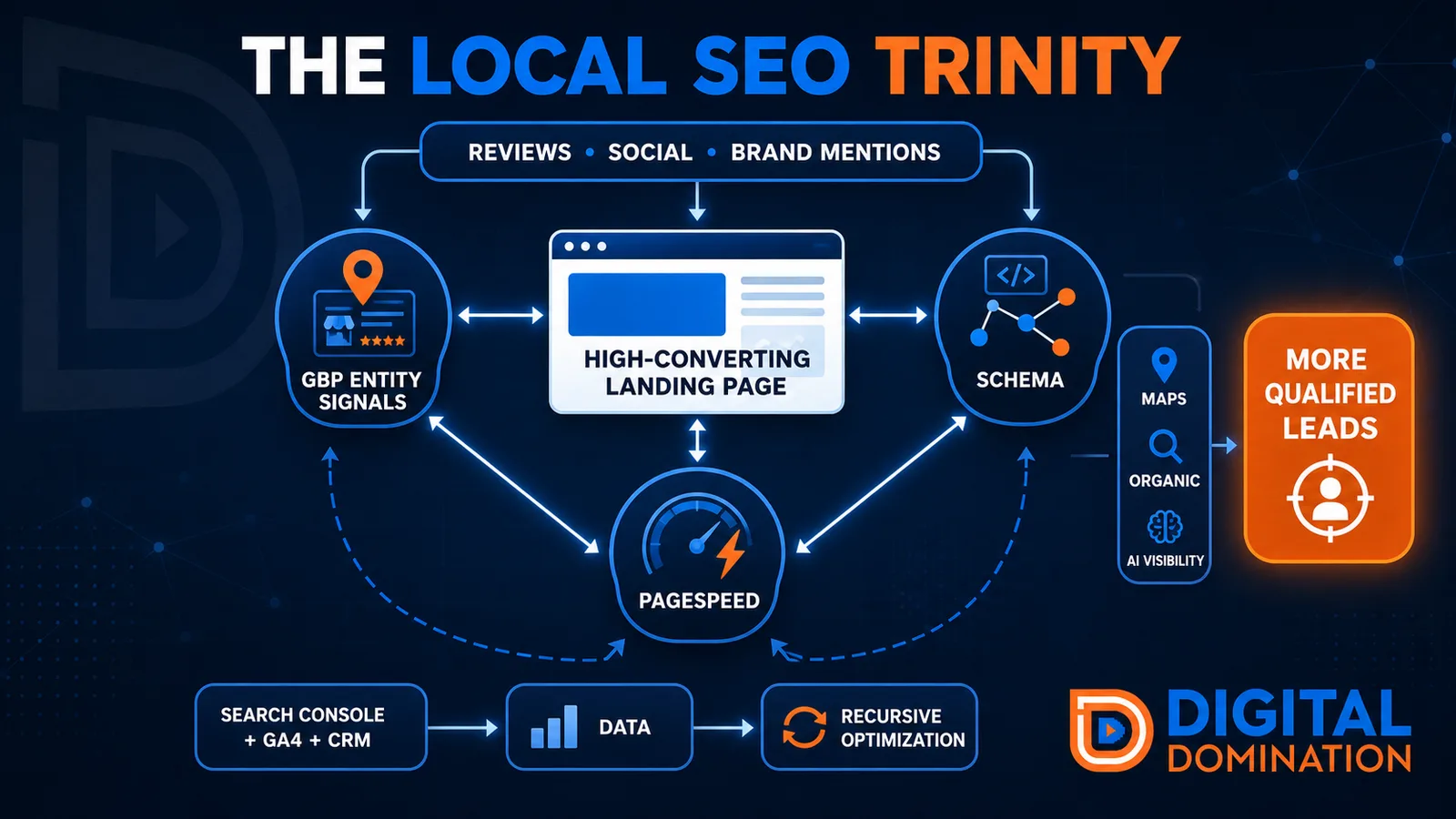
The Local SEO Trinity
Think of a three-legged stool. Your Google profile, your website, and your reviews all have to hold you up. If one leg is short, the whole thing wobbles.
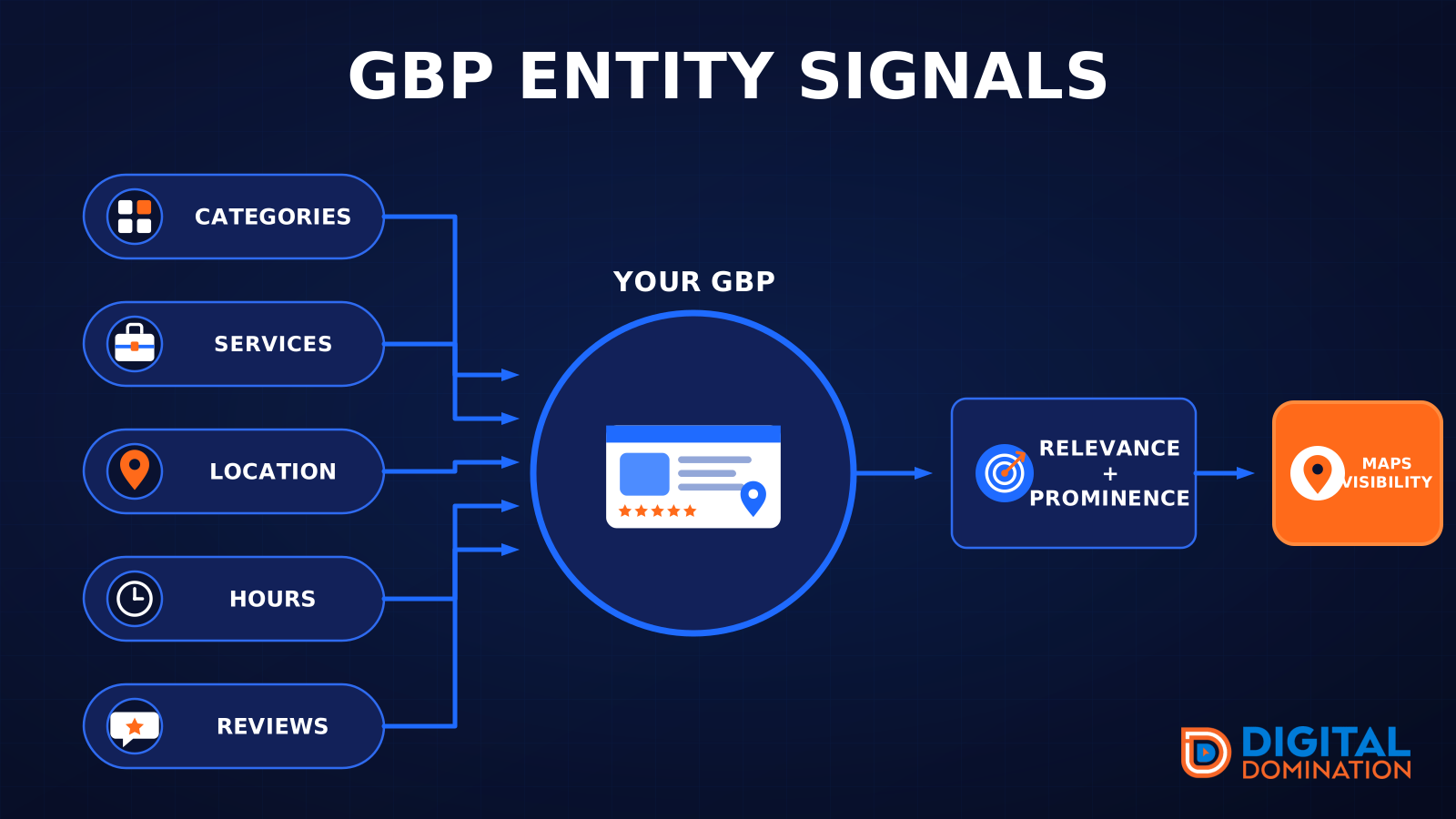
GBP entity signals
This leg is your Google Business Profile. GBP means Google Business Profile. It covers your categories, your services, your location, your hours, and your reviews. Google uses those facts to decide who to show.
Your Google profile is your storefront sign. If the sign is missing, or it names the wrong shop, people drive past.
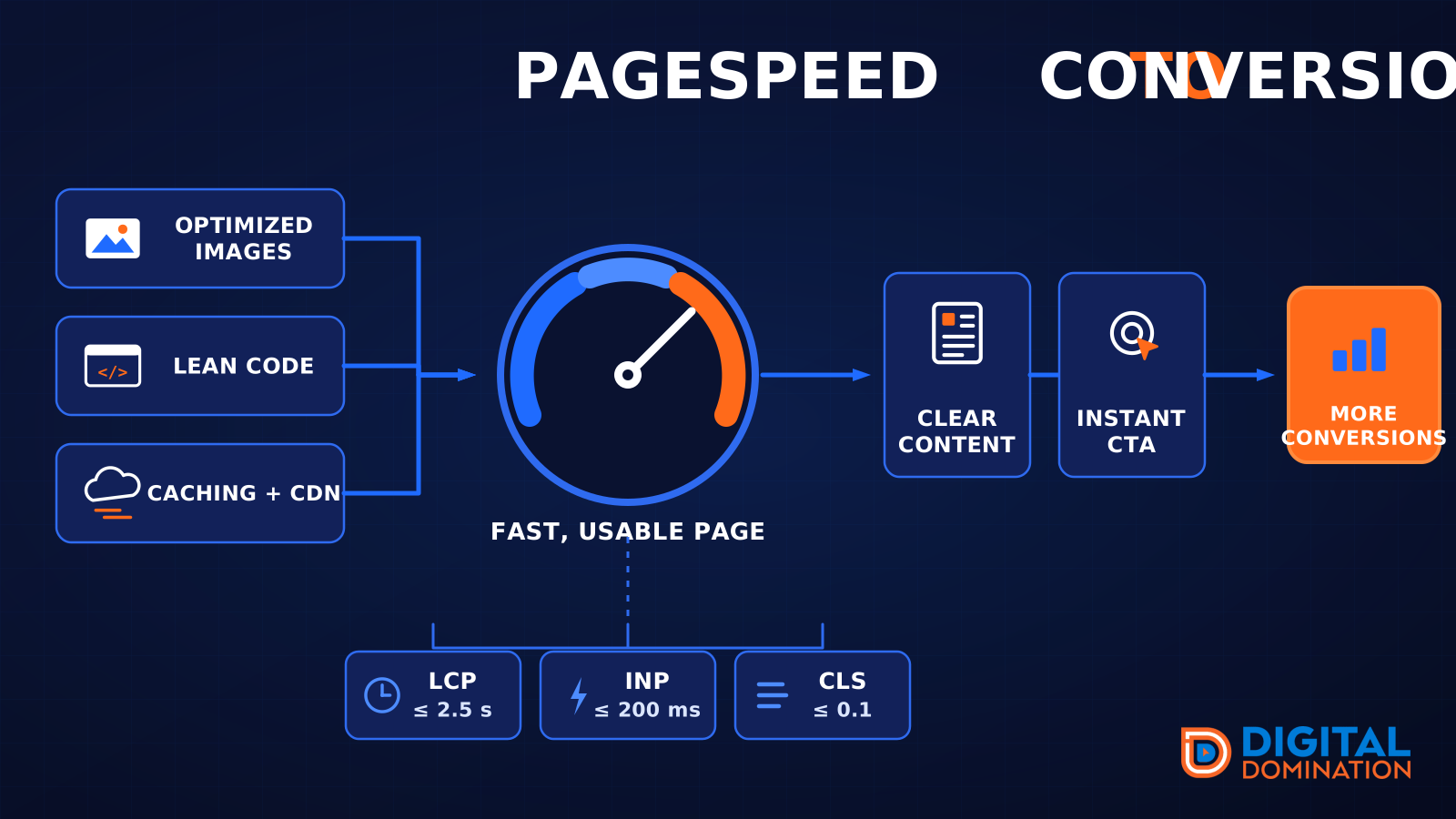
PageSpeed to conversion
This leg is your website, above all on a phone. Small images, lean code, and caching make a page fast. A fast, clear page is what turns a visit into a call. Phone speed is one of the 12 Trinity checks because a slow page loses the call before anyone sees your offer.
Your website is the showroom. If the door sticks, people leave before they look around.
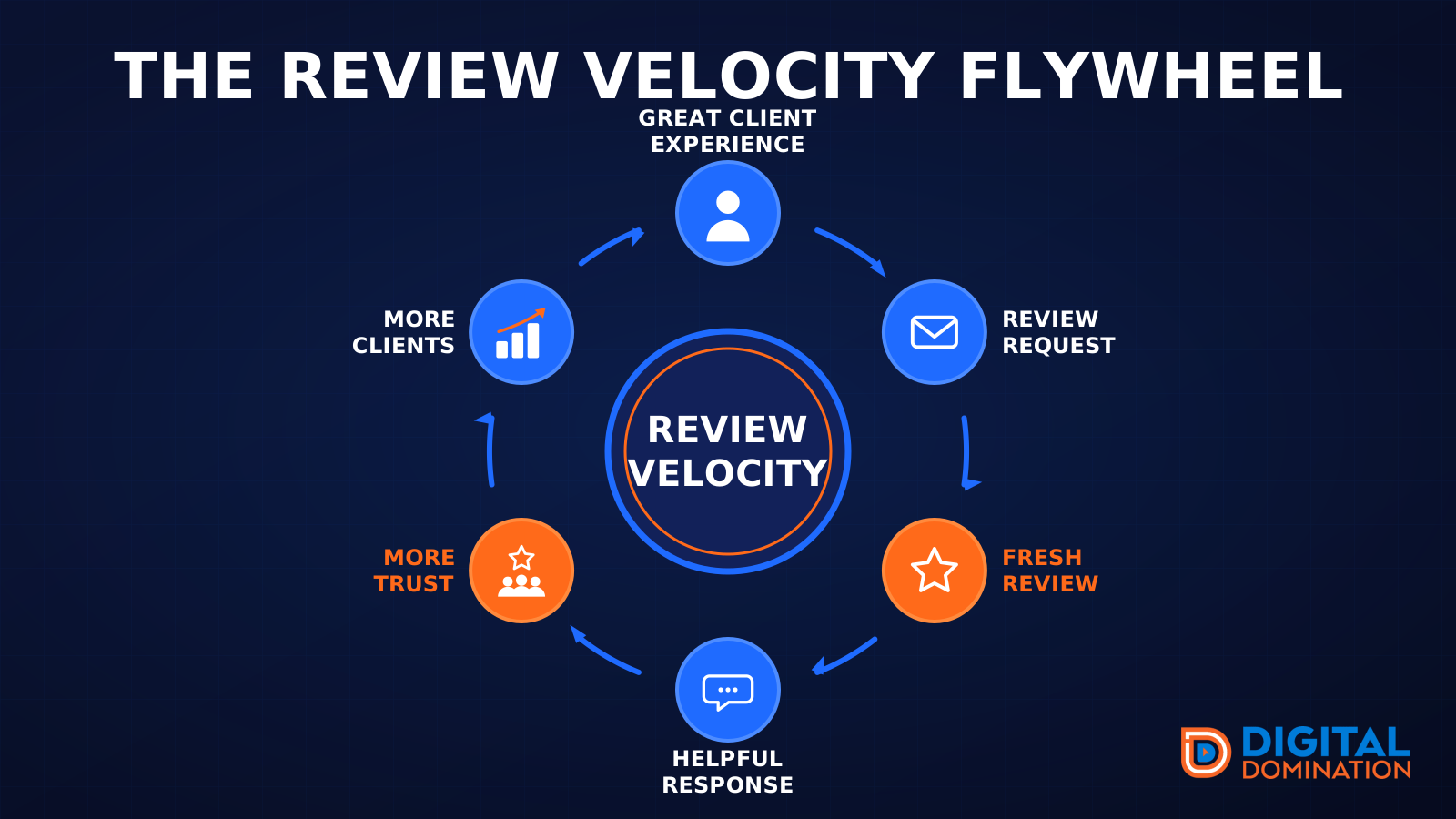
The review velocity flywheel
This leg is reviews and reputation. A good visit leads to a review request, then a fresh review, then a helpful reply, then more trust, then more customers. When the scan can find your Google listing, it shows your rating, your recent reviews, and how many you answered.
Reviews are word of mouth. One kind word helps. A steady stream of real reviews, and a reply from you, helps more.
How this turns into revenue
Being found in more searches leads to more calls. More calls lead to more booked jobs. More booked jobs lead to more revenue.
Example numbers, not a real business: 40 calls from search in a month, a 25 percent close rate, and a $400 average job. That is 10 booked jobs. That is $4,000. The math is the lesson. It is not a promise.
The full page has a box where you can type your own average job value and close rate.
One real story, from our car dealership case study: Medina Auto Group went from invisible on Google Maps to dominating every high-intent search across their market. The turnaround spanned all four of their rooftops at once. The same page says the team eliminated 89 unfair one-star reviews that had been dragging the dealership's reputation down and keeping it out of the Map Pack. It also says: “Results described here are exceptional and non-typical. Outcomes vary based on market conditions, competition, and implementation. No guarantees are made regarding earnings, rankings, or conversions.”
Free strategy call
More booked jobs start with a clear plan
Book a free strategy call. We look at your Google profile, your website, and your reviews, and we tell you what to fix first.
Free. You pick the time. A real person shows up.