
When to choose The Maps Domination Program instead of hiring an in-house marketer
A practical buyer guide for local owners deciding between a specialized Google Maps program and a full-time marketing hire.

The short answer
Choose a structured Google Maps optimization program when the main problem is local visibility, calls, and direction requests from Google Maps, and you do not already have the time or skill inside the company to manage it well. Hire an in-house marketer when you have steady year-round marketing work across many channels, someone to manage that employee, and enough patience to recruit, train, and measure them over time.
Google Business Profile Help says local results on Search and Maps are mainly based on relevance, distance, and prominence. That means your ranking problem is not just a posting problem. It usually involves profile accuracy, categories, reviews, website signals, local authority, service area coverage, and proof that work is moving the business in the right places.
Use this simple fit test before you choose:
- ▸Choose a Maps program if Map Pack rankings are the business outcome you care about most.
- ▸Choose in-house if you need one person to handle many daily marketing tasks beyond Google Maps.
- ▸Choose a Maps program if you want a proven process, weekly ranking proof, and outside accountability.
- ▸Choose in-house if you have a strong manager who can train and inspect local SEO work.
- ▸Choose a Maps program if waiting through hiring and onboarding would cost you momentum.
What the job actually is
A marketing coordinator can be valuable, but Google Maps optimization is a specialized local search job. Google Business Profile Help says complete and accurate information makes businesses more likely to show up in local search results, and it specifically points to address, hours, category, and attributes. That is the starting line, not the full race.
Google Business Profile Help also says prominence is based on information such as websites that link to the business and the number of reviews, and that more reviews and positive ratings can help local ranking. A good Maps program should therefore work on the profile, the website, review growth, local signals, measurement, and issue detection together.
The work usually includes these moving parts:
- ▸Business Profile verification and ownership checks.
- ▸Category, service, hour, and attribute accuracy.
- ▸Review request systems that follow Google policy.
- ▸Website pages that support local relevance.
- ▸Local authority signals and citation consistency.
- ▸GeoGrid rank tracking by neighborhood, not one city-wide average.
- ▸Performance reporting tied to calls, clicks, and rankings.
When hiring in-house genuinely makes sense
Hiring in-house is the better move when marketing is a full-time operational role inside your company. For example, a growing multi-location business may need daily help with promotions, vendor coordination, event calendars, photos, email, social posts, print materials, and customer communication. If that person will be busy even without Google Maps work, the hire can make sense.
It also fits owners who can manage marketing work closely. A new employee needs priorities, feedback, access, approvals, training, and clear scorecards. If the owner is too busy to inspect the work, even a capable coordinator can drift into low-impact tasks because they feel urgent and visible.
Hiring in-house is usually a good fit when these conditions are true:
- ▸You have enough non-Maps marketing work to fill the role all year.
- ▸You can recruit, interview, onboard, and manage the person well.
- ▸You already know how you will judge marketing performance.
- ▸You can wait through the ramp-up period before expecting results.
- ▸You want a generalist who can sit inside the business every day.
- ▸You are prepared to buy tools, training, and outside support when needed.
When a Maps program is the cleaner choice
A structured Maps program is usually cleaner when the owner wants one specific outcome: stronger Google Map Pack visibility in the service area. This is especially true for contractors, clinics, shops, repair businesses, home services, and appointment-based local companies where calls and directions matter.
Google Business Profile Help says there is no way to request or pay for a better local ranking on Google. That matters. A serious provider should not imply it can buy placement. The value is in disciplined work on the factors Google says matter, then measuring whether that work is improving visibility where customers actually search.
A Maps program is often the better choice in these situations:
- ▸Your main issue is that competitors show above you in Maps.
- ▸You do not have a local SEO specialist on staff.
- ▸You want a ranking process, not another general marketing task list.
- ▸You need neighborhood-level visibility reporting.
- ▸You want outside accountability tied to a Maps outcome.
- ▸You do not want to spend weeks recruiting before work starts.
The cost and timing comparison
The money question is not just salary versus a program fee. The U.S. Bureau of Labor Statistics says market research analysts and marketing specialists had a median annual wage of $78,760 in May 2025, and that market research analysts typically need a bachelor’s degree. A full-time hire can also require recruiting time, management time, tools, benefits, training, and replacement risk if the person leaves.
Timing matters too. SHRM’s 2026 Recruiting Executives Benchmarking report says the median time-to-fill for nonexecutive positions was 39 calendar days, based on data from over 4,600 organizations. That is before the new hire learns your business, gets access, understands Google Business Profile work, and starts producing useful reporting.
That does not mean hiring is wrong. It means you should compare the full path. If your urgent goal is Map Pack movement, a specialized program can start the actual Maps work sooner. If your real need is a daily internal marketing helper, an employee may still be worth the wait.
What to look for before you trust a Maps provider
Google Business Profile Help tells businesses evaluating a third party to ask whether the provider has managed Business Profiles before, worked with similar budgets and target audiences, and can provide other services to help grow the business. That is practical advice. You are not just buying tasks, you are trusting someone with a property that affects calls, reputation, and customer decisions.
A provider should be able to show what it will inspect, what it will change, how it will measure progress, and how you keep control. If a salesperson talks only about vague visibility, ask for checkpoints you can verify yourself inside your Business Profile, reports, and search results.
Before you sign, expect these concrete checkpoints:
- ▸A clear scan of current rankings across the service area.
- ▸A profile ownership check before major work begins.
- ▸A written explanation of what will be optimized and why.
- ▸Reporting that shows rank movement by map point.
- ▸Review guidance that does not use incentives or fake activity.
- ▸Call, click, direction, and website activity reporting where available.
- ▸A clear explanation of fees and what is included.
Seven questions to ask before you sign
This is the buyer-protection section. Ask these questions whether you are considering Digital Domination, another Maps provider, or an in-house hire supported by outside tools. Clear answers will tell you whether the plan is serious or just busywork.
Use these questions in your sales call or interview:
- ▸Who owns or co-owns the Google Business Profile at all times?
- ▸What exact ranking report will I receive, and how often?
- ▸Will you show rankings across my service area or only one search location?
- ▸How will you help us get reviews without violating Google policy?
- ▸What parts of the website support the Maps campaign?
- ▸What happens if the work does not improve the ranking outcome?
- ▸Have you managed similar local businesses with similar budgets and customers?
- ▸What performance numbers will I see besides rankings?
Ownership and reporting are not optional
Google’s third-party policy says end customers must retain ownership or co-ownership of their Business Profile at all times. It also says customers must receive accessible Business Profile management cost and performance reports. That is a baseline requirement, not a bonus.
Google Business Profile performance data is available only for verified Business Profiles, according to Google Business Profile Help. It can include views, searches, directions, calls, website clicks, messages, bookings, products, menus, and offers when applicable. A good program should help you understand what those numbers mean without burying you in jargon.
Keep control by verifying these basics:
- ▸Your business keeps ownership or co-ownership of the profile.
- ▸You know who has access and what role each person has.
- ▸You receive cost and performance reporting you can read.
- ▸Your profile is verified before performance data is used as a scorecard.
- ▸Reports connect Maps visibility with customer actions when possible.
Reviews are a ranking and trust issue
Reviews matter because they affect both customers and prominence. BrightLocal’s 2026 Local Consumer Review Survey found that 97% of consumers read reviews for local businesses and that 74% care only about reviews written in the last three months. For an owner, that means review generation cannot be treated as an occasional favor.
Google Business Profile Help says customer reviews show next to the Business Profile in Maps and Search, and customers can be asked to leave reviews through a Google link or QR code. It also says incentives such as payment, discounts, free goods, or free services in exchange for posting, changing, or removing reviews are fake and misleading content and are prohibited. Google’s prohibited-content policy also treats unusual review volumes or patterns that indicate rating manipulation as rating manipulation.
A safe review system should include these rules:
- ▸Ask real customers only.
- ▸Use a Google review link or QR code.
- ▸Do not offer discounts, gifts, cash, or free services for reviews.
- ▸Do not pressure customers to change or remove reviews.
- ▸Watch for unnatural review patterns.
- ▸Make review requests part of normal customer follow-up.
Why grid tracking beats one ranking number
A single ranking number for a city can be misleading. A roofer, dentist, mechanic, or barbershop may rank well near the office but poorly across the neighborhoods they actually want to serve. That is why grid-based reporting is useful for local owners.
BrightLocal Help Center explains that a local search grid report checks where a business ranks for a keyword at multiple map points instead of returning one ranking number for a city. Google Cloud Documentation also describes S2 geometry as an open-source hierarchical grid system developed by Google that assigns a unique 64-bit integer to each cell and has 31 resolution levels. You do not need to understand the math. You just need a visual report that shows where you are winning and where you are not.
Good grid tracking helps an owner see:
- ▸Which neighborhoods already produce visibility.
- ▸Which parts of the service area need work.
- ▸Whether progress is spreading or staying isolated.
- ▸How rankings change near competitors.
- ▸Whether the campaign is improving the real search area, not just one point.
How Digital Domination fits this decision
Digital Domination’s Maps Domination Program is built for owners who want a structured Google Maps ranking program instead of hiring a general marketing coordinator to figure it out from scratch. The program starts with a free 169-point GeoGrid scan that checks 169 real Google results across the service area. Weekly GeoGrid tracking reports provide visual proof of rankings and call volume.
Digital Domination works with one client per trade per service area, which gives territory exclusivity. Its published guarantee is: top 3 in the Google Map Pack in 12 weeks or you do not pay. Pricing for the Maps Domination Program is set per market on a qualification call and tied to the ranking outcome.
The fit is strongest when you want these things:
- ▸A Maps-specific program rather than a general marketing role.
- ▸A scan that shows current visibility across the service area.
- ▸Weekly GeoGrid tracking with ranking and call-volume proof.
- ▸Territory exclusivity by trade and service area.
- ▸A qualification call instead of one-size-fits-all pricing.
- ▸A ranking outcome that is defined before work begins.
The practical recommendation
If your business needs a full-time person for daily marketing operations, hiring in-house can be the right long-term move. If your main problem is that competitors are taking the Map Pack spots where your customers search, start with a structured Google Maps optimization program before you add payroll.
The Maps Domination Program page explains the program, the qualification process, the ranking guarantee, territory exclusivity, and how weekly GeoGrid reporting works. The free GeoGrid scan page is the simplest next step if you want to see where your business ranks across the service area before deciding between a program and an in-house hire.
Keep reading
Related guides
- ▸What to look for when hiring a Google Maps SEO provider
- ▸What To Look For When Hiring A The Maps Domination Program Provider
- ▸Whatsapp Google Business Profile Contact Buttons
Put it into action
Frequently Asked Questions
Should I hire a marketing coordinator or pay for Google Maps SEO?
Hire a marketing coordinator if you have steady daily work across social, email, events, promotions, and internal marketing. Choose Google Maps SEO if your main goal is to improve Map Pack visibility, calls, and direction requests in your service area.
Can an in-house marketer handle Google Business Profile optimization?
Yes, if they have local SEO experience and someone inside the business can manage the work. If they are a generalist, they may still need tools, training, and outside support to handle rankings, reviews, profile issues, and grid reporting well.
Is it possible to pay Google for a better local ranking?
No. Google Business Profile Help says there is no way to request or pay for a better local ranking on Google. A legitimate program works on the signals Google says matter, including relevance, distance, prominence, accurate information, reviews, and supporting website signals.
How do I know if a Maps program is working?
You should see reporting that shows rankings across your service area, not just one ranking number. You should also review available Business Profile performance data such as calls, website clicks, direction requests, searches, and other customer actions when applicable.
What should I ask a Google Business Profile provider before signing?
Ask who owns the profile, what reports you will receive, how reviews will be requested, and whether the provider has managed similar Business Profiles before. Google’s third-party policy says customers must keep ownership or co-ownership and receive accessible cost and performance reports.
Are review incentives allowed for Google reviews?
No. Google Business Profile Help says incentives such as payment, discounts, free goods, or free services in exchange for posting, changing, or removing reviews are prohibited. A safe review process asks real customers through a Google link or QR code without offering rewards.
Why does a GeoGrid scan matter for a local business?
A GeoGrid scan shows how rankings change across different parts of the service area. That is more useful than one city-wide ranking number because local search visibility can vary by neighborhood, distance, and competition.
When should I look at Digital Domination’s Maps Domination Program?
Look at it when your priority is ranking in the Google Map Pack and you want a structured program with weekly GeoGrid tracking. Start with the free GeoGrid scan if you want to see your current visibility before a qualification call.
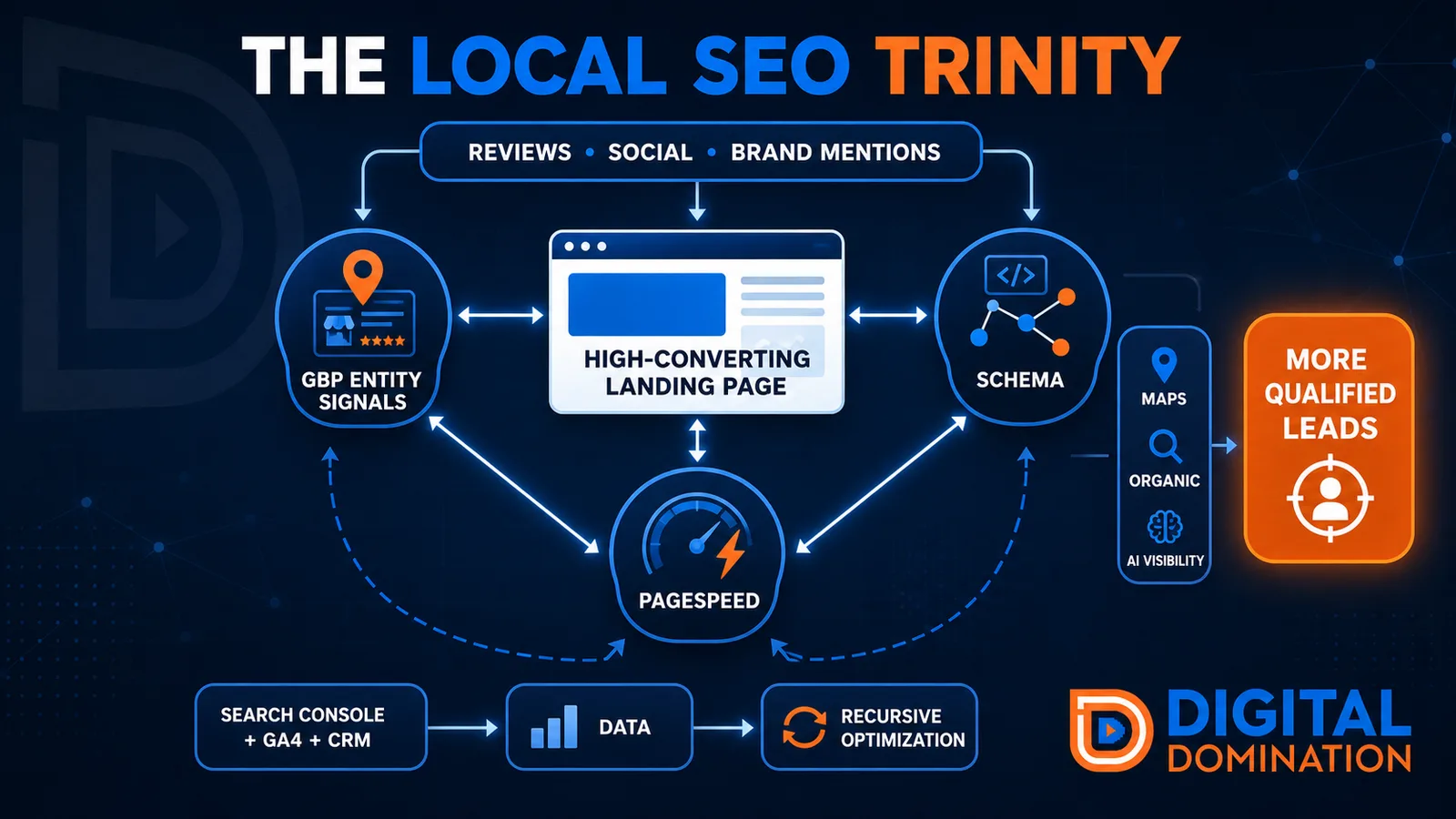
The Local SEO Trinity
Think of a three-legged stool. Your Google profile, your website, and your reviews all have to hold you up. If one leg is short, the whole thing wobbles.
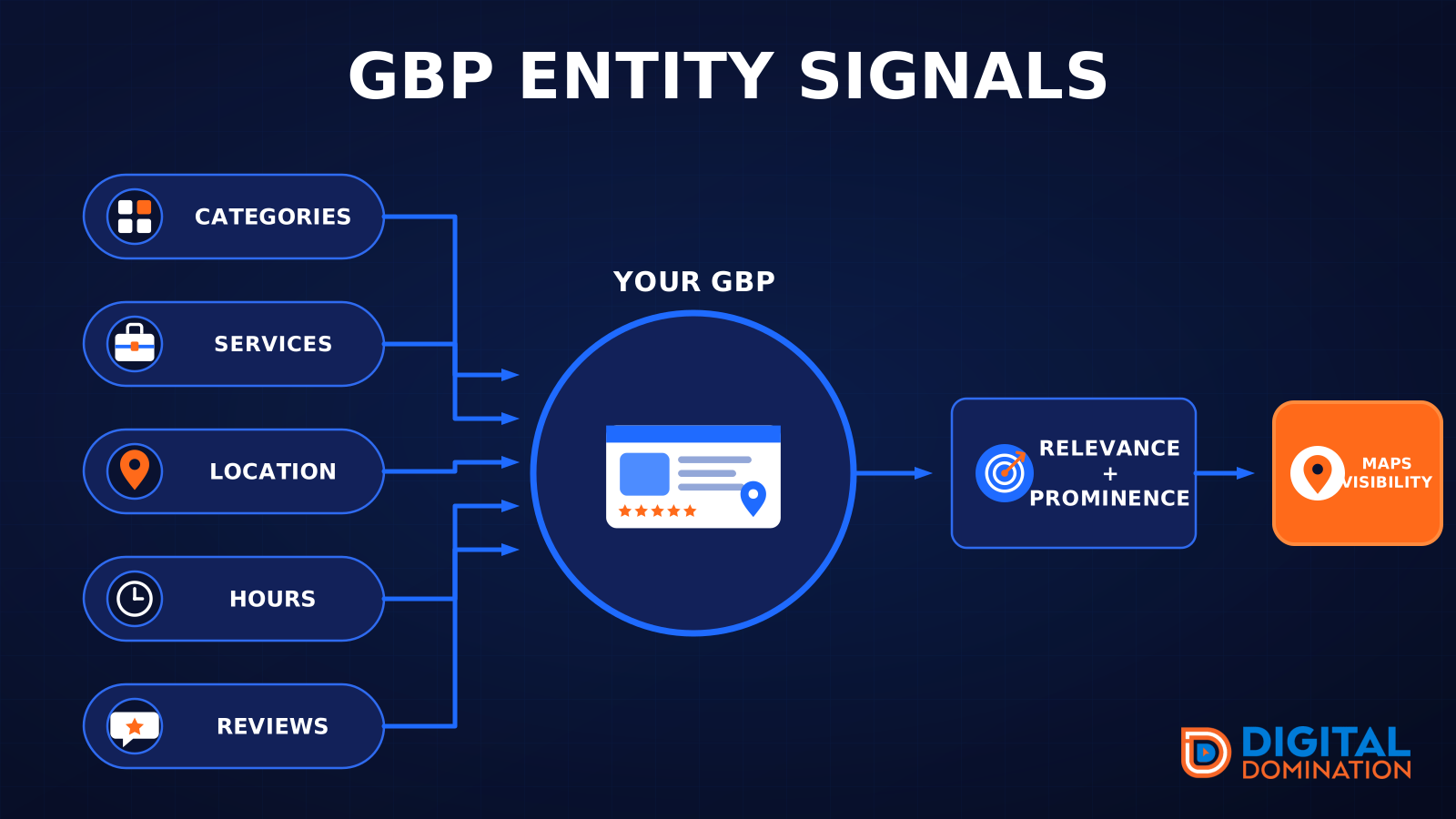
GBP entity signals
This leg is your Google Business Profile. GBP means Google Business Profile. It covers your categories, your services, your location, your hours, and your reviews. Google uses those facts to decide who to show.
Your Google profile is your storefront sign. If the sign is missing, or it names the wrong shop, people drive past.
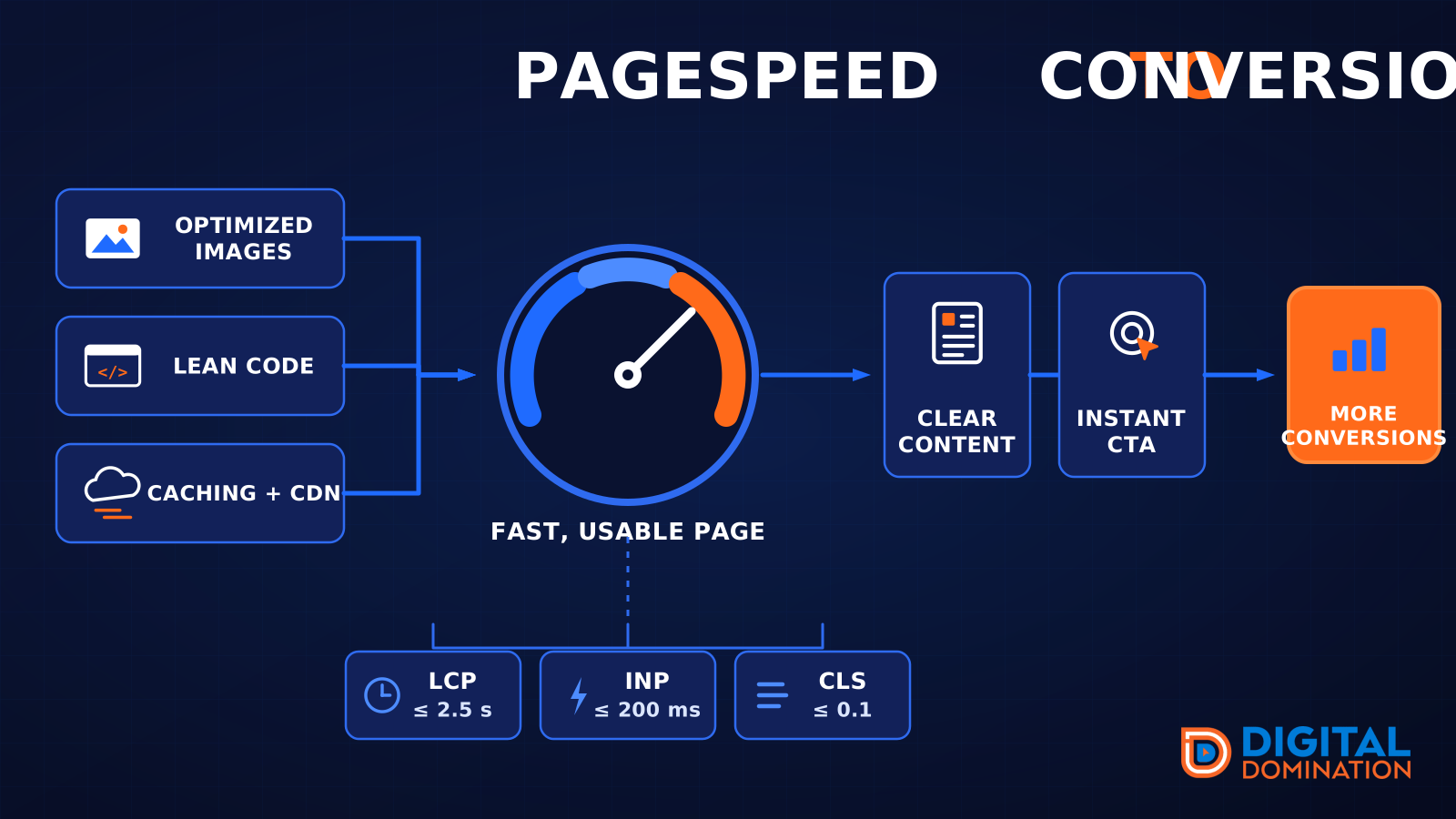
PageSpeed to conversion
This leg is your website, above all on a phone. Small images, lean code, and caching make a page fast. A fast, clear page is what turns a visit into a call. Phone speed is one of the 12 Trinity checks because a slow page loses the call before anyone sees your offer.
Your website is the showroom. If the door sticks, people leave before they look around.
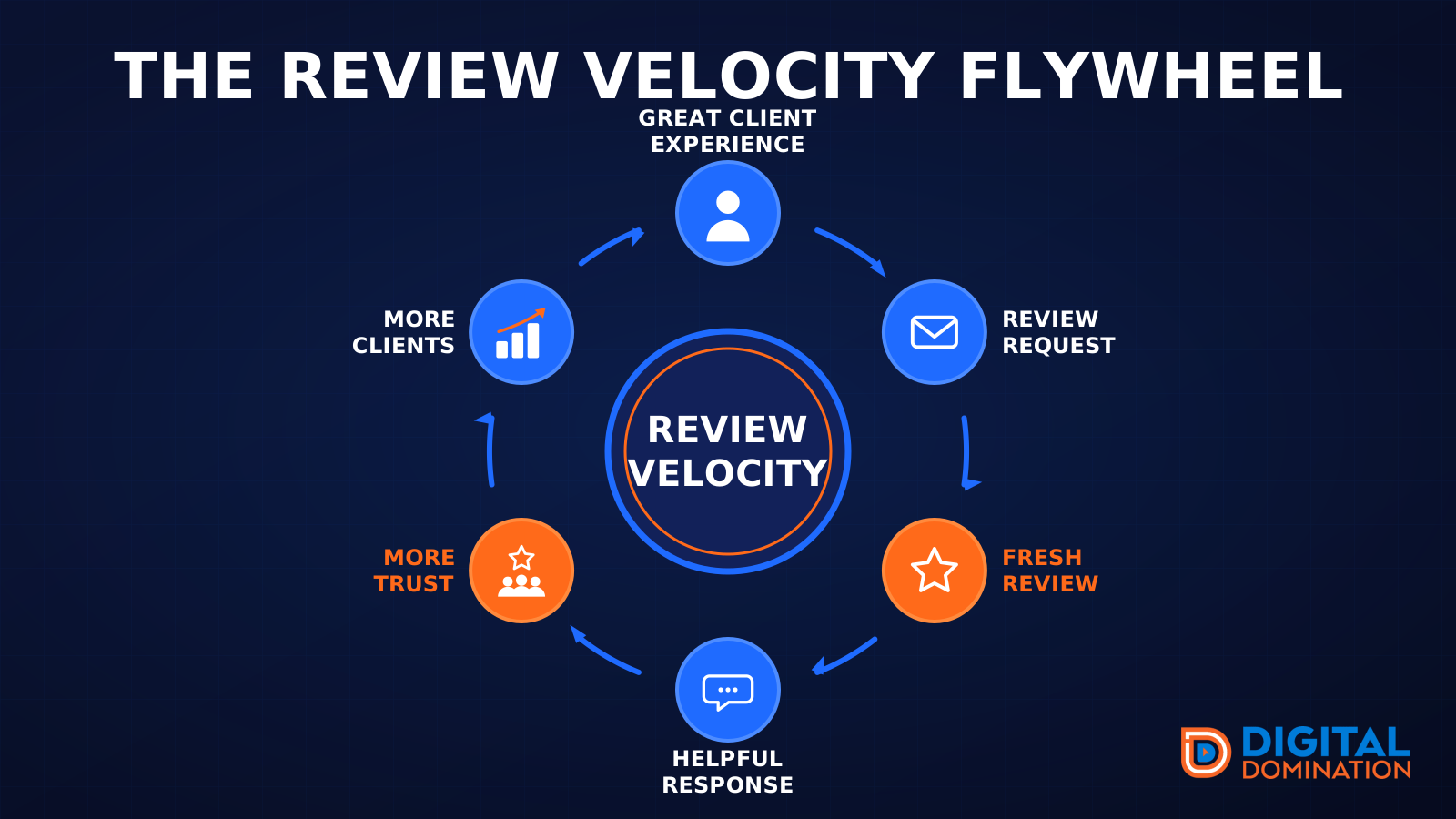
The review velocity flywheel
This leg is reviews and reputation. A good visit leads to a review request, then a fresh review, then a helpful reply, then more trust, then more customers. When the scan can find your Google listing, it shows your rating, your recent reviews, and how many you answered.
Reviews are word of mouth. One kind word helps. A steady stream of real reviews, and a reply from you, helps more.
How this turns into revenue
Being found in more searches leads to more calls. More calls lead to more booked jobs. More booked jobs lead to more revenue.
Example numbers, not a real business: 40 calls from search in a month, a 25 percent close rate, and a $400 average job. That is 10 booked jobs. That is $4,000. The math is the lesson. It is not a promise.
The full page has a box where you can type your own average job value and close rate.
One real story, from our car dealership case study: Medina Auto Group went from invisible on Google Maps to dominating every high-intent search across their market. The turnaround spanned all four of their rooftops at once. The same page says the team eliminated 89 unfair one-star reviews that had been dragging the dealership's reputation down and keeping it out of the Map Pack. It also says: “Results described here are exceptional and non-typical. Outcomes vary based on market conditions, competition, and implementation. No guarantees are made regarding earnings, rankings, or conversions.”
Free strategy call
More booked jobs start with a clear plan
Book a free strategy call. We look at your Google profile, your website, and your reviews, and we tell you what to fix first.
Free. You pick the time. A real person shows up.