
AI search optimization vs hiring an in-house marketer or marketing coordinator
A practical comparison for local business owners who want more calls from Google, Maps, and AI-assisted discovery.
The short answer
If your main goal is more calls from local search and AI-assisted discovery, AI search optimization is usually the more direct fit than hiring an in-house marketer or marketing coordinator. A specialist can focus on the exact work that affects local visibility: your Google Business Profile, website content, reviews, local prominence, crawl access for AI search tools, and tracking for calls from search.
Hiring in-house can be the better move when your business has enough ongoing work to keep a full-time person productive beyond local SEO. That means campaigns, sales materials, email, social posts, photos, vendor coordination, reporting, promotions, events, and internal communication. If the job is mostly “get us more calls from Google,” a broad in-house role can become expensive and unfocused.
The key distinction is not whether marketing matters. It does. The question is whether you need a local search growth function or a full-time general marketing operator.
What AI search optimization actually means for a local business
AI search optimization is not a magic trick. Google Search Central says the best practices for SEO remain relevant for AI Overviews and AI Mode, with no additional requirements or special optimizations necessary to appear in those AI features. That means useful content, crawlable pages, clear business information, strong local signals, and a complete Google Business Profile still matter.
The AI part changes how discovery may happen. Google Search Central says AI Overviews and AI Mode may use query fan-out, issuing multiple related searches across subtopics and data sources to develop a response. OpenAI Help Center says ChatGPT can search the web for current information and can use location information to find local results. Perplexity says its crawler is designed to surface and link websites in Perplexity search results.
For a local company, AI search optimization should usually include these practical pieces:
- ▸Make the Google Business Profile complete, accurate, and active.
- ▸Build service pages that clearly answer local buying questions.
- ▸Create content that explains services, locations, pricing factors, process, and proof.
- ▸Improve review generation and review response habits.
- ▸Check whether important AI search crawlers can access the website.
- ▸Use structured data only in ways supported by Google Search Central guidance.
- ▸Track visibility across the actual service area, not just from one office computer.
What an in-house marketer or coordinator actually does
An in-house marketer or marketing coordinator can be valuable, especially when your business has many moving parts. O*NET OnLine lists Marketing Coordinator as a reported job title under Marketing Managers and includes tasks such as coordinating marketing activities, identifying marketing strategy, initiating market research studies, and reviewing content for marketing materials.
That is a broad role. A good in-house person may help keep vendors organized, chase photos from the field, publish social posts, prepare sales sheets, coordinate events, update the website, collect customer stories, report on campaigns, and keep owners from being the bottleneck. Those jobs matter, but they are not the same as having deep local SEO and AI search expertise.
Hiring in-house makes the most sense when the person will own a wide set of recurring work, such as:
- ▸Sales support materials for estimators, technicians, or office staff.
- ▸Email campaigns, promotions, and customer communication.
- ▸Social media planning, posting, and inbox monitoring.
- ▸Photo, video, and job documentation coordination.
- ▸Vendor management for ads, SEO, design, printing, and software.
- ▸Monthly reporting and internal marketing meetings.
- ▸Brand consistency across trucks, uniforms, signs, proposals, and web pages.
Where calls from local search usually come from
For many local businesses, calls come from Google Maps, the local pack, organic search results, and now AI-assisted tools that summarize or recommend options. Google Business Profile Help defines Business Profile calls as the number of times a customer clicked the call button on the Business Profile. That is not every phone call your company receives, but it is one useful signal.
Google Business Profile Help says local ranking is mainly based on relevance, distance, and prominence. Google also says there is no way to request or pay for a better local ranking. That means the work has to improve the signals Google can understand, not simply ask for better placement.
The most call-focused work usually touches these areas:
- ▸Relevance: categories, services, pages, and wording that match what customers search.
- ▸Distance: visibility measured across the service area, not just near the office.
- ▸Prominence: links, reviews, ratings, mentions, and overall reputation signals.
- ▸Completeness: accurate hours, phone number, services, photos, website, and locations.
- ▸Content quality: clear pages that help a customer choose, not thin filler pages.
Cost and capacity are not the same thing
A full-time hire brings capacity, but capacity only helps if you have the right work and the right management structure. The U.S. Bureau of Labor Statistics says advertising, promotions, and marketing managers typically need a bachelor’s degree and work experience in a related occupation. BLS also reports the median annual wage for marketing managers was $166,790 in May 2025, and the median annual wage for market research analysts was $78,760 in May 2025.
Those BLS roles are not a perfect match for every coordinator posting, but they show an important point: skilled marketing labor is not cheap. Once you include recruiting time, payroll taxes, benefits, software, supervision, training, and the risk of turnover, an in-house hire should have more to do than check rankings and post occasional updates.
AI search optimization has a different cost shape. You are buying a specialized function rather than a full-time employee. That can be better when you need a clear outcome, a repeatable process, and tools your team would not otherwise own.
What to look for before choosing either option
Before you compare proposals or job candidates, define what “more calls” means. If you only look at total phone activity, you may mix together repeat customers, referrals, paid ads, spam calls, and search calls. The goal is to isolate whether local search and AI-assisted discovery are improving.
Google Business Profile performance reporting can show call button clicks from the Business Profile. Website analytics, call tracking, and form tracking can add more context. None of these tools are perfect by themselves, so look for directional proof across several signals.
Use these checkpoints before you spend money:
- ▸Can you see where you rank across the full service area, not just from your office address?
- ▸Is your Google Business Profile complete and accurate? Google says complete and accurate profiles are more likely to show up in local search results.
- ▸Do your main service pages clearly explain what you do, where you do it, and who you help?
- ▸Are reviews being requested consistently, and are they being answered professionally?
- ▸Can Google crawl the important pages on your site?
- ▸Are AI search crawlers being blocked by mistake? OpenAI Developers says sites opted out of OAI-SearchBot will not be shown in ChatGPT search answers, though they can still appear as navigational links.
- ▸Does the person or provider explain what they will change, how it will be measured, and what you should expect next?
Seven questions to ask before you sign
Whether you are interviewing an agency, consultant, or in-house candidate, ask questions that reveal whether they understand local search as a revenue channel. Vague promises are easy. Clear diagnosis is harder.
Ask these questions before you commit:
- ▸How will you measure local visibility across our service area?
- ▸Which Google Business Profile fields, categories, services, and content need attention first?
- ▸How will you improve relevance, distance coverage, and prominence without trying to pay Google for rankings?
- ▸What content should we create because customers actually need it before calling?
- ▸How will you handle reviews, review responses, and reputation signals?
- ▸How will you make sure our site can be discovered by Google, ChatGPT search, and Perplexity where appropriate?
- ▸What will we see each month that proves work was done and calls are being influenced?
When AI search optimization is the better choice
Choose AI search optimization when the business problem is specific: you want more visibility and more calls from Google, Maps, and AI-assisted search. This is especially true when your current profile is incomplete, your service pages are weak, your reviews are inconsistent, or you do not know how you rank across the areas you serve.
Google Search Central says compelling and useful content will likely influence a website’s presence in search results more than any other suggestion in its SEO Starter Guide. Google Business Profile Help says more reviews and positive ratings can help local ranking because prominence uses information such as links and reviews. Those are ongoing local search jobs, not one-time tasks.
AI search optimization is likely the better fit when:
- ▸You need calls from search more than general marketing support.
- ▸You do not have a clear view of rankings across your service area.
- ▸Your Google Business Profile has missing, outdated, or inconsistent information.
- ▸Your website does not answer common buyer questions well.
- ▸Your competitors look stronger in reviews, content, or local authority.
- ▸You want a specialist process rather than a new employee to manage.
When hiring in-house is the better choice
Hiring an in-house marketer or marketing coordinator can be the right decision. It fits a business with enough ongoing campaign, sales-support, content, reporting, and vendor-management work to keep a full-time employee productive beyond local SEO and AI search visibility.
This is often the case for a multi-location company, a business with frequent promotions, a company that needs daily internal coordination, or an owner who is overloaded with marketing requests from staff. A strong in-house person can also help an outside SEO provider move faster by collecting photos, getting service details from technicians, coordinating approvals, and making sure leads are followed up.
Choose the in-house route when these statements are true:
- ▸You have daily or weekly marketing tasks that are not limited to search rankings.
- ▸Your sales team needs regular collateral, updates, and campaign support.
- ▸You already have vendors, but nobody inside manages them well.
- ▸You need faster approvals, better asset collection, and internal follow-through.
- ▸You can train, manage, and retain the person effectively.
- ▸You are prepared for the full cost of employment, not just the salary line.
A practical way to decide
Start with a simple test. If you removed local SEO, Google Business Profile work, AI search visibility, and review work from the job description, would there still be enough important work for a full-time marketer? If yes, hiring may be smart. If no, you may be trying to turn a specialist visibility problem into a general payroll position.
Next, look at your current search foundation. Google Business Profile Help says edits to a verified Business Profile usually take up to 10 minutes to review, but sometimes can take up to 30 days. That matters because local search work requires patience, follow-up, and documentation. It is not just “make a change and wait for calls.”
A sensible decision process looks like this:
- ▸Get a baseline view of your rankings across the service area.
- ▸Audit your Google Business Profile, reviews, website pages, and crawl access.
- ▸Estimate how much non-search marketing work truly exists each week.
- ▸Decide whether you need a specialist outcome or broad internal capacity.
- ▸If you hire in-house, define how that person will work with SEO specialists or vendors.
- ▸If you choose AI search optimization, require transparent reporting tied to visibility and calls.
How Digital Domination approaches this decision
Digital Domination focuses on local visibility, Google Maps performance, and AI search readiness for businesses that need more calls from search. The Free GeoGrid scan checks 169 real Google results across the service area, so an owner can see where the business is visible and where it is not. That is more useful than guessing from one search on one phone.
Digital Domination works with one client per trade per service area, which gives territory exclusivity. The Maps Domination Program pricing is set per market on a qualification call and tied to the ranking outcome. The guarantee, where applicable, is: top 3 in the Google Map Pack in 12 weeks or you do not pay.
For owners comparing this against an employee, the point is simple. If your biggest gap is search visibility, start with a scan and a specialist plan. If your biggest gap is internal coordination and campaign production, hire the coordinator and give that person clear support from outside specialists where needed.
Next step if calls from search are the priority
If you want to compare AI search optimization with hiring in-house using your actual market, visit the Digital Domination AI SEO page. It explains the service, what is checked, and how local search and AI-assisted discovery fit together for a local business.
You can also request the free GeoGrid scan on the Digital Domination scan page. The scan shows 169 real Google results across your service area, which gives you a practical baseline before you hire, sign, or guess.
Keep reading
Related guides
Put it into action
Frequently Asked Questions
Is AI search optimization better than hiring a marketing coordinator?
It is better when your main goal is more calls from Google, Maps, and AI-assisted discovery. A coordinator is better when you have enough daily marketing, campaign, sales-support, and vendor-management work to justify a full-time role.
Do I need special SEO for Google AI Overviews?
Google Search Central says SEO best practices remain relevant for AI Overviews and AI Mode, with no additional requirements or special optimizations necessary. For a local business, that means useful content, accurate business information, strong reviews, and clear local relevance still matter.
Can I pay Google to rank higher in the Map Pack?
No. Google Business Profile Help says local ranking is mainly based on relevance, distance, and prominence, and there is no way to request or pay for a better local ranking. You can pay for ads, but that is different from organic local ranking.
What should an in-house marketer do for a local business?
An in-house marketer can coordinate campaigns, sales materials, social content, vendor communication, reporting, and promotions. If they are only expected to improve Google Maps rankings, you may be asking a generalist to solve a specialist problem.
How do I know if local SEO is producing calls?
Google Business Profile performance reports define calls as clicks on the call button from the Business Profile. You should also review website calls, forms, and call tracking where available, because no single report tells the whole story.
Does ChatGPT matter for local businesses?
Yes, but it should not distract you from the basics. OpenAI Help Center says ChatGPT can search the web for current information and can use location information for local results, so clear local content and crawlable business information can matter.
Should I hire someone first or get an SEO audit first?
Get the audit first if calls from local search are the main problem. A baseline scan can show whether you have a visibility problem, a review problem, a website problem, or a broader marketing operations problem.
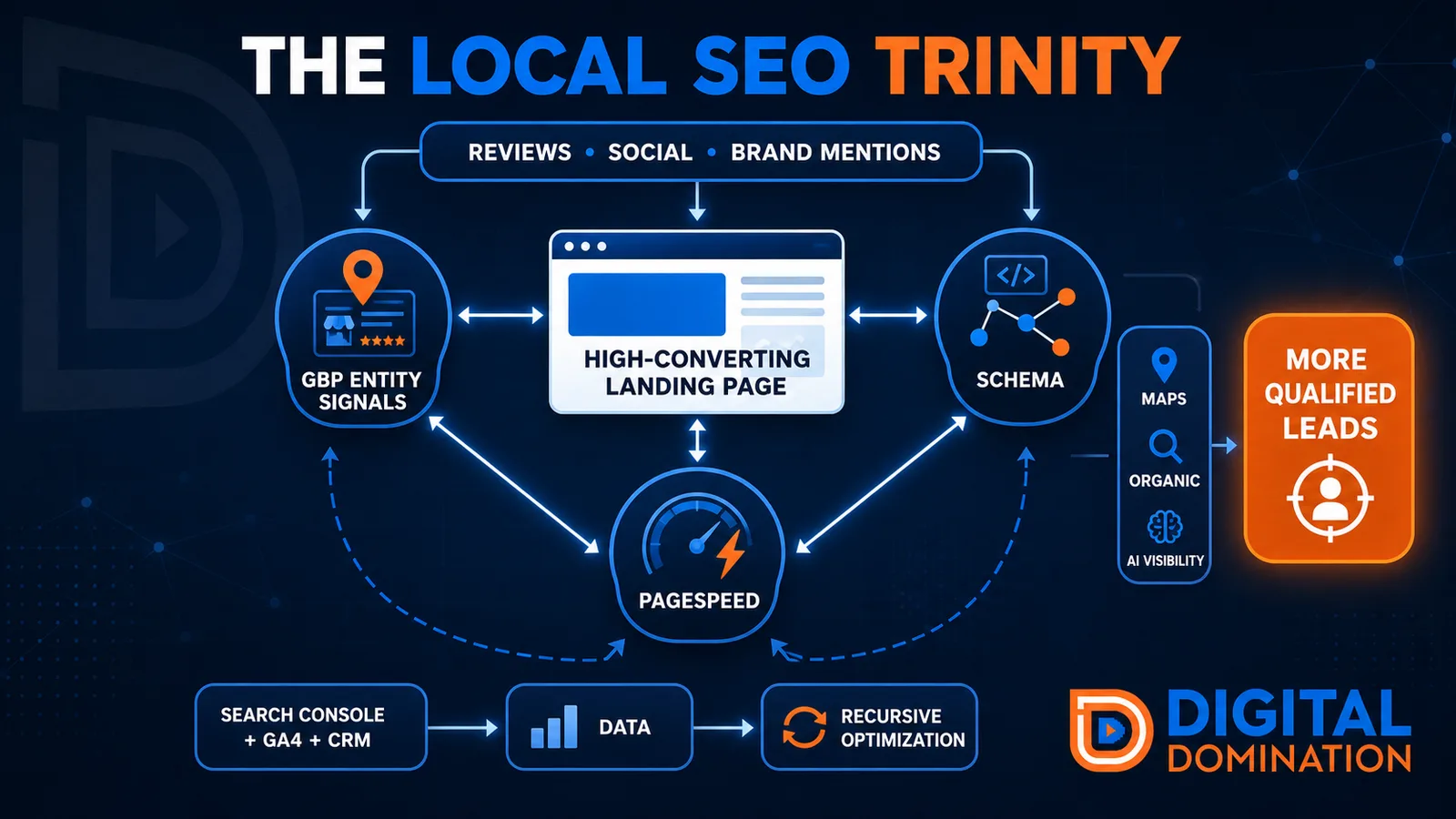
The Local SEO Trinity
Think of a three-legged stool. Your Google profile, your website, and your reviews all have to hold you up. If one leg is short, the whole thing wobbles.
GBP entity signals
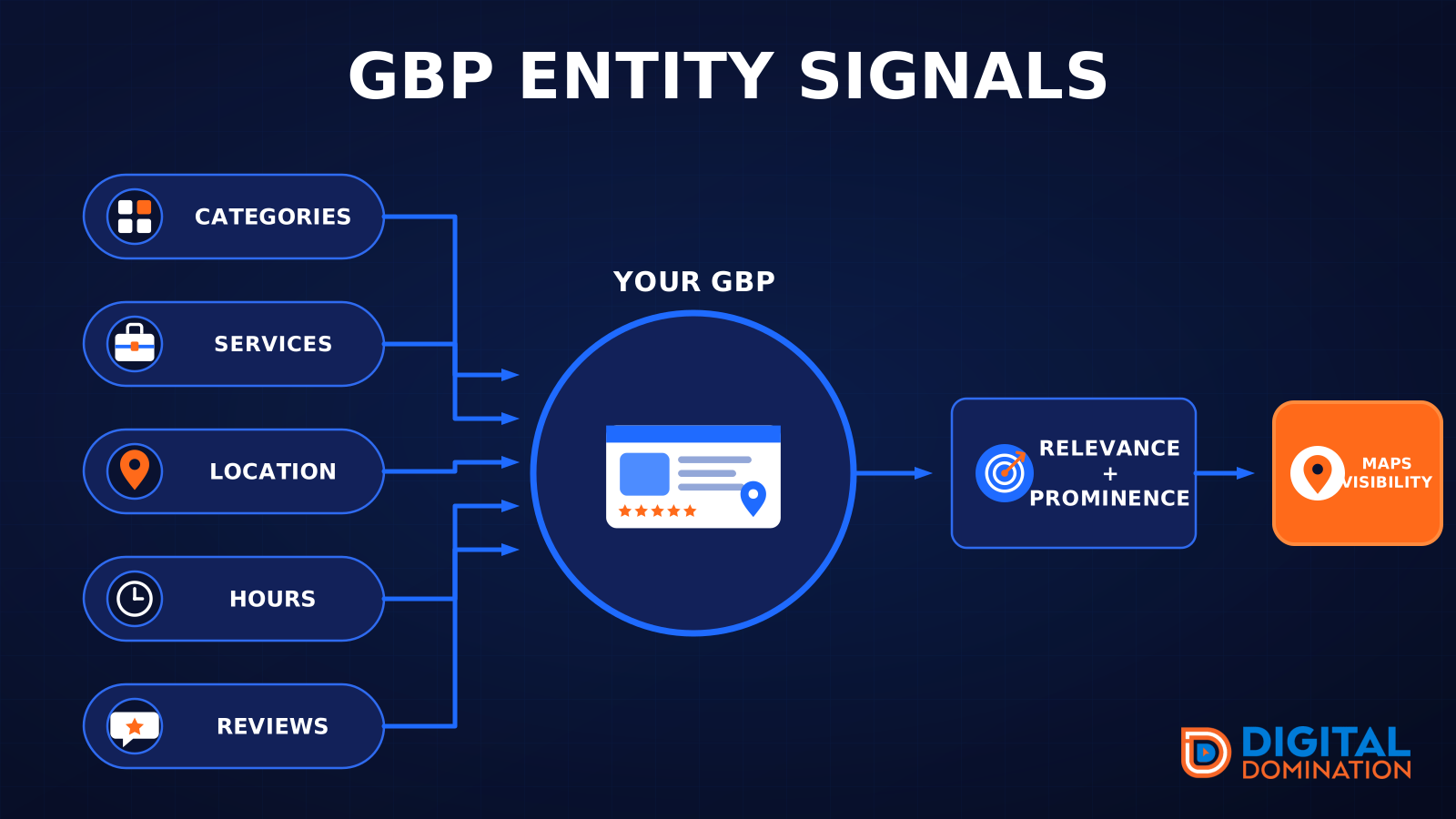
This leg is your Google Business Profile. GBP means Google Business Profile. It covers your categories, your services, your location, your hours, and your reviews. Google uses those facts to decide who to show.
Your Google profile is your storefront sign. If the sign is missing, or it names the wrong shop, people drive past.
PageSpeed to conversion
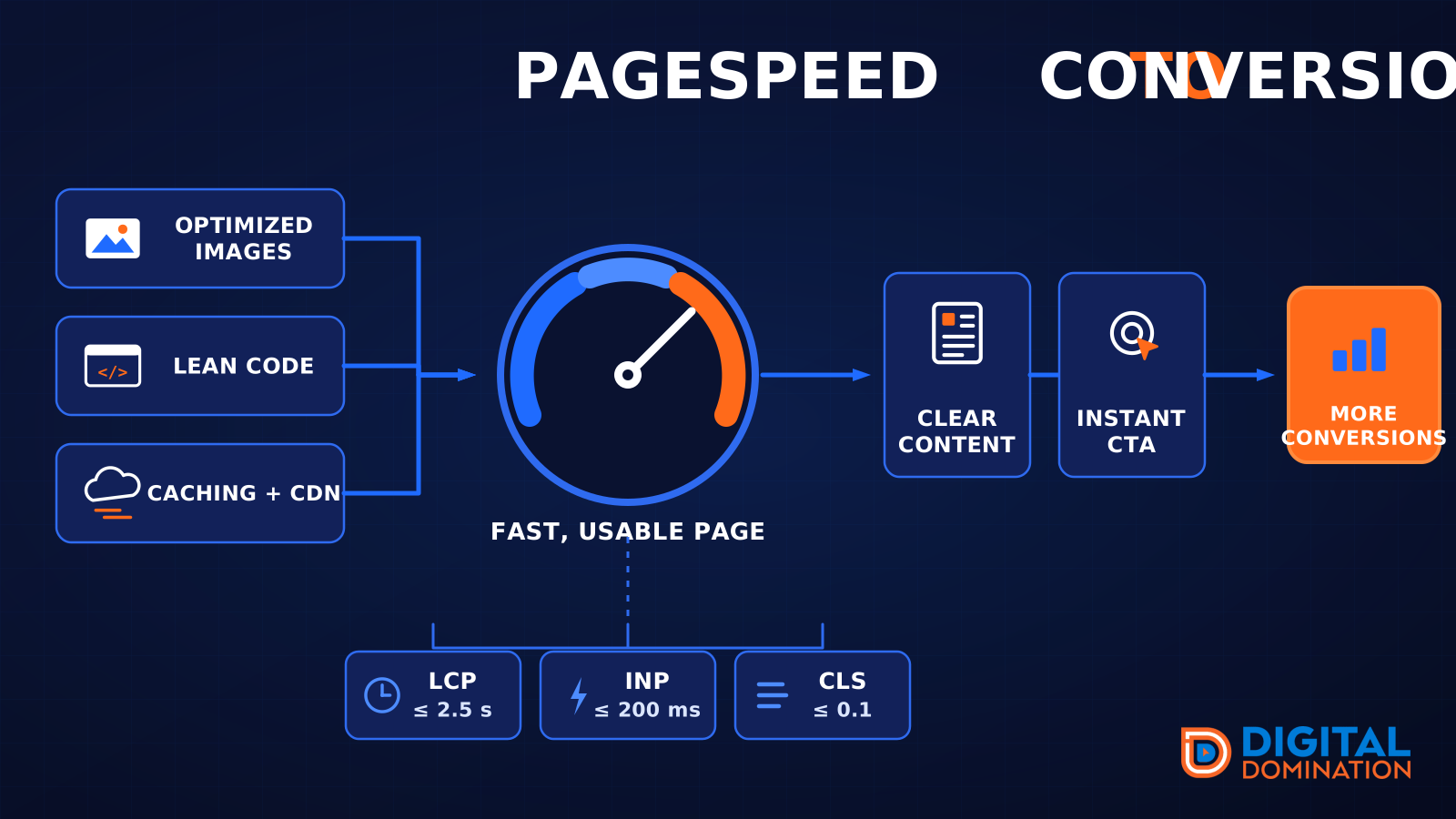
This leg is your website, above all on a phone. Small images, lean code, and caching make a page fast. A fast, clear page is what turns a visit into a call. Phone speed is one of the 12 Trinity checks because a slow page loses the call before anyone sees your offer.
Your website is the showroom. If the door sticks, people leave before they look around.
The review velocity flywheel
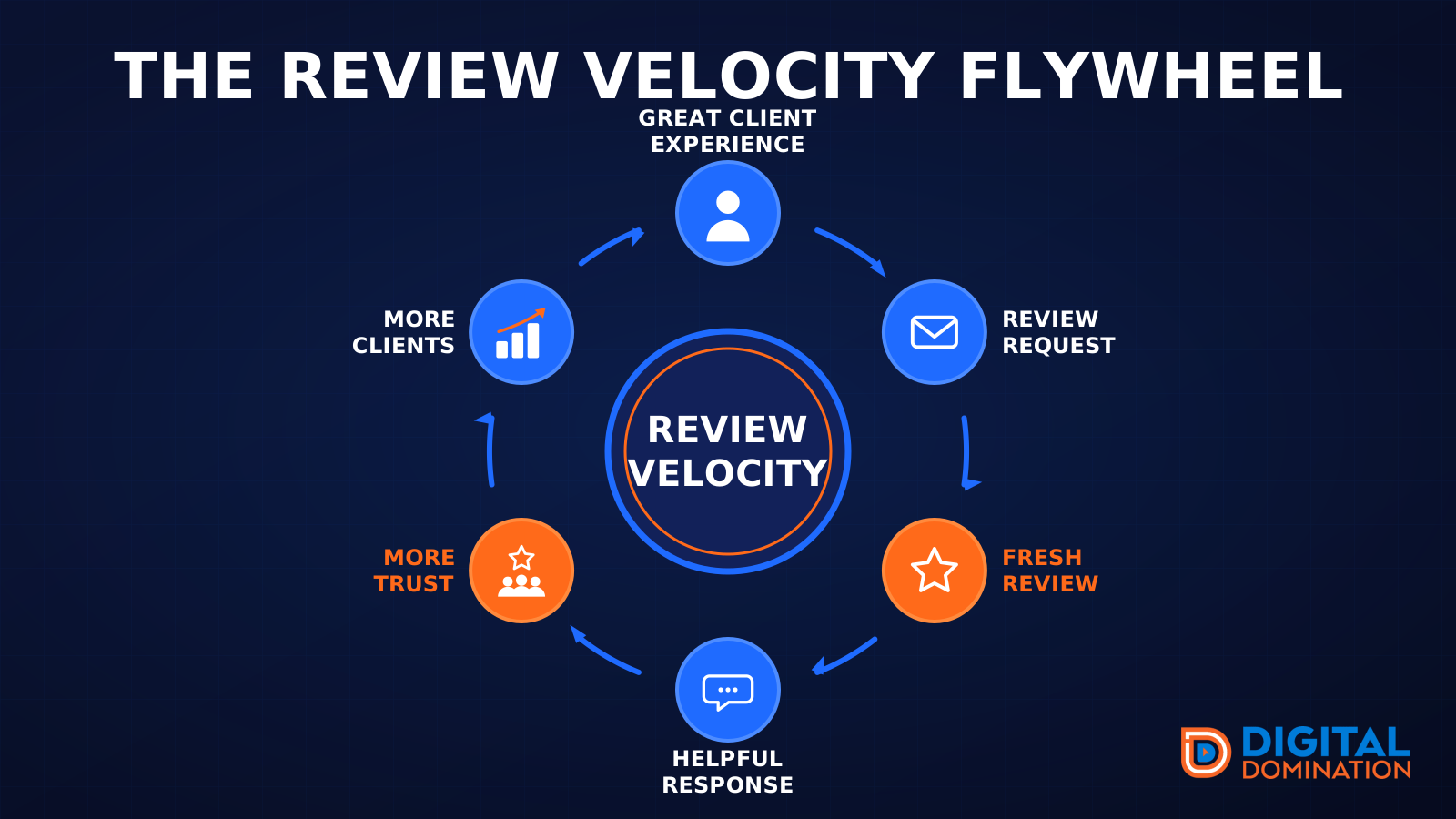
This leg is reviews and reputation. A good visit leads to a review request, then a fresh review, then a helpful reply, then more trust, then more customers. When the scan can find your Google listing, it shows your rating, your recent reviews, and how many you answered.
Reviews are word of mouth. One kind word helps. A steady stream of real reviews, and a reply from you, helps more.
How this turns into revenue
Being found in more searches leads to more calls. More calls lead to more booked jobs. More booked jobs lead to more revenue.
Example numbers, not a real business: 40 calls from search in a month, a 25 percent close rate, and a $400 average job. That is 10 booked jobs. That is $4,000. The math is the lesson. It is not a promise.
The full page has a box where you can type your own average job value and close rate.
One real story, from our car dealership case study: Medina Auto Group went from invisible on Google Maps to dominating every high-intent search across their market. The turnaround spanned all four of their rooftops at once. The same page says the team eliminated 89 unfair one-star reviews that had been dragging the dealership's reputation down and keeping it out of the Map Pack. It also says: “Results described here are exceptional and non-typical. Outcomes vary based on market conditions, competition, and implementation. No guarantees are made regarding earnings, rankings, or conversions.”
Free strategy call
More booked jobs start with a clear plan
Book a free strategy call. We look at your Google profile, your website, and your reviews, and we tell you what to fix first.
Free. You pick the time. A real person shows up.