
ChatGPT traffic is tiny compared with Google. What should local businesses do with AI SEO budgets?
New referral data argues for a practical order of operations: fix Google Maps, GBP, reviews and lead tracking first, then test AI visibility as an add-on.
What changed, and who it hits
Marie Haynes published a 100-site GA4 analysis on October 21, 2026, that should calm down some of the AI SEO panic. Her post, titled GEO is a distraction, found that ChatGPT sessions were only 0.62% of Google organic sessions across the sites she reviewed. All measured LLM referrals combined were 0.73% of Google organic sessions.
Search Engine Land covered the same data in ChatGPT sends less than 1% of Google’s traffic: Data. It also highlighted a conversion finding from the subset of sites tracking conversions: even where ChatGPT visitors converted at a higher rate, Google organic still drove 27 times as many conversions as all LLMs combined.
For a local business owner, the question is not whether AI matters at all. It is whether you should move real budget away from Google Search, Google Maps, your Google Business Profile, reviews and lead tracking to pay for standalone ChatGPT or GEO tools. Based on this data, the answer for most local service businesses is no, not as the first dollar.
The plain-English takeaway from the numbers
The new data does not say ChatGPT traffic has zero value. It says the volume is still tiny next to Google organic traffic. A lead from an AI answer can be a good lead, but if the channel sends very few visitors, it is hard for a local contractor, dentist, attorney, med spa or home service company to justify making it the center of the marketing budget.
That matters because many local businesses are being pitched AI visibility like it is already replacing Google. The data from Marie Haynes and the Search Engine Land coverage points to a more grounded view. AI search is worth watching and testing, but Google is still where most measurable organic demand is showing up.
Think of it like this for budgeting purposes:
- ▸Google organic and Maps are still the base channel for most local discovery.
- ▸AI referrals may be high intent, but the measured volume is small.
- ▸Conversion rate does not pay bills by itself. Total conversions do.
- ▸A business with weak Google visibility should not skip straight to AI citation chasing.
- ▸The smartest plan is to strengthen Google first, then add AI visibility tests.
Why local businesses feel more pressure than the data supports
AI SEO pitches are persuasive because they play on a real fear: nobody wants to miss the next search shift. Local business owners remember when phone books faded, when Google Maps became the front door, and when reviews started deciding who got the call. It is reasonable to ask whether ChatGPT, Perplexity and other answer engines will become the next major local referral source.
The problem is timing. If you run a local service business, you usually do not have unlimited experimental budget. Every dollar going into a new AI tool is a dollar not going into photos, reviews, service pages, GBP cleanup, location content, call tracking, speed fixes or better follow-up.
This is where the October 21 data is useful. It gives owners permission to be curious without being reckless. You can test AI visibility, but you do not have to treat it like an emergency replacement for the channels that are already sending calls.
Google Maps is still the money layer for local intent
When someone searches for an emergency plumber, roof repair, personal injury lawyer, HVAC repair or dental implant consultation, Google still has a huge local advantage. It shows map results, proximity, reviews, hours, services, photos, booking links, directions and click-to-call options. Those are decision tools, not just information.
Google’s local ranking factors are relevance, distance and prominence. That means your visibility depends on how well your profile matches the search, how close you are to the searcher or service area, and how trusted or well-known your business appears to be. Reviews, categories, business information, website content and mentions around the web all feed that practical picture.
If your budget is limited, these are the Google assets to protect before buying a standalone AI SEO product:
- ▸Your Google Business Profile categories, services and business description.
- ▸Your review velocity, review quality and owner responses.
- ▸Your service pages for the jobs you actually want.
- ▸Your location pages if you serve multiple cities or neighborhoods.
- ▸Your call tracking, form tracking and booked-job tracking.
- ▸Your basic website speed and mobile usability.
Where AI visibility does fit right now
AI visibility is not useless. A future customer may ask ChatGPT for the best type of roofer, the safest med spa treatment, how to compare probate attorneys or what to ask before hiring a landscaper. If your brand, content or reviews are part of the information ecosystem those systems can understand, you may benefit over time.
The key is to treat AI visibility as an extension of strong local SEO, not a separate shortcut. Most of the work that helps AI systems understand your business is also work that helps Google and customers understand your business. Clear service pages, consistent business information, helpful explanations, visible reviews and trustworthy local mentions are not wasted if AI traffic stays small.
A practical AI visibility add-on should look like this:
- ▸Create plain-language service content that answers real customer questions.
- ▸Keep your business name, address, phone and service descriptions consistent across the web.
- ▸Earn reviews that mention specific services, cities and customer problems naturally.
- ▸Publish comparison and buying-guide content that helps people choose safely.
- ▸Track referral traffic from ChatGPT and other LLMs in GA4, but do not overreact to tiny numbers.
Five things to check on your profile this week
If you want one useful response to this news, start with the assets that influence local leads now. These checks do not require a developer, a new platform or a major strategy meeting. They require an owner, manager or marketing lead to look at the public information a customer sees before calling.
Check these items this week:
- ▸Your primary Google Business Profile category matches your highest-value service, not a vague industry label.
- ▸Your service list includes the jobs you want more of and removes services you no longer offer.
- ▸Your business hours, holiday hours, phone number and website link are accurate.
- ▸Your last 10 reviews are answered with specific, professional responses.
- ▸Your photos show current vehicles, staff, jobs, office space or finished work, not only stock images.
What to do about it
The right move is not to ignore AI. The right move is to sequence your spend. Local businesses usually win by fixing the closest-to-revenue problems first: can people find you on Google, can they trust you quickly, can they contact you easily, and can you see which leads became real opportunities?
If those basics are weak, an AI SEO subscription may make the owner feel modern without improving the phone. Start with the channel that still shows the most measurable demand, then reserve a small test budget or time budget for AI visibility once the foundation is working.
Use this order of operations:
- ▸Audit your Google Business Profile for category, service, hours, photos and review issues.
- ▸Check your rankings across the actual neighborhoods or cities you serve, not just from your office.
- ▸Make sure every important service has a clear page on your website.
- ▸Add call tracking and form tracking so you know which channels create leads.
- ▸Review call recordings or lead notes to separate good leads from spam and price shoppers.
- ▸Create helpful content that can serve both Google searchers and AI answer systems.
- ▸Test AI visibility only after you can measure Google-driven leads with confidence.
How to measure AI without overspending
If you are already using GA4, you can watch for referrals from ChatGPT and other LLMs. The point is not to create a 40-page monthly report. The point is to know whether the channel is producing enough sessions, calls, forms or booked consultations to deserve more attention.
Be careful with vanity metrics. Being mentioned by an AI tool can feel exciting, but a mention is not the same as a lead. For most local businesses, the useful question is simple: did the person contact you, and did that contact become a qualified opportunity?
A lean measurement setup can include:
- ▸GA4 referral traffic checks for known LLM sources.
- ▸Call tracking numbers on the website, used carefully so your business information stays consistent.
- ▸Form tracking that records the page and channel that led to the inquiry.
- ▸A simple lead status field in your CRM, spreadsheet or booking system.
- ▸A monthly review of leads by source, not just website visits.
Warning signs in an AI SEO sales pitch
Some vendors are doing thoughtful work around AI visibility. Others are selling fear. The difference usually shows up in how they talk about priorities, measurement and tradeoffs.
If a sales pitch says Google is already dead for local businesses, that should make you skeptical. The data covered by Marie Haynes and Search Engine Land points in the opposite direction for current referral volume. The better pitch is honest about uncertainty and connects AI work to the same customer questions, reputation signals and service content that support local SEO.
Be cautious if you hear claims like these:
- ▸You should move most of your local SEO budget to AI immediately.
- ▸Map Pack rankings do not matter anymore.
- ▸Reviews are less important now because AI will summarize everything.
- ▸They can guarantee specific ChatGPT answers across all users and prompts.
- ▸They report AI mentions but cannot show calls, forms or qualified leads.
- ▸They want to replace your Google work before fixing your GBP and tracking.
The budget decision for the next 90 days
For the next 90 days, most local businesses should keep their first dollars focused on Google Search, Google Maps, GBP improvements, reviews and tracking. That does not mean AI gets ignored. It means AI gets placed where it belongs right now: an add-on test after the primary demand channel is healthy.
A good budget question is: if we spend this dollar, will it help a ready-to-buy local customer find us, trust us and contact us? GBP cleanup often passes that test. Review generation often passes that test. Service page improvements often pass that test. Call tracking often passes that test. A standalone AI visibility tool may pass it later, but for many owners, it should not outrank those basics today.
Your 90-day priority list should be:
- ▸Protect and improve Google Maps visibility.
- ▸Fix the Google Business Profile details customers see first.
- ▸Build a steady review process.
- ▸Improve pages for the services that produce profitable jobs.
- ▸Track calls and forms back to the channel that produced them.
- ▸Watch AI referrals monthly without letting them drive the whole plan.
Bottom line for local business owners
The October 21, 2026 data does not prove AI search will stay small forever. It does show that ChatGPT and other measured LLM referrals are still tiny compared with Google organic traffic in the Marie Haynes analysis, and Search Engine Land reported that Google organic produced far more total conversions in the subset tracking them.
So the practical decision is clear: do not replace local SEO with AI citation chasing right now. Build the Google foundation, measure the leads, then test AI visibility in a controlled way.
Digital Domination is a Las Vegas local SEO agency serving local service businesses nationally. If you want to see what a serious Google-first local SEO plan includes, visit digitaldomination.ai/local-seo-services/. That page explains the local SEO services built around Google Maps visibility, Google Business Profile optimization, reviews, local pages and measurable lead tracking. If you want a starting point, get the free GeoGrid scan at digitaldomination.ai/scan/. Digital Domination’s GeoGrid scan checks 169 points across a market.
Keep reading
Related guides
Put it into action
Frequently Asked Questions
Should my local business pay for AI SEO right now?
Maybe, but it should usually be an add-on, not the core budget. The October 21 data from Marie Haynes and the Search Engine Land coverage show that measured LLM referrals are still tiny compared with Google organic traffic. If your Google Business Profile, reviews and tracking are not strong, fix those first.
Is ChatGPT replacing Google for local searches?
Not based on this data. ChatGPT may influence research and recommendations, but Marie Haynes found ChatGPT sessions were only 0.62% of Google organic sessions across the 100-site GA4 analysis. For local businesses, Google Search and Google Maps still deserve the first attention.
What is GEO in SEO?
GEO usually means generative engine optimization, which is work meant to improve visibility in AI-generated answers. Some of that work overlaps with good local SEO, such as clear service content, consistent business information and strong reputation signals. The risk is paying for GEO while neglecting Google Maps and lead tracking.
Can ChatGPT leads convert better than Google leads?
They can in some cases, and Search Engine Land noted higher ChatGPT conversion rates in the data it covered. But total volume matters. In the subset tracking conversions, Google organic still drove 27 times as many conversions as all LLMs combined.
What should I spend money on before AI SEO?
Start with your Google Business Profile, reviews, service pages, local rankings and conversion tracking. Make sure people can find you, trust you and contact you from Google Search and Maps. Then test AI visibility after the main local SEO foundation is measurable.
How do I know if AI is sending my business leads?
Check GA4 referral traffic for ChatGPT and other LLM sources, then connect those visits to calls, forms or booked consultations. Do not judge the channel only by visits or mentions. The useful question is whether AI referrals turn into qualified leads.
Will AI SEO help my Google rankings too?
It can if the work is based on better content, clearer service pages, consistent business details and stronger reputation signals. Those improvements can help customers and may support Google visibility as well. Be wary of AI SEO work that creates reports but does not improve your website, profile or lead tracking.
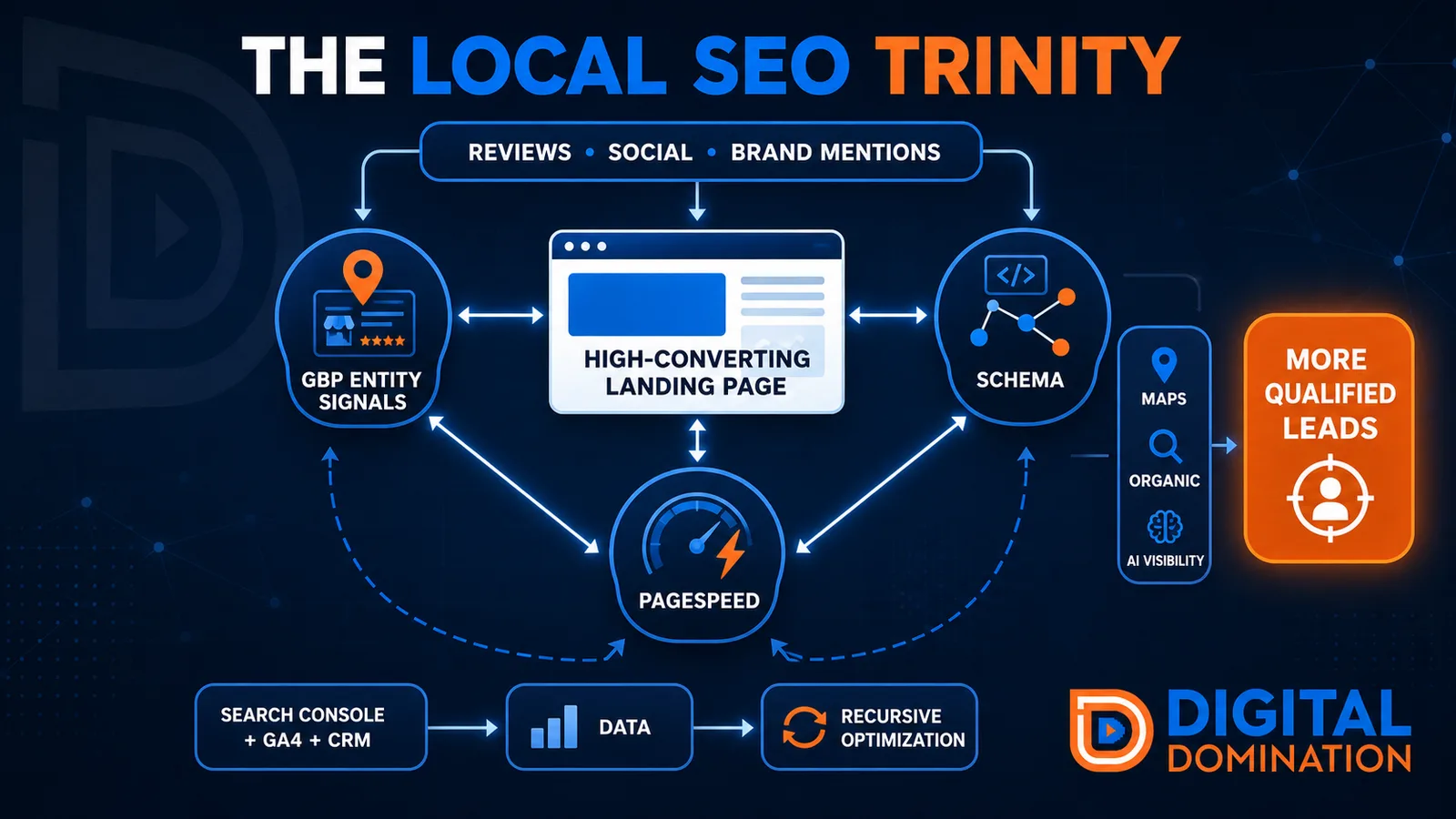
The Local SEO Trinity
Think of a three-legged stool. Your Google profile, your website, and your reviews all have to hold you up. If one leg is short, the whole thing wobbles.
GBP entity signals
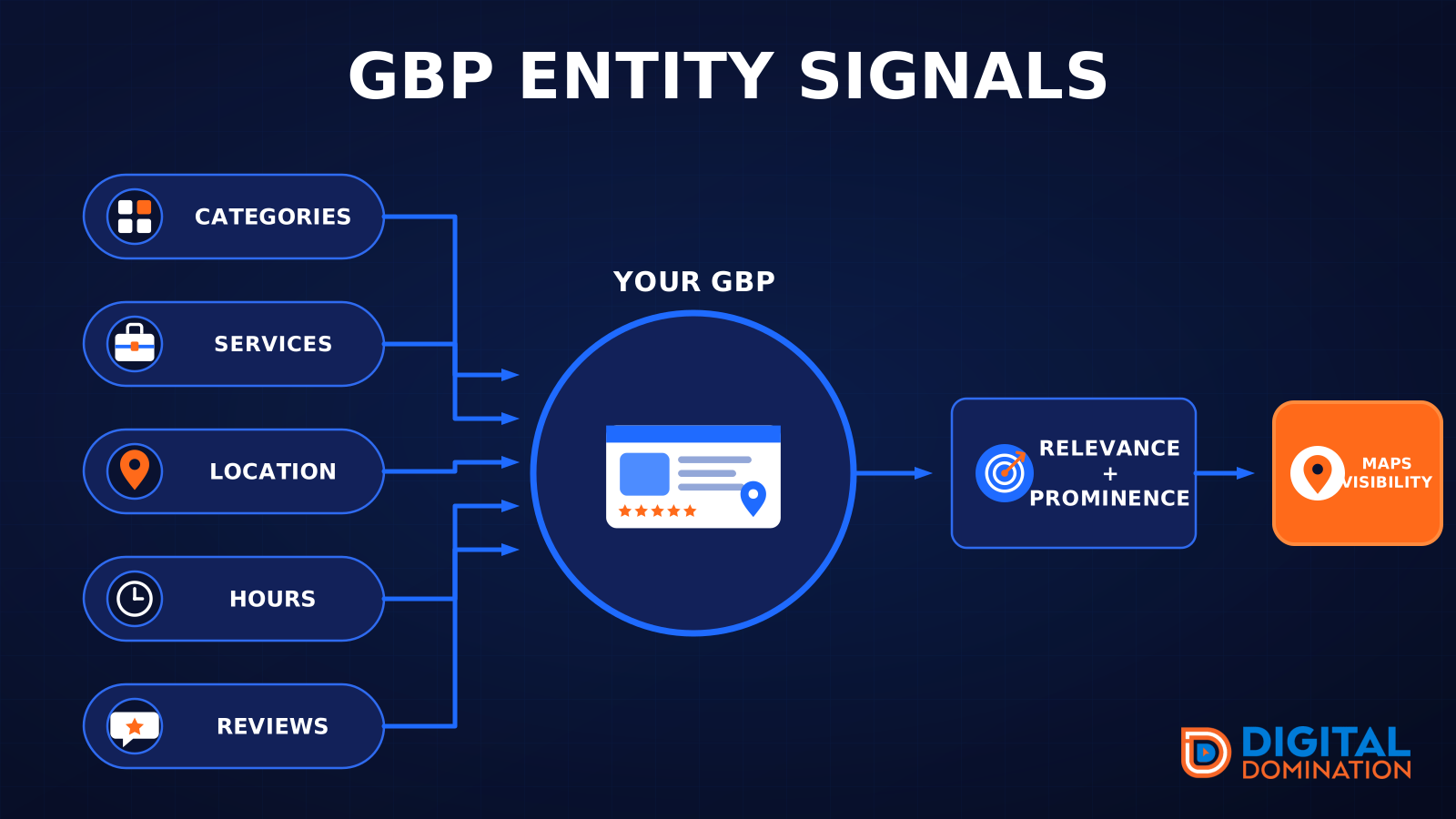
This leg is your Google Business Profile. GBP means Google Business Profile. It covers your categories, your services, your location, your hours, and your reviews. Google uses those facts to decide who to show.
Your Google profile is your storefront sign. If the sign is missing, or it names the wrong shop, people drive past.
PageSpeed to conversion
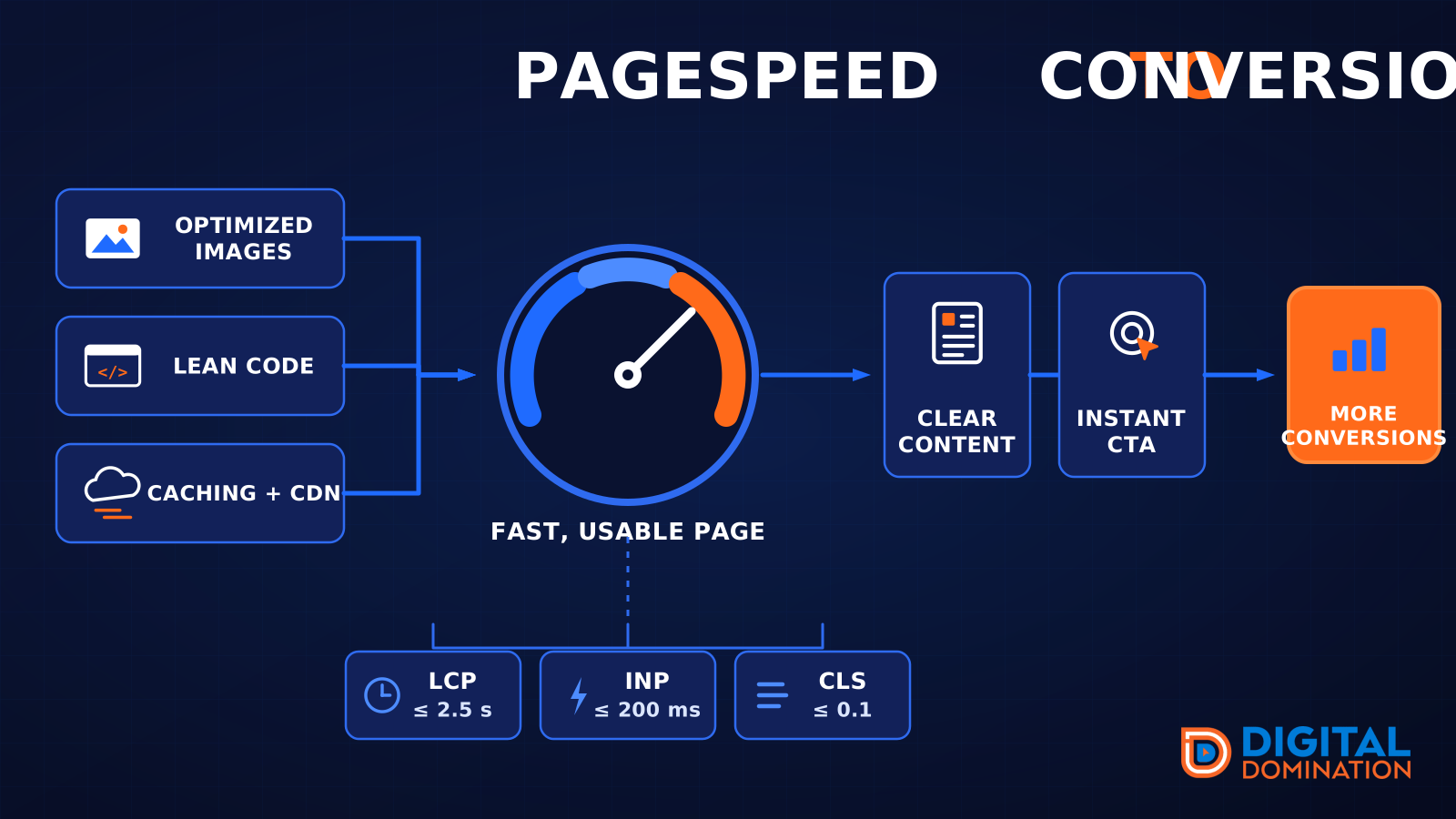
This leg is your website, above all on a phone. Small images, lean code, and caching make a page fast. A fast, clear page is what turns a visit into a call. Phone speed is one of the 12 Trinity checks because a slow page loses the call before anyone sees your offer.
Your website is the showroom. If the door sticks, people leave before they look around.
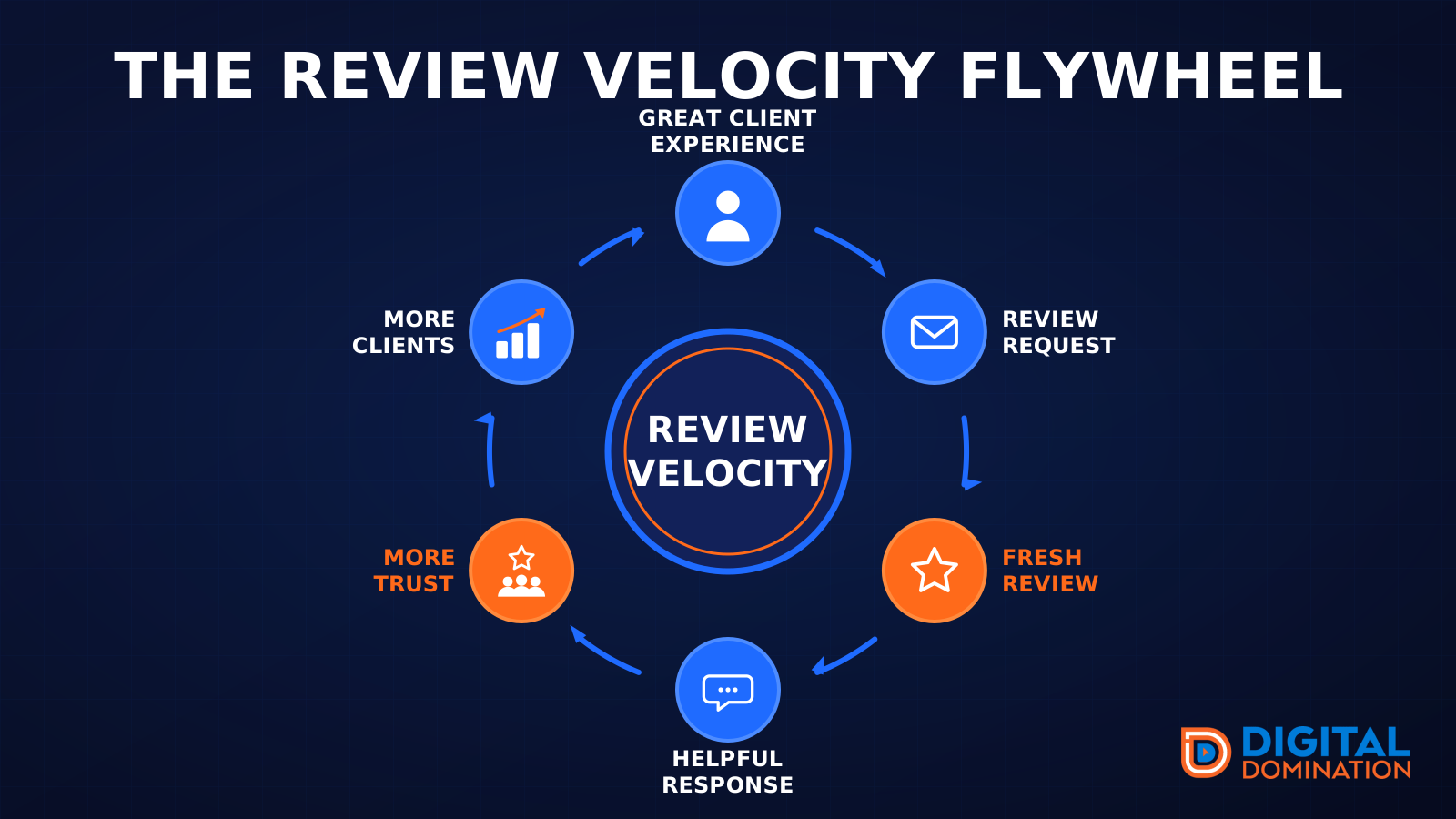
The review velocity flywheel
This leg is reviews and reputation. A good visit leads to a review request, then a fresh review, then a helpful reply, then more trust, then more customers. When the scan can find your Google listing, it shows your rating, your recent reviews, and how many you answered.
Reviews are word of mouth. One kind word helps. A steady stream of real reviews, and a reply from you, helps more.
How this turns into revenue
Being found in more searches leads to more calls. More calls lead to more booked jobs. More booked jobs lead to more revenue.
Example numbers, not a real business: 40 calls from search in a month, a 25 percent close rate, and a $400 average job. That is 10 booked jobs. That is $4,000. The math is the lesson. It is not a promise.
The full page has a box where you can type your own average job value and close rate.
One real story, from our car dealership case study: Medina Auto Group went from invisible on Google Maps to dominating every high-intent search across their market. The turnaround spanned all four of their rooftops at once. The same page says the team eliminated 89 unfair one-star reviews that had been dragging the dealership's reputation down and keeping it out of the Map Pack. It also says: “Results described here are exceptional and non-typical. Outcomes vary based on market conditions, competition, and implementation. No guarantees are made regarding earnings, rankings, or conversions.”
Free strategy call
More booked jobs start with a clear plan
Book a free strategy call. We look at your Google profile, your website, and your reviews, and we tell you what to fix first.
Free. You pick the time. A real person shows up.