
Google's AI link rules give local owners a checklist
New Google documentation turns AI SEO into something local business owners can inspect, question and fix this week.

What changed and who it hits
On November 24, 2026, Google added new Search Central documentation explaining how AI Overviews and AI Mode choose, check and display supporting links. The document, called Attribution and factuality in Search generative AI features, says these AI features draw from the Search index, may run related searches, corroborate answers against web results, data feeds and the Knowledge Graph, then show links that support the response.
This hits local service businesses because many owners are already being sold AI SEO without a clear checklist. A roofer, dentist, plumber, med spa, HVAC company or attorney does not need vague prompt testing as the main deliverable. The new documentation gives owners a more practical question: can Google crawl, understand, verify and cite your actual pages when an AI answer is built?
Google also listed this change in its Latest Google Search documentation updates on November 24, 2026. Search Engine Roundtable covered the update the same day in Google On How Links Are Selected & Shown In AI Overviews & AI Mode, noting the focus on how links are selected and shown in these AI search experiences. For local owners, the news is not that every business must chase a new trick. The news is that the basics have become easier to audit.
What Google says a cited link must be
Google's own documentation says supporting links in Search generative AI features come from pages that are part of the Search index. Google may use the same broad systems it uses for Search, then it may perform additional checks to support the AI response.
The most important part for a local business owner is the eligibility filter. If a page is not indexed, is not eligible to show a snippet or is excluded from Search generative AI features, it may not be used as a cited source there. That means a page can look fine to a visitor and still be a poor candidate for an AI citation.
Here are the owner-level requirements to understand:
- ▸The page should be crawlable by Google.
- ▸The page should be indexed in Google Search.
- ▸The page should be eligible to show a search snippet.
- ▸The page should not be opted out of Search generative AI features.
- ▸The page should contain facts Google can corroborate elsewhere.
Why this matters more for local service businesses
Local search is already filtered through relevance, distance and prominence. AI Overviews and AI Mode do not erase those ideas for local intent. They add another layer where Google may assemble an answer from indexed sources, related searches and entity information.
That makes weak local websites more vulnerable. A single thin services page that says you are trusted, affordable and family owned may not provide enough factual material for Google to cite. A business with outdated hours, mismatched service areas, missing technician credentials or vague service descriptions gives the system less to verify.
This also changes how owners should judge AI SEO vendors. The work should not stop at asking ChatGPT or Gemini what shows up for a few sample prompts. A provider should be improving the pages, facts and technical settings that make your business easier for Google to understand and cite.
Five things your AI SEO provider should fix this week
If a provider says it is doing AI SEO, ask for work you can see in your site, profile and Search Console. The deliverables should connect directly to the way Google's documentation describes source selection and factuality.
Use this as the short buying checklist:
- ▸Crawlable service pages that describe each money-making service in plain language.
- ▸Location or service-area pages that explain where you work and what you do there.
- ▸Consistent business facts across your website, Google Business Profile and major data sources.
- ▸Fresh proof such as recent project examples, staff information, credentials and FAQs.
- ▸Search Console settings that do not block snippets, indexing or Search generative AI inclusion.
Make service pages crawlable, not just attractive
A service page is not only a sales page. It is also evidence. If Google is building an AI answer about emergency drain cleaning, roof repair, AC installation or estate planning, your page needs to clearly state that you provide the service, explain when it is needed and support the claim with specific details.
Owners can check this without being technical. Open your service page and ask whether a new customer would understand the service without calling you. Then ask whether Google can reach the page through normal internal links, such as your main navigation, service menu or footer.
Ask your provider to review each priority service page for these basics:
- ▸One dedicated page for each core service, not one generic services page.
- ▸Clear headings that use the words customers actually search.
- ▸Plain descriptions of problems, process, materials, options or eligibility.
- ▸Visible city, county or service-area context where it is natural.
- ▸Internal links from the homepage, main service hub and related pages.
Build location pages that carry real facts
Many local sites have location pages that are little more than swapped city names. That is weak for traditional local SEO and even weaker when an AI system is trying to corroborate an answer. A useful location page should make it clear why your business is relevant to that place.
For a service-area business, the page should explain what you do in that city, which nearby areas you serve and what local conditions matter. A garage door company might discuss common repair calls by housing type. A family law firm might explain which county court serves the area. The point is not to stuff city names. The point is to publish facts a real customer would find useful.
Local pages also need consistency. If your Google Business Profile says one service area, your website says another and your footer lists cities you no longer serve, you are making corroboration harder. Clean service-area facts are now part of AI visibility, not just directory hygiene.
Clean up the entity information Google can corroborate
Google's documentation says Search generative AI features may corroborate answers against web results, data feeds and the Knowledge Graph. For a local owner, that means your business identity matters. Google needs to understand who you are, what you do, where you operate and why you are a trustworthy source for the query.
This is where AI SEO overlaps with local SEO. Your name, address, phone number, categories, services, staff, credentials and hours should not tell different stories across the web. A messy footprint makes it harder for systems to connect your pages to the real-world business.
Ask your provider to verify these facts first:
- ▸Business name, address and phone number are consistent where they appear.
- ▸Google Business Profile categories match the services you want to win.
- ▸Website service names match the terms used on your Google Business Profile.
- ▸Practitioner, technician or attorney bios are current when relevant.
- ▸Credentials, licenses and affiliations are described accurately and visibly.
Keep freshness and trust signals visible
AI citations are not awarded just because a page exists. Google says its systems check and corroborate information, which makes stale or thin pages less useful. A page that has not been touched in years may still rank, but it might not be the best source for a current AI answer.
Freshness does not mean changing words for no reason. It means keeping the page accurate and adding useful proof over time. Local businesses often have more proof than they publish: common questions from calls, before-and-after context without exaggerated claims, service process details, updated staff bios and current photos.
This week, look for trust signals that are missing or outdated:
- ▸Outdated service descriptions or discontinued offers.
- ▸Old staff information or missing professional bios.
- ▸No explanation of estimates, scheduling, warranties or service process.
- ▸Missing license, insurance or certification details when applicable.
- ▸Thin FAQ sections that do not answer real customer questions.
Check Search Console settings that can block AI citations
One of the clearest parts of Google's new documentation is that pages must be eligible. This is not only about content quality. A page can be blocked by robots.txt, noindex tags, canonical mistakes, snippet restrictions or other settings that prevent Google from using it normally in Search features.
Business owners do not need to diagnose every technical issue alone. But you should expect your provider to check Google Search Console and explain what is indexed, what is excluded and why. If an important service page is not indexed, AI SEO work should start there before anyone promises more visibility in AI answers.
Ask for a simple report that covers these items:
- ▸Which priority service and location pages are indexed.
- ▸Which important pages are discovered but not indexed.
- ▸Whether any pages use noindex by mistake.
- ▸Whether snippet controls are limiting what Google can show.
- ▸Whether canonical tags point Google to the correct page.
Prompt testing is not a strategy
Testing prompts can be useful as a snapshot. It can show whether your business is mentioned for certain questions, whether competitors are being cited and whether AI answers understand your category. But prompt testing is not the same as fixing the reasons you are missing.
AI answers can vary by query wording, location, user context and timing. If your provider only sends screenshots of AI Overviews or AI Mode responses, you still do not know whether your site is healthier. The work has to tie back to indexed pages, corroborated facts and eligibility for Search generative AI features.
A stronger report shows both visibility and repair work. It should connect the query to the page that should support it, the page's index status, the local facts Google can verify and the content improvements made that month. That is the difference between AI SEO theater and AI SEO operations.
What to do about it this week
You do not need to rebuild your whole website because Google published this documentation. Start with the services that drive real calls and the cities or service areas that matter most. Then check whether those pages are good candidates for citation.
The fastest owner-level audit is to choose a few priority services and trace the path from Google to your website to your business facts. If something is blocked, missing, vague or inconsistent, fix that before buying another AI visibility report.
Take these actions this week:
- ▸List your top services and confirm each has its own useful page.
- ▸Search Google for each page title and see whether the page appears.
- ▸Open Google Search Console and check indexing for those URLs.
- ▸Compare your website services with your Google Business Profile services.
- ▸Update old facts, hours, service areas and staff details.
- ▸Ask your provider which pages are eligible for snippets and which are not.
- ▸Add practical FAQs based on real calls, estimates and objections.
How to judge an AI SEO pitch now
The new Google documentation gives owners better questions to ask. You are not looking for a vendor who simply says AI is changing search. You are looking for someone who can show how your business becomes a better source for Google's AI systems and normal local results at the same time.
A serious AI SEO proposal for a local business should include technical eligibility, content quality, entity consistency and local prominence. It should also be honest about uncertainty. No provider controls whether Google cites a specific page in a specific AI answer.
Use these questions before you sign:
- ▸Which pages will you make more crawlable, indexable and citation-worthy?
- ▸How will you check whether important pages are snippet-eligible?
- ▸What business facts will you clean up across my site and profiles?
- ▸How will you improve service and location pages without stuffing keywords?
- ▸What will you report besides prompt screenshots?
- ▸How does this work support my Google Business Profile and Map Pack visibility?
The decision for local owners
Google's November 24 documentation does not make AI SEO mysterious. It makes it more accountable. If AI Overviews and AI Mode use indexed pages, related searches, corroboration and eligibility rules, then your provider should be improving the assets Google can actually use.
That means better service pages, stronger location pages, cleaner business facts, current trust signals and Search Console checks. It also means being cautious with anyone selling AI SEO as a separate magic trick from local search fundamentals.
Digital Domination is a Las Vegas local SEO agency serving local service businesses nationally, and we look at this through a practical local ranking lens. Our AI SEO service page at digitaldomination.ai/ai-seo/ explains how we connect AI visibility work with local SEO, content, entity cleanup and search performance. If you want to see where you stand in Google Maps first, start with the free GeoGrid scan at digitaldomination.ai/scan/.
Keep reading
Related guides
- ▸Digital Marketing Company for Local Service Businesses
- ▸Divorce lawyer local SEO
- ▸Does Chatgpt Use Google Reviews
Put it into action
Frequently Asked Questions
How do AI Overviews and AI Mode choose cited links?
Google's Search Central documentation says these features draw from the Search index and may run related searches to build and support an answer. Google says it can corroborate answers against web results, data feeds and the Knowledge Graph, then display supporting links.
Can my local business be cited in AI Overviews if my page is not indexed?
Based on Google's documentation, a page needs to be in the Search index to be eligible as a supporting link. If an important service or location page is not indexed, fixing that should come before prompt testing or AI visibility claims.
What does snippet-eligible mean for AI SEO?
Snippet-eligible means Google is allowed to show a preview or summary from the page in Search. If your settings limit snippets or block normal Search features, the page may be less usable for AI Overviews and AI Mode citations.
Should I block my pages from Search generative AI features?
Most local businesses that want more discovery should be careful before blocking inclusion. If you exclude pages from Search generative AI features, Google says those pages may not be cited there, even if they can still appear in other search experiences.
Is AI SEO different from local SEO?
There is overlap. Local SEO still depends on relevance, distance and prominence, while AI SEO adds more focus on whether your pages and facts can be crawled, verified and cited. For a local service business, the same weak pages that hurt local rankings can also hurt AI visibility.
What should I ask an AI SEO company before hiring them?
Ask which pages they will improve, how they will check indexing and snippet eligibility, and how they will clean up your business facts. If the plan is mostly prompt screenshots with no page, profile or Search Console work, it is not enough.
Do reviews affect whether Google cites my website in AI answers?
Google's new documentation is about attribution and factuality in Search generative AI features, not a simple review-based citation formula. Reviews can still support local prominence and trust, but your pages also need to be indexable, specific and consistent with your business facts.
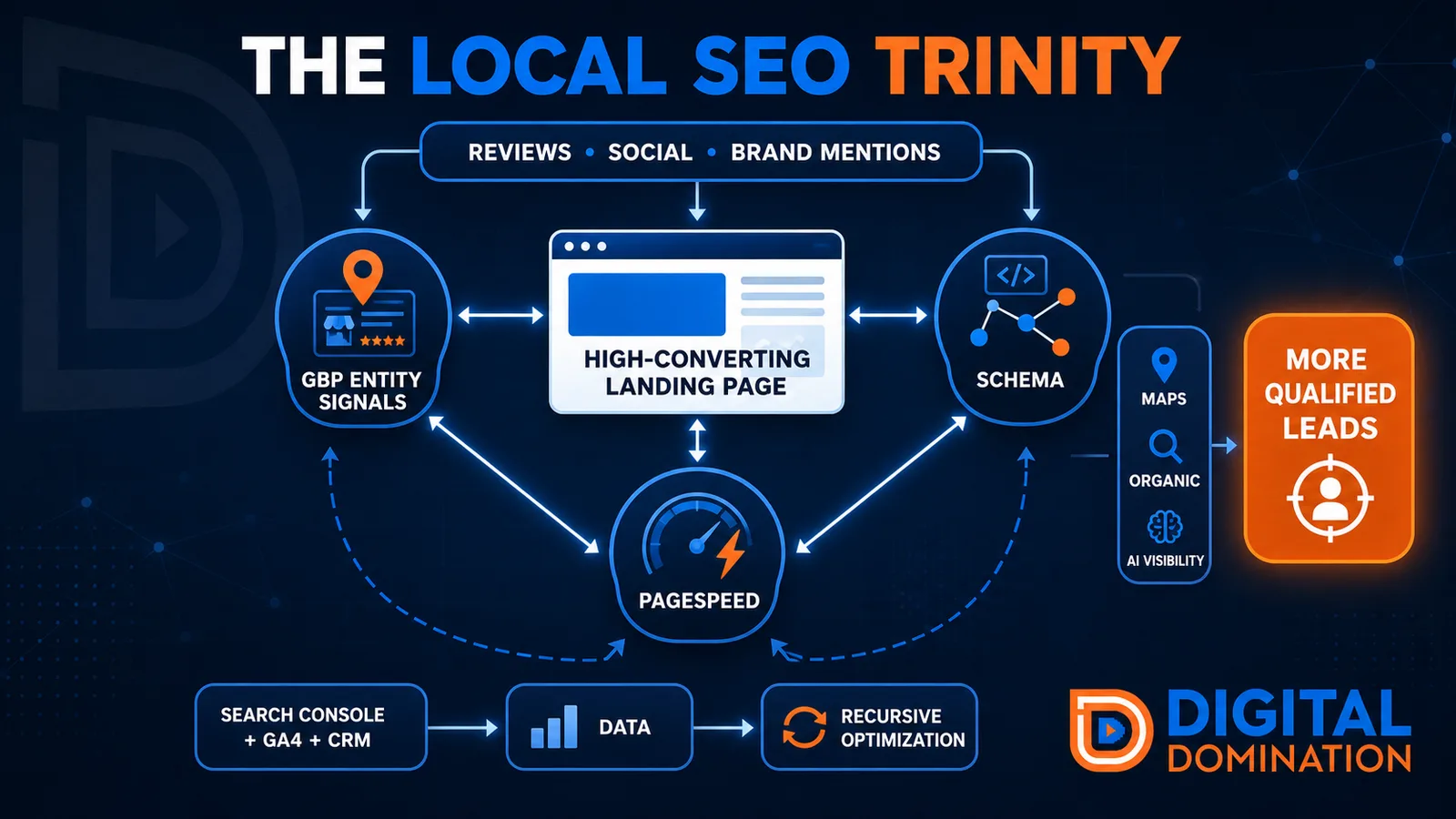
The Local SEO Trinity
Think of a three-legged stool. Your Google profile, your website, and your reviews all have to hold you up. If one leg is short, the whole thing wobbles.
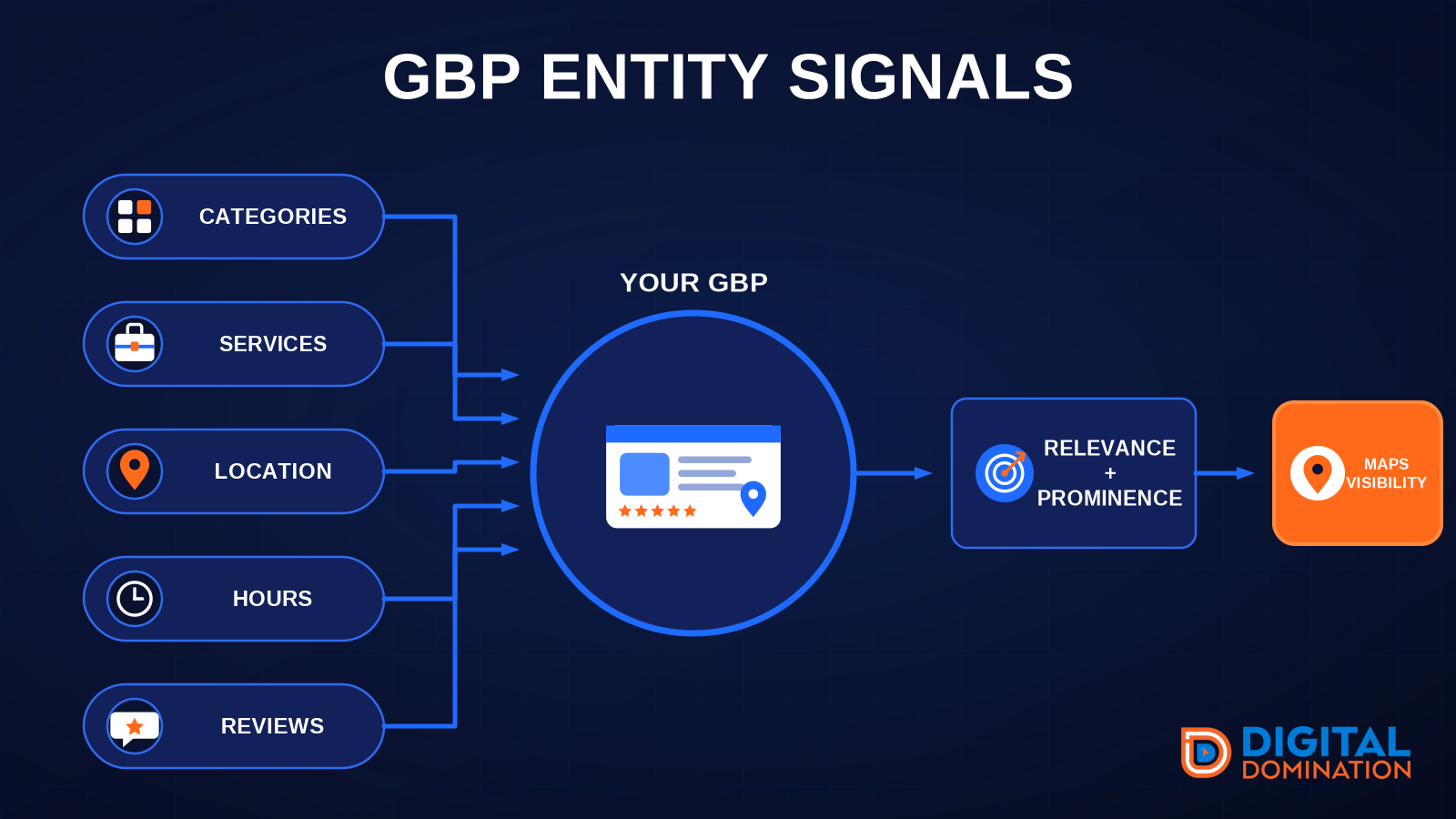
GBP entity signals
This leg is your Google Business Profile. GBP means Google Business Profile. It covers your categories, your services, your location, your hours, and your reviews. Google uses those facts to decide who to show.
Your Google profile is your storefront sign. If the sign is missing, or it names the wrong shop, people drive past.
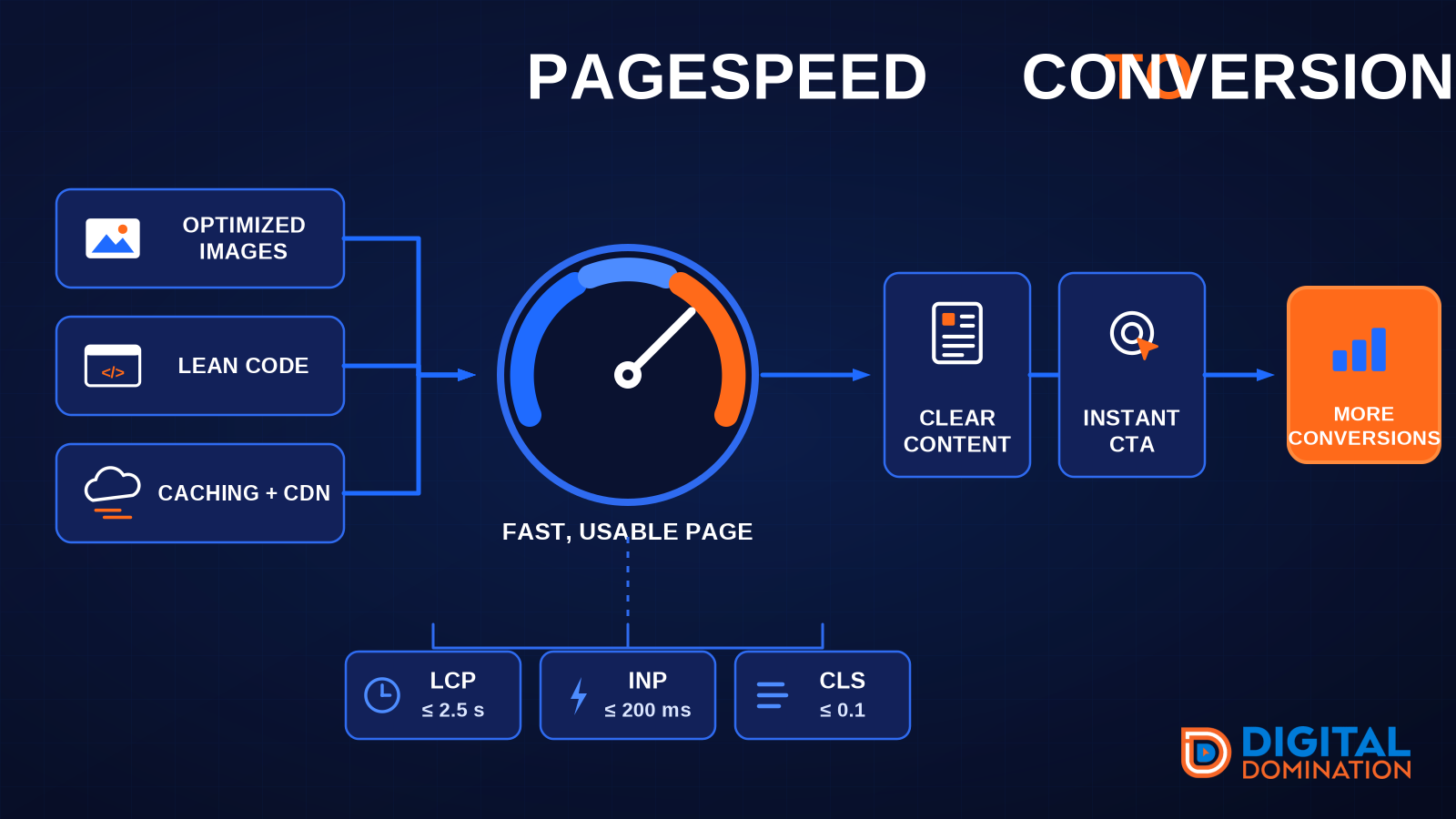
PageSpeed to conversion
This leg is your website, above all on a phone. Small images, lean code, and caching make a page fast. A fast, clear page is what turns a visit into a call. Phone speed is one of the 12 Trinity checks because a slow page loses the call before anyone sees your offer.
Your website is the showroom. If the door sticks, people leave before they look around.
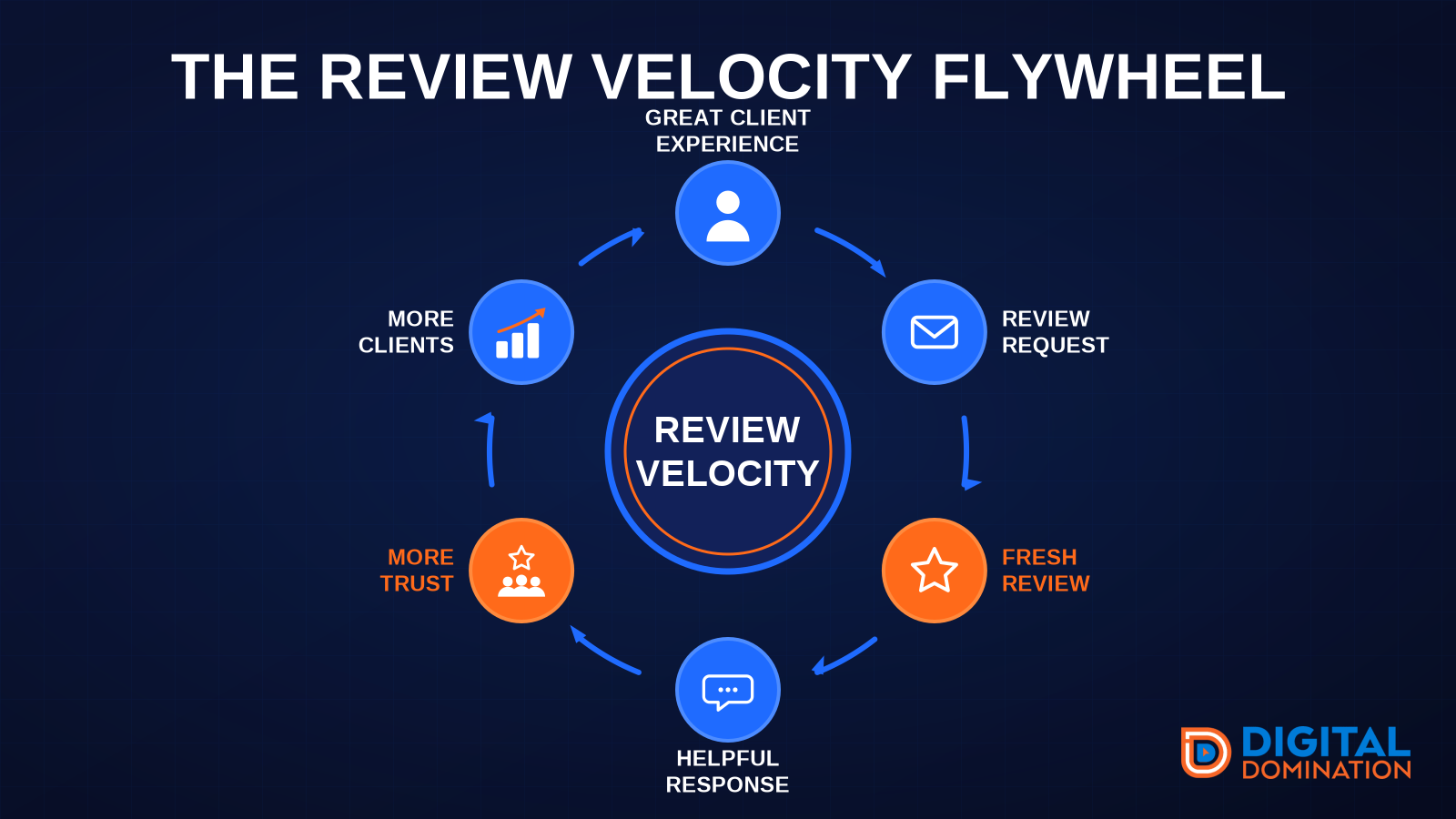
The review velocity flywheel
This leg is reviews and reputation. A good visit leads to a review request, then a fresh review, then a helpful reply, then more trust, then more customers. When the scan can find your Google listing, it shows your rating, your recent reviews, and how many you answered.
Reviews are word of mouth. One kind word helps. A steady stream of real reviews, and a reply from you, helps more.
How this turns into revenue
Being found in more searches leads to more calls. More calls lead to more booked jobs. More booked jobs lead to more revenue.
Example numbers, not a real business: 40 calls from search in a month, a 25 percent close rate, and a $400 average job. That is 10 booked jobs. That is $4,000. The math is the lesson. It is not a promise.
The full page has a box where you can type your own average job value and close rate.
One real story, from our car dealership case study: Medina Auto Group went from invisible on Google Maps to dominating every high-intent search across their market. The turnaround spanned all four of their rooftops at once. The same page says the team eliminated 89 unfair one-star reviews that had been dragging the dealership's reputation down and keeping it out of the Map Pack. It also says: “Results described here are exceptional and non-typical. Outcomes vary based on market conditions, competition, and implementation. No guarantees are made regarding earnings, rankings, or conversions.”
Free strategy call
More booked jobs start with a clear plan
Book a free strategy call. We look at your Google profile, your website, and your reviews, and we tell you what to fix first.
Free. You pick the time. A real person shows up.