
Digital Domination vs doing local SEO yourself with free Google tools and a rank tracker
A fair comparison for local business owners who can manage Google Business Profile, Search Console, Analytics, and rank tracking, but want to know what changes when the work becomes done for you.
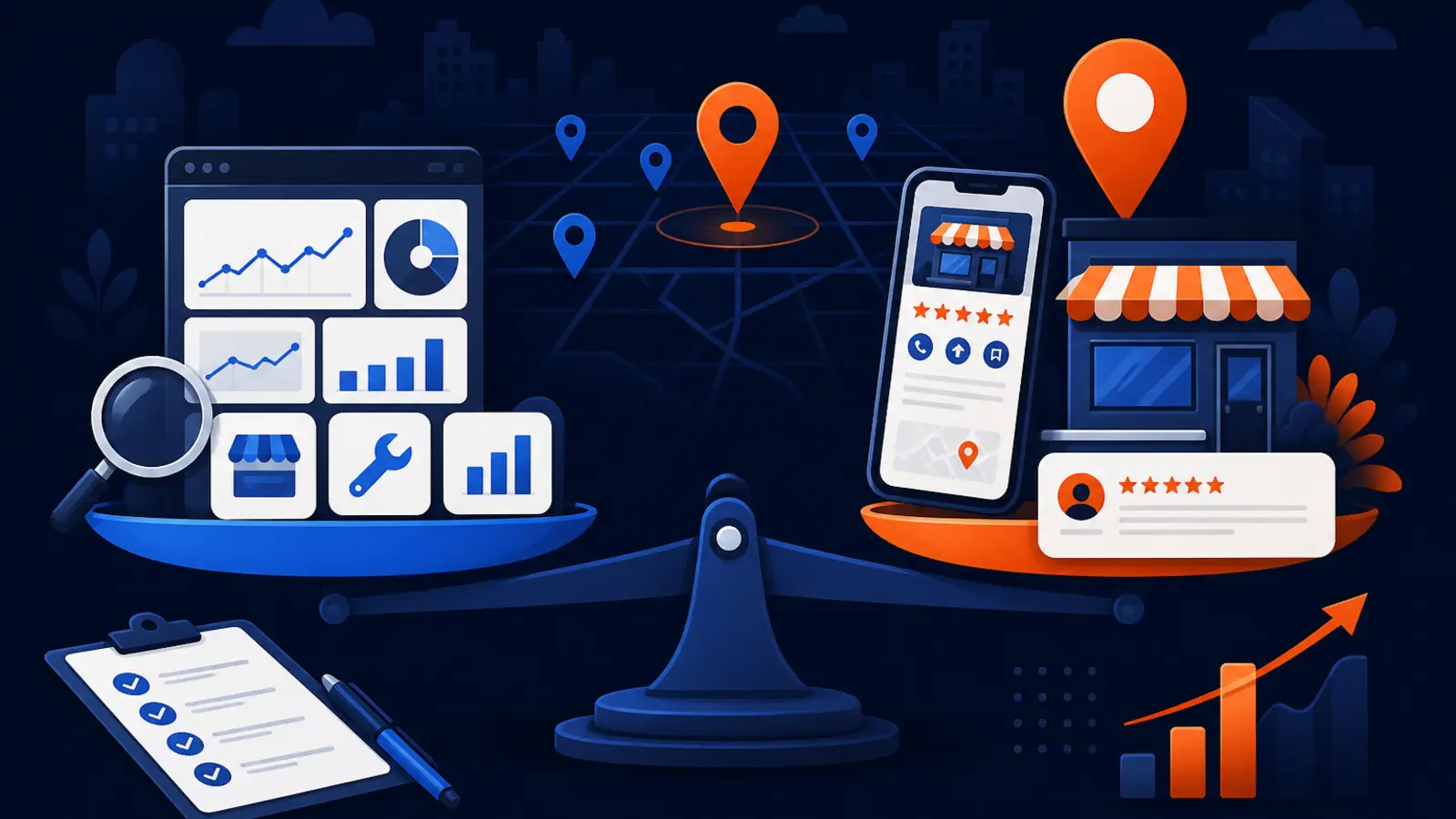
The short answer
If you switch from DIY local SEO to Digital Domination, the biggest change is not that Google works differently. Google still ranks local results mainly by relevance, distance, and prominence, according to Google Business Profile Help. Google also says there is no way to request or pay Google for a better local ranking.
What changes is who owns the weekly work. Instead of you learning guidelines, updating your Google Business Profile, checking Search Console, reading Analytics, watching rank movements, asking for reviews correctly, and deciding what to fix next, a local SEO team runs the process for you and reports back with visual proof.
DIY can work. Google Search Central says a small local business can probably do much of its SEO work itself, starting with the SEO Starter Guide. The tradeoff is time, judgment, and consistency. A done-for-you program is for the owner who wants a system, accountability, and clearer local ranking measurement across the service area.
What the DIY path can do well
Free Google tools are useful. Google Search Console reports Search traffic and performance, including queries, clicks, impressions, and position. It can submit sitemaps and individual URLs for crawling, and it provides URL Inspection information from Google’s index. Google Analytics says it provides tools free of charge to understand the customer journey and improve marketing ROI across sites and apps.
Google Business Profile is also central to local visibility. Google Business Profile Help says complete and accurate profile information makes a business more likely to show up in local search results, while inaccurate information can prevent a profile from showing for relevant searches in the area.
A careful owner can handle a lot with these tools, especially in a less competitive market or when the business has a simple service area. The DIY job usually includes these basics:
- ▸Keep address, hours, categories, and attributes accurate
- ▸Watch profile performance such as calls, website clicks, directions, messages, bookings, products, menus, and offers
- ▸Use Search Console to see which searches are bringing impressions and clicks
- ▸Use Analytics to understand what visitors do after they reach the site
- ▸Request customer reviews without gifts, discounts, or other incentives
- ▸Reply to reviews in a professional way
- ▸Use a rank tracker to watch movement over time
What changes when you switch to Digital Domination
The main shift is from tool ownership to outcome ownership. With DIY, you own the to-do list and the interpretation. With Digital Domination, the program is built around ranking improvement in Google Maps, measured geographically, with the work planned and executed for you.
Digital Domination’s Maps Domination Program pricing is set per market on a qualification call and tied to the ranking outcome. The guarantee is: top 3 in the Google Map Pack in 12 weeks or you do not pay. That does not mean anyone can pay Google for placement. It means the service is accountable for the local SEO work required to compete for Map Pack visibility.
The practical changes are easy to understand:
- ▸You get a 169-point GeoGrid scan instead of only one rank check from one location
- ▸You get weekly GeoGrid tracking reports with visual proof of rankings and call volume
- ▸You get a plan based on real local search results across the service area
- ▸You are not expected to diagnose every ranking movement yourself
- ▸You get territory exclusivity because Digital Domination works with one client per trade per service area
- ▸You still need to run a real business that earns customer trust and reviews
Why one rank tracker is not the same as local ranking proof
A rank tracker can help you see movement, but local search is location sensitive. A business may rank well near its office and poorly a few miles away. That is why a single keyword report can feel encouraging while the phone is still quiet in parts of town you want to serve.
Google Search Central says third-party SEO tools do not have access to Google internal ranking data, cannot guarantee performance, and should be checked against official Google Search guidance. That does not make rank trackers bad. It means you should treat them as a measurement aid, not as Google’s final word.
This is one reason Digital Domination starts with a free GeoGrid scan. The scan checks 169 real Google results across the service area, so the conversation is based on where the business is visible and where it is not. For an owner, that is easier to act on than one average position number.
The work that becomes more consistent
Local SEO is not only a profile edit once a year. Google Business Profile Help says profile information should include items such as address, business hours, business category, and attributes. Google also says replying to customer reviews shows the business values feedback, and that more reviews and positive ratings can help local ranking.
The market data lines up with what owners usually need. BrightLocal reported that agencies in its Agency Edition survey most commonly offered Google Business Profile optimization or management, SEO audits and analysis, content creation or optimization, technical SEO, and reporting or analytics. Those are the same categories many DIY owners start, stop, and restart when business gets busy.
When the work is done for you, the biggest benefit is cadence. These are the recurring jobs that are easier to keep moving when someone owns them:
- ▸Profile cleanup and accuracy checks
- ▸Category and service review
- ▸Review request process and review response guidance
- ▸Website content and local relevance improvements
- ▸Technical checks that affect crawlability and visibility
- ▸Performance review from Google tools and rank tracking
- ▸Local search reporting that an owner can understand
What to look for before you hire any local SEO provider
Google Search Central says hiring a professional can improve visibility and save time, but it can also risk damage to the site and reputation. That warning matters. You should not hire a local SEO provider only because the sales pitch sounds confident.
Look for plain explanations, proof of how rankings are measured, a clean review process, and a clear answer about what the provider will not do. Google Business Profile Help says offering incentives such as free or discounted goods or services in exchange for customers posting, changing, or removing reviews is prohibited as fake and misleading content.
Before you sign, verify these checkpoints:
- ▸The provider explains how it measures Maps visibility by location, not only from one search point
- ▸The provider follows Google’s review rules and does not offer incentives for reviews
- ▸The provider can explain what profile information will be updated and why
- ▸The provider reviews Search Console and Analytics data instead of relying only on a rank tracker
- ▸The provider sets expectations that SEO changes can take weeks or months to assess
- ▸The provider gives you reporting you can read without needing to be technical
- ▸The provider is clear about pricing, scope, and what happens if the ranking target is not met
Seven questions to ask before you sign
This is the buyer’s checklist. Use it whether you are considering Digital Domination, another agency, or staying DIY for now.
Ask these questions in plain language and listen for direct answers:
- ▸How do you measure Map Pack rankings across my real service area
- ▸What work happens in the first month
- ▸What work happens every week after that
- ▸How do you handle reviews without violating Google’s rules
- ▸What access do you need to my Google Business Profile, Search Console, and Analytics
- ▸What reports will I receive, and will they show calls as well as rankings
- ▸Who else do you work with in my trade and service area
Who should choose DIY instead
The DIY path genuinely suits an owner who has time to learn Google’s guidelines, perform profile and site updates, monitor performance data, request reviews without incentives, and accept that rankings are not guaranteed or fixed. If that sounds manageable, DIY can be the right call.
DIY also makes sense when budget is tight, the business is brand new, or the owner wants to understand the basics before hiring anyone. Google Search Central’s SEO Starter Guide is a reasonable place to begin, and Google’s own tools give you enough information to make smart early improvements.
Choose DIY if these statements fit your situation:
- ▸You can set aside time every week for local SEO work
- ▸You are comfortable reading Google documentation
- ▸You can keep profile information accurate during holidays, staffing changes, and service changes
- ▸You are willing to ask every happy customer for a review without offering incentives
- ▸You can compare ranking movement with calls, clicks, and real lead quality
- ▸You will not panic when Google changes take a few weeks to assess
- ▸You prefer saving money over saving time right now
Who is a better fit for Digital Domination
Digital Domination is a better fit when Maps visibility is important enough that you want a specialist team handling the work. That is usually the case for service businesses, appointment-based local businesses, and multi-location businesses where calls from nearby searches matter.
It is also a better fit when the owner wants accountability. Digital Domination has 20 years learning how businesses earn attention, authority, trust, and rankings online. It shows Google Partner and Meta Business Partner badges on its roster page, offers territory exclusivity, and uses weekly GeoGrid tracking reports with visual proof of rankings and call volume.
You are more likely to fit the program if these points describe you:
- ▸You want local Maps growth handled for you
- ▸You care about rank visibility across a full service area, not just near your office
- ▸You want one client per trade per service area protection
- ▸You want a qualification call before pricing is set
- ▸You want reporting that shows rankings and call volume together
- ▸You are willing to follow a review process that complies with Google’s rules
Verification, reviews, and timing do not disappear
A done-for-you program can reduce your workload, but it does not remove Google’s processes. Google Business Profile Help says verification methods are automatically determined by Google and may require more than one method depending on business type, public information, region, or business hours.
Google also says verification reviews take up to 5 business days after the verification steps are completed, with rare cases taking longer. Postcard verification codes usually arrive within 14 days and expire after 30 days. If a profile needs verification work, patience and accuracy matter.
Timing matters in SEO too. Google Search Central says some changes can take effect in a few hours while others can take several months, and it recommends waiting a few weeks to assess whether work affected Google Search results. A serious provider should explain timing without pretending every change will produce instant movement.
What ranking factors mean in practical terms
Local SEO gets complicated, but the owner-level version is simple. Google Business Profile Help says local results are mainly based on relevance, distance, and prominence. You cannot control where the searcher stands, but you can improve how clearly Google understands your business and how trusted your business appears online.
Whitespark’s Local Search Ranking Factors survey ranked Primary Google Business Profile Category, proximity of address to the point of search, keywords in the Google Business Profile business title, and physical address in city of search among the top local pack and Maps factors by contributor score. Some of those are controllable, and some are not. For example, your primary category is a business decision, while the searcher’s distance from you is not.
This is where DIY owners can get stuck. They may keep changing small items while missing bigger issues like weak prominence, poor service-area coverage, thin website content, review gaps, or inaccurate profile data. A good done-for-you program should separate what can be improved from what simply has to be measured and worked around.
The bottom line and next step
Stay DIY if you have the time, patience, and interest to learn the rules, keep the profile current, study the data, ask for reviews properly, and accept that rankings move. That is a valid path, especially when saving budget matters more than saving time.
Consider Digital Domination if you want a done-for-you Maps program built around local ranking measurement, weekly GeoGrid reporting, call volume visibility, and a ranking guarantee. The Get Ranked page explains the Maps Domination Program and how the qualification call works. The free GeoGrid scan page is the place to request the 169-point scan that checks real Google results across your service area.
Keep reading
Related guides
- ▸Google Business Profile AI summaries
- ▸Google Business Profile Collected Info
- ▸Google Business Profile optimization for HVAC
Put it into action
Frequently Asked Questions
Can I do local SEO myself with free Google tools?
Yes. Google Search Central says a small local business can probably do much of its SEO work itself, starting with the SEO Starter Guide. The tradeoff is that you must keep learning, keep updating, and keep checking performance over time.
What does Digital Domination do that I cannot do myself?
The tools are not magic. The difference is that Digital Domination runs a done-for-you local SEO process, uses a 169-point GeoGrid scan, provides weekly GeoGrid tracking reports, and ties its Maps Domination Program to a ranking outcome. You can do many tasks yourself, but you may not want to own the full process every week.
Does paying an SEO company buy better Google rankings?
No. Google Business Profile Help says there is no way to request or pay for a better local ranking on Google. A legitimate local SEO provider works on relevance, prominence, profile accuracy, reviews, website quality, and measurement rather than paying Google for placement.
Is a rank tracker enough for local SEO?
A rank tracker is helpful, but it is not the whole picture. Google Search Central says third-party SEO tools do not have access to Google internal ranking data and cannot guarantee performance. For local SEO, it is better to check visibility across the real service area, not only from one search location.
How long should I wait to judge local SEO work?
Google Search Central says some SEO changes can take effect in a few hours while others can take several months. It recommends waiting a few weeks to assess whether work affected Google Search results. Local SEO should be judged with rankings, calls, clicks, and lead quality together.
Who should not hire Digital Domination yet?
Do not hire if you want to learn every step yourself, have more time than budget, or are not ready to follow Google’s rules for reviews and profile accuracy. DIY may also be better if your business is still changing its name, address, category, or core services.
What is the guarantee?
Digital Domination’s guarantee is: top 3 in the Google Map Pack in 12 weeks or you do not pay. Pricing for the Maps Domination Program is set per market on a qualification call and tied to the ranking outcome.
What should I check before switching from DIY to done-for-you?
Check how rankings will be measured, what work is included, how reviews are handled, and whether reports show both rankings and calls. Also ask whether the provider works with competitors in your trade and service area. Digital Domination offers one client per trade per service area.
Ready to dominate your map?
Top 3 in the Google Map Pack in 12 weeks, or you don't pay.