
Digital Domination vs hiring an in-house marketer or marketing coordinator
If your main goal is more local search and Google Maps leads, the choice changes who owns the work, how fast work starts, how much you must manage, and what is measured.

The short answer
If you need more leads from Google Maps and local search, a done-for-you Maps optimization program usually gives you a narrower scope, a faster start, clearer ranking and call tracking, and stronger accountability around one outcome. Hiring an in-house marketer gives you broader daily support across brand, content, sales materials, events, email, social media, reporting, and vendor coordination, but Google Maps is only one part of that person’s job.
The practical difference is focus. Digital Domination is built around Google Business Profile optimization, local visibility, reviews, GeoGrid tracking, and Map Pack outcomes. An in-house marketer is built around being available inside your company every day, handling whatever marketing priority is most urgent.
Choose Digital Domination when the bottleneck is local search visibility. Choose an in-house marketer when the bottleneck is overall marketing capacity inside the business.
What changes in scope
Google Business Profile work is more specialized than many owners expect. Google Business Profile Help says a business must add or claim and then verify a Business Profile to show on Search, Maps, and other Google services. Google also says a verified profile can be edited to update address, hours, contact information, and photos.
That sounds simple, but local SEO reaches beyond profile edits. BrightLocal’s local SEO checklist includes Google Business Profile, citations, review management, competitor analysis, website work, link building, keyword research, on-page SEO, schema, location pages, service area pages, speed, multi-location SEO, and AI local SEO.
A done-for-you Maps program narrows the job to the pieces that influence local search and Google Maps visibility. An in-house marketer usually has a wider job description and may be pulled into many other needs. Here is the scope difference most owners feel first:
- ▸Digital Domination focuses on Maps, Google Business Profile, local rankings, reviews, tracking, and calls.
- ▸An in-house marketer often owns brand content, social posts, events, email, brochures, website edits, sales support, and vendor management.
- ▸Digital Domination brings a defined Maps process rather than a general marketing desk.
- ▸An in-house marketer can sit in meetings, learn the company voice, support the sales team, and react to daily needs.
- ▸If Maps leads are the main issue, narrow focus is often an advantage.
- ▸If the business needs a full-time marketing generalist, broad scope is often an advantage.
What changes in speed
Hiring takes time. SHRM reported that 2025 median time-to-fill from job requisition to offer acceptance was roughly a month and a half for both executive and nonexecutive positions. After that, a new employee still needs onboarding, tool access, training, and time to understand your market.
Google Search Central also says every SEO change takes time to be reflected, with some changes taking a few hours and others taking several months. That applies whether the work is done by your employee, an agency, or your own team.
A done-for-you Maps program can usually start faster because the people, process, tools, and local search workflow are already in place. Speed does not mean Google instantly changes rankings. It means diagnosis, implementation, and tracking begin without a recruiting cycle. Expect these timing differences:
- ▸With an in-house hire, you first create the role, recruit, interview, make an offer, and onboard.
- ▸With Digital Domination, the first step is qualification and a GeoGrid scan of the service area.
- ▸With an in-house hire, the person may need outside help for technical local SEO or Maps troubleshooting.
- ▸With Digital Domination, the Maps process is the main product, not an extra task.
- ▸With either option, Google’s systems still need time to reflect changes.
- ▸The best speed comparison is not instant ranking. It is how fast qualified work starts.
What changes in oversight
An in-house marketer reports to you or your manager. That can be helpful if you want daily collaboration, quick internal requests, and someone who understands every promotion, truck wrap, hiring push, and community event. It also means you must manage the role, set priorities, review quality, and judge whether the person’s local SEO work is right.
With a done-for-you Maps program, you are not managing an employee. You are managing a vendor relationship. Your job is to approve access, provide accurate business information, review reports, and ask good questions about what changed and what it means.
Google Business Profile Help says Google Business Profile performance reporting can include directions, calls, website clicks, messages, bookings, products, menus, and offers where those features apply. Digital Domination adds weekly GeoGrid tracking reports with visual proof of rankings and call volume. These are the owner checkpoints to expect:
- ▸You can see whether the business is improving in the service area, not just at the office address.
- ▸You can compare visibility across a grid instead of relying on one search from one phone.
- ▸You can review call volume alongside ranking movement.
- ▸You can confirm profile information, photos, hours, categories, services, and review activity are being handled.
- ▸You can ask what was changed, why it was changed, and what should be watched next.
- ▸You can separate Maps work from unrelated marketing activity.
What changes in accountability
Accountability is where the two options feel very different. An employee is accountable for effort, availability, internal responsiveness, and assigned projects. A specialized Maps program is accountable for a narrower business outcome tied to rankings, visibility, and lead signals.
Google Business Profile Help says local results are mainly based on relevance, distance, and popularity. It also says there is no way to request or pay for a better local ranking on Google. Google’s guidance for third parties says they cannot promise or directly influence rankings through any special means.
That matters because a legitimate provider should never imply a secret Google connection. Digital Domination’s guarantee is a commercial commitment around the work and outcome, not a claim of special access to Google: top 3 in the Google Map Pack in 12 weeks or you do not pay.
The accountability difference is easier to see this way:
- ▸An in-house marketer is accountable to your internal manager and job description.
- ▸Digital Domination is accountable to a defined Maps outcome and reporting process.
- ▸An employee may be measured across many channels at once.
- ▸Digital Domination’s Maps Domination Program is tied to ranking outcome and market qualification.
- ▸An employee’s performance review may include teamwork, responsiveness, and general output.
- ▸Digital Domination’s reporting centers on GeoGrid visibility, ranking proof, and call volume.
Who should hire an in-house marketer instead
Hiring an in-house marketer or marketing coordinator is the better fit when the business needs a full-time generalist embedded in daily operations. If the person will attend sales meetings, coordinate events, update flyers, manage social posts, brief designers, chase vendors, help with recruiting campaigns, and report across every channel, a specialized Maps provider is not a replacement.
O*NET OnLine describes search marketing strategists as workers who use search marketing tactics to increase visibility and engagement, analyze search behavior, and measure outcomes for ongoing optimization. O*NET also lists tasks like SEO asset optimization, web metrics analysis, online marketing strategy implementation, KPI reporting, content strategy, and local search engine or directory listing placement.
That is a broad professional lane. A good in-house marketer can be extremely valuable when the business needs day-to-day marketing ownership. The other option fits best when these statements are true:
- ▸You need someone available inside the company most workdays.
- ▸You have recurring content, events, sales enablement, recruiting, email, and reporting needs.
- ▸You want one person coordinating many vendors and channels.
- ▸You can train, manage, and retain the person well.
- ▸You are not trying to solve only a Google Maps visibility problem.
- ▸You value internal context more than a specialized Maps process.
Cost is not only salary
The budget comparison is not as simple as salary versus agency fee. The U.S. Bureau of Labor Statistics says the median annual wage for market research analysts was $78,760 in May 2025. That is not the exact salary for every marketing coordinator, but it is a useful reminder that skilled marketing labor has a real payroll cost.
An employee also carries recruiting time, payroll taxes, benefits, software, training, management attention, and possible turnover. A done-for-you Maps program has a service cost instead, and Digital Domination prices the Maps Domination Program per market on a qualification call, tied to the ranking outcome.
Digital Domination does publish one separate price: the 5-Star Review System is $297 per month, with no setup fee, cancel anytime, and monthly billing through Stripe. For Maps Domination, the fair comparison is the total cost of getting qualified local search work done, not just the line item. Owners should compare these cost buckets:
- ▸Recruiting and interview time for an employee.
- ▸Salary, taxes, benefits, software, and management time.
- ▸The risk of hiring a generalist who still needs outside local SEO help.
- ▸The service fee for a specialized Maps program after market review.
- ▸The value of territory exclusivity if you do not want your provider helping a direct local competitor.
- ▸The cost of waiting if Maps visibility is already costing you leads.
What to look for before you choose
Google’s own guidance is useful here. Google Business Profile Help says buyers evaluating a third party should ask whether the provider has managed Business Profiles before and whether it has worked with businesses that have similar budgets and target audiences. Google also says third-party providers may charge a fee to keep a profile up to date, provide customer insights, answer questions, and respond to reviews.
For an in-house hire, you want proof that the candidate can manage priorities, report clearly, and either perform or coordinate local SEO work. For a Maps provider, you want proof that the work is specific, trackable, and tied to local visibility instead of vague marketing activity.
Use these concrete checkpoints before making the decision:
- ▸Ask to see how rankings will be measured across the service area.
- ▸Ask how Business Profile edits, photos, services, categories, and reviews are handled.
- ▸Ask how often you will receive ranking and call reporting.
- ▸Ask whether the provider works with more than one business in the same trade and service area.
- ▸Ask an in-house candidate to explain relevance, distance, and popularity in plain language.
- ▸Ask who will fix citation, website, profile, or review issues when they appear.
- ▸Ask what happens if rankings do not move after work is completed.
Questions to ask before you sign
This is the section to slow down and protect the business. The right choice should match the job you actually need done. Do not hire a full-time generalist if the only serious problem is Maps visibility, and do not hire a Maps provider if you really need someone running daily marketing operations inside the company.
Ask these questions before you commit:
- ▸Is my main problem Google Maps visibility, or is it overall marketing capacity?
- ▸Do I need a full-time person in meetings and daily operations?
- ▸Can I manage, train, and retain a marketing employee right now?
- ▸Do I have enough local SEO knowledge to judge an employee’s Maps work?
- ▸Will I receive reporting that shows rankings across the service area?
- ▸Will call volume be reported with ranking movement?
- ▸Is the provider taking direct competitors in my trade and service area?
- ▸Does the plan respect Google’s rule that nobody can buy or request a better local ranking?
How Digital Domination is different from a general vendor
Digital Domination is not positioned as a general marketing coordinator. The program is built for local businesses that want more visibility in Google Maps and local search. The company uses a 169-point GeoGrid scan to check 169 real Google results across the service area, then tracks progress with weekly GeoGrid reports and call volume.
Digital Domination also offers one client per trade per service area, which means territory exclusivity. That matters when you are comparing vendors, because a general provider may work with several competitors in the same local market.
The company states 20 years of learning how businesses earn attention, authority, trust, and rankings online. Its roster page shows Google Partner and Meta Business Partner badges. It also has a 4.9 Google rating from 35 reviews in Las Vegas, Nevada. For an owner, the most important differences are these:
- ▸The focus is local search and Maps, not general marketing tasks.
- ▸The scan checks actual Google results across the service area.
- ▸Weekly reporting shows ranking proof and call volume.
- ▸The Maps Domination Program is priced after market qualification.
- ▸The ranking guarantee is tied to the stated Map Pack outcome.
- ▸Territory exclusivity reduces conflict with direct local competitors.
The bottom line
If your business needs a full-time marketing generalist, hire an in-house marketer or coordinator. That person can become part of the team, help with brand and content, support sales, coordinate events, manage vendors, and keep daily marketing tasks moving.
If your main problem is Google Maps and local search leads, a done-for-you Maps optimization program is usually the cleaner choice. It gives you a narrower scope, a faster path to starting the work, less day-to-day management, and reporting built around rankings and calls.
To compare Digital Domination’s Maps Domination Program, visit the Get Ranked page. It explains the program, the qualification process, and the ranking guarantee. To see where your business shows up now, request the free GeoGrid scan on the free GeoGrid scan page. It checks 169 real Google results across your service area before you decide what to do next.
Keep reading
Related guides
- ▸Google Business Home Beta GBP Owners
- ▸Google Business Profile 4 Day Edits
- ▸Google Business Profile AI summaries
Put it into action
Frequently Asked Questions
Should I hire a marketer or an agency for Google Maps leads?
If the main goal is Google Maps leads, a specialized Maps program is usually more focused. If you need daily help with content, events, sales materials, social media, and reporting, an in-house marketer may fit better.
Can an in-house marketer handle Google Business Profile optimization?
Yes, if the person has local SEO experience and enough time to do the work well. The risk is that Google Maps becomes one task among many, so the owner still needs a clear way to measure rankings, calls, reviews, and profile changes.
How fast can Google Maps rankings improve?
Google Search Central says SEO changes can take anywhere from a few hours to several months to be reflected. A done-for-you program can start the work faster than recruiting an employee, but Google’s systems still need time to respond.
Can anyone guarantee Google Maps rankings?
Google says there is no way to request or pay for a better local ranking, and third parties cannot directly influence rankings through special means. Digital Domination’s guarantee is a business commitment around its program outcome: top 3 in the Google Map Pack in 12 weeks or you do not pay.
What should I ask a Google Business Profile provider?
Ask whether the provider has managed Business Profiles before and whether it has worked with businesses that have similar budgets and target audiences. Also ask how rankings are tracked, how often you receive reports, and whether the provider works with your local competitors.
Is salary the only cost of hiring a marketing coordinator?
No. Salary is only one part of the cost. Recruiting time, onboarding, benefits, software, training, management attention, and possible outside local SEO help should also be included in the comparison.
What does a GeoGrid scan show me?
A GeoGrid scan shows how your business appears in real Google results across your service area, not just from one search at your office. Digital Domination’s free scan checks 169 real Google results so you can see local visibility before choosing a plan.
Who should not choose Digital Domination for this decision?
A business should not choose Digital Domination as a replacement for a full-time generalist. If you need someone embedded in daily brand, content, events, sales enablement, reporting, and cross-channel work, hiring in-house is the better fit.
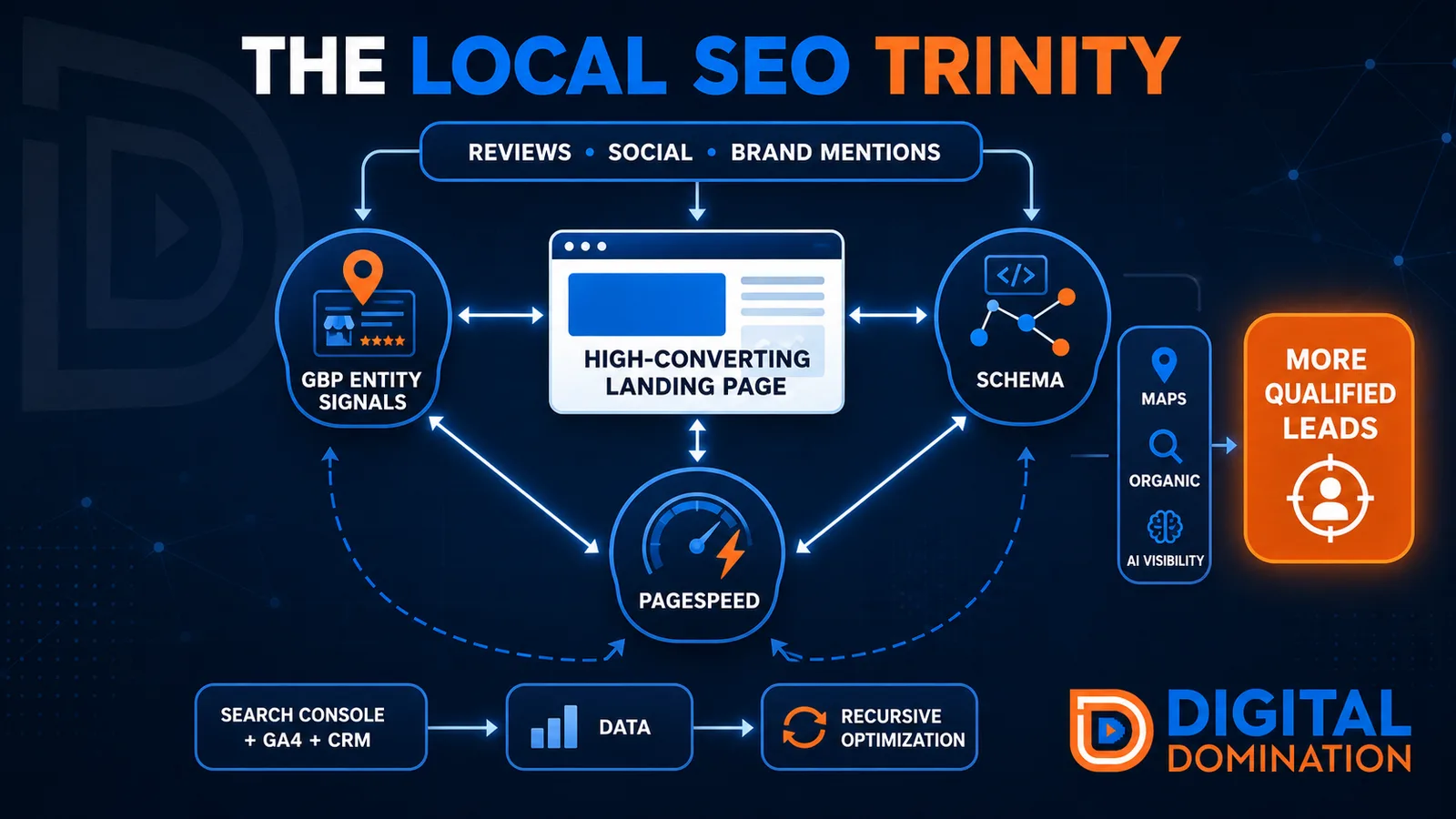
The Local SEO Trinity
Think of a three-legged stool. Your Google profile, your website, and your reviews all have to hold you up. If one leg is short, the whole thing wobbles.
GBP entity signals
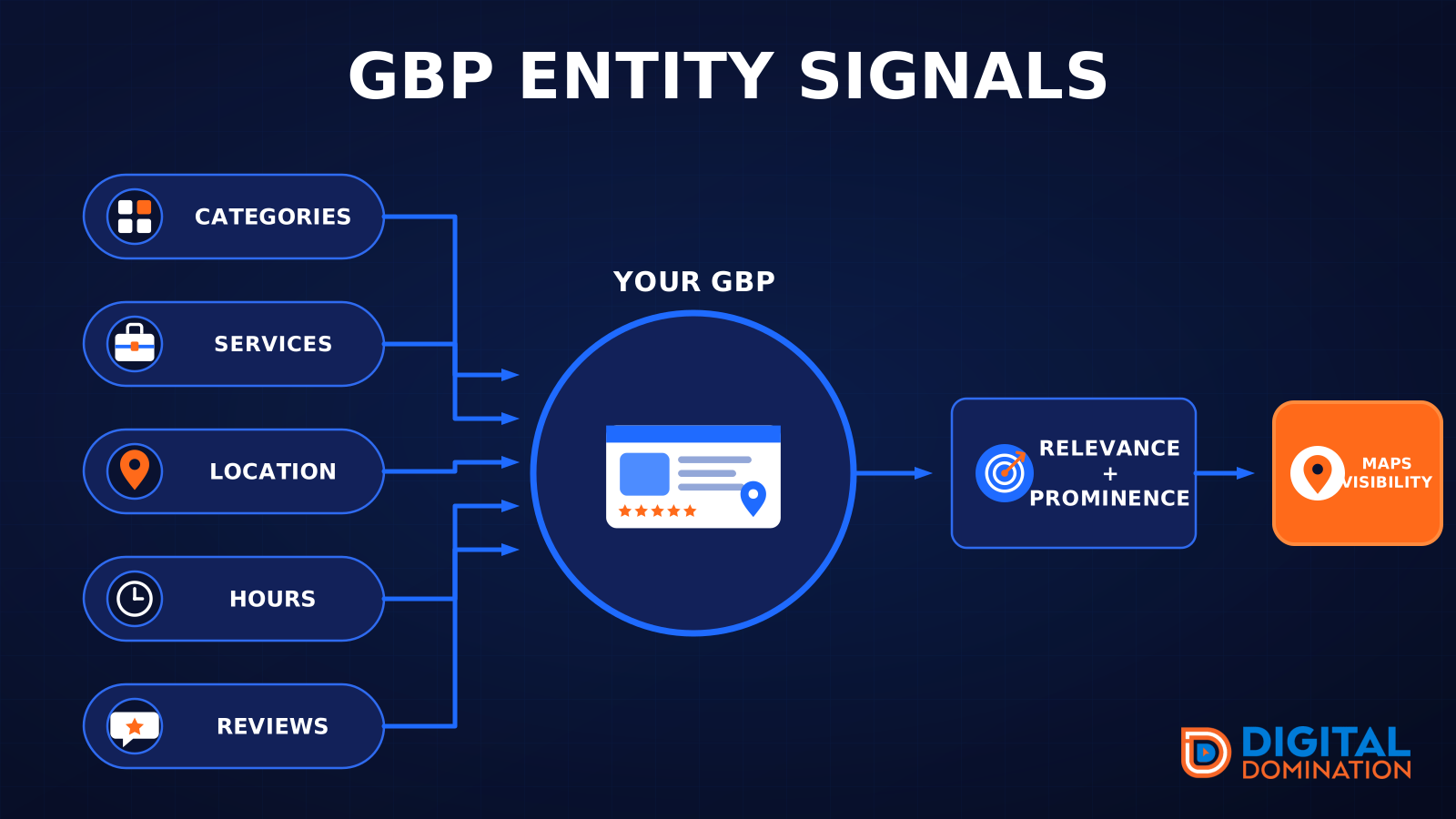
This leg is your Google Business Profile. GBP means Google Business Profile. It covers your categories, your services, your location, your hours, and your reviews. Google uses those facts to decide who to show.
Your Google profile is your storefront sign. If the sign is missing, or it names the wrong shop, people drive past.
PageSpeed to conversion
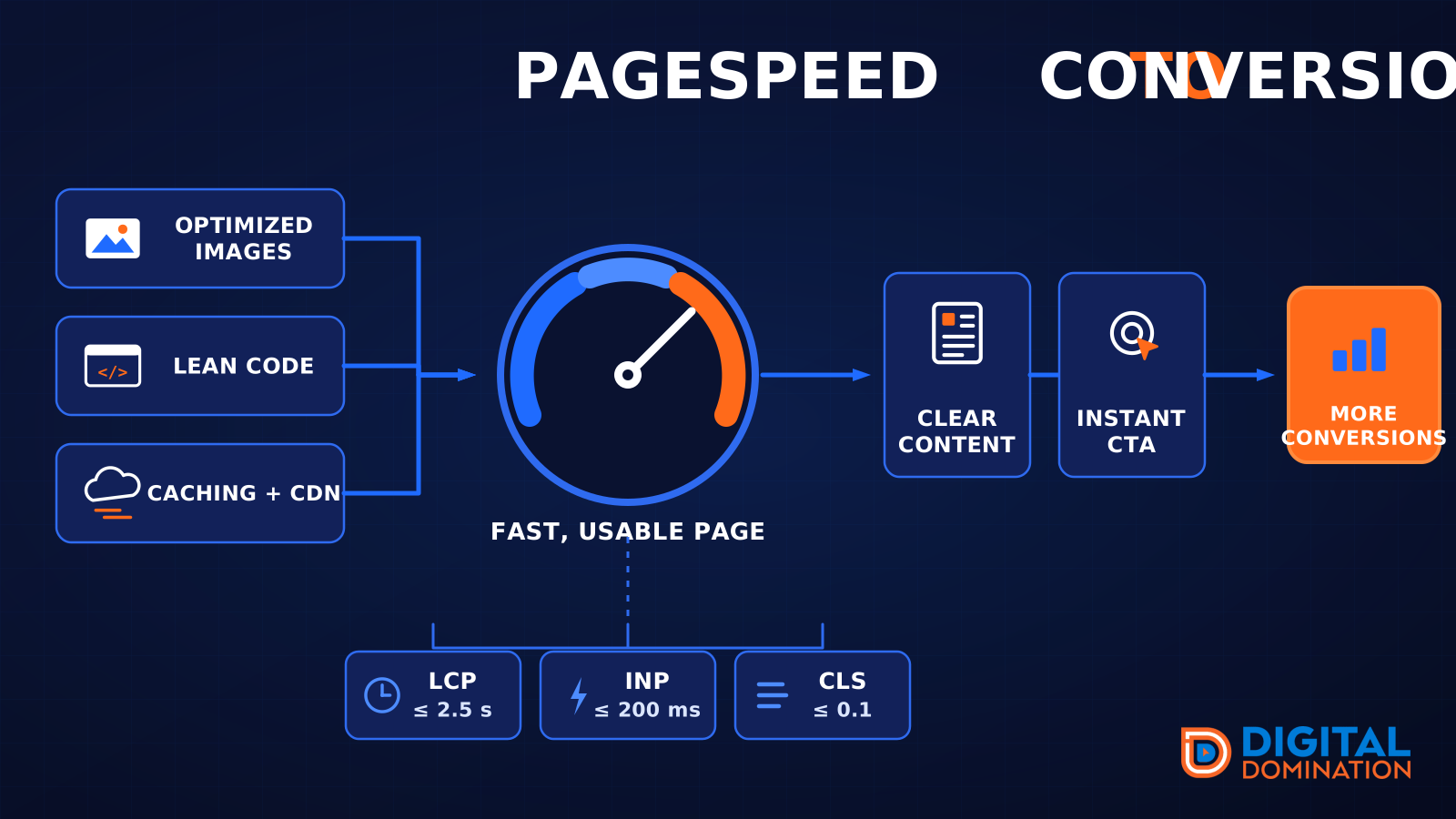
This leg is your website, above all on a phone. Small images, lean code, and caching make a page fast. A fast, clear page is what turns a visit into a call. Phone speed is one of the 12 Trinity checks because a slow page loses the call before anyone sees your offer.
Your website is the showroom. If the door sticks, people leave before they look around.
The review velocity flywheel
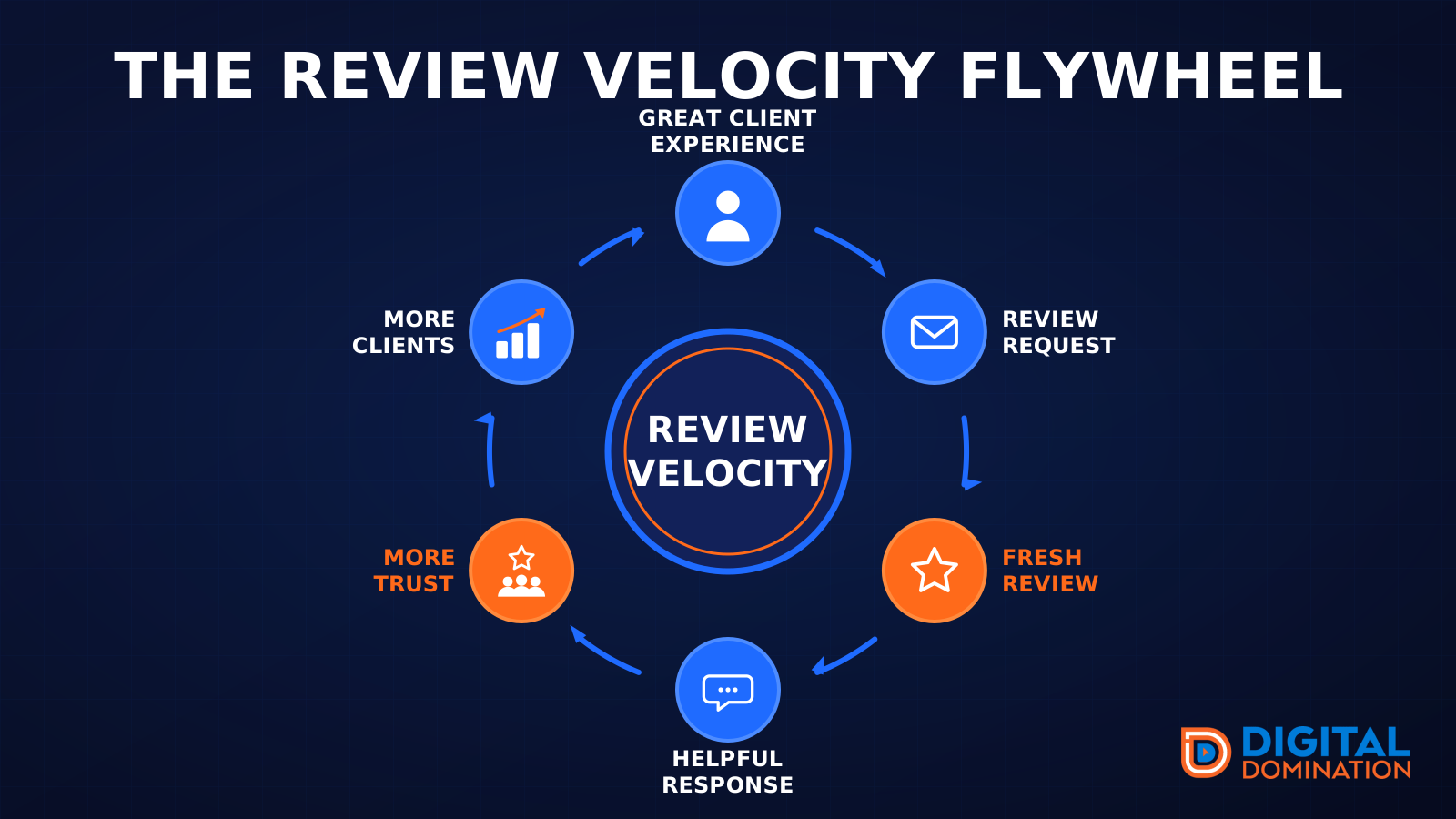
This leg is reviews and reputation. A good visit leads to a review request, then a fresh review, then a helpful reply, then more trust, then more customers. When the scan can find your Google listing, it shows your rating, your recent reviews, and how many you answered.
Reviews are word of mouth. One kind word helps. A steady stream of real reviews, and a reply from you, helps more.
How this turns into revenue
Being found in more searches leads to more calls. More calls lead to more booked jobs. More booked jobs lead to more revenue.
Example numbers, not a real business: 40 calls from search in a month, a 25 percent close rate, and a $400 average job. That is 10 booked jobs. That is $4,000. The math is the lesson. It is not a promise.
The full page has a box where you can type your own average job value and close rate.
One real story, from our car dealership case study: Medina Auto Group went from invisible on Google Maps to dominating every high-intent search across their market. The turnaround spanned all four of their rooftops at once. The same page says the team eliminated 89 unfair one-star reviews that had been dragging the dealership's reputation down and keeping it out of the Map Pack. It also says: “Results described here are exceptional and non-typical. Outcomes vary based on market conditions, competition, and implementation. No guarantees are made regarding earnings, rankings, or conversions.”
Free strategy call
More booked jobs start with a clear plan
Book a free strategy call. We look at your Google profile, your website, and your reviews, and we tell you what to fix first.
Free. You pick the time. A real person shows up.