
The Maps Domination Program vs hiring an in-house marketer or marketing coordinator
A practical comparison for local business owners who want more qualified calls from Google Search and Google Maps.
The short answer for call generation
If the main goal is more qualified calls from Google Search and Google Maps, a specialized Google Maps and Business Profile program is usually the more focused choice. That is because the work is narrow, technical, and tied to local visibility, reviews, profile accuracy, ranking movement, and call tracking.
An in-house marketer or marketing coordinator can be the better hire when the business needs daily help across many marketing tasks. That includes events, email, social media, sales collateral, reporting, vendor coordination, and internal follow-up. If Google Maps visibility is only one of many problems, a generalist can make sense.
The fair answer is this: choose the Maps Domination Program if the business needs a specialist accountable for Map Pack visibility and calls. Choose an in-house marketer if the business needs a daily operator who can support the whole marketing function, not only Google Business Profile growth.
Why Google Maps calls are a specialized problem
Google Business Profile work is not just posting photos or updating hours. Google Business Profile Help says local results on Google Maps and Search are mainly based on relevance, distance, and popularity, and there is no way to request or pay for a better local ranking. That means better performance comes from improving the signals Google can trust, not from pushing a single button.
Google Business Profile Help also says complete and accurate profile information makes a business more likely to show in local search results, while inaccurate information can keep a profile from showing for relevant local searches. For an owner, that means small profile details can become call generation details.
A focused Maps program should be built around the parts of local visibility an owner can verify:
- ▸Business Profile completeness and accuracy
- ▸Primary and secondary category choices
- ▸Service area and location relevance
- ▸Review quality, frequency, and recency
- ▸Website and local authority signals
- ▸GeoGrid rank movement across the service area
- ▸Business Profile call clicks and call volume
Where an in-house marketer shines
An in-house marketer is often the right person when the business needs consistent daily marketing execution. The U.S. Bureau of Labor Statistics says market research analysts and marketing specialists commonly monitor marketing and sales trends, measure marketing program effectiveness, gather consumer and competitor data, and prepare reports for management.
That kind of broad work matters. A growing home service company, dental office, med spa, law firm, auto shop, or clinic may need someone who can coordinate promotions, update brochures, chase down photos, help the sales team, organize events, and keep leadership informed.
An in-house marketer or coordinator is especially useful when the owner needs one person to keep many loose ends moving inside the business. The tradeoff is that a generalist may not have deep local SEO experience, GeoGrid tracking habits, review operations, Google Business Profile troubleshooting skill, and competitive Map Pack strategy on day one.
Cost and accountability are not the same thing
The cost comparison is not only agency fee versus salary. The U.S. Bureau of Labor Statistics reports that market research analysts and marketing specialists had a median annual wage of $78,760 in May 2025 and typically need a bachelor’s degree. That wage does not tell an owner whether the person can improve Google Maps rankings, fix profile issues, or build a review system.
Digital Domination does not publish one flat retainer for the Maps Domination Program. Pricing is set per market on a qualification call and tied to the ranking outcome. The reason is simple: a plumber in a dense city, an attorney in a competitive metro, and a specialty retailer in a smaller town are not fighting the same battle.
When comparing cost, look past the monthly number and compare what each option is accountable for:
- ▸Is the goal broad marketing support or Map Pack call growth
- ▸Is reporting tied to visibility across the service area
- ▸Is there a clear ranking outcome
- ▸Who owns profile access and assets
- ▸Who handles review generation without incentives
- ▸Who notices ranking drops and competitor movement
- ▸Who can explain why calls rose or fell
Seven questions to ask before you sign or hire
This decision gets clearer when you ask the same questions of both options. A good vendor and a good employee candidate should be able to answer plainly, without hiding behind jargon.
Use these questions before you sign an agreement or make a hire:
- ▸What exact Google Maps outcome will you be responsible for
- ▸How will you measure rankings from different parts of our service area
- ▸How will you track calls from the Business Profile
- ▸What profile changes will you make first
- ▸How will you ask for reviews without offering incentives
- ▸What will I own if we stop working together
- ▸Who will explain the report to me each week or month
- ▸What experience do you have in competitive local search
What to expect from the Maps Domination Program
Digital Domination’s Maps Domination Program is built for local businesses that want stronger Google Map Pack visibility and more call opportunities from Google Search and Google Maps. The program uses a 169-point GeoGrid scan to check real Google results across the service area, then tracks progress with weekly GeoGrid reporting that shows ranking movement and call volume.
Digital Domination offers territory exclusivity: one client per trade per service area. That matters because a local SEO provider should not be trying to rank direct competitors in the same area for the same work.
The program also carries this guarantee: top 3 in the Google Map Pack in 12 weeks or you do not pay. An owner should still understand that Google Business Profile Help says no one can request or pay Google for a better local ranking. The guarantee is about Digital Domination’s program accountability, not buying placement from Google.
The owner should expect concrete visibility into the work:
- ▸A 169-point GeoGrid scan before strategy is discussed
- ▸A qualification call to review market difficulty and fit
- ▸Weekly GeoGrid tracking reports
- ▸Visual proof of ranking movement
- ▸Call volume reporting
- ▸Clear ownership expectations for the Google Business Profile
- ▸A focus on calls from Google Maps and Search, not general marketing errands
What to expect from a good in-house marketer
A good in-house marketer should make the business more organized. They can help create a marketing calendar, coordinate campaigns, collect customer photos, support email communication, keep social channels active, work with vendors, and prepare reports for leadership.
If you hire this role with Google Maps call growth as the main objective, be specific in the job description. Do not assume every marketing coordinator has experience with local ranking factors, review operations, citations, on-page local SEO, or competitor analysis in the Map Pack.
A strong in-house candidate for this specific goal should be able to explain how they would handle these tasks:
- ▸Audit the Google Business Profile for accuracy
- ▸Track rankings by neighborhood or service area
- ▸Request reviews using Google-approved methods
- ▸Report Business Profile call clicks
- ▸Coordinate website changes that support local relevance
- ▸Watch competitor categories, reviews, and visibility
- ▸Explain what they would outsource if needed
Reviews can affect both rankings and conversion
Reviews are one of the biggest reasons this decision matters. BrightLocal’s 2026 Local Consumer Review Survey found that 97% of consumers read reviews for local businesses and 41% always read reviews when browsing for businesses. The same BrightLocal survey found that 74% of consumers seek reviews written in the last three months and 31% will only use a business with 4.5 stars or more.
Google Business Profile Help says prominence is based on information such as how many websites link to the business and how many reviews it has, and that more reviews and positive ratings can help local ranking. Google also allows businesses to ask customers for reviews through a Google link or QR code, but prohibits incentives such as free or discounted goods or services in exchange for posting, changing, or removing reviews.
This is where the right choice depends on discipline. An in-house coordinator may be close to the team and able to ask for reviews after real customer interactions. A specialized Maps program may bring a more consistent system, better reporting, and tighter compliance.
Review work should be judged by simple checkpoints:
- ▸Customers are asked consistently
- ▸No discounts, gifts, or incentives are offered for reviews
- ▸Recent reviews continue to appear over time
- ▸Negative reviews get a calm, professional response
- ▸The owner can see review trends alongside ranking and call trends
Measurement: map rankings are not one citywide number
Many owners think they either rank or they do not. Local search is more complicated than that because distance matters. A business can rank near its office, disappear a few miles away, and show up again in another pocket of the city.
BrightLocal says geo-grid local rank tracking simulates searches from dozens of points in a city or neighborhood to show how a business ranks across an area. BrightLocal’s Local Search Grid report can also reveal top competitors at each grid point, plus competitor review count, rating, primary category, and additional categories.
Whitespark’s 2026 Local Search Ranking Factors report surveyed 47 local search experts who scored 187 factors across local pack, local organic, conversion, and AI search visibility impact. Whitespark organizes local ranking factor groups to include Google Business Profile signals, review signals, on-page signals, link signals, behavioral signals, citation signals, personalization signals, and social signals. For an owner, that means a simple monthly rank screenshot is not enough.
A useful report should show what changed and where it changed:
- ▸Ranking position across multiple points in the service area
- ▸Top competitors in different pockets of town
- ▸Review count and rating comparisons
- ▸Business Profile call clicks
- ▸Call volume trends
- ▸Actions completed during the reporting period
- ▸Next steps tied to the ranking problem
Profile ownership and control matter
Whether you hire an employee or an outside program, keep control of the Google Business Profile. Google Business Profile third-party policies require agencies managing a Business Profile to inform clients of profile changes, keep clients as owners or co-owners, and provide a way to regain exclusive control within 7 business days after notice.
This is not a small detail. Your profile is a major local asset. If the relationship ends, you should not lose access, reporting history, or the ability to update your phone number, hours, services, or location details.
Google Business Profile Help also says a phone number must be added to track Business Profile calls, and defines Business Profile calls in performance reporting as the number of times customers clicked the call button on a Business Profile. Before judging performance, make sure the tracking setup is actually in place.
Who should choose the in-house marketer instead
Choose an in-house marketer or marketing coordinator if the business needs daily hands-on support across the full marketing operation. This is the better route when leadership needs someone inside the company who can attend meetings, gather details from staff, coordinate events, communicate with vendors, update materials, and keep many projects moving.
This is also the better choice if the owner is not ready to focus on Google Maps as a primary growth channel. If the website is being rebuilt, the brand is changing, the sales process is messy, or the business needs basic marketing organization first, an in-house coordinator may create more immediate internal relief.
The in-house route can also work well when the company already has a trusted local SEO specialist or agency and needs an internal person to manage that relationship. In that setup, the marketer does not need to be the Maps expert. They need to be the accountable internal coordinator.
The practical recommendation
If your main buying question is, “Which option is more likely to increase qualified calls from Google Search and Google Maps,” the Maps Domination Program is the more direct fit. It is specialized around Google Maps visibility, GeoGrid tracking, Business Profile performance, review signals, and ranking accountability.
If your real problem is that marketing work is scattered across the company and nobody owns the daily details, hire the in-house marketer. That person can support broader execution in a way a specialized Maps program is not designed to do.
To see how Digital Domination structures the specialist option, visit the Maps Domination Program page. It explains the program, the ranking guarantee, territory exclusivity, reporting, and how qualification works. To see where your business currently ranks across your service area, request the free GeoGrid scan page. It checks 169 real Google results across the service area before you decide what to do next.
Keep reading
Related guides
Put it into action
Frequently Asked Questions
Is it better to hire a marketer or an agency for Google Maps rankings?
If the goal is Google Maps rankings and calls, a specialized Maps program is usually the more focused option. If the business needs daily help with social media, events, emails, sales collateral, and coordination, an in-house marketer may be the better fit.
Can I pay Google to rank higher in the Map Pack?
No. Google Business Profile Help says there is no way to request or pay for a better local ranking. Local results are mainly based on relevance, distance, and popularity.
What should I track if I want more calls from Google?
Track GeoGrid rankings across your service area, Business Profile call clicks, overall call volume, reviews, profile accuracy, and competitor movement. Google Business Profile Help defines Business Profile calls as clicks on the call button, and a phone number must be added to track that metric.
Can an in-house marketing coordinator handle Google Business Profile work?
Yes, if they have the skill and time. The risk is that many coordinators are generalists, so they may need outside help for local SEO strategy, GeoGrid tracking, review systems, and competitive Map Pack analysis.
How important are reviews for local calls?
Reviews matter for both trust and visibility. BrightLocal’s 2026 Local Consumer Review Survey found that most consumers read reviews for local businesses, and Google Business Profile Help says more reviews and positive ratings can help local ranking.
What should I ask before hiring someone for local SEO?
Ask how they measure rankings by location, how they report calls, how they handle reviews without incentives, and who owns the Google Business Profile. You should also ask what happens if you stop working together.
Does Digital Domination publish Maps Domination Program pricing?
No. Pricing for the Maps Domination Program is set per market on a qualification call and tied to the ranking outcome. Digital Domination does publish the 5-Star Review System at $297 per month, with no setup fee, cancel anytime, billed monthly through Stripe.
What is a GeoGrid scan?
A GeoGrid scan checks rankings from many points across a service area instead of treating the whole city as one search result. Digital Domination’s free GeoGrid scan checks 169 real Google results across the service area.
The Local SEO Trinity
Think of a three-legged stool. Your Google profile, your website, and your reviews all have to hold you up. If one leg is short, the whole thing wobbles.
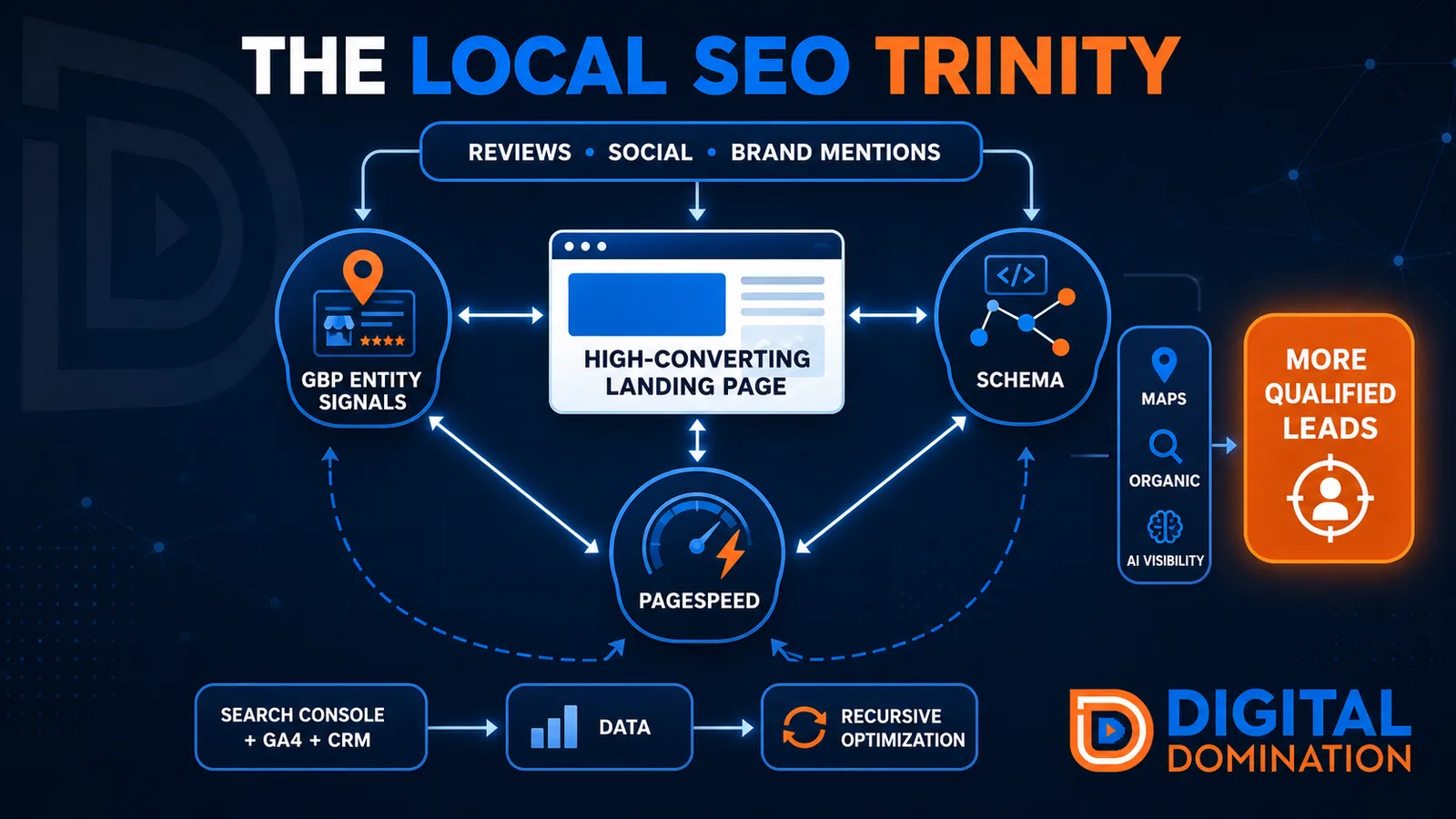
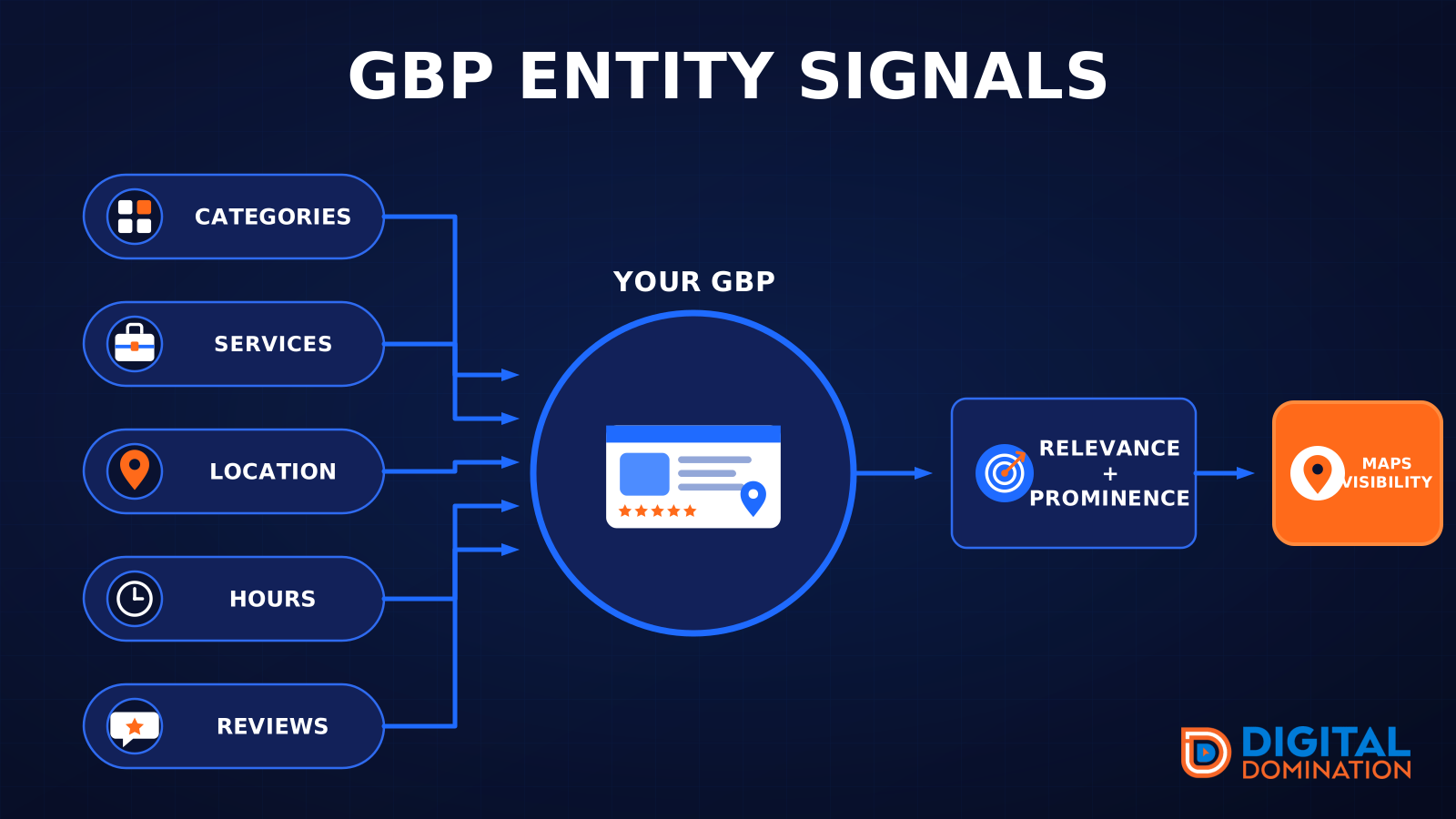
GBP entity signals
This leg is your Google Business Profile. GBP means Google Business Profile. It covers your categories, your services, your location, your hours, and your reviews. Google uses those facts to decide who to show.
Your Google profile is your storefront sign. If the sign is missing, or it names the wrong shop, people drive past.
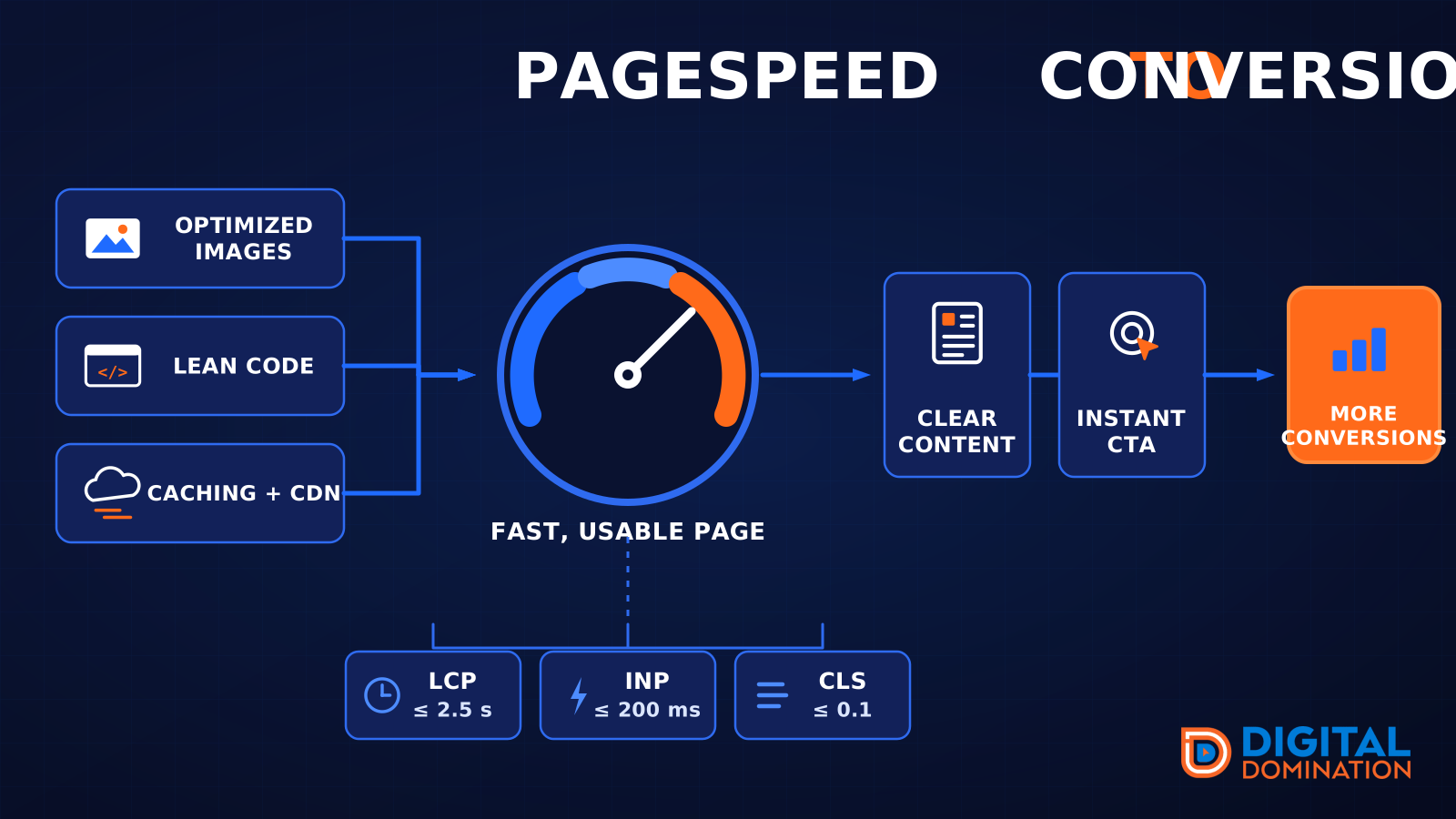
PageSpeed to conversion
This leg is your website, above all on a phone. Small images, lean code, and caching make a page fast. A fast, clear page is what turns a visit into a call. Phone speed is one of the 12 Trinity checks because a slow page loses the call before anyone sees your offer.
Your website is the showroom. If the door sticks, people leave before they look around.
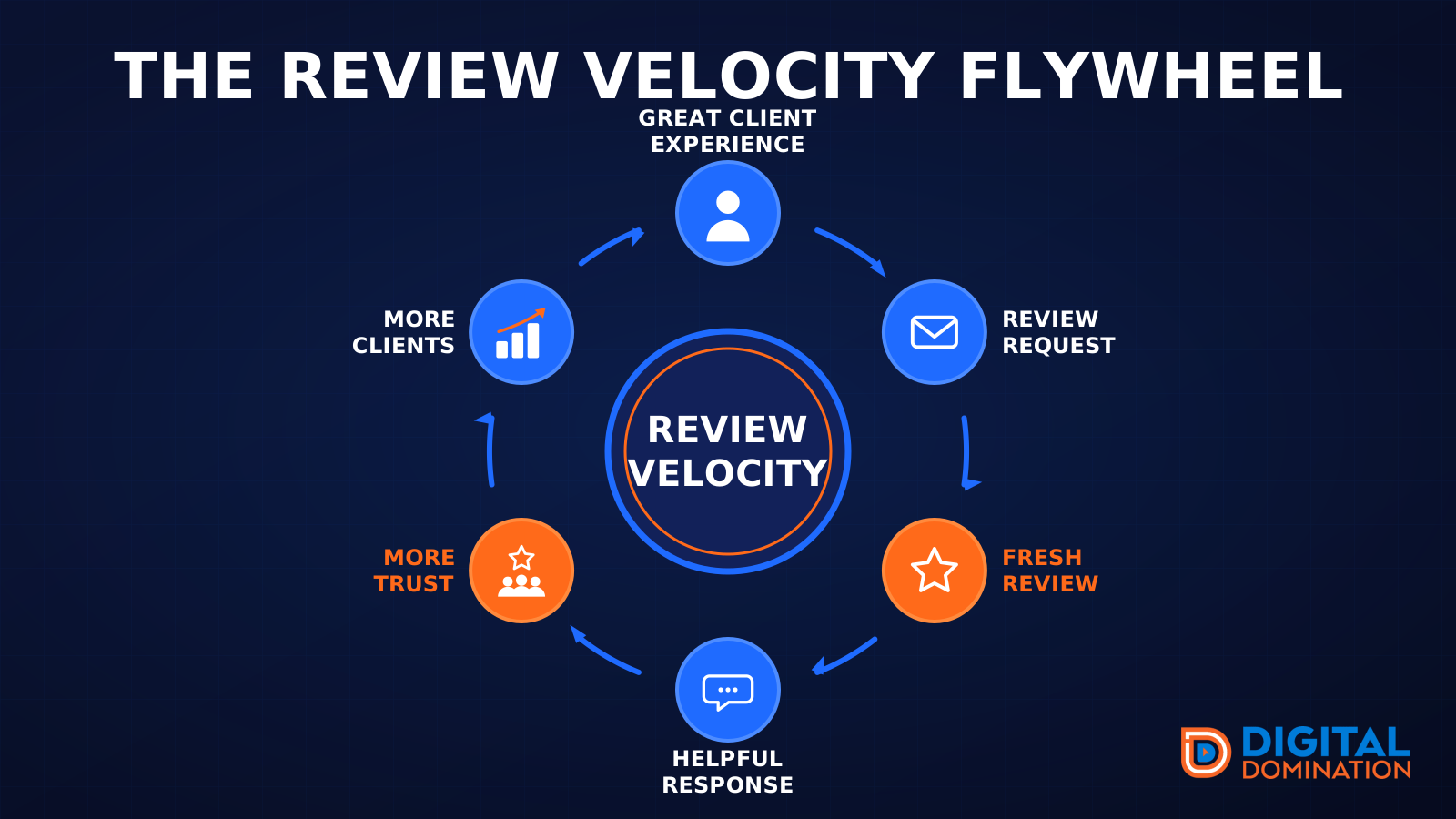
The review velocity flywheel
This leg is reviews and reputation. A good visit leads to a review request, then a fresh review, then a helpful reply, then more trust, then more customers. When the scan can find your Google listing, it shows your rating, your recent reviews, and how many you answered.
Reviews are word of mouth. One kind word helps. A steady stream of real reviews, and a reply from you, helps more.
How this turns into revenue
Being found in more searches leads to more calls. More calls lead to more booked jobs. More booked jobs lead to more revenue.
Example numbers, not a real business: 40 calls from search in a month, a 25 percent close rate, and a $400 average job. That is 10 booked jobs. That is $4,000. The math is the lesson. It is not a promise.
The full page has a box where you can type your own average job value and close rate.
One real story, from our car dealership case study: Medina Auto Group went from invisible on Google Maps to dominating every high-intent search across their market. The turnaround spanned all four of their rooftops at once. The same page says the team eliminated 89 unfair one-star reviews that had been dragging the dealership's reputation down and keeping it out of the Map Pack. It also says: “Results described here are exceptional and non-typical. Outcomes vary based on market conditions, competition, and implementation. No guarantees are made regarding earnings, rankings, or conversions.”
Free strategy call
More booked jobs start with a clear plan
Book a free strategy call. We look at your Google profile, your website, and your reviews, and we tell you what to fix first.
Free. You pick the time. A real person shows up.